Estimated Tax Payments Calculator
Accurate quarterly tax estimation • 2026 rates
Estimated Tax Payment Formula:
Show the calculator\( \text{Estimated Payment} = \frac{\text{Expected Annual Tax Liability}}{4} \)
Where:
- \( \text{Expected Annual Tax Liability} \) = Projected income × tax rate - credits - deductions
- \( \text{Quarterly Payments} \) = 4 equal installments throughout the year
This formula calculates quarterly estimated tax payments for individuals with non-wage income.
Example: For expected annual tax liability of $12,000:
Quarterly Payment = $12,000 ÷ 4 = $3,000
Thus, the quarterly estimated payment would be $3,000.
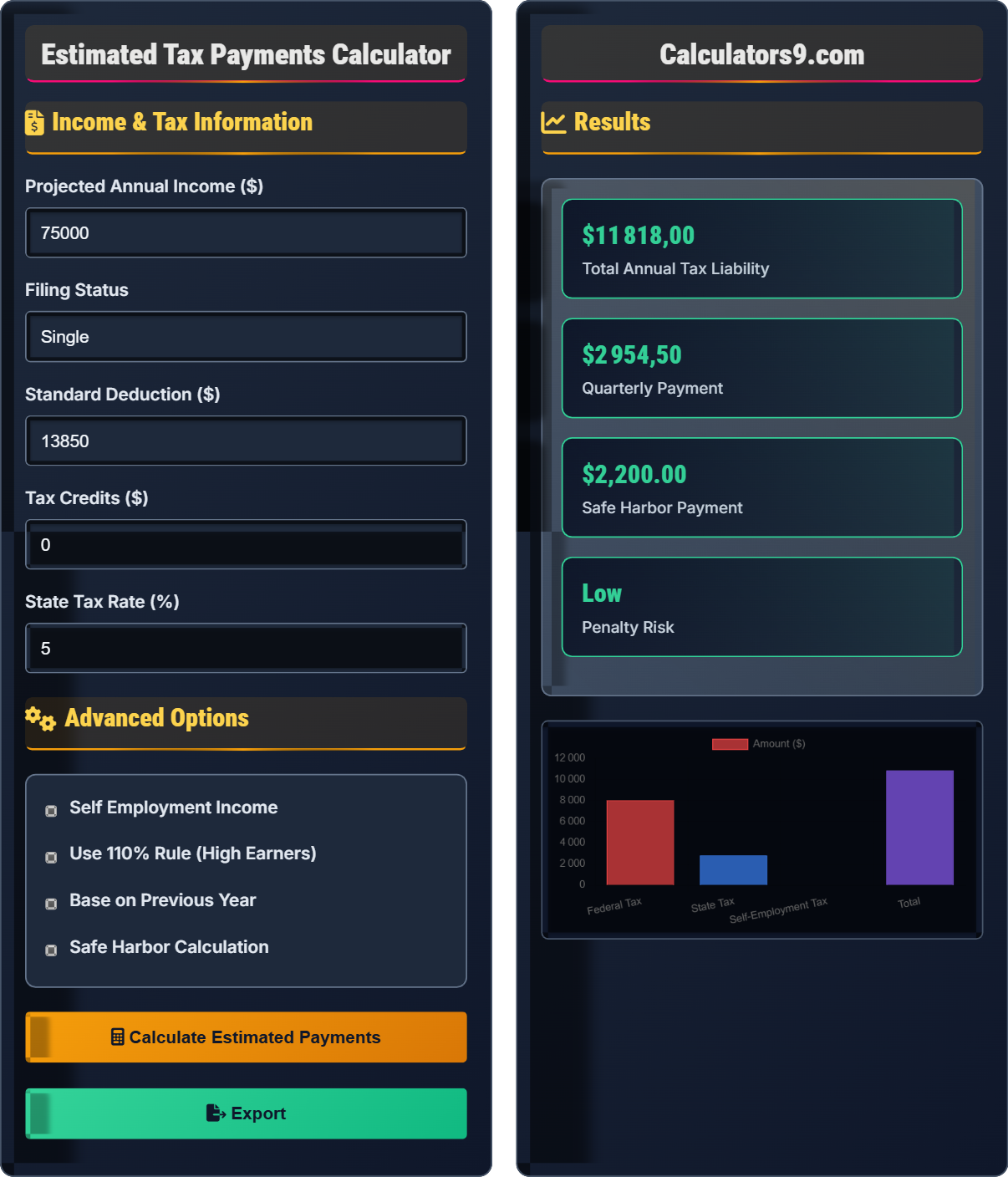
Income & Tax Information
Advanced Options
Results
| Quarter | Due Date | Payment Amount |
|---|
| Description | Amount |
|---|
Comprehensive Estimated Tax Guide
Estimated tax payments are advance payments made to the IRS and state tax authorities for income that is not subject to withholding. These payments are required when you expect to owe at least $1,000 in tax for the year after subtracting withholding and credits. They help ensure you meet your tax obligations throughout the year rather than facing a large bill at tax time.
The standard method for calculating estimated tax payments follows these steps:
Where:
- \( \text{Expected Annual Tax Liability} \) = Projected income × tax rate - credits - deductions
- \( \text{Quarterly Payments} \) = 4 equal installments throughout the year
To avoid underpayment penalties, you must pay at least:
- 100% of previous year's tax (if AGI ≤ $150,000)
- 110% of previous year's tax (if AGI > $150,000)
- 90% of current year's tax (whichever is smaller)
- Quarterly Reviews: Adjust payments based on actual income
- Safe Harbor: Use previous year's tax to avoid penalties
- Income Timing: Consider deferring income to next year
- Deduction Acceleration: Front-load deductible expenses
- Retirement Contributions: Maximize deductible contributions
Estimated Tax Basics
Advance payments to cover tax liability for income not subject to withholding.
\( \text{Quarterly Payment} = \frac{\text{Expected Annual Tax Liability}}{4} \)
Where: Expected Annual Tax Liability = Projected income × tax rate - credits - deductions.
- Required when expecting ≥ $1,000 tax liability
- Four quarterly payments throughout the year
- Safe harbor protects against penalties
Strategies
Pay safe harbor amounts to avoid underpayment penalties regardless of actual tax liability.
- Equal quarterly payments
- Adjust for seasonal income
- Use safe harbor method
- Consider annualized income method
- Due dates are fixed regardless of weekends/holidays
- Underpayment penalties apply if too little paid
- Estimated payments include federal and state taxes
- Professional advice recommended for complex situations
Estimated Tax Learning Quiz
Who is required to make estimated tax payments?
The answer is B) Individuals with income not subject to withholding. Estimated tax payments are required when you expect to owe at least $1,000 in tax after subtracting withholding and credits. This typically includes self-employed individuals, freelancers, investors, and anyone else earning income that isn't subject to regular payroll withholding.
Understanding who needs to make estimated payments is crucial for tax compliance. The key distinction is between income that has taxes withheld (like traditional employment) versus income that doesn't (like self-employment or investment income). This concept helps taxpayers determine their payment obligations early in the year.
Estimated Tax: Advance payments for income not subject to withholding
Withholding: Taxes automatically deducted from paycheck by employer
Safe Harbor: Minimum payment amount to avoid underpayment penalties
• Required when expecting ≥ $1,000 tax liability after withholding/credits
• Applies to self-employment, investment, and other non-withheld income
• Four quarterly payments throughout the tax year
• Remember: No withholding = potential estimated tax requirement
• Use Form 1040-ES to calculate and track payments
• Assuming only employees need to worry about taxes
• Forgetting to make estimated payments on investment income
• Not accounting for self-employment tax in estimates
Jessica earned $80,000 last year and paid $12,000 in taxes. This year, she expects to earn $90,000 and estimates her tax liability will be $14,000. Calculate her safe harbor payment amount and explain whether she should use this approach. Assume she files single.
Step 1: Calculate safe harbor amount
Safe Harbor = Previous Year Tax × 110% (since income likely exceeds $150,000 threshold)
Safe Harbor = $12,000 × 1.10 = $13,200
Step 2: Compare to current year liability
Current Year Liability = $14,000
Safe Harbor Amount = $13,200
Step 3: Determine required payment
To avoid penalties, Jessica must pay the lesser of:
- 110% of previous year's tax ($13,200)
- 90% of current year's tax ($14,000 × 0.90 = $12,600)
Since $12,600 is less than $13,200, Jessica should aim for $12,600 total, or $3,150 per quarter.
This problem demonstrates the safe harbor rule, which provides protection from underpayment penalties. Students learn that they can use either 100% of last year's tax (for AGI ≤ $150,000) or 110% (for AGI > $150,000), whichever is smaller compared to 90% of current year's tax.
Safe Harbor: Minimum payment amount to avoid underpayment penalties
Underpayment Penalty: Fee for not paying enough tax during the year
Annualized Income Method: Alternative calculation for uneven income throughout the year
• Safe Harbor: 100% of previous tax if AGI ≤ $150,000
• Safe Harbor: 110% of previous tax if AGI > $150,000
• Alternatively: 90% of current year's tax
• Use the smaller of safe harbor or 90% of current year tax
• Consider annualized method for irregular income patterns
• Track payments with Form 1040-ES worksheet
• Using 100% threshold for high-income earners (should be 110%)
• Not comparing safe harbor to 90% of current year tax
• Forgetting to account for state tax requirements
FAQ
Q: What happens if I miss an estimated tax payment deadline?
A: Missing an estimated tax payment deadline can result in an underpayment penalty from the IRS. The penalty is calculated based on the amount of tax you should have paid but didn't, multiplied by the applicable interest rate (which fluctuates quarterly).
However, you can avoid the penalty if you meet any of these conditions:
1. You owe less than $1,000 in tax after accounting for withholding and credits
2. You paid at least 90% of your current year's tax liability
3. You paid at least 100% of your previous year's tax liability (110% if your AGI exceeded $150,000)
If you missed a payment, you can still make up for it by increasing subsequent payments to reach the required total for the year.
Q: Can I make estimated tax payments monthly instead of quarterly?
A: While the IRS sets four specific quarterly deadlines for estimated tax payments, you can technically make payments more frequently if you wish. However, the IRS only recognizes payments made by the quarterly due dates for penalty purposes.
The quarterly due dates are:
• Q1: Payment for Jan-Mar, due April 15
• Q2: Payment for Apr-May, due June 17
• Q3: Payment for Jun-Aug, due Sept 16
• Q4: Payment for Sep-Dec, due Jan 15 of following year
If you make monthly payments, the IRS will aggregate them and consider the total amount paid by each quarterly deadline. Making more frequent payments doesn't provide additional penalty protection beyond meeting the quarterly requirements.