Filing Status Comparer
Optimize your tax strategy • 2026 rates
Filing Status Tax Calculation Formula:
Show the calculator\( \text{Tax Liability} = \text{Tax}(Taxable Income, Filing Status) \)
Where:
- \( \text{Taxable Income} \) = Adjusted Gross Income - Deductions
- \( \text{Filing Status} \) = Single, Married Filing Jointly, Head of Household, etc.
- \( \text{Deductions} \) = Standard deduction varies by filing status
This formula calculates tax liability based on different filing status parameters.
Example: For $75,000 income as Single vs MFJ:
Single: Taxable Income = $75,000 - $13,850 = $61,150
MFJ: Taxable Income = $75,000 - $27,700 = $47,300
Thus, MFJ could result in significant tax savings depending on income level.
Income & Personal Info
Advanced Options
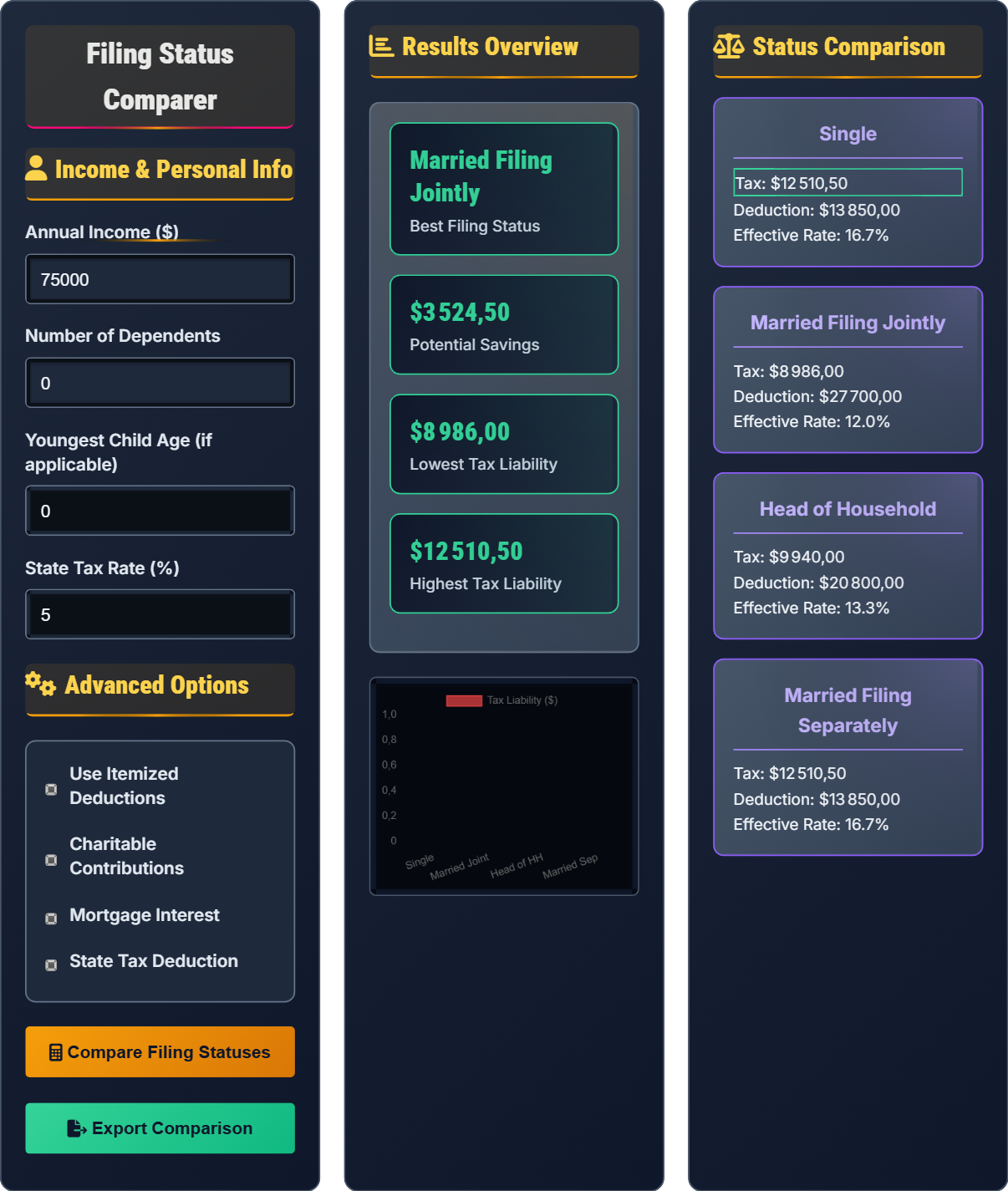
Results Overview
| Status | Tax Liability | Standard Deduction |
|---|
| Status | Taxable Income | Tax Rate |
|---|
Status Comparison
Comprehensive Filing Status Guide
Your filing status determines your tax rates, standard deduction amount, and eligibility for various credits and deductions. There are five main filing statuses: Single, Married Filing Jointly, Married Filing Separately, Head of Household, and Qualifying Widow(er). Your choice can significantly impact your tax liability.
Each filing status has different tax brackets and standard deduction amounts:
Where:
- \( \text{Taxable Income} \) = Adjusted Gross Income - Deductions
- \( \text{Filing Status} \) = Affects brackets and deduction amounts
- \( \text{Deductions} \) = Standard deduction varies by status
Standard deduction amounts vary by filing status:
- Single: $13,850
- Married Jointly: $27,700
- Head of Household: $20,800
- Married Separate: $13,850
- Qualifying Widow: $27,700
- Married Jointly: Often offers lowest tax liability
- Head of Household: Beneficial for unmarried with dependents
- Married Separate: May be beneficial in specific circumstances
- Income Splitting: Consider timing of income recognition
- Life Events: Marriage, divorce, or death affect status
Filing Status Basics
Tax categories that determine rates, deductions, and credit eligibility.
\( \text{Tax Liability} = \text{Tax}(Taxable Income, Filing Status) \)
Where: Taxable Income=AGI-Deductions, Filing Status=affects brackets and deductions.
- Must qualify for chosen status
- Standard deduction varies by status
- Can significantly impact tax liability
Strategies
Choose the status that minimizes your tax liability while meeting eligibility requirements.
- Compare all eligible statuses
- Consider income splitting opportunities
- Plan around life events
- Factor in credits and deductions
- Married joint often offers best rates
- Head of household beneficial with dependents
- Life changes may alter optimal status
- Professional advice recommended for complex situations
Filing Status Learning Quiz
Which filing status typically offers the highest standard deduction amount?
The answer is B) Married Filing Jointly. For 2026, the standard deduction for married filing jointly is $27,700, which is the highest among all filing statuses. This is nearly double the single standard deduction of $13,850, providing a significant tax advantage for married couples who file together.
Understanding standard deduction amounts is crucial for tax planning. The higher standard deduction for married couples reflects the concept of "marriage bonus" in the tax code, where combining incomes often results in a lower tax liability than if the individuals were single. This is why married filing jointly is often the most advantageous option.
Standard Deduction: Fixed amount that reduces taxable income without itemizing
Filing Status: Tax category determining rates and deduction amounts
Marriage Bonus: Tax advantage for married couples filing jointly
• Married Jointly: Highest standard deduction
• Single and Married Separate: Same standard deduction amount
• Head of Household: Middle-tier standard deduction
• Remember: MFJ offers the highest standard deduction
• Compare all statuses to find the most beneficial option
• Assuming single and married separate have different standard deductions
John and Jane are married with two children. Their combined income is $120,000. John's income is $80,000 and Jane's is $40,000. Calculate the tax difference between filing jointly vs. separately, assuming they have no other deductions or credits. Use 2026 tax brackets for comparison.
Step 1: Calculate MFJ filing
Combined income: $120,000
Standard deduction (MFJ): $27,700
Taxable income: $120,000 - $27,700 = $92,300
Tax calculation: 10% on first $22,000 = $2,200
Plus 12% on remaining $70,300 = $8,436
Total MFJ tax: $10,636
Step 2: Calculate MFJ filing
John's income: $80,000
Standard deduction (Separate): $13,850
John's taxable income: $80,000 - $13,850 = $66,150
John's tax: 10% on first $11,000 = $1,100
Plus 12% on remaining $55,150 = $6,618
John's tax: $7,718
Jane's income: $40,000
Jane's taxable income: $40,000 - $13,850 = $26,150
Jane's tax: 10% on first $11,000 = $1,100
Plus 12% on remaining $15,150 = $1,818
Jane's tax: $2,918
Total separate tax: $7,718 + $2,918 = $10,636
Tax difference: $10,636 (Joint) - $10,636 (Separate) = $0
In this case, there's no difference, but in other scenarios, there could be significant differences.
This problem demonstrates the importance of comparing filing statuses even when the math seems straightforward. Students learn that tax calculations involve multiple brackets and that the optimal status isn't always obvious without doing the actual calculations. The example shows how the progressive tax system works differently for different filing statuses.
Progressive Tax System: Higher income levels taxed at higher rates
Tax Bracket: Range of income taxed at specific rate
Taxable Income: Income after deductions
• Calculate tax for each scenario separately
• Consider different standard deductions for each status
• Apply correct tax brackets for each filing status
• Always compare filing statuses when eligible for multiple options
• Use tax software or calculators for complex scenarios
• Consider state tax implications as well
• Using wrong standard deduction amount for filing status
FAQ
Q: Should my spouse and I always file jointly?
A: While married filing jointly is often the most beneficial option, there are situations where married filing separately might be advantageous:
1. Significant medical expenses: If one spouse has substantial medical expenses, separate filing might allow both to meet the 7.5% of AGI threshold
2. Student loan interest: If one spouse's income is too high for the deduction, separate filing might help
3. Protecting against audit: If one spouse has questionable deductions
4. Special circumstances: Legal separations, non-resident aliens, etc.
However, in most cases, the higher standard deduction and favorable tax brackets for married filing jointly result in lower overall tax liability.
Q: How do I know if I qualify for Head of Household status?
A: To qualify for Head of Household status, you must meet all of these requirements:
1. Unmarried: Or considered unmarried on the last day of the tax year
2. Qualifying person: A child or other qualifying relative lived with you for more than half the year
3. Main home: The qualifying person's main home was yours for more than half the year
4. More than half: You paid more than half the cost of keeping up a home for the year
Being able to claim Head of Household status is extremely beneficial because it offers a higher standard deduction ($20,800 in 2026) and more favorable tax brackets compared to the single filing status.