Self Employment Tax Calculator
Accurate SE tax estimation • 2026 rates
Self Employment Tax Formula:
Show the calculator\( \text{SE Tax} = (\text{Net Earnings} \times 0.9235) \times \text{SE Tax Rate} \)
Where:
- \( \text{Net Earnings} \) = Business income minus business expenses
- \( 0.9235 \) = Adjustment factor (accounts for deduction of half SE tax)
- \( \text{SE Tax Rate} \) = 15.3% (12.4% Social Security + 2.9% Medicare)
This formula calculates the self employment tax liability for freelancers, contractors, and business owners.
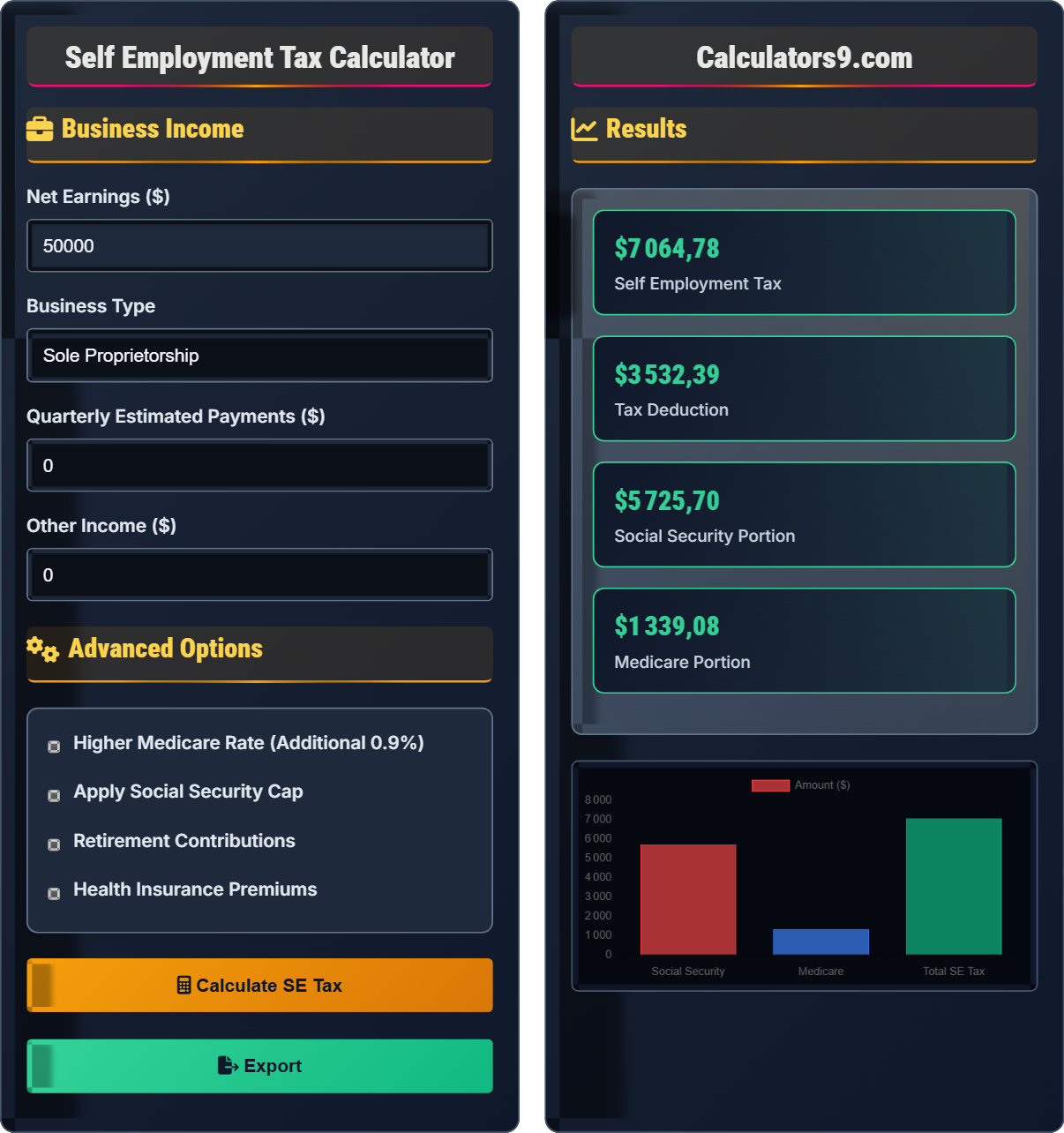
Example: For net earnings of $50,000:
Adjusted Net Earnings = $50,000 × 0.9235 = $46,175
SE Tax = $46,175 × 0.153 = $7,064.78
Half of SE Tax (deduction) = $7,064.78 ÷ 2 = $3,532.39
Thus, the self employment tax liability would be $7,064.78 with a deduction of $3,532.39.
Business Income
Advanced Options
Results
| Description | Amount |
|---|
| Quarter | Estimated Payment |
|---|
Comprehensive Self Employment Tax Guide
Self employment tax (SE tax) is a tax consisting of Social Security and Medicare taxes for individuals who work for themselves. SE tax applies to sole proprietors, partners in partnerships, LLC members, and S-corporation shareholders who receive compensation. The SE tax rate is 15.3% of net earnings from self-employment, which includes 12.4% for Social Security and 2.9% for Medicare.
The standard method for calculating self employment tax follows these steps:
Where:
- \( \text{Net Earnings} \) = Business income minus business expenses
- \( 0.9235 \) = Adjustment factor (accounts for deduction of half SE tax)
- \( \text{SE Tax Rate} \) = 15.3% (12.4% Social Security + 2.9% Medicare)
SE tax applies when net earnings exceed $400:
- Threshold: $400 net earnings from self-employment
- Social Security Cap: Applies to first $160,200 of earnings (2023)
- Higher Medicare: Additional 0.9% on earnings above $200,000
- Quarterly Payments: Make estimated payments to avoid penalties
- Deductions: Maximize business expense deductions to reduce net earnings
- Retirement Plans: Contribute to SEP-IRA or Solo 401(k) to reduce taxable income
- Health Insurance: Deduct premiums for self-employed individuals
- Business Structure: Consider S-corp election to potentially reduce SE tax
SE Tax Basics
Tax on income earned from self-employment, covering Social Security and Medicare.
\( \text{SE Tax} = (\text{Net Earnings} \times 0.9235) \times \text{SE Tax Rate} \)
Where: Net Earnings=Business income minus expenses, 0.9235=adjustment factor, SE Tax Rate=15.3%.
- Applies when net earnings exceed $400
- Rate is 15.3% (12.4% SS + 2.9% Medicare)
- Half of SE tax is deductible
Strategies
Consider maximizing deductions and quarterly payments to optimize SE tax obligations.
- Maximize business expense deductions
- Contribute to retirement plans
- Pay health insurance premiums
- Consider S-corp election
- Social Security cap applies to first $160,200
- Additional Medicare tax on high earners
- Quarterly estimated payments required
- Professional advice recommended for complex situations
SE Tax Learning Quiz
What is the correct breakdown of the self employment tax rate?
The answer is B) 12.4% Social Security + 2.9% Medicare. The self employment tax rate totals 15.3%, with 12.4% going to Social Security and 2.9% going to Medicare. This is a fundamental concept that all self-employed individuals need to understand when calculating their tax obligations.
Understanding the composition of the SE tax rate is crucial because the two components have different characteristics. The Social Security portion has a wage base limit, while the Medicare portion does not. This knowledge helps freelancers and business owners plan their tax strategies more effectively.
Self Employment Tax: Tax covering Social Security and Medicare for self-employed individuals
Social Security Tax: 12.4% portion of SE tax, subject to annual wage base limit
Medicare Tax: 2.9% portion of SE tax, applies to all earnings
• Total SE tax rate is 15.3%
• Social Security portion: 12.4% (subject to wage base limit)
• Medicare portion: 2.9% (no income limit)
• Remember: 12.4 + 2.9 = 15.3%
• Use the mnemonic "12.4 for SS, 2.9 for Med" to remember the rates
• Confusing SE tax rate with employee tax rate (which is split with employer)
• Forgetting the 0.9235 adjustment factor
• Not accounting for Social Security wage base limit
Sam has net earnings of $80,000 from self-employment and no other income. Calculate Sam's self employment tax liability, the deduction amount, and explain the calculation process. Assume the Social Security wage base limit does not apply.
Step 1: Calculate adjusted net earnings
Adjusted Net Earnings = Net Earnings × 0.9235
Adjusted Net Earnings = $80,000 × 0.9235 = $73,880
Step 2: Calculate Social Security portion
Social Security Tax = Adjusted Net Earnings × 0.124
Social Security Tax = $73,880 × 0.124 = $9,161.12
Step 3: Calculate Medicare portion
Medicare Tax = Adjusted Net Earnings × 0.029
Medicare Tax = $73,880 × 0.029 = $2,142.52
Step 4: Calculate total SE tax
Total SE Tax = Social Security Tax + Medicare Tax
Total SE Tax = $9,161.12 + $2,142.52 = $11,303.64
Step 5: Calculate deduction
Deduction = Total SE Tax ÷ 2
Deduction = $11,303.64 ÷ 2 = $5,651.82
Therefore, Sam's SE tax liability is $11,303.64 with a deduction of $5,651.82.
This problem demonstrates the multi-step process of calculating self employment tax. Students learn about the 0.9235 adjustment factor, which accounts for the fact that self-employed individuals can deduct half of their SE tax on their income tax return. The calculation also shows how the total SE tax breaks down into its two components.
Net Earnings: Business income minus business expenses
Adjusted Net Earnings: Net earnings multiplied by 0.9235
Tax Deduction: Half of SE tax deductible on Form 1040
• Apply 0.9235 adjustment factor to net earnings
• Social Security tax: 12.4% of adjusted net earnings
• Medicare tax: 2.9% of adjusted net earnings
• Remember: 0.9235 is approximately 92.35%
• The deduction is exactly half of the SE tax liability
• Always apply the adjustment factor before calculating taxes
• Forgetting to apply the 0.9235 adjustment factor
• Calculating the deduction incorrectly
• Applying the Social Security wage base limit incorrectly
FAQ
Q: Why do self-employed individuals pay more in Social Security/Medicare taxes than employees?
A: Self-employed individuals pay both the employee and employer portions of Social Security and Medicare taxes, which is why the rate appears higher:
• Employee: Pays 7.65% (6.2% SS + 1.45% Medicare)
• Employer: Pays 7.65% (6.2% SS + 1.45% Medicare)
• Combined: 15.3% (12.4% SS + 2.9% Medicare)
When you're self-employed, you pay the full 15.3% because you're considered both the employee and employer. However, you get to deduct half of this amount (7.65%) on your Form 1040 as an adjustment to income, which effectively makes the tax burden equivalent to that of an employee and employer combined.
Q: How does the 0.9235 adjustment factor work in self employment tax calculations?
A: The 0.9235 adjustment factor accounts for the fact that self-employed individuals can deduct half of their self employment tax on their Form 1040. Here's how it works:
1. The deduction reduces your adjusted gross income, which in turn reduces your income tax liability.
2. Since this deduction lowers your income tax, the government allows you to exclude an equivalent portion from your self employment tax calculation.
3. The mathematical equivalent of this exclusion is multiplying net earnings by 0.9235 (which is 1 - 0.5 × 0.153).
Mathematically: If your net earnings are $X$, your SE tax is $X × 0.9235 × 0.153$, and your deduction is $(X × 0.9235 × 0.153) ÷ 2$.