Standard Deduction Check
Optimize your tax deduction strategy • 2026 rates
Standard vs Itemized Deduction Formula:
Show the calculator\( \text{Taxable Income} = \text{AGI} - \max(\text{Standard Deduction}, \text{Itemized Deductions}) \)
Where:
- \( \text{AGI} \) = Adjusted Gross Income
- \( \text{Standard Deduction} \) = Fixed amount based on filing status
- \( \text{Itemized Deductions} \) = Sum of qualifying expenses
This formula determines which deduction method minimizes your taxable income.
Example: For $75,000 AGI with $15,000 in itemized deductions:
Standard Deduction (Single) = $13,850
Itemized Deductions = $15,000
Since $15,000 > $13,850, itemizing saves $1,150 in taxable income.
Personal Information
Income Information
Itemized Deductions
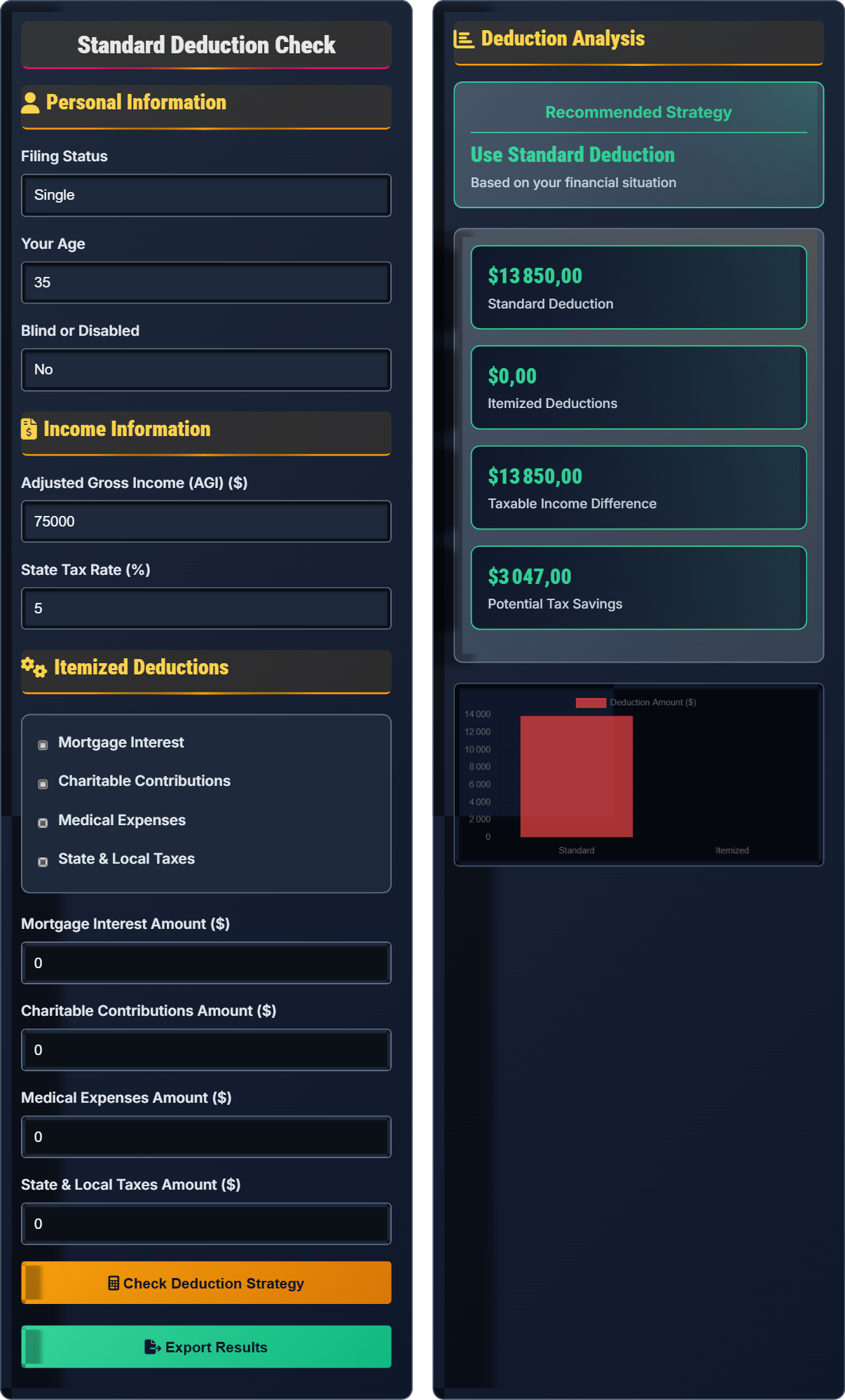
Deduction Analysis
| Deduction Type | Amount | Recommendation |
|---|
| Item | Amount |
|---|
Comprehensive Standard Deduction Guide
The standard deduction is a fixed dollar amount that reduces your taxable income. It's available to most taxpayers and represents the IRS's estimate of the average amount of personal expenses incurred by individuals. You can choose to either take the standard deduction or itemize your deductions, whichever provides the greater tax benefit.
The standard deduction amount varies by filing status:
Where:
- \( \text{AGI} \) = Adjusted Gross Income
- \( \text{Standard Deduction} \) = Fixed amount based on filing status
- \( \text{Itemized Deductions} \) = Sum of qualifying expenses
Consider itemizing if you have significant expenses in these categories:
- Mortgage Interest: On qualified residence loans
- Charitable Contributions: Cash and property donations
- Medical Expenses: Exceeding 7.5% of AGI
- State & Local Taxes: Up to $10,000 cap
- State & Local Income/Sales Taxes: Alternative to state/local income tax
- Annual Review: Your optimal choice may change yearly
- Timing: Consider accelerating or deferring expenses
- Pease Limitation: High earners face reduced itemized deductions
- State Implications: Some states don't conform to federal treatment
- Record Keeping: Itemizing requires detailed documentation
Standard Deduction Basics
Fixed dollar amount that reduces your taxable income without itemizing expenses.
\( \text{Taxable Income} = \text{AGI} - \max(\text{Standard Deduction}, \text{Itemized Deductions}) \)
Where: AGI=Adjusted Gross Income, Standard Deduction=fixed amount by status, Itemized Deductions=sum of qualifying expenses.
- You must choose between standard or itemized
- Cannot take both simultaneously
- Higher of two options is used
Strategies
Compare total itemized deductions to standard deduction amount to maximize tax benefit.
- Calculate both options annually
- Time charitable contributions strategically
- Accelerate medical expenses if beneficial
- Consider bunching deductions in certain years
- Standard deduction increases with age/disability
- State tax implications may differ
- Record keeping requirements vary
- Professional advice recommended for complex situations
Standard Deduction Learning Quiz
When might a taxpayer benefit from itemizing deductions instead of taking the standard deduction?
The answer is B) When their total itemized deductions are greater than the standard deduction. The purpose of itemizing is to claim deductions that exceed the standard deduction amount. If your itemized deductions total $20,000 but the standard deduction is $13,850 (for single), itemizing would save you $6,150 in taxable income.
Understanding the comparison between standard and itemized deductions is fundamental to tax planning. Students learn that the decision should be based purely on which option provides the greater tax benefit. The key is to calculate both options each year since the optimal choice can change based on changes in income, expenses, or tax law.
Standard Deduction: Fixed amount that reduces taxable income
Itemized Deductions: Specific expenses that can be deducted from income
Taxable Income: Income subject to taxation after deductions
• Choose the higher of standard or itemized deductions
• Cannot take both simultaneously
• Must calculate both options annually
• Remember: Itemize when total exceeds standard deduction
• Keep receipts for all potential deductions
• Consider bunching deductions in certain years
• Assuming itemizing is always better for homeowners
Sarah is single with an AGI of $80,000. Her potential itemized deductions include: $12,000 mortgage interest, $3,000 charitable contributions, $2,500 in state taxes, and $1,500 in medical expenses. Calculate her optimal deduction strategy and explain the tax implications.
Step 1: Calculate total itemized deductions
Mortgage Interest: $12,000
Charitable Contributions: $3,000
State Taxes: $2,500
Medical Expenses: $1,500
Total Itemized Deductions: $19,000
Step 2: Compare to standard deduction
Standard Deduction (Single): $13,850
Itemized Deductions: $19,000
Step 3: Determine optimal strategy
Since $19,000 > $13,850, Sarah should itemize.
Step 4: Calculate tax benefit
Difference: $19,000 - $13,850 = $5,150
At a 22% tax bracket, this saves: $5,150 × 0.22 = $1,133 in federal taxes.
Therefore, Sarah should itemize her deductions to save $1,133 in taxes.
This problem demonstrates the systematic approach to comparing standard vs itemized deductions. Students learn to add up all potential itemized deductions and compare the total to the standard deduction. The example shows how the decision can result in significant tax savings when itemizing exceeds the standard amount.
Adjusted Gross Income (AGI): Income after adjustments
Tax Bracket: Rate at which income is taxed
Deduction: Amount that reduces taxable income
• Add all potential itemized deductions
• Compare total to standard deduction
• Choose the higher amount
• Always calculate both options
• Consider timing of expenses for optimal years
• Keep detailed records for itemized deductions
• Forgetting to include all potential deductions
FAQ
Q: As a homeowner, should I always itemize my deductions?
A: Not necessarily! While homeowners often have significant mortgage interest and property tax deductions, you should still compare the total itemized deductions to the standard deduction amount. Many factors influence the decision:
1. Mortgage size: Smaller mortgages may not generate enough interest to exceed the standard deduction
2. Location: Property taxes vary significantly by state and locality
3. Other deductions: Charitable contributions, medical expenses, etc., contribute to the total
4. State tax treatment: Some states don't conform to federal itemized deduction rules
Always calculate both options to determine which provides the greater tax benefit for your specific situation.
Q: How do I decide whether to bunch my charitable donations into certain years?
A: Bunching charitable donations can be a strategic approach when you're close to the standard deduction threshold. Here's how to evaluate it:
1. Two-year average: Calculate your average itemized deductions over two years
2. Even distribution: If you typically donate $5,000 annually, consider donating $10,000 every other year
3. Threshold calculation: If your usual deductions (mortgage, property tax, etc.) total $12,000, you're $1,850 short of exceeding the standard deduction for single filers ($13,850)
4. Benefit realization: Bunching $5,000+ in charitable donations in one year could push you over the standard deduction threshold
This strategy allows you to itemize in the donation year and take the standard deduction in the alternate year, maximizing your tax benefit over the two-year period.