State Tax Calculator
Accurate tax estimation • 2026 rates
State Tax Calculation Formula:
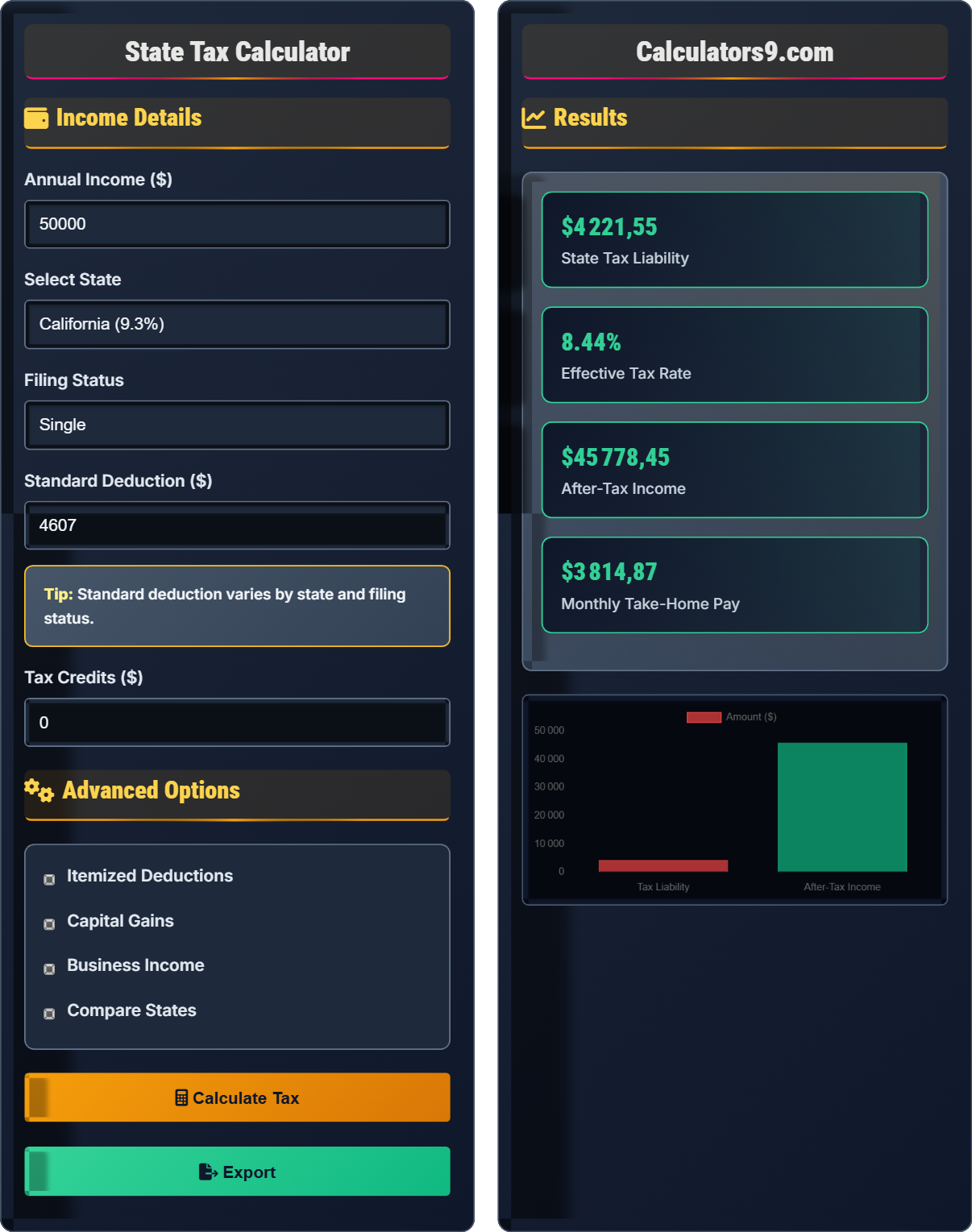
Show the calculator\( \text{Tax Liability} = (\text{Taxable Income} - \text{Deductions}) \times \text{Tax Rate} - \text{Credits} \)
Where:
- \( \text{Taxable Income} \) = Adjusted gross income after exemptions
- \( \text{Deductions} \) = Standard deduction or itemized deductions
- \( \text{Tax Rate} \) = Marginal tax rate based on income bracket
- \( \text{Credits} \) = Direct reductions in tax liability
This formula calculates your state tax liability considering progressive tax brackets and available deductions/credits.
Example: For taxable income of $50,000 in a state with 5% tax rate and $2,000 in credits:
Tax Liability = $50,000 × 0.05 - $2,000 = $2,500 - $2,000 = $500
Thus, the state tax liability would be $500.
Income Details
Advanced Options
Results
| Description | Amount |
|---|
| Category | Amount |
|---|
Comprehensive State Tax Guide
State income tax is a tax imposed by individual states on income earned within their borders. Unlike federal income tax, state tax rates and rules vary significantly across the United States. Forty-one states and the District of Columbia levy personal income taxes, while nine states have no personal income tax at all.
The standard method for calculating state income tax follows these steps:
Where:
- \( \text{Taxable Income} \) = Adjusted gross income after exemptions
- \( \text{Deductions} \) = Standard deduction or itemized deductions
- \( \text{Tax Rate} \) = Marginal tax rate based on income bracket
- \( \text{Credits} \) = Direct reductions in tax liability
States employ different tax systems:
- Progressive: Higher rates for higher incomes (e.g., California, New York)
- Flat: Same rate for all taxpayers (e.g., Pennsylvania, Michigan)
- No Income Tax: Relies on other revenue sources (e.g., Texas, Florida)
- State Residency: Move to states with no income tax
- Maximize Deductions: Choose between standard and itemized deductions
- Take Advantage of Credits: Research available state tax credits
- Timing: Plan income recognition across state lines
- Retirement Planning: Consider state tax implications for retirement income
State Tax Basics
Tax levied by individual states on income earned within their jurisdiction.
\( \text{Tax Liability} = (\text{Taxable Income} - \text{Deductions}) \times \text{Tax Rate} - \text{Credits} \)
Where: Taxable Income=Adjusted income, Deductions=Standard/Itemized, Tax Rate=Marginal rate, Credits=Direct reductions.
- Tax rates vary by state and income level
- Deductions reduce taxable income
- Credits directly reduce tax liability
Strategies
Consider moving to states with favorable tax policies for optimal financial outcomes.
- Choose optimal filing status
- Maximize available deductions
- Research applicable tax credits
- Consider state residency changes
- Some states have no income tax
- Sales and property taxes vary
- Retirement income may be taxed differently
- Professional advice recommended for complex situations
State Tax Learning Quiz
Which of the following statements about state income taxes is TRUE?
The answer is B) Nine states have no personal income tax. These states include Texas, Florida, Washington, Nevada, Tennessee, South Dakota, Wyoming, New Hampshire, and Alaska. The other options are incorrect: not all states have income taxes, state rates differ from federal rates, and state taxes significantly impact take-home pay.
It's crucial to understand that state tax obligations vary dramatically across the U.S. This knowledge is fundamental for financial planning, career decisions, and residential choices. The variation in state tax policy affects millions of Americans' financial decisions each year.
State Income Tax: Tax imposed by individual states on income earned within their borders
Tax-Free States: States that do not impose personal income taxes
Tax Liability: The total amount of tax owed to the government
• 41 states and DC impose personal income taxes
• 9 states have no personal income tax
• State tax rates and structures vary significantly
• Remember: TX, FL, WA, NV, TN, SD, WY, NH, AK have no personal income tax
• Use the mnemonic "TFWNSTSWA" (Texas, Florida, Washington, Nevada, South Dakota, Wyoming, Alaska) to remember some tax-free states
• Assuming all states tax income the same way
• Forgetting about differences in state tax rates
• Not considering state tax implications when relocating
Jennifer earns $75,000 annually and lives in California. She has $5,000 in itemized deductions and qualifies for $1,200 in tax credits. Calculate her approximate state tax liability and explain the calculation process. Assume California's tax rate is 9.3% for her income level.
Step 1: Calculate taxable income
Taxable Income = Gross Income - Deductions
Taxable Income = $75,000 - $5,000 = $70,000
Step 2: Calculate tax before credits
Tax Before Credits = Taxable Income × Tax Rate
Tax Before Credits = $70,000 × 0.093 = $6,510
Step 3: Apply credits
Final Tax Liability = Tax Before Credits - Credits
Final Tax Liability = $6,510 - $1,200 = $5,310
Therefore, Jennifer's state tax liability is $5,310.
This problem demonstrates the multi-step process of calculating state tax liability. Students learn that deductions reduce taxable income, while credits directly reduce the final tax amount. The calculation involves subtraction for deductions and credits, then multiplication by the tax rate.
Gross Income: Total income before any deductions
Taxable Income: Income subject to taxation after deductions
Tax Credits: Direct dollar-for-dollar reduction in tax liability
• Deductions reduce taxable income, not tax liability directly
• Credits reduce tax liability dollar-for-dollar
• Tax rates vary by income level and state
• Remember: Deductions come before credits in calculations
• Use the formula: (Income - Deductions) × Rate - Credits = Liability
• Credits are more valuable than deductions of the same amount
• Applying credits before calculating tax (should be after)
• Adding instead of subtracting deductions
• Confusing marginal tax rates with effective rates
FAQ
Q: How do state tax deductions differ from federal tax deductions?
A: State tax deductions differ significantly from federal tax deductions in several ways:
1. Availability: Not all states offer itemized deductions. Some states only allow a standard deduction or a limited set of itemized deductions.
2. Amounts: State standard deduction amounts are generally lower than federal amounts. For example, while the federal standard deduction for single filers in 2023 is $13,850, many states have much lower standard deductions.
3. Types: Some deductions allowed at the federal level are not allowed at the state level, and vice versa. For instance, state and local taxes (SALT) deducted on federal returns are not deductible on most state returns.
4. Calculation: Some states piggyback on federal AGI and allow additional adjustments, while others require separate calculations entirely.
5. Limitations: State deductions often have different phase-out thresholds compared to federal limits.
Q: What is the difference between marginal and effective state tax rates?
A: The marginal tax rate and effective tax rate represent different concepts in state taxation:
Marginal Tax Rate: This is the rate applied to the last dollar of income earned. In progressive tax systems, different portions of income are taxed at different rates. For example, if you're in the 7% tax bracket, your next dollar of income will be taxed at 7%.
Effective Tax Rate: This is the average rate at which your total income is taxed. It's calculated as total tax liability divided by total income. Using the previous example, if you earn $50,000 and owe $2,500 in state taxes, your effective rate is 5% ($2,500 ÷ $50,000).
Mathematically:
Effective Rate = Total Tax Liability ÷ Total Income
For our example: 2,500 ÷ 50,000 = 0.05 = 5%
The effective rate is always lower than or equal to the marginal rate in progressive systems, as lower brackets are taxed at lower rates.