Tax Bracket Visualizer
Understand your tax brackets • 2026 rates
Tax Bracket Formula:
Show the calculator\( \text{Tax Liability} = \sum (\text{Taxable Income in Bracket} \times \text{Bracket Rate}) \)
Where:
- \( \text{Taxable Income in Bracket} \) = Income falling within each tax bracket
- \( \text{Bracket Rate} \) = Marginal tax rate for that bracket
This formula calculates your total tax liability across all applicable tax brackets.
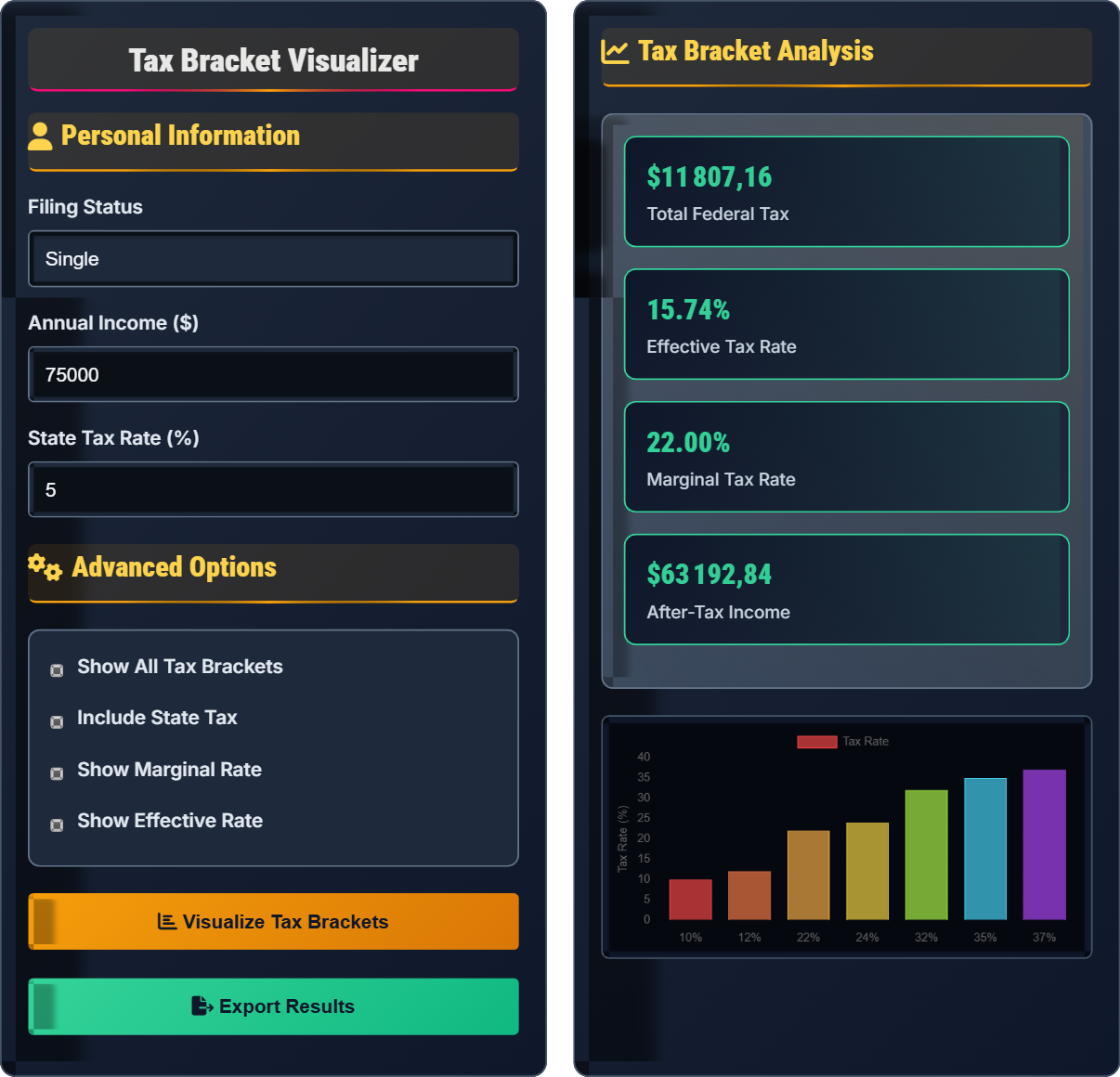
Example: For $75,000 income in single filing status:
10% bracket: $11,000 × 10% = $1,100
12% bracket: ($44,725 - $11,000) × 12% = $4,047
22% bracket: ($75,000 - $44,725) × 22% = $6,660.50
Total Tax = $11,807.50, Effective Rate = 15.7%
Personal Information
Advanced Options
Tax Bracket Analysis
| Bracket | Range | Tax Rate | Taxable Income | Tax Amount |
|---|
| Rate | Amount |
|---|
Comprehensive Tax Bracket Guide
Tax brackets are ranges of income that are taxed at specific rates. The U.S. tax system uses a progressive tax structure where higher income levels are taxed at higher rates. However, only the income within each bracket is taxed at that rate, not all income. This means if you're in the 22% tax bracket, only the income above the 12% bracket threshold is taxed at 22%.
The calculation works as follows:
Where:
- \( \text{Taxable Income in Bracket} \) = Income falling within each tax bracket
- \( \text{Bracket Rate} \) = Marginal tax rate for that bracket
Important tax bracket concepts:
- Marginal Rate: Tax rate applied to the last dollar earned
- Effective Rate: Average tax rate across all income
- Taxable Income: Income after deductions and exemptions
- Progressive System: Higher earners pay higher rates
- Bracket Creep: Inflation pushing income into higher brackets
- Deduction Timing: Accelerate deductions to lower brackets
- Income Shifting: Defer income to avoid higher brackets
- Tax-Loss Harvesting: Offset gains with losses
- Roth Conversions: Convert to Roth in low bracket years
- Retirement Planning: Plan withdrawals to minimize bracket creep
Tax Bracket Basics
Income ranges taxed at specific rates in a progressive tax system.
\( \text{Tax Liability} = \sum (\text{Taxable Income in Bracket} \times \text{Bracket Rate}) \)
Where: Taxable Income in Bracket=income falling within each bracket, Bracket Rate=marginal tax rate.
- Only income within each bracket is taxed at that rate
- Higher income levels face higher rates
- Marginal rate differs from effective rate
Strategies
Plan income and deductions to optimize tax bracket placement.
- Time income recognition strategically
- Accelerate deductions when possible
- Consider tax-loss harvesting
- Plan retirement distributions
- Marginal vs effective tax rates differ
- State taxes may have different brackets
- Investment income may be taxed differently
- Professional advice recommended for complex situations
Tax Bracket Learning Quiz
If someone is in the 22% tax bracket, what percentage of their total income is taxed at 22%?
The answer is C) Only the income above the 22% bracket threshold. In a progressive tax system, only the income that falls within the 22% bracket is taxed at that rate. For example, if someone earns $75,000 (single filing status), only the income above $44,725 is taxed at 22%. The first $11,000 is taxed at 10%, and the next $33,725 is taxed at 12%.
This question addresses one of the most common misconceptions about tax brackets. Students often think that being in a higher bracket means all their income is taxed at that rate. Understanding the progressive nature of the tax system is crucial for proper tax planning.
Tax Bracket: Range of income taxed at a specific rate
Progressive Tax System: Higher income levels taxed at higher rates
Marginal Rate: Rate applied to the last dollar earned
• Only income within each bracket is taxed at that rate
• Lower income is taxed at lower rates
• Progressive system means rates increase with income
• Remember: You move up brackets gradually
• Think of it like filling containers with water
• Each container fills before spilling into the next
• Thinking all income is taxed at marginal rate
Calculate the federal tax liability for a single filer with $60,000 in taxable income. Show the calculation for each bracket and determine the effective tax rate.
Step 1: Calculate tax for each bracket
10% bracket: First $11,000 × 10% = $1,100
12% bracket: Next ($44,725 - $11,000) × 12% = $4,047
22% bracket: Remaining ($60,000 - $44,725) × 22% = $3,360.50
Step 2: Calculate total tax
Total Tax = $1,100 + $4,047 + $3,360.50 = $8,507.50
Step 3: Calculate effective tax rate
Effective Rate = Total Tax ÷ Total Income
Effective Rate = $8,507.50 ÷ $60,000 = 14.18%
Therefore, the tax liability is $8,507.50 with an effective rate of 14.18%.
This problem demonstrates the step-by-step calculation of tax liability across multiple brackets. Students learn that the marginal rate (22% in this case) is different from the effective rate (14.18%), which is the average rate across all income.
Effective Tax Rate: Average rate across all income (Total Tax ÷ Total Income)
Marginal Tax Rate: Rate on the last dollar earned
Taxable Income: Income after deductions and exemptions
• Calculate tax for each bracket separately
• Sum the tax amounts from all brackets
• Effective rate is always lower than marginal rate
• Remember to calculate each bracket separately
• Effective rate = Total Tax ÷ Total Income
• Marginal rate is the highest bracket rate
• Applying marginal rate to all income
FAQ
Q: What's the difference between marginal and effective tax rates?
A: The marginal tax rate is the rate applied to the last dollar of income earned, while the effective tax rate is the average rate applied to all income.
For example, if you're in the 22% tax bracket:
• Marginal Rate: 22% (the rate on your next dollar of income)
• Effective Rate: Much lower (the average of all brackets applied to your income)
If you earn $75,000, you'll pay 10% on the first $11,000, 12% on the next $33,725, and 22% on the remaining $30,275. Your marginal rate is 22%, but your effective rate will be around 15.7%.
Q: Does getting a raise put me in a higher tax bracket and make me worse off?
A: No, moving to a higher tax bracket does not make you worse off. This is a common misconception about the progressive tax system.
Here's why: Only the income that falls within the higher bracket is taxed at the higher rate. All other income continues to be taxed at the lower rates.
For example, if you're earning $44,725 and get a $1 raise to $44,726, only that $1 is taxed at 22% instead of 12%. You still keep 78 cents of that additional dollar after tax, plus all your other income is unaffected.
Mathematically: If your raise moves you from 12% to 22% bracket, you still keep 78% of that additional income, so you're always better off with more income.