Tax Refund Estimator
Estimate your tax refund • 2026 rates
Tax Refund Formula:
Show the calculator\( \text{Tax Refund} = \text{Total Withholding} + \text{Estimated Payments} - \text{Tax Liability} \)
Where:
- \( \text{Tax Liability} \) = Calculated tax based on income, deductions, and credits
- \( \text{Total Withholding} \) = Amount withheld from paychecks
- \( \text{Estimated Payments} \) = Quarterly payments made directly to IRS
This formula calculates your expected tax refund or amount owed.
Example: With $15,000 in withholding and $8,000 in tax liability:
Refund = $15,000 - $8,000 = $7,000
Thus, the expected refund would be $7,000.
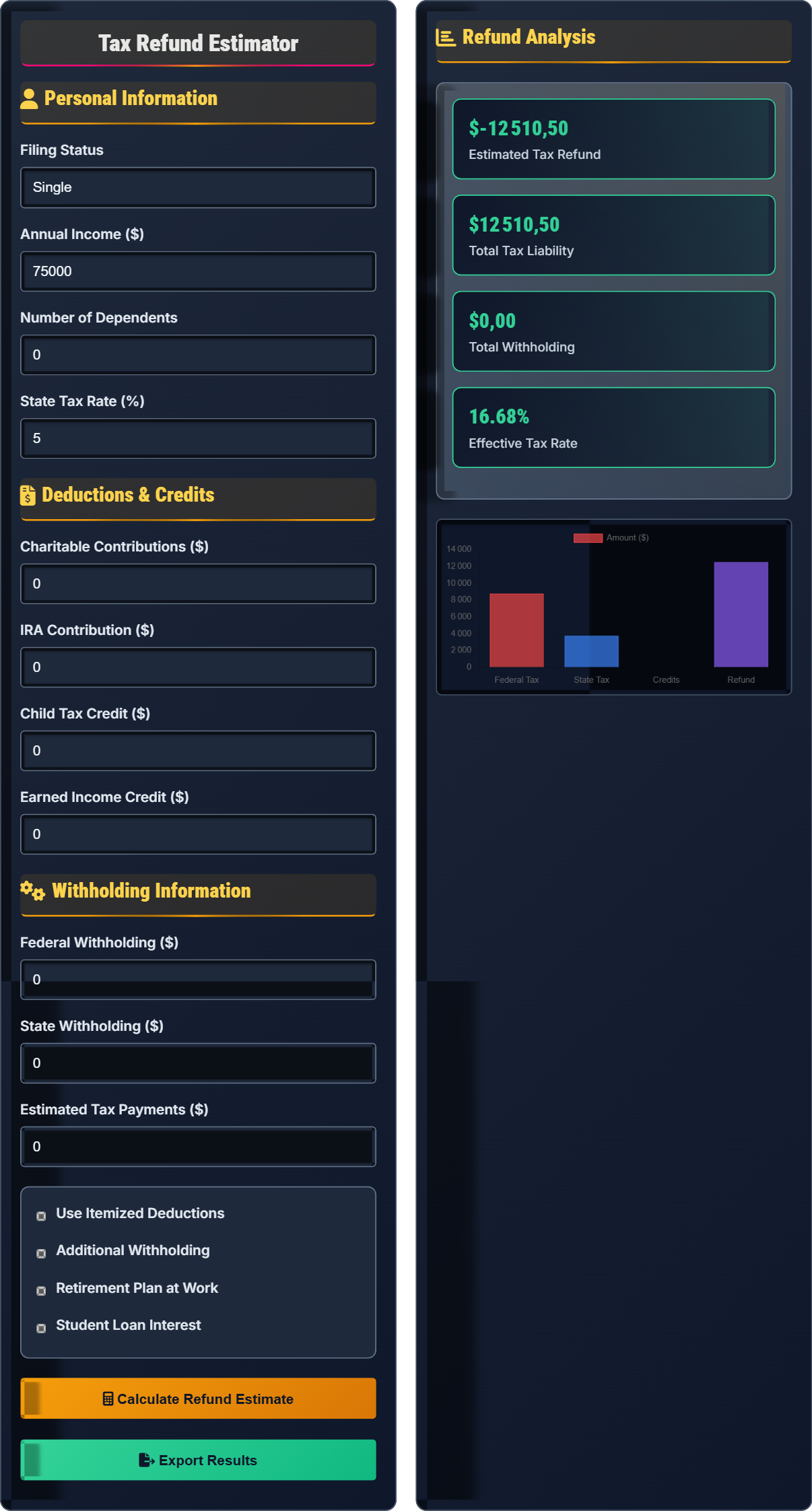
Personal Information
Deductions & Credits
Withholding Information
Refund Analysis
| Component | Amount |
|---|
Comprehensive Tax Refund Guide
A tax refund is the amount of money returned to you by the IRS when your total tax payments (including withholding and estimated payments) exceed your actual tax liability. This occurs when too much tax was withheld from your paychecks or when you made more estimated payments than necessary.
The standard method for calculating tax refunds follows these steps:
Where:
- \( \text{Tax Liability} \) = Calculated tax based on income, deductions, and credits
- \( \text{Total Withholding} \) = Amount withheld from paychecks
- \( \text{Estimated Payments} \) = Quarterly payments made directly to IRS
There are two types of tax credits:
- Refundable: Provide refund even if tax liability is zero (EITC, CTC, American Opportunity Tax Credit)
- Non-Refundable: Reduce tax liability to zero but don't provide additional refund (Child Care Credit, Lifetime Learning Credit)
- Withholding Optimization: Balance between refunds and cash flow
- Credit Planning: Maximize qualifying credits throughout the year
- Timing: Consider when to claim deductions for optimal impact
- Documentation: Keep records to support refund claims
- Professional Help: Complex situations may require assistance
Refund Basics
Money returned when total payments exceed tax liability.
\( \text{Tax Refund} = \text{Total Withholding} + \text{Estimated Payments} - \text{Tax Liability} \)
Where: Total Withholding=amount withheld from paychecks, Estimated Payments=direct payments to IRS, Tax Liability=calculated tax obligation.
- Refund occurs when payments exceed liability
- Refundable credits can increase refunds beyond tax paid
- Processing takes 21 days for e-filed returns
Strategies
Balance between refund size and cash flow throughout the year.
- Adjust withholding to match liability
- Maximize qualifying credits and deductions
- Consider timing of income and expenses
- Plan for major life events
- Large refunds mean giving interest-free loan to government
- Small refunds require careful budgeting
- Refundable credits can provide refunds even with no tax liability
- Professional advice recommended for complex situations
Tax Refund Learning Quiz
If your total tax liability is $8,000 and your total withholding is $12,000, what is your expected tax refund?
The answer is A) $4,000. The tax refund is calculated as: Total Withholding - Tax Liability = $12,000 - $8,000 = $4,000. This means you overpaid by $4,000 and will receive that amount back as a refund.
Understanding the basic refund calculation is fundamental to tax planning. Students learn that the refund amount equals the difference between what was paid in and what was actually owed. This helps them understand the relationship between withholding and actual tax liability.
Tax Liability: Total amount of tax owed based on income and applicable rates
Withholding: Amount deducted from paychecks throughout the year
Tax Refund: Excess payments returned to taxpayer
• Refund = Total Payments - Tax Liability
• Positive result = refund, negative = additional tax owed
• Refundable credits can create refunds beyond tax paid
• Remember: More withholding = larger refund (but less cash flow)
• Aim for zero balance to optimize cash flow
• Confusing tax liability with withholding amount
Sarah has an annual income of $75,000, is single with no dependents. Her total federal withholding was $12,000. She qualifies for a $1,000 child tax credit and $500 earned income credit. Calculate her estimated tax refund, considering the credits reduce her tax liability.
Step 1: Calculate tax liability
For $75,000 single income:
First $11,000 × 10% = $1,100
Remaining $64,000 × 12% = $7,680
Total tax before credits = $8,780
Step 2: Apply credits
Child Tax Credit: $1,000
Earned Income Credit: $500
Total Credits: $1,500
Step 3: Calculate adjusted tax liability
Adjusted Tax = $8,780 - $1,500 = $7,280
Step 4: Calculate refund
Refund = Total Withholding - Adjusted Tax Liability
Refund = $12,000 - $7,280 = $4,720
Therefore, Sarah's estimated tax refund is $4,720.
This problem demonstrates the multi-step process of calculating tax refunds. Students learn how credits reduce tax liability before calculating the refund. The example shows how refundable credits directly increase the refund amount, while non-refundable credits only reduce the tax owed to zero.
Child Tax Credit: $2,000 per qualifying child (up to $1,600 refundable)
Earned Income Credit: Credit for low-to-moderate income workers
Refundable Credit: Credit that can provide refund beyond tax liability
• Credits reduce tax liability dollar-for-dollar
• Refundable credits can create refunds beyond tax paid
• Calculate tax before applying credits
• Credits are more valuable than deductions
• Verify eligibility for all available credits
• Keep documentation for all claimed credits
• Applying credits before calculating tax liability
FAQ
Q: How can I increase my tax refund?
A: You can increase your tax refund by:
1. Increasing Withholding: Have more tax withheld from paychecks
2. Maximizing Deductions: Claim all eligible itemized deductions
3. Maximizing Credits: Ensure you qualify for all refundable and non-refundable credits
4. Contributing to Retirement: Traditional IRA contributions can reduce taxable income
5. Charitable Giving: Donate to qualified organizations
6. Timing Expenses: Pay deductible expenses in the tax year you want the benefit
Note that while these strategies increase refunds, they may also reduce your cash flow throughout the year.
Q: How long does it take to receive a tax refund?
A: Refund processing times vary:
1. E-filed Returns: Approximately 21 days for direct deposit
2. Paper Returns: 6-8 weeks or longer
3. Returns with EITC/CTC: Processing begins mid-February due to fraud prevention measures
4. Amended Returns: 8-16 weeks for Form 1040-X
Factors that can delay refunds include errors on the return, missing documentation, identity verification issues, or if the return is selected for review.