Withholding Adjuster
Optimize your tax withholding • 2026 rates
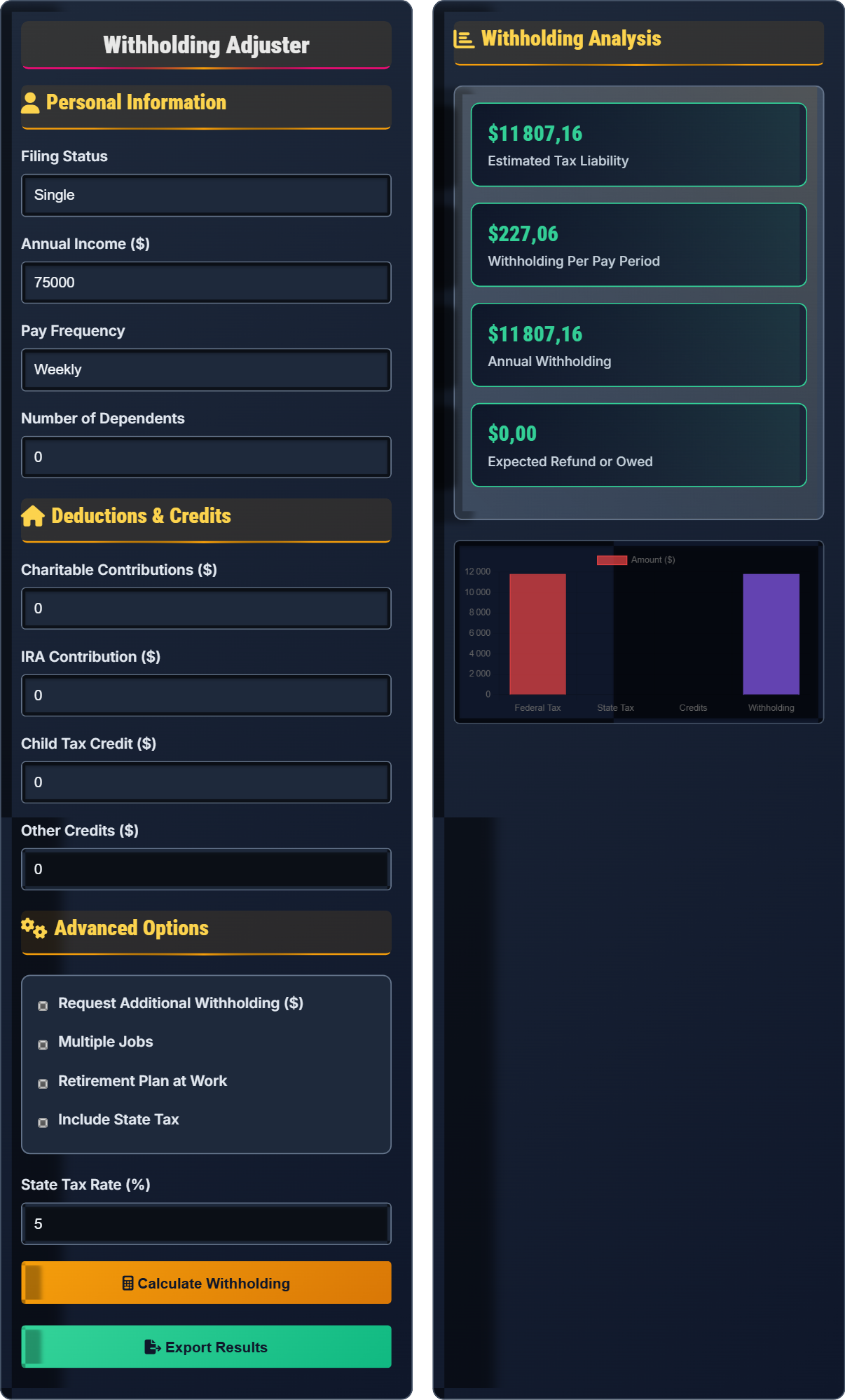
Withholding Calculation Formula:
Show the calculator\( \text{Withholding Amount} = \text{Tax Liability} - \text{Credits} - \text{Additional Amount} \)
Where:
- \( \text{Tax Liability} \) = Calculated tax based on income and filing status
- \( \text{Credits} \) = Child tax credit, other credits
- \( \text{Additional Amount} \) = Extra withholding requested
This formula calculates your ideal withholding amount to avoid under/over-withholding.
Example: For $75,000 income with $3,000 in credits:
Estimated Tax = $11,807.50
Withholding Amount = $11,807.50 - $3,000 = $8,807.50
Monthly Withholding ≈ $734
Personal Information
Deductions & Credits
Advanced Options
Withholding Analysis
- Download Form W-4 from IRS.gov
- Complete Steps 1 and 2 with your personal information
- Enter 0 dependents in Step 3
- Claim additional credits in Step 4(c) if applicable
- Submit updated form to your employer
| Component | Amount |
|---|
Comprehensive Withholding Guide
Tax withholding is the amount your employer deducts from your paycheck for federal and state income taxes. The goal is to match your annual tax liability through regular payroll deductions, preventing a large tax bill at filing time. Your W-4 form tells your employer how much to withhold based on your personal tax situation.
The withholding calculation considers multiple factors:
Where:
- \( \text{Tax Liability} \) = Calculated tax based on income and filing status
- \( \text{Credits} \) = Child tax credit, other credits
- \( \text{Additional Amount} \) = Extra withholding requested
Effective withholding approaches:
- Accurate Withholding: Match your actual tax liability closely
- Emergency Fund: Small refund provides safety net
- Interest Consideration: Avoid interest penalties for underpayment
- Refund Timing: Consider cash flow needs
- Life Events: Adjust for expected changes
- Quarterly Reviews: Monitor your withholding throughout the year
- Life Changes: Update immediately after major events
- Multiple Jobs: Coordinate with all employers
- Investment Income: Consider quarterly payments
- Professional Advice: Complex situations may require help
Withholding Basics
Amount deducted from paycheck for federal and state income taxes.
\( \text{Withholding Amount} = \text{Tax Liability} - \text{Credits} - \text{Additional Amount} \)
Where: Tax Liability=calculated tax, Credits=child tax credit and others, Additional Amount=extra withholding.
- Should match annual tax liability
- Updated via W-4 form
- Prevents under/over-withholding penalties
Strategies
Adjust withholding to balance between avoiding penalties and maximizing cash flow.
- Review after major life changes
- Monitor quarterly for accuracy
- Consider additional withholding for safety
- Coordinate with multiple employers
- Underpayment penalties apply if too little withheld
- Overwithholding means lost interest on money
- W-4 changes take effect with next paycheck
- Professional advice recommended for complex situations
Withholding Learning Quiz
When should you update your W-4 form?
The answer is B) When there are major life changes or income changes. You should update your W-4 whenever there are significant changes to your personal or financial situation that affect your tax liability. This includes marriage, birth of a child, divorce, getting a second job, or significant changes in income. Regular review ensures your withholding matches your actual tax liability.
Understanding when to update your W-4 is crucial for proper tax planning. Students learn that withholding should reflect current life circumstances to avoid penalties or excessive refunds. The W-4 form is a living document that should be adjusted as life changes occur.
W-4 Form: Employee's Withholding Certificate used to determine tax withholding
Withholding: Amount deducted from paycheck for taxes
Tax Liability: Total amount of tax owed for the year
• Update W-4 after major life events
• Changes take effect with next paycheck
• Should reflect current tax situation
• Review W-4 annually even without changes
• Use IRS withholding calculator for accuracy
• Consider life changes before they occur
• Not updating W-4 after marriage or children
Sarah is single with an annual salary of $75,000. She recently got married and now has a spouse with an annual salary of $60,000. Calculate how this life change might affect their combined withholding if they file jointly, and explain why they should update their W-4 forms.
Step 1: Calculate single filing tax liability
Sarah's tax (single): $11,807.50 (using tax brackets)
Spouse's tax (single): $8,507.50 (on $60,000)
Combined tax (single): $20,315.00
Step 2: Calculate joint filing tax liability
Combined income: $135,000
Joint tax liability: $19,084.00 (using married filing jointly brackets)
Step 3: Calculate tax savings from marriage
Tax savings: $20,315.00 - $19,084.00 = $1,231.00
Step 4: Determine W-4 adjustment
They should update their W-4 forms to reflect their new filing status and combined income. This will ensure they're not over-withholding and losing interest on their money throughout the year.
Therefore, Sarah and her spouse should update their W-4 forms to reflect their married status and combined income, which could save them approximately $1,231 in taxes due to the marriage filing jointly benefit.
This problem demonstrates the importance of updating W-4 forms after major life events. Students learn that marital status changes can significantly impact tax liability due to different tax brackets and standard deductions for joint filers versus single filers. The example shows how failing to update withholding could result in over-withholding.
Marriage Penalty/Bonus: Effect of filing jointly vs. separately
Combined Income: Total household income for tax purposes
Withholding Adjustment: Change to W-4 to reflect current situation
• Update W-4 after major life events
• Marriage can affect tax liability significantly
• Combined income affects bracket placement
• Consider timing of life events
• Use online calculators for accuracy
• Coordinate with all employers
• Forgetting to update W-4 after marriage
FAQ
Q: How often should I review my W-4 withholding?
A: You should review your W-4 withholding:
1. Annually: Even without changes, review to ensure accuracy
2. After life events: Marriage, divorce, birth of child, job change
3. When income changes: Promotion, second job, or loss of income
4. After tax law changes: New tax brackets or credit amounts
5. Mid-year check: If you're consistently over/under-withholding
The goal is to have your annual withholding match your tax liability as closely as possible, avoiding penalties while not giving the government an interest-free loan.
Q: How do I handle withholding with multiple jobs?
A: When you have multiple jobs, proper withholding coordination is crucial:
1. Worksheet Method: Use the Multiple Jobs Worksheet on page 3 of Form W-4
2. IRS Calculator: Use the IRS Tax Withholding Estimator
3. Coordination: Typically, have your highest-paying job do most of the withholding
4. Form W-4: Fill out a W-4 for each employer but coordinate total allowances
5. Quarterly Monitoring: Check if your combined withholding is adequate
Without proper coordination, you may end up having too little tax withheld because each employer treats your income as if it were your only source of income.