Average Price Calculator
Business pricing tool • 2026 edition
Average Price Formula:
Show the calculator\( Average Price = \frac{\sum(Price_i \times Quantity_i)}{\sum Quantity_i} \)
Where:
- \( Price_i = Individual price point\)
- \( Quantity_i = Corresponding quantity\)
- \( Average Price = Weighted average of all prices\)
This formula calculates the weighted average price across different quantities, which is essential for inventory valuation and pricing strategies.
Example: For items priced at $10 (quantity 5) and $15 (quantity 3):
Weighted sum = \( (10 \times 5) + (15 \times 3) = 50 + 45 = 95 \)
Total quantity = \( 5 + 3 = 8 \)
Average Price = \( \frac{95}{8} = \$11.88 \)
Thus, the weighted average price is $11.88.
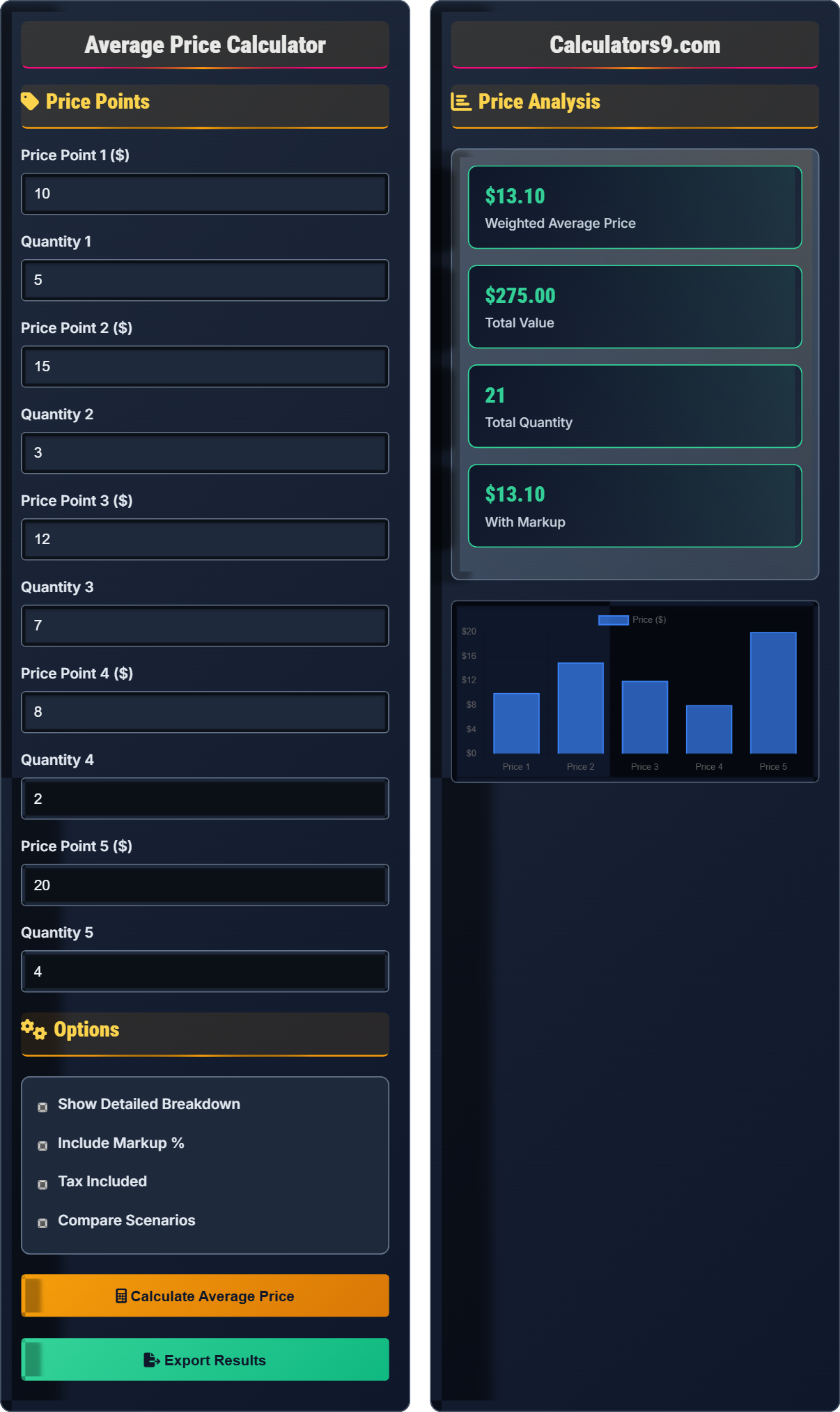
Price Points
Options
Price Analysis
| Price Point | Quantity | Value | Weight |
|---|
| Metrics | Value |
|---|
Comprehensive Average Price Guide
Average price is a critical metric in business finance that represents the mean value of a product or service across different quantities or transactions. The weighted average price takes into account both the price and quantity of each transaction, providing a more accurate representation of the average cost than a simple arithmetic mean.
The weighted average price calculation uses the following formula:
Where:
- \(Price_i\) = Individual price point
- \(Quantity_i\) = Corresponding quantity
- \(\sum\) = Sum of all price-quantity pairs
Different approaches to calculating average prices serve various business needs:
- Simple Average: Arithmetic mean of all prices, ignoring quantities
- Weighted Average: Considers both price and quantity for each transaction
- Volume-Weighted: Emphasizes prices based on sales volume
- Time-Weighted: Considers the timing of price changes
- Use weighted averages: For more accurate cost basis than simple averages
- Consider market dynamics: Adjust prices based on demand and competition
- Factor in all costs: Include overhead, shipping, and handling in calculations
- Monitor regularly: Review and update prices based on cost fluctuations
- Plan for markup: Establish consistent markup percentages for profitability
Average Price Learning Quiz
Why is a weighted average more accurate than a simple average for inventory valuation?
The answer is B) It considers both price and quantity. A weighted average takes into account the quantity of each item purchased at different prices, providing a more accurate representation of the average cost. A simple average treats all purchases equally regardless of quantity, which can skew the result if different quantities were purchased at different prices.
Understanding the difference between simple and weighted averages is crucial in business finance. The weighted average provides a more accurate cost basis because it reflects the actual distribution of inventory. For example, if you bought 100 units at $10 and 10 units at $20, the weighted average would be closer to $10 than $20, reflecting the larger quantity at the lower price.
Weighted Average: Average that considers the importance or frequency of each value
Simple Average: Arithmetic mean of all values
Inventory Valuation: Process of assigning values to inventory items
• Weighted average = (Sum of Price×Quantity) / (Sum of Quantities)
• Simple average = (Sum of Prices) / (Number of Prices)
• Weighted average better reflects actual cost distribution
• Use weighted averages for inventory costing
• Consider quantity when comparing prices
• Verify calculations with sample data
• Using simple average instead of weighted average for inventory
• Forgetting to consider quantity in calculations
• Mixing up numerator and denominator in the formula
Calculate the weighted average price for the following purchases: 50 units at $12 each, 30 units at $15 each, and 20 units at $10 each. Show your work.
Using the weighted average formula: Weighted Average = (Sum of Price×Quantity) / (Sum of Quantities)
Step 1: Calculate total value for each purchase:
- 50 × $12 = $600
- 30 × $15 = $450
- 20 × $10 = $200
Step 2: Sum of values = $600 + $450 + $200 = $1,250
Step 3: Sum of quantities = 50 + 30 + 20 = 100
Step 4: Weighted Average = $1,250 ÷ 100 = $12.50
Therefore, the weighted average price is $12.50.
This calculation demonstrates how quantities affect the average price. Even though the highest price was $15, the weighted average is $12.50 because the majority of units were purchased at lower prices. This reflects the actual cost distribution more accurately than a simple average of the three prices ($12.33).
Weighted Average: Average that accounts for the relative importance of each value
Inventory Costing: Method of valuing inventory items
Cost Basis: Original value of an asset for tax purposes
• Always multiply price by quantity for each transaction
• Sum all price-quantity products for the numerator
• Sum all quantities for the denominator
• Organize data in a table before calculating
• Double-check multiplication steps
• Verify that the average falls within the range of individual prices
• Adding prices together without multiplying by quantities
• Dividing by the number of transactions instead of total quantity
• Forgetting to include all purchase transactions
A retailer purchased 100 units at $8 each in January, 150 units at $10 each in February, and 50 units at $12 each in March. If the retailer sold 200 units during the quarter, what is the cost of goods sold using the weighted average method?
Step 1: Calculate total value of all purchases
January: 100 × $8 = $800
February: 150 × $10 = $1,500
March: 50 × $12 = $600
Total value = $800 + $1,500 + $600 = $2,900
Step 2: Calculate total quantity purchased
Total quantity = 100 + 150 + 50 = 300 units
Step 3: Calculate weighted average cost per unit
Weighted average = $2,900 ÷ 300 = $9.67 per unit
Step 4: Calculate cost of goods sold
COGS = 200 units × $9.67 = $1,934
Therefore, the cost of goods sold is $1,934.
This example demonstrates how weighted average costing works in practice. The retailer's cost of goods sold reflects the average cost of all inventory available during the period, weighted by the quantity of each purchase. This method smooths out price fluctuations and provides a more stable cost basis.
Cost of Goods Sold (COGS): Direct costs attributable to producing goods sold
Weighted Average Method: Inventory valuation method using average cost
Inventory Turnover: How quickly inventory is sold and replaced
• COGS = Units Sold × Weighted Average Cost per Unit
• Weighted average applies to all available inventory
• Cost is determined at the time of sale
• Update weighted average after each purchase
• Track quantities separately from prices
• Use spreadsheets for complex calculations
• Forgetting to recalculate average after new purchases
• Using simple average instead of weighted average
• Miscounting total quantities available
A manufacturer has three suppliers offering the same component at different prices and quantities: Supplier A offers 500 units at $25 each, Supplier B offers 300 units at $28 each, and Supplier C offers 200 units at $22 each. If the manufacturer needs to determine the average cost per unit to calculate a selling price with a 40% markup, what should the selling price be?
Step 1: Calculate weighted average cost per unit
Supplier A: 500 × $25 = $12,500
Supplier B: 300 × $28 = $8,400
Supplier C: 200 × $22 = $4,400
Total value = $12,500 + $8,400 + $4,400 = $25,300
Total quantity = 500 + 300 + 200 = 1,000 units
Weighted average cost = $25,300 ÷ 1,000 = $25.30 per unit
Step 2: Calculate selling price with 40% markup
Markup amount = $25.30 × 0.40 = $10.12
Selling price = $25.30 + $10.12 = $35.42
Therefore, the selling price should be $35.42.
This demonstrates how weighted average costs impact pricing decisions. By considering the quantity from each supplier, the manufacturer gets a more accurate picture of their actual cost basis. The markup is then applied to this weighted average cost to ensure profitability across all units sold.
Markup: Addition to cost to determine selling price
Selling Price: Price at which goods are offered for sale
Cost-Plus Pricing: Pricing strategy based on cost plus markup
• Selling Price = Cost × (1 + Markup Percentage)
• Weighted average reflects actual cost distribution
• Markup should cover overhead and generate profit
• Consider market prices when setting markups
• Account for all costs in the cost basis
• Monitor competitor pricing regularly
• Using simple average instead of weighted average for cost basis
• Forgetting to include all cost components
• Applying markup to individual prices instead of average cost
Which of the following scenarios would LEAST benefit from using a weighted average price calculation?
The answer is C) Comparing prices of identical purchases. When all purchases are identical (same quantity and price), there's no variation to weight, so a simple average would yield the same result as a weighted average. The benefit of weighted averages comes from considering different quantities at different prices.
Weighted averages are most valuable when there are variations in quantities or prices. For identical purchases, the weighting factor becomes uniform, making the weighted average equivalent to the simple average. However, in real-world business scenarios, purchase quantities and prices often vary, making weighted averages essential for accurate financial reporting.
Weighted Average: Most beneficial when quantities or prices vary
Identical Purchases: Same price and quantity for all transactions
Financial Reporting: Preparation of financial statements
• Weighted averages are essential for varied purchases
• Simple averages suffice for identical purchases
• Accounting standards often require weighted averages
• Use weighted averages for inventory with varied purchases
• Consider the frequency of different prices
• Follow applicable accounting standards
• Using weighted averages unnecessarily for identical purchases
• Applying simple averages when weighted averages are required
• Not following accounting standards for inventory valuation
Average Price Basics
Weighted average of prices considering quantity purchased.
\(Average Price = \frac{\sum(Price_i \times Quantity_i)}{\sum Quantity_i}\)
Where Average Price=weighted mean, Price=individual prices, Quantity=corresponding quantities.
- Multiply each price by its quantity
- Sum all price-quantity products
- Divide by total quantity
Applications
Used for FIFO, LIFO, and weighted average costing methods.
- Calculate weighted average
- Determine cost basis
- Add markup percentage
- Verify profitability
- Follow accounting standards
- Consider tax implications
- Update regularly
- Account for all costs
FAQ
Q: What's the difference between simple average and weighted average for pricing?
A: A simple average adds all prices together and divides by the number of prices, giving equal weight to each price regardless of quantity purchased.
A weighted average multiplies each price by its corresponding quantity, sums these products, and divides by the total quantity. This gives more weight to prices associated with larger quantities.
For example, if you bought 100 units at $10 and 10 units at $20:
- Simple average: ($10 + $20) ÷ 2 = $15
- Weighted average: [(100×$10) + (10×$20)] ÷ 110 = $10.91
The weighted average ($10.91) better reflects the actual cost since most units were purchased at $10.
Q: How often should I recalculate my average cost for inventory?
A: The frequency depends on your inventory system and business needs:
- Perpetual systems: Recalculate after each purchase (most accurate)
- Periodic systems: At the end of each accounting period
- High-volume businesses: Daily or weekly updates
- Low-volume businesses: Monthly updates may suffice
For accurate financial reporting and pricing decisions, recalculate whenever there's a significant change in purchase prices or when new inventory is added to existing stock at different costs. This ensures your cost of goods sold and inventory valuation remain accurate.