Churn Rate Impact Calculator
Customer retention analysis • 2026 edition
Churn Impact Formulas:
Show the calculator\( \text{Retention Rate} = 1 - \text{Churn Rate} \)
\( \text{Customers Lost} = \text{Total Customers} \times \text{Churn Rate} \)
\( \text{Revenue Loss} = \text{Customers Lost} \times \text{ARPU} \)
\( \text{LTV Loss} = \text{Customers Lost} \times \text{LTV per Customer} \)
Where:
- Churn Rate = Percentage of customers lost per time period
- Retention Rate = Percentage of customers retained
- ARPU = Average Revenue Per User
- LTV = Customer Lifetime Value
These formulas calculate the financial impact of customer churn on business metrics.
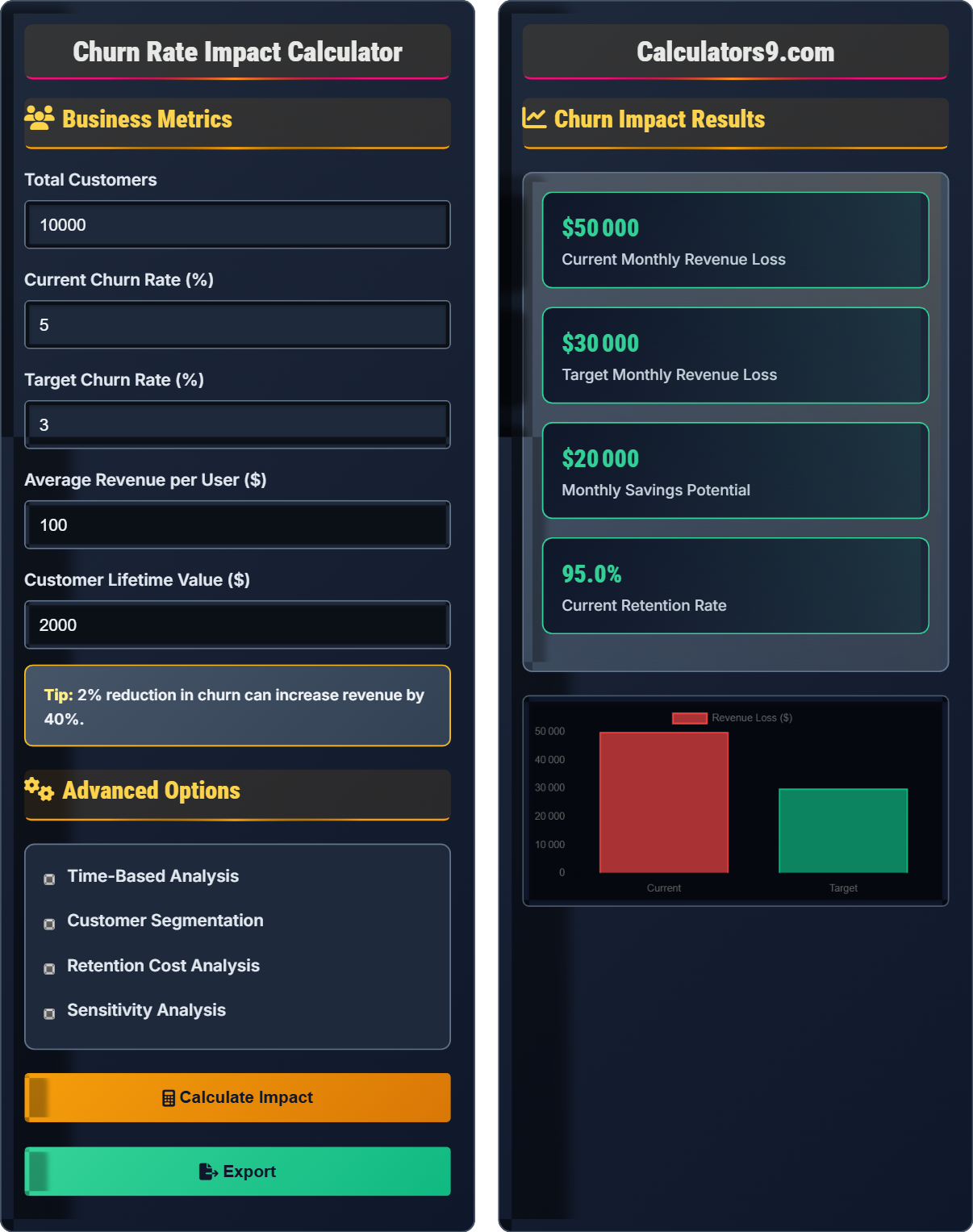
Example: For a company with 10,000 customers, 5% monthly churn, $100 ARPU, and $2,000 LTV:
Customers Lost = 10,000 × 0.05 = 500 customers
Revenue Loss = 500 × $100 = $50,000/month
LTV Loss = 500 × $2,000 = $1,000,000 total value lost
Business Metrics
Advanced Options
Churn Impact Results
| Scenario | Churn Rate | Customers Lost | Revenue Loss | LTV Loss |
|---|
| Month | Current Customers | Lost Customers | Retained Customers | Revenue Impact |
|---|
Comprehensive Churn Analysis Guide
Churn refers to the percentage of customers who discontinue their relationship with a business during a specific time period. It's a critical metric for subscription-based businesses, measuring customer attrition and business sustainability. High churn rates indicate customer dissatisfaction or competitive pressure.
Key formulas for analyzing churn impact:
Where:
- Churn Rate = Percentage of customers lost per period
- ARPU = Average Revenue Per User
- Revenue Loss = Total revenue lost due to churn
Churn affects multiple business areas:
- Revenue Impact: Direct loss of recurring revenue from departing customers
- Acquisition Costs: Need to acquire new customers to replace lost ones
- Operational Efficiency: Reduced economies of scale
- Brand Reputation: Negative word-of-mouth from departing customers
- Onboarding Optimization: Improve initial customer experience
- Engagement Programs: Regular communication and value delivery
- Feedback Systems: Early identification of at-risk customers
- Product Improvement: Address root causes of churn
- Retention Offers: Targeted incentives for at-risk customers
Churn Fundamentals
Percentage of customers who leave during a time period.
\( \text{Churn Rate} = \frac{\text{Lost Customers}}{\text{Total Customers}} \times 100 \)
\( \text{Revenue Loss} = \text{Lost Customers} \times \text{ARPU} \)
- Churn rate should be <5% monthly for healthy SaaS
- Retention rate = 100% - Churn rate
- Focus on preventing churn vs acquiring new customers
Strategies
Focus on keeping existing customers satisfied.
- Improve onboarding process
- Enhance customer support
- Regular engagement programs
- Early warning systems
- High-value customers need special attention
- Seasonal patterns affect churn
- Competitor actions impact retention
- Product quality directly affects churn
Churn Learning Quiz
Which of the following statements about churn rate and retention rate is TRUE?
The answer is C) Churn rate + Retention rate = 100%. By definition, churn rate and retention rate are complementary metrics that represent opposite sides of the same customer population. If 5% of customers churn, then 95% are retained. The mathematical relationship is: Retention Rate = 100% - Churn Rate, or Churn Rate + Retention Rate = 100%.
This fundamental relationship is crucial for understanding customer dynamics. Think of it as a pie representing all customers: if 5% of the pie (churn) is taken away, 95% remains (retention). These two portions must always add up to the whole pie (100%). This relationship allows you to calculate one metric if you know the other. For example, if churn rate is 3%, then retention rate must be 97%. This concept is foundational for all churn analysis and forecasting.
Churn Rate: Percentage of customers who discontinue their relationship during a specific period
Retention Rate: Percentage of customers who continue their relationship during a specific period
Complementary Metrics: Metrics that together account for 100% of a given population
• Churn Rate + Retention Rate = 100%
• Retention Rate = 100% - Churn Rate
• Churn Rate = 100% - Retention Rate
• Remember: Churn + Retention = 100%
• Use this relationship to double-check calculations • Focus on retention rate improvements for better business outcomes• Adding churn rates instead of subtracting from 100%
• Confusing the relationship between churn and retention
• Not recognizing that these metrics are complementary
A SaaS company has 15,000 customers, an average monthly revenue per user (ARPU) of $120, and a current monthly churn rate of 6%. The company plans to implement a retention program that aims to reduce churn to 4%. Calculate the current monthly revenue loss due to churn, the projected revenue loss after implementing the program, and the monthly savings potential. Also calculate the LTV loss assuming an average customer LTV of $3,000.
Step 1: Calculate current monthly customers lost
Current Customers Lost = Total Customers × Current Churn Rate
Current Customers Lost = 15,000 × 0.06 = 900 customers
Step 2: Calculate current monthly revenue loss
Current Revenue Loss = Customers Lost × ARPU
Current Revenue Loss = 900 × $120 = $108,000
Step 3: Calculate projected monthly customers lost
Projected Customers Lost = Total Customers × Target Churn Rate
Projected Customers Lost = 15,000 × 0.04 = 600 customers
Step 4: Calculate projected monthly revenue loss
Projected Revenue Loss = 600 × $120 = $72,000
Step 5: Calculate monthly savings potential
Monthly Savings = Current Revenue Loss - Projected Revenue Loss
Monthly Savings = $108,000 - $72,000 = $36,000
Step 6: Calculate LTV loss
Current LTV Loss = 900 × $3,000 = $2,700,000
Projected LTV Loss = 600 × $3,000 = $1,800,000
LTV Savings = $2,700,000 - $1,800,000 = $900,000
Conclusion: The retention program could save $36,000 in monthly revenue and $900,000 in total customer lifetime value annually.
This calculation demonstrates the significant financial impact of churn reduction. The 2% improvement in churn rate (from 6% to 4%) results in 300 fewer customers lost per month, translating to substantial revenue savings. The LTV calculation shows the long-term value impact, as each lost customer represents not just immediate revenue but also future revenue potential. This illustrates why even small improvements in churn rate can have dramatic financial benefits for subscription businesses.
ARPU: Average Revenue Per User - average revenue generated per customer per time period
LTV: Customer Lifetime Value - total revenue expected from a customer over their entire relationship
Revenue Loss: Total revenue lost due to customer churn
• Revenue Loss = Customers Lost × ARPU
• LTV Loss = Customers Lost × Average LTV
• Small changes in churn rate have large impacts
• Focus on high-value customers first
• Calculate both short-term and long-term impacts
• Consider the compounding effect of reduced churn
• Forgetting to convert percentages to decimals in calculations
• Only calculating immediate revenue loss, ignoring LTV impact
• Not considering the cumulative effect of churn over time
FAQ
Q: What's the difference between gross churn and net churn, and which should I focus on?
A: Gross churn measures customer losses without considering upgrades from existing customers, while net churn accounts for both customer losses and revenue gains from existing customers:
- Gross Churn Rate: \( \frac{\text{Lost Customers}}{\text{Starting Customers}} \times 100 \)
- Net Churn Rate: \( \frac{\text{Lost Revenue} - \text{Expansion Revenue}}{\text{Starting Revenue}} \times 100 \)
Focus on gross churn for customer retention strategy since it directly measures customer losses. Gross churn is more actionable for retention efforts. However, net churn provides insight into overall revenue health, especially for businesses with significant upselling opportunities. Both metrics are important, but gross churn is the primary indicator of customer satisfaction and retention effectiveness.
Q: How do I calculate the ROI of a customer retention program?
A: The ROI of a retention program is calculated by comparing the cost of the program to the financial benefits gained:
ROI Formula: \( \text{ROI} = \frac{\text{Revenue Gains from Reduced Churn} - \text{Program Cost}}{\text{Program Cost}} \times 100 \)
Steps to calculate:
- Estimate reduction in churn rate from the program
- Calculate revenue savings: (Reduced Customers Lost) × ARPU
- Calculate LTV savings: (Reduced Customers Lost) × Average LTV
- Subtract program costs from total savings
- Divide by program costs and multiply by 100
For example, if a $50,000 program prevents 500 customer losses with $100 ARPU and $2,000 LTV: Total savings = (500 × $100) + (500 × $2,000) = $1,050,000. ROI = ($1,050,000 - $50,000) ÷ $50,000 × 100 = 2,000%.