Lifetime Value (LTV) Calculator
Customer profitability • 2026 edition
LTV Formula:
Show the calculator\( \text{LTV} = \frac{\text{Average Revenue per User} \times \text{Gross Margin \%}}{\text{Churn Rate}} \)
Where:
- Average Revenue per User (ARPU) = Average revenue generated per customer per time period
- Gross Margin % = Percentage of revenue after direct costs
- Churn Rate = Percentage of customers lost per time period
This formula calculates the total profit a business can expect to earn from a single customer over their entire relationship.
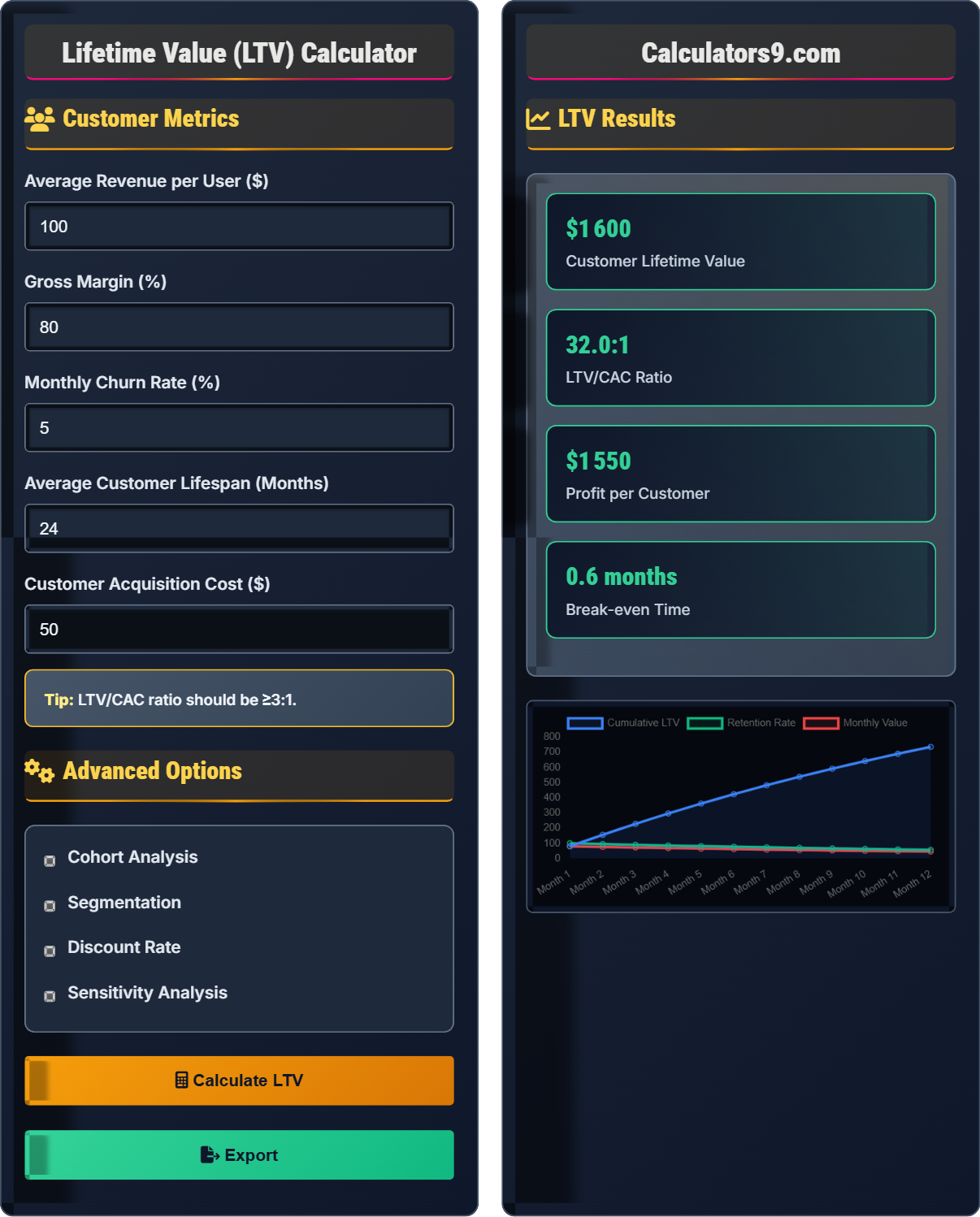
Example: For a SaaS company with $100 ARPU, 80% gross margin, and 5% monthly churn:
\( \text{LTV} = \frac{100 \times 0.80}{0.05} = \frac{80}{0.05} = 1{,}600 \)
Thus, the average customer is worth $1,600 over their lifetime.
Customer Metrics
Advanced Options
LTV Results
| Period | Revenue | Margin | Retention | Value |
|---|
| Scenario | LTV | LTV/CAC | Notes |
|---|
Comprehensive LTV Guide
LTV (Lifetime Value) is the total revenue a business can reasonably expect from a single customer account throughout the business relationship. It's a critical metric for understanding customer profitability and making informed decisions about customer acquisition and retention strategies.
The basic LTV calculation uses the following formula:
Where:
- ARPU = Average Revenue Per User per time period
- Gross Margin % = Percentage of revenue after direct costs
- Churn Rate = Percentage of customers lost per time period
LTV is used for several strategic purposes:
- Customer Acquisition: Determine maximum cost per acquisition
- Product Development: Prioritize features that increase LTV
- Marketing Budget: Allocate resources across channels
- Pricing Strategy: Evaluate price changes impact
- Increase Revenue: Upsell, cross-sell, and premium offerings
- Extend Lifespan: Improve customer satisfaction and retention
- Reduce Churn: Implement retention programs and feedback loops
- Optimize Pricing: Test pricing models and tiers
- Improve Margins: Reduce costs and increase efficiency
LTV Fundamentals
Total profit expected from a customer over their entire relationship.
\( \text{LTV} = \frac{\text{ARPU} \times \text{Gross Margin \%}}{\text{Churn Rate}} \)
Where LTV represents total customer value.
- LTV/CAC ratio should be ≥3:1
- Focus on retention over acquisition
- Track LTV by customer segment
Strategies
Focus on increasing customer lifetime and value.
- Increase average order value
- Reduce customer churn
- Implement loyalty programs
- Personalize customer experience
- Seasonal variations affect LTV
- Market conditions impact retention
- Segment-specific behaviors vary
- Discount rates affect long-term value
LTV Learning Quiz
Which of the following factors would INCREASE a customer's lifetime value?
The answer is C) Higher retention rate. Looking at the LTV formula \( \text{LTV} = \frac{\text{ARPU} \times \text{Gross Margin \%}}{\text{Churn Rate}} \), we can see that retention rate is inversely related to churn rate. Higher retention means lower churn, which increases the LTV. When churn rate decreases (in the denominator), the overall LTV increases.
This relationship demonstrates the fundamental principle of LTV: customer longevity directly impacts value. Think of it mathematically: if churn rate is 10% (0.10), the denominator is 0.10. If we reduce churn to 5% (0.05), the denominator becomes smaller, making the fraction larger. For example, with $100 ARPU and 80% margin: LTV with 10% churn = $80/0.10 = $800, but with 5% churn = $80/0.05 = $1,600. This shows how retention improvements dramatically increase LTV.
LTV: Lifetime Value - total profit expected from a customer over their entire relationship
Churn Rate: Percentage of customers who stop using a service during a specific period
Retention Rate: Percentage of customers who continue using a service during a specific period
• LTV = (ARPU × Gross Margin) ÷ Churn Rate
• Higher retention = lower churn = higher LTV
• All other factors being equal
• Remember: Retention + Churn = 100%
• Focus on retention improvements for maximum LTV impact
• Small reductions in churn can have large LTV impacts
• Confusing retention rate with churn rate in the formula
• Forgetting that churn is in the denominator
• Assuming all customer segments have the same LTV
A subscription company has $150 ARPU, 75% gross margin, and a 4% monthly churn rate. Calculate the LTV and then determine how the LTV would change if the company improved its retention by reducing churn to 2%. Also, calculate the LTV/CAC ratio if the customer acquisition cost is $75.
Step 1: Calculate the initial LTV
LTV = (ARPU × Gross Margin %) ÷ Churn Rate
LTV = ($150 × 0.75) ÷ 0.04
LTV = $112.50 ÷ 0.04 = $2,812.50
Step 2: Calculate the LTV with improved retention
New LTV = ($150 × 0.75) ÷ 0.02
New LTV = $112.50 ÷ 0.02 = $5,625.00
Step 3: Calculate the LTV/CAC ratio with original LTV
LTV/CAC = $2,812.50 ÷ $75 = 37.5:1
Step 4: Calculate the LTV/CAC ratio with improved LTV
New LTV/CAC = $5,625.00 ÷ $75 = 75:1
Conclusion: By reducing churn from 4% to 2%, the company doubled its LTV from $2,812.50 to $5,625.00. The LTV/CAC ratio also improved from 37.5:1 to 75:1, indicating a much healthier business model with improved retention.
This calculation demonstrates the exponential impact of retention improvements on LTV. When churn rate is halved (from 4% to 2%), the LTV doubles. This occurs because the churn rate is in the denominator of the LTV formula, so any reduction in churn has a multiplicative effect. The LTV/CAC ratio of 37.5:1 and 75:1 indicates exceptional business health - the industry benchmark is typically 3:1 or higher. This shows how retention improvements can transform a business's economic model.
ARPU: Average Revenue Per User - average revenue generated per customer per time period
Gross Margin: Percentage of revenue remaining after direct costs are deducted
LTV/CAC Ratio: Lifetime Value to Customer Acquisition Cost ratio
• LTV = (ARPU × Gross Margin) ÷ Churn Rate
• Industry standard LTV/CAC ratio is 3:1 or higher
• Churn rate is in the denominator (inverse relationship)
• Small improvements in churn can have dramatic LTV impacts
• Aim for LTV/CAC ratios of 3:1 or higher
• Track LTV by customer segment for better insights
• Forgetting to convert percentages to decimals in calculations
• Confusing gross margin percentage with net profit
• Not considering the inverse relationship between churn and LTV
FAQ
Q: How often should I recalculate my LTV, and what factors cause it to change significantly?
A: You should recalculate LTV monthly for fast-growing companies and quarterly for mature businesses. Significant changes occur when:
- Pricing Changes: Adjustments to subscription fees or product prices
- Feature Launches: New features that affect usage or value perception
- Market Conditions: Economic shifts affecting customer behavior
- Product Quality: Issues that impact retention or usage
The mathematical sensitivity of LTV to churn makes it particularly volatile. Even a 1% change in monthly churn can significantly impact LTV due to the inverse relationship in the formula: \( \text{LTV} = \frac{\text{ARPU} \times \text{Gross Margin \%}}{\text{Churn Rate}} \). For example, if churn increases from 3% to 4% (33% increase), LTV decreases from $3,333 to $2,500 (25% decrease).
Q: What's the difference between cohort-based LTV and simple LTV, and when should I use each?
A: Simple LTV uses overall averages, while cohort-based LTV analyzes groups of customers acquired at the same time. The formulas differ:
- Simple LTV: \( \text{LTV} = \frac{\text{ARPU} \times \text{Gross Margin \%}}{\text{Average Churn Rate}} \)
- Cohort LTV: Calculate LTV for each acquisition month separately, then average
Use simple LTV when:
- Your business is early stage
- Customer behavior is relatively uniform
- You need quick calculations
Use cohort-based LTV when:
- You have sufficient data (typically 12+ months)
- Customer behavior varies significantly by acquisition period
- You want to measure retention strategy effectiveness
Cohort analysis reveals trends invisible in aggregate data, such as whether newer customers have different retention patterns than older ones.