Runway Calculator
Business cash flow • 2026 edition
Runway Formula:
Show the calculator\( \text{Runway (months)} = \frac{\text{Current Cash Balance}}{\text{Monthly Burn Rate}} \)
Where:
- Current Cash Balance = total liquid assets available
- Monthly Burn Rate = net monthly cash outflow (expenses - revenue)
This formula calculates how long a business can operate before running out of cash, assuming current spending patterns continue.
Example: For a company with $120,000 in cash and a monthly burn rate of $10,000:
\( \text{Runway} = \frac{120{,}000}{10{,}000} = 12 \text{ months} \)
Thus, the business has 12 months of operational runway.
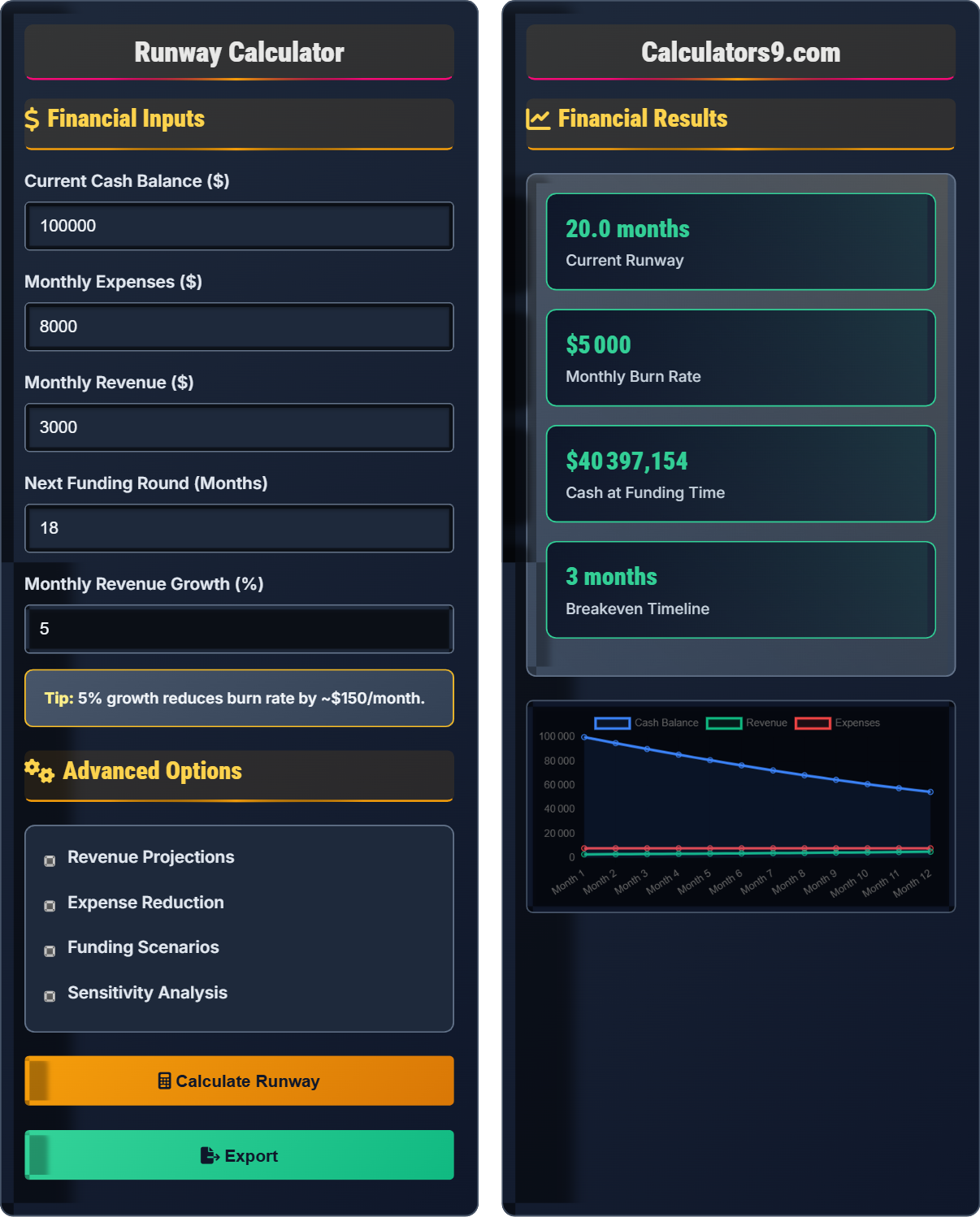
Financial Inputs
Advanced Options
Financial Results
| Month | Starting Balance | Revenue | Expenses | Ending Balance |
|---|
| Scenario | Runway | Burn Rate | Notes |
|---|
Comprehensive Runway Guide
Runway refers to the amount of time a business can continue operating before running out of cash, based on its current cash reserves and burn rate. It's a critical metric for startups and growing businesses to understand their financial sustainability.
The basic runway calculation uses the following formula:
Where:
- Cash Balance = total liquid cash available
- Monthly Burn Rate = net monthly cash outflow (expenses - revenue)
You can extend your runway through several strategies:
- Increase Revenue: Focus on sales, marketing, and customer acquisition
- Reduce Expenses: Cut non-essential costs and optimize operations
- Raise Capital: Secure funding rounds or investment
- Improve Efficiency: Increase revenue per employee or per dollar spent
- Monitor Weekly: Track cash flow weekly rather than monthly
- Plan Ahead: Always maintain 6-12 months of runway
- Diversify Revenue: Reduce dependence on single revenue streams
- Build Reserves: Keep emergency cash for unexpected expenses
- Optimize Timing: Align funding rounds with cash needs
Runway Fundamentals
Time until cash runs out based on current burn rate.
\( \text{Runway} = \frac{\text{Cash Balance}}{\text{Burn Rate}} \)
Where runway is measured in months.
- Always monitor burn rate trends
- Plan for 6-12 months of runway
- Track revenue growth impact
Strategies
Focus on extending runway through efficiency improvements.
- Reduce unnecessary expenses
- Increase revenue streams
- Negotiate payment terms
- Secure additional funding
- Market conditions affect funding
- Growth requires investment
- Balance speed with efficiency
- Plan for contingencies
Runway Learning Quiz
Which of the following best describes the relationship between burn rate and runway?
The answer is B) Lower burn rate = longer runway. According to the runway formula \( \text{Runway} = \frac{\text{Cash Balance}}{\text{Monthly Burn Rate}} \), when the denominator (burn rate) decreases, the result (runway) increases, assuming cash balance remains constant. A lower burn rate means the company spends less money each month, allowing its cash to last longer.
This relationship follows inverse proportionality. Think of it like a fuel tank: if you drive more efficiently (lower burn rate), your fuel lasts longer (longer runway). Conversely, if you drive aggressively (higher burn rate), your fuel depletes faster (shorter runway). In business terms, if a company maintains $100,000 in cash and burns $10,000 per month, it has 10 months of runway. If it reduces its burn rate to $5,000 per month, the runway extends to 20 months.
Runway: The length of time a business can operate before running out of cash
Burn Rate: The rate at which a company spends money, typically measured monthly
Cash Balance: The total amount of liquid cash a company currently holds
• Runway is inversely proportional to burn rate
• Higher burn rate = shorter runway (all else equal)
• Lower burn rate = longer runway (all else equal)
• Remember: Runway = Cash ÷ Burn Rate
• Use the fuel tank analogy to understand the inverse relationship
• Track burn rate monthly to identify trends
• Confusing direct proportionality with inverse relationship
• Forgetting that higher burn rate reduces runway
• Not accounting for changing revenue streams in burn rate
A startup has $150,000 in cash, monthly expenses of $12,000, and monthly revenue of $4,000. Calculate the company's runway and explain the steps. Then, determine how much the runway would change if revenue increased by 25%.
Step 1: Calculate the monthly burn rate
Monthly Burn Rate = Monthly Expenses - Monthly Revenue
Monthly Burn Rate = $12,000 - $4,000 = $8,000 per month
Step 2: Calculate the current runway
Runway = Current Cash Balance ÷ Monthly Burn Rate
Runway = $150,000 ÷ $8,000 = 18.75 months
So the company has approximately 18.75 months of runway.
Step 3: Calculate the new revenue after 25% increase
New Revenue = $4,000 × (1 + 0.25) = $4,000 × 1.25 = $5,000 per month
Step 4: Calculate the new burn rate
New Burn Rate = $12,000 - $5,000 = $7,000 per month
Step 5: Calculate the new runway
New Runway = $150,000 ÷ $7,000 = 21.43 months
Conclusion: With a 25% revenue increase, the runway extends from 18.75 months to 21.43 months, an improvement of approximately 2.68 months.
This calculation demonstrates the critical relationship between revenue, expenses, and runway. The burn rate represents the net cash outflow each month. Even small changes in revenue can have significant impacts on runway duration. The calculation shows that improving revenue efficiency is crucial for extending operational time. The 25% revenue increase resulted in a 14.3% extension of the runway, showing the leverage effect of revenue growth on financial sustainability.
Burn Rate: Net monthly cash outflow (expenses minus revenue)
Runway: Duration a company can operate before cash runs out
Revenue Growth: Percentage increase in monthly income
• Burn Rate = Expenses - Revenue
• Runway = Cash Balance ÷ Burn Rate
• Revenue increases reduce burn rate and extend runway
• Always calculate net burn rate (expenses minus revenue)
• Small revenue increases can have outsized runway impacts
• Monitor both numerator (cash) and denominator (burn rate)
• Forgetting to subtract revenue from expenses when calculating burn rate
• Using gross expenses instead of net burn rate
• Not considering how revenue changes affect runway calculations
FAQ
Q: How do I calculate my burn rate when my expenses vary significantly month to month?
A: When expenses vary significantly, calculate your burn rate using a rolling average over the past 3-6 months. This smooths out fluctuations and gives a more accurate picture of your actual burn pattern.
Formula for rolling average burn rate:
\( \text{Avg Burn Rate} = \frac{\sum(\text{Net Cash Outflow}_{month1}^{monthN})}{N} \)
For example, if your net outflows for the last 3 months were $8,000, $10,000, and $7,000:
\( \text{Avg Burn Rate} = \frac{8{,}000 + 10{,}000 + 7{,}000}{3} = \frac{25{,}000}{3} = 8{,}333 \text{ per month} \)
If you have predictable seasonal variations, project your upcoming burn rate based on historical patterns. This approach provides a more realistic estimate for runway calculations than using just the most recent month.
Q: What's the difference between gross and net burn rate, and which should I use for runway calculations?
A: Gross burn rate is your total monthly expenses regardless of revenue, while net burn rate accounts for your monthly revenue:
- Gross Burn Rate: Total monthly expenses only
- Net Burn Rate: Monthly expenses minus monthly revenue
For runway calculations, always use net burn rate. The runway formula is specifically designed to calculate how long your cash will last given your actual net cash outflow:
\( \text{Runway} = \frac{\text{Cash Balance}}{\text{Net Burn Rate}} \)
For example, if you have $100,000 in cash, $15,000 in monthly expenses, and $5,000 in monthly revenue:
- Gross burn rate: $15,000 per month
- Net burn rate: $15,000 - $5,000 = $10,000 per month
- Runway using gross burn: $100,000 ÷ $15,000 = 6.67 months (incorrect)
- Runway using net burn: $100,000 ÷ $10,000 = 10 months (correct)
Using gross burn rate would significantly understate your actual runway.