Working Capital Calculator
Business liquidity analysis • 2026 edition
Working Capital Formulas:
Show the calculator\( \text{Working Capital} = \text{Current Assets} - \text{Current Liabilities} \)
\( \text{Current Ratio} = \frac{\text{Current Assets}}{\text{Current Liabilities}} \)
\( \text{Quick Ratio} = \frac{\text{Current Assets} - \text{Inventory}}{\text{Current Liabilities}} \)
\( \text{Net Working Capital} = \text{Current Assets} - \text{Current Liabilities} \)
Where:
- Current Assets: Assets expected to be converted to cash within one year
- Current Liabilities: Obligations due within one year
- Working Capital: Funds available for day-to-day operations
- Current Ratio: Measure of short-term liquidity
These formulas assess a company's ability to meet short-term obligations.
Example: For a company with $500,000 current assets and $300,000 current liabilities:
Working Capital = $500,000 - $300,000 = $200,000
Current Ratio = $500,000 ÷ $300,000 = 1.67
This indicates strong liquidity with $1.67 in current assets for every $1 of current liabilities.
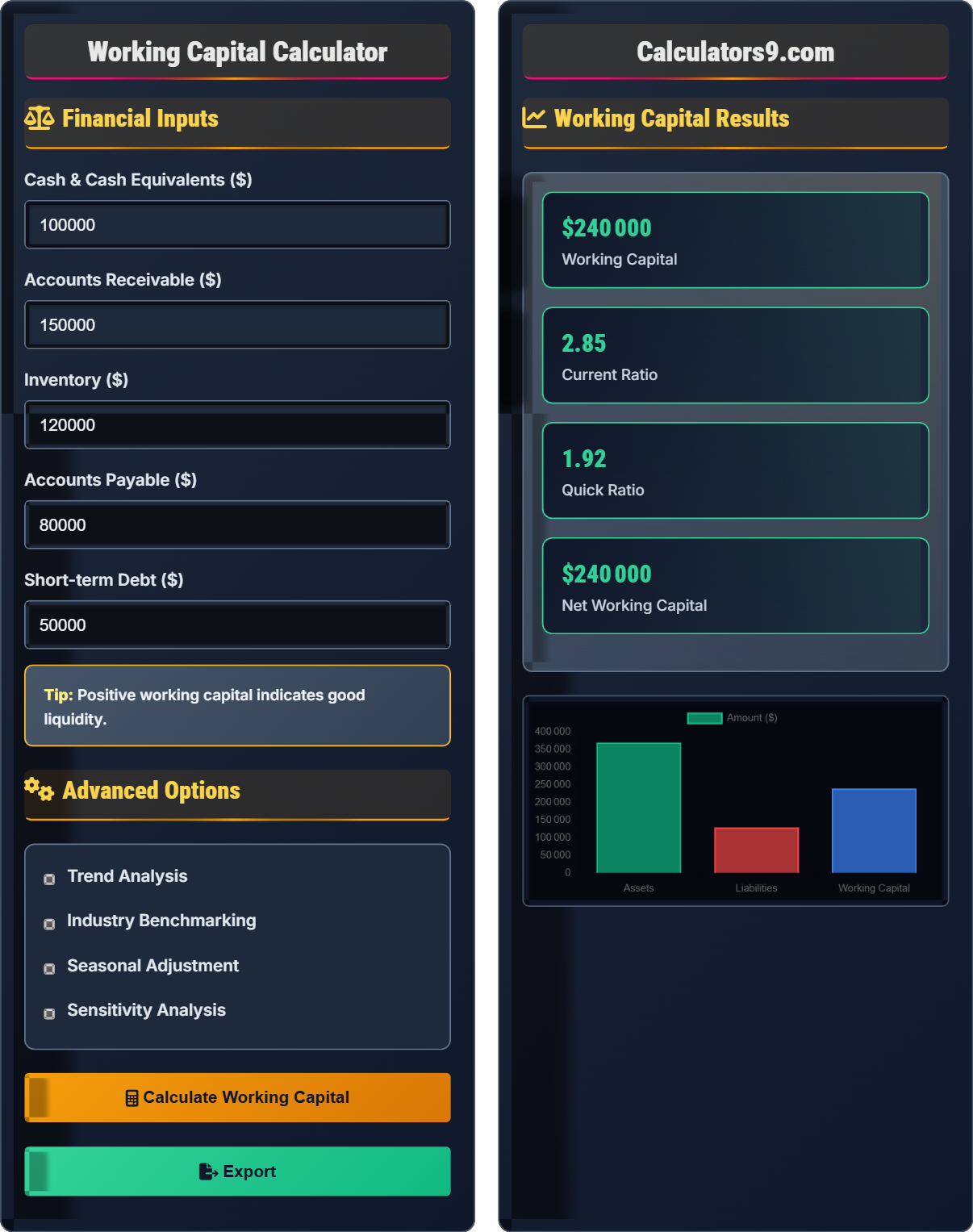
Financial Inputs
Advanced Options
Working Capital Results
| Metric | Value | Industry Avg | Status | Recommendation |
|---|
| Month | Working Capital | Current Ratio | Cash Flow | Alert Level |
|---|
Comprehensive Working Capital Guide
Working capital represents the funds available for a company's day-to-day operations. It's calculated as current assets minus current liabilities. Positive working capital indicates that a company can meet its short-term obligations, while negative working capital suggests potential liquidity problems. It's a critical measure of operational efficiency and short-term financial health.
Key formulas for working capital analysis:
Where:
- Working Capital = Funds available for operations
- Current Ratio = Short-term liquidity measure
- Quick Ratio = Immediate liquidity without inventory
Interpretation of key ratios:
- Current Ratio 1.5-2.0: Healthy liquidity for most industries
- Quick Ratio 1.0-1.5: Adequate immediate liquidity
- Working Capital Turnover: Efficiency of working capital utilization
- Days Sales Outstanding: Average collection period
- Improve Collections: Accelerate accounts receivable recovery
- Manage Inventory: Optimize stock levels and turnover
- Extend Payment Terms: Negotiate favorable supplier terms
- Forecast Cash Flow: Plan for seasonal variations
- Asset-Liability Matching: Align timing of inflows/outflows
Working Capital Fundamentals
Funds available for daily business operations (Current Assets - Current Liabilities).
\( \text{WC} = \text{CA} - \text{CL} \)
\( \text{Current Ratio} = \frac{\text{CA}}{\text{CL}} \)
\( \text{Quick Ratio} = \frac{\text{CA - Inventory}}{\text{CL}} \)
- Current ratio should be 1.5-2.0 for healthy liquidity
- Positive working capital indicates good financial health
- Monitor trends, not just absolute values
Strategies
Focus on maintaining optimal working capital levels.
- Accelerate receivables collection
- Optimize inventory levels
- Extend payables appropriately
- Improve cash forecasting
- Industry standards vary significantly
- Seasonal businesses need special planning
- Balance liquidity with profitability
- Consider cost of capital in decisions
Working Capital Learning Quiz
Which of the following statements about working capital is TRUE?
The answer is B) Working capital = Current Assets - Current Liabilities. Working capital measures the difference between assets that can be converted to cash within one year and obligations due within one year. This represents the funds available for day-to-day operations. The formula is: Working Capital = Current Assets - Current Liabilities.
Think of working capital as the "operational cushion" of a business. Current assets (like cash, receivables, and inventory) provide resources for operations, while current liabilities (like payables and short-term debt) represent immediate obligations. The difference between these two amounts shows how much "free" money the company has for operations. If current assets exceed current liabilities, the company has positive working capital and can meet its short-term obligations comfortably.
Current Assets: Assets expected to be converted to cash within one year
Current Liabilities: Obligations due within one year
Working Capital: Funds available for daily business operations
• Working Capital = Current Assets - Current Liabilities
• Positive working capital indicates good liquidity • Negative working capital suggests potential problems• Remember: CA - CL = WC
• Focus on current assets and liabilities only • Track trends over time, not just absolute values• Confusing working capital with total equity
• Including long-term assets/liabilities in the calculation
• Not considering the timing of cash flows
A company has $200,000 in cash, $150,000 in accounts receivable, $100,000 in inventory, $80,000 in accounts payable, and $40,000 in short-term debt. Calculate the working capital, current ratio, and quick ratio. Interpret what these metrics mean for the company's financial health.
Step 1: Calculate total current assets
Current Assets = Cash + Accounts Receivable + Inventory
Current Assets = $200,000 + $150,000 + $100,000 = $450,000
Step 2: Calculate total current liabilities
Current Liabilities = Accounts Payable + Short-term Debt
Current Liabilities = $80,000 + $40,000 = $120,000
Step 3: Calculate working capital
Working Capital = Current Assets - Current Liabilities
Working Capital = $450,000 - $120,000 = $330,000
Step 4: Calculate current ratio
Current Ratio = Current Assets ÷ Current Liabilities
Current Ratio = $450,000 ÷ $120,000 = 3.75
Step 5: Calculate quick ratio
Quick Ratio = (Current Assets - Inventory) ÷ Current Liabilities
Quick Ratio = ($450,000 - $100,000) ÷ $120,000 = $350,000 ÷ $120,000 = 2.92
Interpretation: The company has excellent liquidity with $330,000 in working capital, a current ratio of 3.75 (much higher than the typical 1.5-2.0 range), and a quick ratio of 2.92. This indicates strong financial health with more than enough resources to cover short-term obligations even without selling inventory.
This calculation demonstrates how working capital metrics provide insights into a company's short-term financial health. The current ratio of 3.75 means the company has $3.75 in current assets for every $1 of current liabilities, indicating strong liquidity. The quick ratio of 2.92 excludes inventory, providing a more conservative measure that still shows excellent liquidity. Both ratios suggest the company can easily meet its short-term obligations and has flexibility for operational investments.
Current Ratio: Measure of short-term liquidity (CA ÷ CL)
Quick Ratio: Immediate liquidity measure excluding inventory
Liquidity: Ability to convert assets to cash quickly
• Current Ratio = Current Assets ÷ Current Liabilities
• Quick Ratio = (Current Assets - Inventory) ÷ Current Liabilities
• Ideal current ratio is 1.5-2.0 for most industries
• Compare ratios to industry benchmarks
• Look at trends over time, not just current values • Consider seasonal variations in working capital needs• Including long-term assets in current assets calculation
• Forgetting to exclude inventory from quick ratio calculation
• Not considering the quality of receivables and inventory
FAQ
Q: What's the difference between working capital and cash flow, and why do I need to track both?
A: Working capital is a snapshot measure (balance sheet item) showing the difference between current assets and current liabilities at a specific point in time. Cash flow is a flow measure (income statement item) showing the movement of cash over a period.
Working capital formula: \( \text{WC} = \text{Current Assets} - \text{Current Liabilities} \)
Cash flow tracks actual cash coming in and going out. You need both because:
- Working capital shows your liquidity buffer
- Cash flow shows how that buffer changes over time
- High working capital with negative cash flow indicates problems
- Low working capital with positive cash flow may be sustainable
Together, they provide a complete picture of short-term financial health.
Q: How do I interpret working capital ratios in different industries?
A: Working capital ratios vary significantly by industry:
- Retail: Current ratio 1.2-1.8 (high inventory, fast turnover)
- Manufacturing: Current ratio 1.5-2.5 (longer production cycles)
- Services: Current ratio 1.0-1.5 (minimal inventory)
- Technology: Current ratio 2.0-4.0 (high cash, minimal inventory)
Industry-specific formulas account for business model differences:
Retail: \( \text{Current Ratio} = \frac{\text{Cash + Receivables + Inventory}}{\text{Payables + Short-term Debt}} \)
Service: \( \text{Current Ratio} = \frac{\text{Cash + Receivables}}{\text{Payables + Short-term Debt}} \)
Always compare your ratios to industry benchmarks rather than generic standards.