Investment Calculator
Wealth building • Compound interest
Investment Growth Formula:
Show the calculatorFuture Value: \( FV = PV \times (1 + r)^t + PMT \times \frac{(1 + r)^t - 1}{r} \)
Where:
- \( FV \) = Future Value
- \( PV \) = Present Value (initial investment)
- \( PMT \) = Periodic contribution
- \( r \) = Interest rate per period
- \( t \) = Number of periods
This formula calculates the future value of an investment account with regular contributions, incorporating compound interest. It combines the growth of the initial investment with the compounded returns on regular contributions.
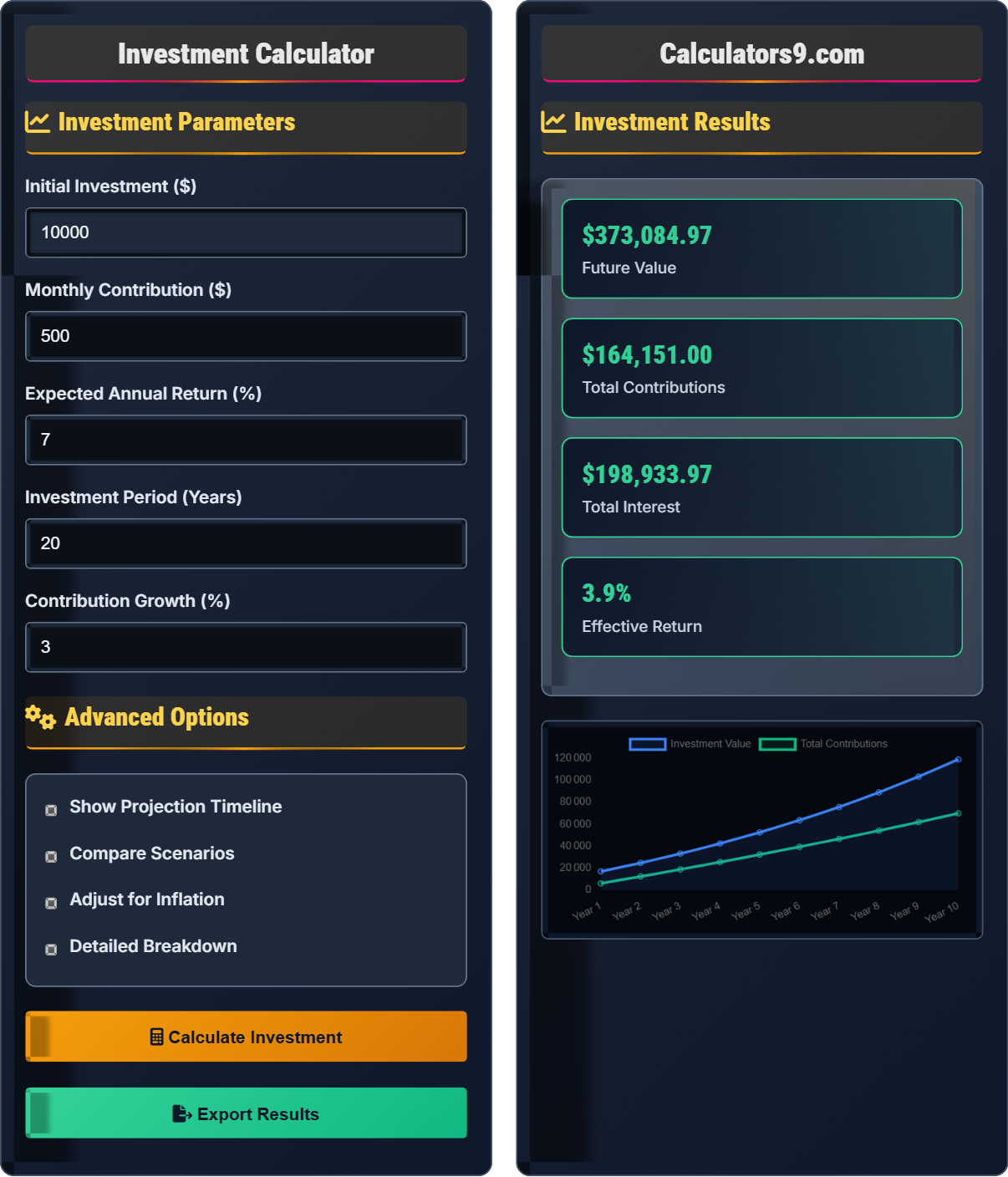
Example: For an initial investment of $10,000 with monthly contributions of $500 at an annual return of 7% over 20 years:
Periodic rate: \( r = \frac{7\%}{12} = 0.005833 \)
Number of periods: \( t = 20 \times 12 = 240 \)
Future Value: \( FV = 10,000 \times (1.005833)^{240} + 500 \times \frac{(1.005833)^{240} - 1}{0.005833} \approx \$284,500 \)
Thus, the investment would grow to approximately $284,500 after 20 years.
Investment Parameters
Advanced Options
Investment Results
| Year | Balance | Contributions | Interest |
|---|
| Source | Amount | Percentage |
|---|
Comprehensive Investment Guide
Investment growth refers to the increase in value of an asset over time due to appreciation, dividends, interest, or other returns. The power of compound interest allows your money to earn returns not only on your initial investment but also on the accumulated returns, leading to exponential growth over time.
The standard investment growth calculation uses this formula:
Where:
- \(FV\) = Future Value
- \(PV\) = Present Value (initial investment)
- \(PMT\) = Periodic contribution
- \(r\) = Interest rate per period
- \(t\) = Number of periods
Critical factors affecting investment growth:
- Time Horizon: Longer periods allow for greater compound growth
- Rate of Return: Higher returns accelerate wealth accumulation
- Regular Contributions: Consistent investing builds wealth systematically
- Expense Ratios: Lower fees preserve more of your returns
- Tax Implications: Tax-efficient strategies maximize net returns
- Start Early: Leverage the power of compound interest over time
- Automate Investments: Set up regular contributions to maintain discipline
- Maximize Tax Advantages: Use 401(k), IRA, and other tax-advantaged accounts
- Minimize Costs: Choose low-cost index funds and ETFs
- Stay Consistent: Continue investing through market ups and downs
Investment Fundamentals
Earning returns on both principal and previously earned returns.
\(FV = PV \times (1 + r)^t + PMT \times \frac{(1 + r)^t - 1}{r}\)
Where FV=future value, PV=initial investment, PMT=contributions, r=rate, t=time.
- Time is the most important factor in compound growth
- Higher returns accelerate wealth accumulation
- Regular contributions build wealth systematically
Strategies
Investing fixed amounts regularly regardless of market conditions.
- Start investing as early as possible
- Contribute consistently to your investments
- Choose diversified, low-cost investments
- Rebalance periodically to maintain allocation
- Expense ratios impact net returns
- Market volatility is normal
- Tax efficiency matters
- Emergency fund is important
Investment Learning Quiz
Which of the following has the greatest impact on investment growth over a 30-year period?
The answer is B) Time invested. While all factors matter, time has the most dramatic impact due to the exponential nature of compound interest. The longer your money has to grow, the more pronounced the compounding effect becomes. This is why starting early is often considered the most important factor in wealth building.
This question highlights the exponential nature of compound interest. While a higher return rate is important, the compounding effect means that each additional year of investment adds exponentially more value. For example, $1,000 invested at 7% for 30 years grows to $7,612, but for 40 years it grows to $14,974 - nearly double the gain for just 10 more years.
Compound Interest: Interest earned on both principal and previously earned interest
Time Value of Money: Money available today is worth more than the same amount later
Exponential Growth: Growth that accelerates over time due to compounding
• Time is the most powerful factor in compound growth
• Starting early beats starting big in the long run
• The longer the investment period, the greater the compounding effect
• Start investing as soon as possible, even with small amounts
• The difference between starting at 25 vs 35 is significant by retirement
• Time compensates for lower returns in the long run
• Believing that starting with a large amount is better than starting early
• Underestimating the impact of compound interest over time
• Delaying investments in favor of other goals
Calculate the future value of an investment with $5,000 initial investment, $300 monthly contributions, earning 6% annually over 25 years. Show your work.
Using the investment formula: \(FV = PV \times (1 + r)^t + PMT \times \frac{(1 + r)^t - 1}{r}\)
Given:
- PV = $5,000
- PMT = $300
- r = 0.06 ÷ 12 = 0.005
- t = 25 × 12 = 300
Step 1: Calculate (1+r)^t = (1.005)^300 = 4.4650
Step 2: Calculate PV component: $5,000 × 4.4650 = $22,325
Step 3: Calculate PMT component: $300 × [(1.005^300 - 1)/0.005] = $300 × 639.30 = $191,790
Step 4: Calculate FV = $22,325 + $191,790 = $214,115
Therefore, the future value is approximately $214,115.
This calculation demonstrates how both the initial investment and regular contributions contribute to total growth. The initial $5,000 grows to $22,325, while the $90,000 in contributions grows to $214,115 due to compound interest. This shows the power of systematic investing combined with compound returns.
Future Value: Value of an asset at a specific date in the future
Periodic Rate: Interest rate applied per compounding period
Systematic Investing: Regular contributions to investments over time
• Always convert annual rates to periodic rates for calculations
• Convert time periods to match compounding frequency
• Both initial investment and contributions compound over time
• Remember: r = annual rate ÷ compounding frequency
• Remember: t = years × compounding frequency
• Use a calculator for complex exponent calculations
• Forgetting to convert annual rates to monthly rates
• Using the wrong number of periods (not adjusting for frequency)
• Making calculation errors with large exponents
Sarah starts investing at age 25 with $200 per month at 7% annual return. John waits until age 35 to start investing $400 per month at the same return. Who will have more money at age 65? Show your calculations.
For Sarah (40 years): r = 0.07 ÷ 12 = 0.005833, t = 40 × 12 = 480
Future Value = $0 × (1.005833)^480 + $200 × [(1.005833^480 - 1)/0.005833]
= $0 + $200 × [(18.42 - 1)/0.005833] = $200 × 2,987.50 = $597,500
For John (30 years): r = 0.07 ÷ 12 = 0.005833, t = 30 × 12 = 360
Future Value = $0 × (1.005833)^360 + $400 × [(1.005833^360 - 1)/0.005833]
= $0 + $400 × [(8.12 - 1)/0.005833] = $400 × 1,220.50 = $488,200
Therefore, Sarah will have $597,500 compared to John's $488,200 despite investing less per month.
This example perfectly illustrates the power of starting early. Despite investing only $200 per month (half of John's contribution), Sarah ends up with more money due to the extra 10 years of compounding. The 10 additional years of growth more than compensate for the doubled monthly contribution. This demonstrates why time is often more valuable than money in investing.
Time Advantage: Extra years of compounding that benefit early investors
Compounding Period: Time interval over which interest is calculated
Investment Duration: Length of time money is invested
• Starting early beats investing more in the long run
• Extra years of compounding have exponential impact
• Small differences in time can lead to large differences in outcomes
• Start investing immediately, even with small amounts
• Take advantage of employer matching in retirement accounts
• Automate investments to maintain consistency
• Believing that higher contributions always beat starting early
• Not appreciating the exponential impact of compounding
• Delaying investments while waiting for "better times"
Mike invests $100,000 in a fund with a 1% annual expense ratio, while Nancy invests the same amount in a similar fund with a 0.1% expense ratio. Both earn 7% gross returns over 30 years. How much more will Nancy have than Mike? (Hint: Calculate net returns after expenses)
Mike's net return: 7% - 1% = 6% annually
Nancy's net return: 7% - 0.1% = 6.9% annually
Mike's future value: $100,000 × (1.06)^30 = $100,000 × 5.7435 = $574,350
Nancy's future value: $100,000 × (1.069)^30 = $100,000 × 7.5940 = $759,400
Difference: $759,400 - $574,350 = $185,050
Therefore, Nancy will have $185,050 more than Mike due to the lower expense ratio.
This example shows how seemingly small differences in expense ratios can have massive impacts over time due to compounding. The 0.9% difference in expenses compounds over 30 years to create a $185,000 difference. This is why selecting low-cost investment options is crucial for long-term wealth building. Every percentage point of fees reduces your returns permanently.
Expense Ratio: Annual fee charged by investment funds as a percentage of assets
Net Return: Investment return after deducting fees and expenses
Fee Drag: Reduction in returns caused by investment fees
• Even small differences in fees compound over time
• Low-cost investments generally outperform high-cost ones
• Expense ratios directly reduce your net returns
• Look for expense ratios below 0.2% for index funds
• Avoid funds with expense ratios above 1%
• Use the rule of thumb: cut fees in half = keep more of returns
• Ignoring the impact of fees on long-term returns
• Believing that higher fees guarantee better performance
• Not comparing expense ratios when selecting investments
Which of the following statements about investment risk and return is TRUE?
The answer is C) There is generally a positive relationship between risk and expected return. This is a fundamental principle of investing: investors demand higher expected returns to compensate for taking on additional risk. However, this is not a guarantee - higher-risk investments can still lose money.
While there is a general relationship between risk and expected return, it's important to understand that this doesn't guarantee actual returns. High-risk investments may fail to deliver high returns, and low-risk investments provide more certainty but lower expected returns. The relationship is about expected returns over time, not guaranteed outcomes.
Risk-Return Tradeoff: Principle that higher potential returns require accepting higher risk
Expected Return: Average return anticipated from an investment
Volatility: Degree of variation in investment returns
• Higher risk investments offer higher expected returns
• Risk and return relationship exists over long periods
• Past performance does not guarantee future results
• Match risk level to investment time horizon
• Diversify to manage risk without sacrificing returns
• Understand your risk tolerance before investing
• Confusing expected returns with guaranteed returns
• Taking unnecessary risks without understanding the tradeoffs
• Not diversifying to manage risk appropriately
FAQ
Q: How does compound interest work in real investments?
A: Compound interest works by earning returns on both your initial investment and the accumulated returns. The formula \( FV = PV \times (1 + r)^t + PMT \times \frac{(1 + r)^t - 1}{r} \) shows how your money grows exponentially over time.
For example, with an initial investment of $10,000 at 7% annual return:
- After 1 year: $10,000 × 1.07 = $10,700
- After 2 years: $10,700 × 1.07 = $11,449
- After 10 years: $10,000 × (1.07)^10 = $19,672
Notice that the growth accelerates each year as you earn interest on your interest. This exponential growth is the foundation of long-term wealth building.
Q: Should I prioritize investment amount or investment timing?
A: Based on the compound interest formula \( FV = PV \times (1 + r)^t + PMT \times \frac{(1 + r)^t - 1}{r} \), time (t) has an exponential impact, while investment amount (PV) and contributions (PMT) have linear impacts.
For example, investing $10,000 at age 25 vs. age 35 at 7% return:
- Age 25 to 65 (40 years): $10,000 × (1.07)^40 = $149,745
- Age 35 to 65 (30 years): $10,000 × (1.07)^30 = $76,123
Starting 10 years earlier doubles your money! While both amount and timing matter, time is the most powerful factor due to compounding.