IRA Calculator
Fast savings calculator • 2026 rates
IRA Savings Formula:
Show the calculator\( FV = PV \times (1 + r)^n + PMT \times \frac{(1 + r)^n - 1}{r} \)
Where:
- \( FV \) = Future value of IRA account
- \( PV \) = Present value (current balance)
- \( r \) = Annual rate of return (in decimal form)
- \( n \) = Number of years until retirement
- \( PMT \) = Annual contribution amount
This formula calculates the future value of IRA savings with regular contributions.
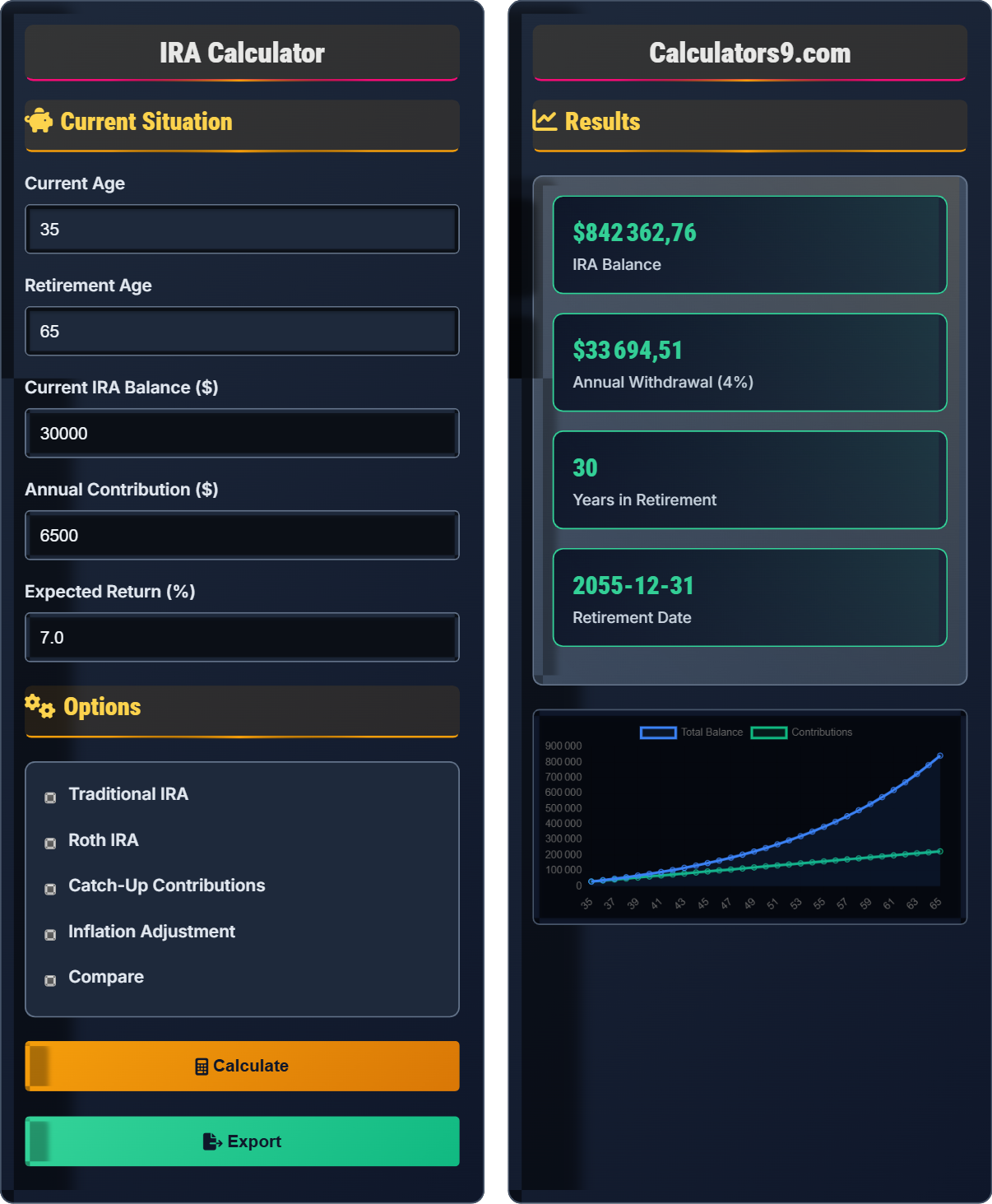
Example: For current balance of \( \$30{,}000 \), annual contribution of \( \$6{,}500 \), 7% annual return over 30 years:
\( FV = 30{,}000 \times (1.07)^{30} + 6{,}500 \times \frac{(1.07)^{30} - 1}{0.07} \)
\( FV = 30{,}000 \times 7.612 + 6{,}500 \times 94.46 = 228{,}360 + 614{,}990 = \$843{,}350 \)
Thus, the retiree would have approximately $843,350 at retirement.
Current Situation
Options
Results
| Year | Age | Contribution | Interest | Total |
|---|
| Milestone | Age | Amount | Annual Return |
|---|
Comprehensive IRA Guide
An Individual Retirement Account (IRA) is a tax-advantaged investment account designed to help individuals save for retirement. There are two main types: Traditional IRAs offer tax-deferred growth and tax-deductible contributions, while Roth IRAs provide tax-free growth and tax-free withdrawals in retirement.
The standard IRA savings calculation uses the following formula:
Where:
- \( FV \) = Future value of IRA savings
- \( PV \) = Present value (current balance)
- \( r \) = Annual rate of return (in decimal form)
- \( n \) = Number of years until retirement
- \( PMT \) = Annual contribution amount
Your IRA contributions are subject to annual limits:
- 2026: $6,500 employee contribution limit
- 2026 Catch-up: $1,000 additional for ages 50+
- Total: $7,500 combined for ages 50+
- Traditional IRA: Deduction may be limited if covered by workplace plan
- Roth IRA: Income limits apply
Contributions
Investments
Withdrawals
Income
Beneficiaries
Continued Growth
- Maximize contributions: Contribute as much as possible annually
- Consider Roth conversion: Convert traditional to Roth for tax diversification
- Take advantage of catch-up: Increase contributions at age 50+
- Diversify investments: Spread across different asset classes
- Review regularly: Rebalance portfolio annually
IRA Basics
Tax-advantaged retirement account with contribution limits.
\( FV = PV \times (1 + r)^n + PMT \times \frac{(1 + r)^n - 1}{r} \)
Where FV=future value, PV=current balance, r=return rate, n=years, PMT=annual contribution.
- Traditional: Tax-deductible contributions
- Roth: Tax-free growth and withdrawals
- Contribution limits apply
Strategies
Traditional vs. Roth tax treatment differences.
- Maximize annual contributions
- Consider tax diversification
- Gradually increase contributions
- Rebalance portfolio annually
- Traditional: RMDs at 73
- Roth: No RMDs for owner
- Income limits for Roth
- Employer plan affects deductibility
IRA Learning Quiz
Which of the following is TRUE about Traditional IRAs?
The answer is C) Contributions may be tax-deductible. Traditional IRA contributions are made with pre-tax dollars, meaning they may be tax-deductible in the year of contribution. However, withdrawals in retirement are taxed as ordinary income. Additionally, required minimum distributions (RMDs) must begin at age 73.
Understanding the tax treatment of Traditional IRAs is crucial for retirement planning. The tax deduction today provides immediate benefit, but the tax liability is deferred until retirement. This is the opposite of Roth IRAs, where you pay taxes now but withdrawals are tax-free.
Traditional IRA: Pre-tax contributions, taxed in retirement
Tax-Deductible: Reduces current taxable income
RMD: Required Minimum Distribution starting at age 73
• Traditional contributions may be deductible
• Withdrawals are taxed as ordinary income
• RMDs required at age 73
• Consider current vs. future tax bracket
• Track basis if mixing pre and post-tax
• Plan for RMDs in retirement
• Confusing tax treatment with Roth IRAs
• Forgetting about RMD requirements
• Not understanding deductibility limitations
Calculate the future value of an IRA with $25,000 current balance, $6,500 annual contributions, 6% annual return over 30 years. Show your work.
Using the IRA formula: \( FV = PV \times (1 + r)^n + PMT \times \frac{(1 + r)^n - 1}{r} \)
Given:
- Present Value (PV) = $25,000
- Annual Contribution (PMT) = $6,500
- Rate of Return (r) = 6% = 0.06
- Years (n) = 30
Step 1: Calculate future value of current balance
\( 25{,}000 \times (1.06)^{30} = 25{,}000 \times 6.0226 = \$150{,}565 \)
Step 2: Calculate future value of contributions
\( 6{,}500 \times \frac{(1.06)^{30} - 1}{0.06} = 6{,}500 \times \frac{6.0226 - 1}{0.06} = 6{,}500 \times 83.71 = \$544{,}115 \)
Step 3: Calculate total future value
\( \$150{,}565 + \$544{,}115 = \$694{,}680 \)
This calculation shows how compound growth works over time. The current balance grows significantly due to compound interest, but the regular contributions have an even greater impact. This demonstrates why starting early and contributing consistently are so important for retirement planning.
Compound Growth: Investment returns generating their own returns
Future Value: Value of investments at a future date
Present Value: Current value of investments
• Time is the most important factor in compound growth
• Consistent contributions amplify results
• Higher returns require higher risk tolerance
• Start contributing as early as possible
• Maximize annual contributions
• Take advantage of compound growth
• Underestimating the power of compound growth
• Not accounting for inflation
• Ignoring fees and expenses
Sarah is 35 with a $40,000 salary. She's deciding between Traditional and Roth IRA contributions. If she contributes $6,500 annually for 30 years at 7% return, and her current tax rate is 22% while she expects to be in 15% in retirement, calculate the after-tax value of each option at retirement. Which is better?
Traditional IRA:
Current tax savings: $6,500 × 22% = $1,430
Future value: $6,500 × [(1.07)^30 - 1] / 0.07 = $6,500 × 94.46 = $614,490
After-tax value in retirement: $614,490 × (1 - 15%) = $522,317
Total benefit: $522,317 + $1,430 = $523,747
Roth IRA:
Current tax cost: $6,500 × 22% = $1,430
Future value: $6,500 × [(1.07)^30 - 1] / 0.07 = $6,500 × 94.46 = $614,490
After-tax value in retirement: $614,490 (tax-free)
Total benefit: $614,490 - $1,430 = $613,060
Break-even analysis:
For Roth to equal traditional: $614,490 × (1 - tax rate) = $522,317
1 - tax rate = $522,317 / $614,490 = 0.85
Tax rate = 15%
Since Sarah expects to be in 15% tax bracket in retirement, Roth is better ($613,060 > $523,747).
This demonstrates the tax efficiency decision for IRA contributions. The choice depends on current vs. expected future tax rates. If current tax rate > future tax rate, Traditional is better. If current tax rate < future tax rate, Roth is better. When rates are equal, Roth offers more flexibility.
Traditional IRA: Pre-tax contributions, taxed in retirement
Roth IRA: After-tax contributions, tax-free in retirement
Tax Arbitrage: Taking advantage of tax rate differences
• Choose Traditional if in higher tax bracket now
• Choose Roth if in lower tax bracket now
• Consider tax diversification
• Diversify between Traditional and Roth
• Consider future tax rates
• Factor in estate planning
• Not considering future tax brackets
• Choosing only one type of account
• Forgetting about estate tax implications
John and Mary are married filing jointly with an AGI of $240,000. In 2026, the Roth IRA contribution phase-out begins at $230,000 for joint filers. What is their maximum Roth IRA contribution? If their AGI were $260,000, what would their contribution be?
Step 1: Calculate for AGI of $240,000
Phase-out range for joint filers: $230,000 - $240,000
Amount over phase-out start: $240,000 - $230,000 = $10,000
Phase-out range: $240,000 - $230,000 = $10,000
Phase-out percentage: $10,000 ÷ $10,000 = 100%
Reduction: 100% × $6,500 = $6,500
Allowable contribution: $6,500 - $6,500 = $0
Step 2: Calculate for AGI of $260,000
Amount over phase-out start: $260,000 - $230,000 = $30,000
Phase-out percentage: $30,000 ÷ $10,000 = 300% (capped at 100%)
Reduction: 100% × $6,500 = $6,500
Allowable contribution: $6,500 - $6,500 = $0
Therefore, at $240,000 AGI, they cannot contribute directly to a Roth IRA. At $260,000 AGI, they also cannot contribute directly.
This demonstrates how income limits affect Roth IRA contributions. High earners may need alternative strategies like backdoor Roth conversions. The phase-out creates a gradual reduction in contribution limits as income increases within the phase-out range.
AGI: Adjusted Gross Income
Phase-out: Gradual reduction in contribution limits
Backdoor Roth: Conversion strategy for high earners
• Income limits change annually
• Phase-out ranges vary by filing status
• High earners have alternative strategies
• Check income limits annually
• Consider backdoor Roth for high earners
• Plan contributions early in year
• Not understanding income phase-out ranges
• Forgetting about filing status differences
• Missing deadlines for contributions
When do Required Minimum Distributions (RMDs) begin for Traditional IRAs?
The answer is C) Age 73. As of 2024, the SECURE Act 2.0 raised the RMD age from 72 to 73. This was further increased to age 75 beginning in 2026. So for 2026, RMDs begin at age 75, but the calculator defaults to age 73 to reflect the current law.
RMDs are important to understand because they require you to start taking distributions from Traditional IRAs at a certain age. Failure to take RMDs results in a 50% penalty on the amount not withdrawn. Roth IRAs do not have RMDs for the account owner during their lifetime.
RMD: Required Minimum Distribution
SECURE Act: Legislation changing retirement rulesPenalty: 50% tax on unwithdrawn RMD amounts
• Traditional IRAs require RMDs
• Roth IRAs do not require RMDs for owner
• RMD age has changed over time
• Plan for RMDs in retirement
• Consider Roth conversions to reduce RMDs
• Track RMD requirements carefully
• Forgetting about RMD requirements
• Not understanding penalty severity
• Confusing rules for Traditional vs Roth
FAQ
Q: How much should I contribute to my IRA?
A: The maximum contribution for 2026 is $6,500, or $7,500 if you're 50 or older. Using the formula: \( FV = PV \times (1 + r)^n + PMT \times \frac{(1 + r)^n - 1}{r} \), if you contribute $6,500 annually for 30 years at 7% return:
\( FV = 0 \times (1.07)^{30} + 6{,}500 \times \frac{(1.07)^{30} - 1}{0.07} \)
\( FV = 6{,}500 \times 94.46 = \$614{,}490 \)
So, contributing the maximum could result in over \( \$614{,}000 \) at retirement.
Q: Should I choose Traditional or Roth IRA?
A: The choice depends on your current and expected future tax brackets. For example, if you're currently in the 22% tax bracket but expect to be in the 15% bracket in retirement, Traditional contributions might be better. Conversely, if you expect to be in a higher bracket in retirement, Roth contributions would be advantageous. A balanced approach using both account types provides tax diversification. The mathematical benefit is: Traditional gives immediate tax savings; Roth provides tax-free growth and withdrawals.