IRR Calculator
Investment analysis • Cash flow returns
IRR Formula:
Show the calculator\( NPV = \sum_{t=0}^{n} \frac{CF_t}{(1+IRR)^t} = 0 \)
\( IRR = \text{Rate that makes NPV equal to zero} \)
\( NPV = \sum_{t=0}^{n} \frac{C_t}{(1+r)^t} - C_0 \)
Where:
- \( IRR \) = Internal Rate of Return
- \( NPV \) = Net Present Value
- \( CF_t \) = Cash flow at time t
- \( r \) = Discount rate
- \( C_0 \) = Initial investment (negative)
- \( C_t \) = Cash flow at time t
- \( n \) = Number of periods
The IRR is the discount rate that makes the net present value of all cash flows equal to zero. It represents the annualized effective compound return rate of an investment. The IRR calculation requires iterative methods since it cannot be solved algebraically.
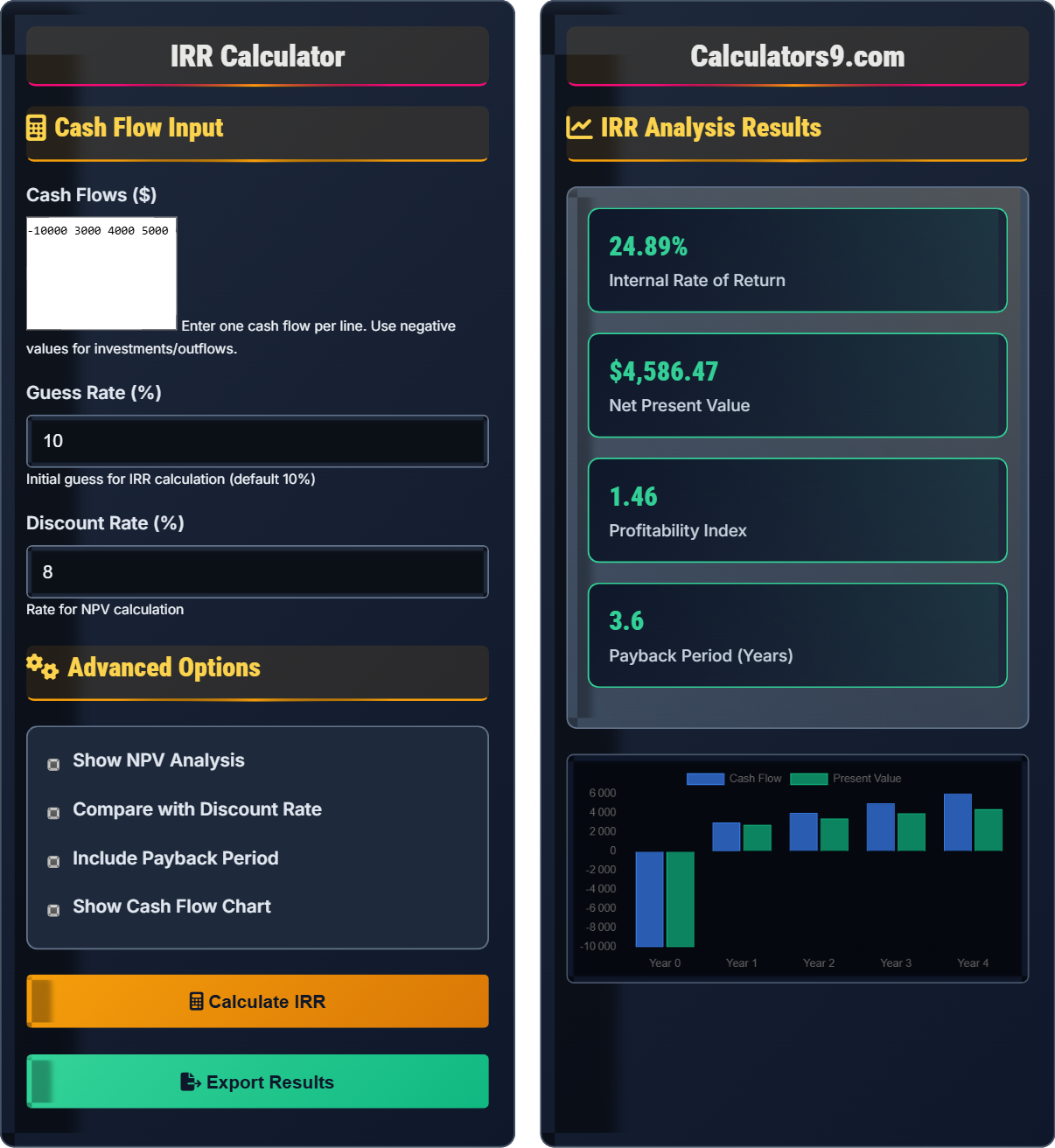
Example: For an investment of $10,000 followed by returns of $3,000, $4,000, $5,000, and $6,000 over 4 years:
\( 0 = -10,000 + \frac{3,000}{(1+IRR)^1} + \frac{4,000}{(1+IRR)^2} + \frac{5,000}{(1+IRR)^3} + \frac{6,000}{(1+IRR)^4} \)
The IRR is approximately 18.8%.
Cash Flow Input
Advanced Options
IRR Analysis Results
| Period | Cash Flow | Present Value | Cumulative |
|---|
| Metric | Value | Interpretation |
|---|
Comprehensive IRR Guide
The Internal Rate of Return (IRR) is a financial metric used to estimate the profitability of potential investments. IRR is the discount rate that makes the net present value (NPV) of all cash flows equal to zero in a discounted cash flow analysis. It represents the annualized effective compound return rate of an investment.
The IRR calculation requires solving this equation iteratively:
Where:
- \(CF_t\) = Cash flow at time t
- \(IRR\) = Internal Rate of Return
- \(n\) = Number of periods
Key advantages of IRR analysis include:
- Time Value of Money: Accounts for timing of cash flows
- Standardized Metric: Comparable across different investments
- Intuitive Result: Expressed as percentage return
- Break-Even Point: Shows required return for zero NPV
- Decision Tool: Clear accept/reject criteria
- Use with NPV: IRR alone may not capture scale of investment
- Check for Conventions: Ensure cash flow signs are correct
- Multiple IRRs: Watch for unconventional cash flow patterns
- Reinvestment Assumption: IRR assumes reinvestment at IRR rate
- Scale Considerations: Larger projects may have lower IRR but higher NPV
IRR Fundamentals
Discount rate that makes NPV of cash flows equal to zero.
\(0 = \sum_{t=0}^{n} \frac{CF_t}{(1+IRR)^t}\)
Where CFt=cash flow at time t, IRR=internal rate of return, n=periods.
- Accept project if IRR > required rate of return
- IRR assumes reinvestment at IRR rate
- Multiple IRRs possible with unconventional cash flows
Strategies
Using IRR for capital budgeting decisions.
- Identify all cash flows with correct signs
- Calculate IRR using iterative methods
- Compare IRR to required rate of return
- Validate with NPV analysis
- IRR may not work for mutually exclusive projects
- Reinvestment rate assumption can be unrealistic
- Timing of cash flows affects IRR significantly
- Consider both IRR and NPV for decisions
IRR Analysis Learning Quiz
What does the Internal Rate of Return (IRR) represent?
The answer is A) The discount rate that makes NPV equal to zero. The IRR is defined as the rate that satisfies the equation: \(0 = \sum_{t=0}^{n} \frac{CF_t}{(1+IRR)^t}\). This means when the discount rate equals the IRR, the present value of inflows equals the present value of outflows.
This question addresses the fundamental definition of IRR. The IRR is not a simple average or sum of cash flows, but rather the specific discount rate that results in a net present value of zero. This makes it a useful tool for comparing investments with different cash flow patterns and time horizons.
Internal Rate of Return (IRR): Discount rate that makes NPV equal to zero
Net Present Value (NPV): Sum of present values of all cash flows
Discount Rate: Rate used to calculate present value of future cash flows
• IRR is the rate where NPV = 0
• IRR incorporates time value of money
• IRR is expressed as a percentage
• IRR = rate that makes NPV equal zero
• Higher IRR generally indicates better investment
• Compare IRR to required rate of return
• Confusing IRR with simple rate of return
• Thinking IRR is just an average of returns
• Not understanding the NPV relationship
If an investment has an IRR of 15% and the required rate of return is 12%, what should be the decision?
The investment should be accepted because the IRR (15%) is greater than the required rate of return (12%). When IRR > required rate, the project creates value for shareholders. The NPV at the required rate of 12% would be positive, indicating the investment is worthwhile.
This question demonstrates the basic decision rule for IRR: accept projects where IRR exceeds the required rate of return. The required rate of return (also called the hurdle rate or discount rate) represents the minimum acceptable return given the risk level of the investment. When IRR > required rate, the project generates excess returns above the minimum threshold.
Required Rate of Return: Minimum acceptable return given investment risk
Hurdle Rate: Minimum rate required for project acceptance
Decision Rule: Accept if IRR > required rate of return
• Accept if IRR > required rate of return
• Reject if IRR < required rate of return
• Indifferent if IRR = required rate of return
• IRR > required rate = ACCEPT
• IRR < required rate = REJECT
• Higher IRR = more attractive investment
• Accepting projects with IRR below required rate
• Not comparing IRR to appropriate benchmark
• Ignoring the required rate of return
Company ABC is considering two projects: Project X has an IRR of 18% and NPV of $25,000, while Project Y has an IRR of 22% and NPV of $18,000. If the required rate of return is 15%, which project should be chosen and why? What potential issue might arise from using only IRR for this decision?
Both projects have IRRs above the required rate (15%), so both are acceptable. Project Y has a higher IRR (22% vs 18%), but Project X has a higher NPV ($25,000 vs $18,000). If projects are mutually exclusive, Project X should be chosen because it creates more absolute value for shareholders.
The potential issue is that IRR doesn't consider the scale of investment. Project Y might require significantly less initial investment to achieve the higher IRR, but Project X creates more total value.
This example highlights the potential conflict between IRR and NPV rankings. While IRR is useful for ranking projects of similar scale, NPV is superior for determining which project creates the most value. The IRR focuses on percentage returns, while NPV focuses on absolute dollar value created.
Mutually Exclusive Projects: Projects where accepting one precludes accepting others
Scale Differences: Projects requiring different initial investments
Value Creation: Absolute dollar increase in shareholder wealth
• Use NPV for value maximization decisions
• IRR good for ranking similar-sized projects
• Consider both metrics together
• NPV is theoretically superior for value creation
• IRR is intuitive but can be misleading for scale differences
• Use both metrics for comprehensive analysis
• Relying solely on IRR for mutually exclusive projects
• Not considering NPV when IRR conflicts occur
• Ignoring scale differences between projects
An investment requires an initial outlay of $100,000, generates $150,000 in year 1, but requires an additional $60,000 in year 2 for cleanup costs. Calculate the NPV at discount rates of 10% and 50%, then explain why this pattern of cash flows might have multiple IRRs. (Hint: Consider the pattern of cash flow signs)
NPV at 10%: -$100,000 + $150,000/(1.10) - $60,000/(1.10)² = -$100,000 + $136,364 - $49,587 = -$13,223
NPV at 50%: -$100,000 + $150,000/(1.50) - $60,000/(1.50)² = -$100,000 + $100,000 - $26,667 = -$26,667
This investment has unconventional cash flows: negative → positive → negative. This pattern can create multiple IRRs because the NPV function crosses zero multiple times. When cash flows change sign more than once, multiple discount rates can satisfy the IRR equation.
This question addresses a limitation of IRR: unconventional cash flows can result in multiple IRRs. When cash flows change sign more than once (outflow → inflow → outflow), the NPV profile can cross zero multiple times, creating multiple solutions to the IRR equation. In such cases, NPV is a more reliable decision criterion.
Unconventional Cash Flows: Cash flows that change sign more than once
Multiple IRRs: More than one discount rate makes NPV equal zero
Sign Changes: Switching between positive and negative cash flows
• Multiple sign changes can create multiple IRRs
• Conventional cash flows have one IRR
• Use NPV when multiple IRRs exist
• Count sign changes to anticipate multiple IRRs
• Use NPV for unconventional cash flows
• Plot NPV profile to visualize multiple IRRs
• Assuming there's always one IRR
• Not recognizing unconventional cash flow patterns
• Using IRR when multiple rates exist
Which statement about IRR and NPV is TRUE?
The answer is B) NPV is theoretically superior to IRR for value maximization. NPV directly measures the dollar value added to shareholders, while IRR is a percentage return. NPV accounts for the scale of investment and is not subject to the multiple IRR problem or reinvestment rate assumptions that can bias IRR.
While IRR is popular because it's expressed as a percentage return that's easy to understand, NPV is considered theoretically superior for decision-making. NPV directly measures value creation in dollar terms, whereas IRR can lead to incorrect decisions in certain circumstances, such as mutually exclusive projects with different scales or timing of cash flows.
NPV Superiority: NPV is preferred for value maximization decisions
Value Maximization: Goal of maximizing shareholder wealth
Reinvestment Assumption: IRR assumes reinvestment at IRR rate
• NPV directly measures value added to shareholders
• IRR assumes reinvestment at IRR rate (potentially unrealistic)
• NPV handles scale differences better than IRR
• Use NPV for value maximization decisions
• IRR is good for communicating returns
• Always calculate both when possible
• Assuming IRR and NPV always agree
• Preferring IRR over NPV in all situations
• Not understanding the theoretical basis for NPV superiority
FAQ
Q: What does IRR tell me about an investment?
A: IRR tells you the annualized effective compound return rate of an investment. It's the discount rate that makes the net present value of all cash flows equal to zero: \(0 = \sum_{t=0}^{n} \frac{CF_t}{(1+IRR)^t}\).
For example, if an investment has an IRR of 15%, it means the investment generates a 15% annual return considering all cash inflows and outflows. If the IRR exceeds your required rate of return, the investment is considered acceptable.
Q: When should I use IRR versus NPV for investment decisions?
A: Use NPV for value maximization decisions because it directly measures dollar value added: \(NPV = \sum_{t=0}^{n} \frac{C_t}{(1+r)^t} - C_0\). NPV is theoretically superior.
Use IRR for communicating returns because it's intuitive (expressed as percentage). However, use NPV when comparing mutually exclusive projects or when cash flows are unconventional. For example, if Project A has NPV of $100,000 and IRR of 12%, and Project B has NPV of $80,000 and IRR of 15%, choose Project A for value maximization.