ROI Calculator
Investment returns • Performance analysis
ROI Formula:
Show the calculatorBasic ROI: \( ROI = \frac{\text{Net Profit}}{\text{Investment Cost}} \times 100 \)
Annualized ROI: \( AROI = \left(\frac{\text{Final Value}}{\text{Initial Investment}}\right)^{\frac{1}{n}} - 1 \)
Simple ROI: \( ROI = \frac{\text{Gain from Investment} - \text{Cost of Investment}}{\text{Cost of Investment}} \times 100 \)
Where:
- \( ROI \) = Return on Investment (%)
- \( AROI \) = Annualized Return on Investment
- \( \text{Net Profit} \) = Gain - Investment Cost
- \( n \) = Number of years
ROI measures the efficiency of an investment by comparing the gain to the investment cost. The annualized version accounts for the time factor, making it easier to compare investments with different time horizons.
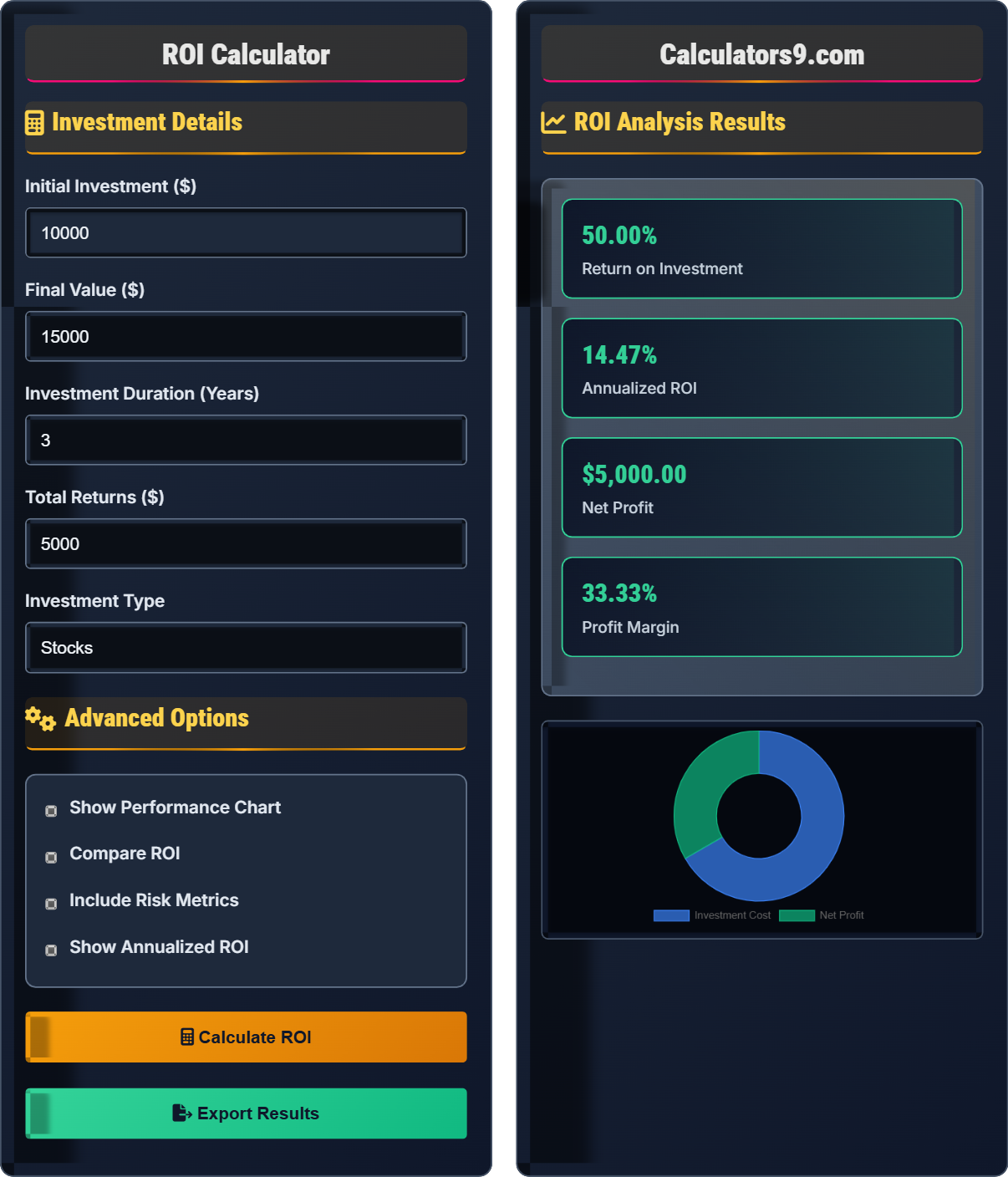
Example: For an investment of $10,000 that generates $15,000 in returns:
ROI = ($15,000 - $10,000) / $10,000 × 100 = 50%
For a 3-year investment period, the annualized ROI would be:
AROI = ($15,000/$10,000)^(1/3) - 1 = 14.47%
Investment Details
Advanced Options
ROI Analysis Results
| Metric | Value | Description |
|---|
| Component | Amount | Percentage |
|---|
Comprehensive ROI Guide
Return on Investment (ROI) is a performance measure used to evaluate the efficiency or profitability of an investment. It compares the net profit to the investment cost, expressed as a percentage. ROI is a simple yet powerful metric that helps investors compare the profitability of different investments.
The standard ROI calculation uses these formulas:
Where:
- \(ROI\) = Return on Investment
- \(AROI\) = Annualized Return on Investment
- \(n\) = Number of years
Key advantages of ROI analysis include:
- Simplicity: Easy to calculate and understand
- Standardization: Universal metric for comparison
- Efficiency: Measures investment effectiveness
- Decision-Making: Helps prioritize investments
- Performance Tracking: Monitor investment progress
- Include All Costs: Account for fees, taxes, and transaction costs
- Use Annualized ROI: For comparing investments with different durations
- Consider Risk: Higher ROI may indicate higher risk
- Factor in Timing: When returns were generated matters
- Compare Against Benchmarks: Evaluate relative to market returns
ROI Fundamentals
Percentage measure of investment profitability and efficiency.
\(ROI = \frac{\text{Net Profit}}{\text{Investment Cost}} \times 100\)
Where Net Profit = Final Value - Initial Investment.
- ROI > 0% indicates profitable investment
- Higher ROI generally indicates better investment
- Annualized ROI enables time-period comparison
Strategies
Using ROI for investment decision-making and comparison.
- Identify all investment costs
- Calculate net returns accurately
- Compute basic and annualized ROI
- Compare with alternative investments
- ROI doesn't account for investment risk
- Timing of returns affects ROI significance
- Taxes and fees impact net returns
- Market conditions influence ROI
ROI Analysis Learning Quiz
What is the ROI for an investment of $5,000 that generates $7,500 in returns?
The answer is B) 50%. Using the formula: \(ROI = \frac{\text{Net Profit}}{\text{Investment Cost}} \times 100\)
Net Profit = $7,500 - $5,000 = $2,500
ROI = ($2,500 / $5,000) × 100 = 50%
This question tests the basic understanding of ROI calculation. The key is to identify the net profit (gain minus investment) and divide by the investment cost. This is the most fundamental calculation in investment analysis and forms the basis for all other return metrics.
Return on Investment (ROI): Percentage measure of investment profitability
Net Profit: Total returns minus investment costs
Investment Cost: Initial amount invested
• ROI = (Net Profit / Investment Cost) × 100
• Net Profit = Total Returns - Investment Cost
• ROI > 0% indicates profitable investment
• Always subtract investment cost from returns
• Divide by original investment amount
• Multiply by 100 to get percentage
• Forgetting to subtract investment cost from returns
• Dividing by returns instead of investment cost
• Not converting to percentage format
Calculate the annualized ROI for an investment of $8,000 that grows to $12,000 over 4 years. Show your work.
Using the annualized ROI formula: \(AROI = \left(\frac{\text{Final Value}}{\text{Initial Investment}}\right)^{\frac{1}{n}} - 1\)
Given:
- Initial Investment = $8,000
- Final Value = $12,000
- n = 4 years
Step 1: Calculate ratio = $12,000 / $8,000 = 1.5
Step 2: Calculate 4th root = (1.5)^(1/4) = 1.1067
Step 3: Calculate AROI = 1.1067 - 1 = 0.1067 = 10.67%
Therefore, the annualized ROI is 10.67%.
This calculation demonstrates how to annualize returns for comparison across different time periods. The annualized ROI accounts for the compounding effect over time, making it easier to compare investments with different durations. This is particularly useful when comparing a 2-year investment to a 5-year investment.
Annualized ROI: ROI normalized to a one-year period
Compounding Effect: Growth of investment returns over timeTime-Period Normalization: Adjusting returns for different durations
• Use annualized ROI for time-period comparisons
• Annualized ROI accounts for compounding
• Formula: (Final/Initial)^(1/n) - 1
• Annualized ROI allows fair comparisons
• Use for investments with different durations
• Accounts for compound growth effects
• Not annualizing returns for comparison
• Forgetting to subtract 1 from the final result
• Using simple division instead of exponentiation
Investment A has a 40% ROI over 2 years, while Investment B has a 60% ROI over 4 years. Which investment performed better on an annualized basis? Calculate both annualized ROIs and explain your answer.
For Investment A (40% ROI over 2 years):
Final Value = Initial Investment × (1 + 0.40) = 1.40 × Initial Investment
AROI = (1.40)^(1/2) - 1 = 1.1832 - 1 = 18.32%
For Investment B (60% ROI over 4 years):
Final Value = Initial Investment × (1 + 0.60) = 1.60 × Initial Investment
AROI = (1.60)^(1/4) - 1 = 1.1247 - 1 = 12.47%
Investment A performed better with an annualized ROI of 18.32% vs 12.47% for Investment B.
This example demonstrates why annualized ROI is important for investment comparison. Although Investment B has a higher total return, Investment A actually performed better on a per-year basis. This is because Investment A achieved 40% return in half the time, making it more efficient.
Investment Efficiency: How quickly returns are generated
Time-Adjusted Returns: Returns normalized for time period
Performance Comparison: Evaluating investments on equal basis
• Annualized ROI enables fair comparisons
• Higher total ROI doesn't mean better annual performance
• Time factor is crucial in investment evaluation
• Always annualize ROI for duration comparisons
• Consider both total and annualized returns
• Time-adjusted metrics provide better insights
• Comparing total returns without considering time
• Assuming higher total ROI means better investment
• Not annualizing returns for comparison
Two investments have the same 15% annualized ROI, but Investment X has low volatility while Investment Y has high volatility. How should this affect your investment decision? What additional metrics might you consider? (Hint: Think about risk-adjusted returns)
Although both investments have the same annualized ROI, Investment X is preferable because it achieves the same return with lower risk. Additional metrics to consider include:
1. Sharpe Ratio: Return per unit of risk (volatility)
2. Standard Deviation: Measure of return volatility
3. Maximum Drawdown: Largest peak-to-trough decline
4. Sortino Ratio: Return per unit of downside risk
The Sharpe ratio would be higher for Investment X, indicating better risk-adjusted returns.
This question addresses an important limitation of ROI: it doesn't account for risk. Two investments with the same ROI can have vastly different risk profiles. Risk-adjusted returns provide a more complete picture of investment performance, helping investors make better decisions based on their risk tolerance.
Risk-Adjusted Returns: Returns adjusted for investment risk
Volatility: Degree of variation in investment returns
Sharpe Ratio: Excess return per unit of risk
• ROI doesn't account for investment risk
• Same ROI can have different risk profiles
• Consider risk-adjusted metrics for complete analysis
• Always consider risk alongside returns
• Use Sharpe ratio for risk-adjusted comparison
• Lower volatility is generally preferred
• Focusing only on ROI without considering risk
• Assuming equal ROIs mean equal investments
• Not evaluating risk-adjusted returns
Which of the following is NOT a limitation of ROI?
The answer is C) Difficult to calculate. ROI is actually quite simple to calculate using the formula: ROI = (Net Profit / Investment Cost) × 100. This simplicity is one of its strengths, making it accessible and widely understood. The other options are genuine limitations of ROI.
This question addresses both the strengths and limitations of ROI. While ROI has several limitations (doesn't account for risk, time value of money, or opportunity cost), its calculation is straightforward, which is why it's so widely used. Understanding both the strengths and weaknesses of ROI is important for proper investment analysis.
ROI Strengths: Simplicity and widespread understanding
ROI Limitations: Missing risk, time value, and opportunity cost
Investment Analysis: Comprehensive evaluation of investments
• ROI is simple to calculate and understand
• ROI has several important limitations
• Use ROI alongside other metrics for complete analysis
• Use ROI as starting point for analysis
• Combine with risk-adjusted metrics
• Consider time value of money separately
• Assuming ROI is difficult to calculate
• Using ROI as sole investment metric
• Not considering its limitations
FAQ
Q: What's the difference between ROI and annualized ROI?
A: ROI measures total return: \( ROI = \frac{\text{Net Profit}}{\text{Investment Cost}} \times 100 \). Annualized ROI accounts for time: \( AROI = \left(\frac{\text{Final Value}}{\text{Initial Investment}}\right)^{\frac{1}{n}} - 1 \).
For example, an investment of $10,000 growing to $15,000 over 3 years:
- Basic ROI: ($5,000/$10,000) × 100 = 50%
- Annualized ROI: ($15,000/$10,000)^(1/3) - 1 = 14.47%
Annualized ROI enables comparison of investments with different time horizons.
Q: How should I interpret ROI values?
A: ROI interpretation depends on context and benchmarks. Positive ROI (>0%) indicates profit, while negative ROI (<0%) indicates loss.
General benchmarks:
- Stock market: ~7-10% annually
- Bonds: ~2-5% annually
- Real Estate: ~6-8% annually
For example, a 15% ROI might be excellent for bonds but average for stocks. Always compare ROI to relevant benchmarks and consider risk-adjusted returns.