REIT Return Calculator
Fast REIT return calculator • 2026 metrics
REIT Return Formula:
Show the calculator\( Total\ Return = \frac{(Final\ Value - Initial\ Value) + Dividends}{Initial\ Value} \times 100 \)
Where:
- \( Total\ Return \) = Overall percentage return
- \( Final\ Value \) = Ending value of investment
- \( Initial\ Value \) = Starting value of investment
- \( Dividends \) = Total dividends received during holding period
Alternative formulas:
\( Dividend\ Yield = \frac{Annual\ Dividends\ per\ Share}{Share\ Price} \times 100 \)
\( NAV\ Return = \frac{Change\ in\ NAV}{Initial\ NAV} \times 100 \)
This formula calculates the total return from REIT investments including both price appreciation and dividend income.
Example: Investing $10,000 in a REIT, receiving $400 in dividends, and selling for $11,000:
\( Total\ Return = \frac{(11,000 - 10,000) + 400}{10,000} \times 100 = 14\% \)
So the total return is 14% over the investment period.
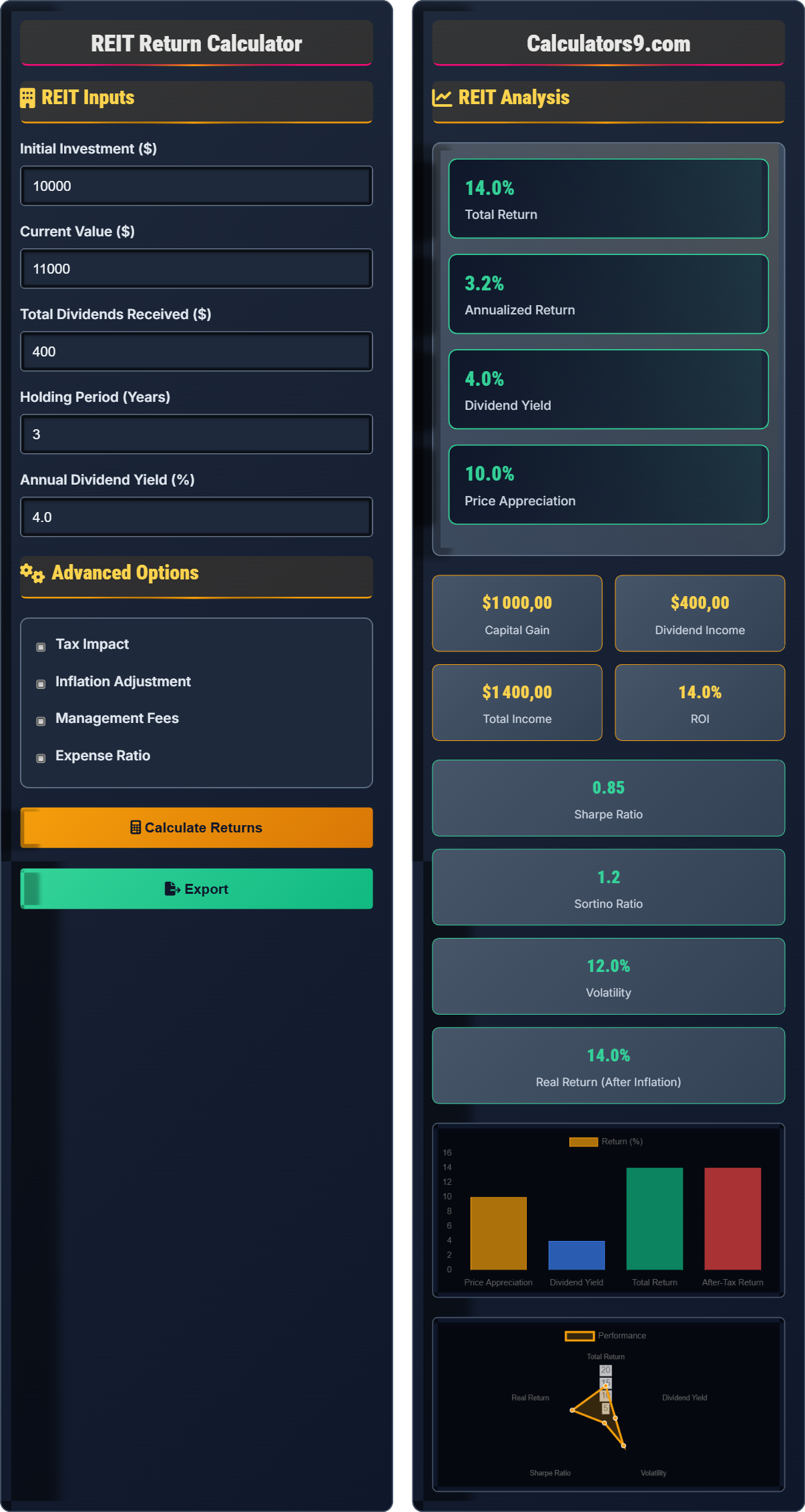
REIT Inputs
Advanced Options
REIT Analysis
Comprehensive REIT Guide
A Real Estate Investment Trust (REIT) is a company that owns, operates, or finances income-producing real estate. REITs allow individual investors to buy shares of commercial real estate portfolios, similar to mutual funds. They must distribute at least 90% of taxable income to shareholders annually in the form of dividends, making them attractive for income-focused investors.
The fundamental REIT return calculation uses the following formula:
Where:
- \(Total\ Return\) = Overall percentage return
- \(Final\ Value\) = Ending value of investment
- \(Initial\ Value\) = Starting value of investment
- \(Dividends\) = Total dividends received
Key metrics for evaluating REIT investments:
- FFO (Funds From Operations): Net income adjusted for depreciation and gains/losses on sales
- Dividend Yield: Annual dividends per share divided by share price
- Price-to-FFO Ratio: Valuation metric comparing share price to FFO per share
- Debt-to-Equity Ratio: Financial leverage indicator
- Occupancy Rate: Percentage of occupied space in portfolio
- Diversification: Spread investments across different REIT sectors and geographies
- Dividend Focus: Prioritize REITs with consistent dividend payments
- Growth Potential: Invest in REITs with strong property development pipelines
- Market Timing: Consider interest rate cycles affecting REIT valuations
- Tax Efficiency: Understand tax implications of REIT distributions
REIT Basics
Real Estate Investment Trust - company owning income-producing real estate.
\(Total\ Return = \frac{(Final\ Value - Initial\ Value) + Dividends}{Initial\ Value} \times 100\)
Where Return=percentage return, Value=investment value, Dividends=income.
- Must distribute 90% of income
- High dividend yields typical
- Interest rate sensitive
Strategies
Focus on quality management and property fundamentals.
- Research property fundamentals
- Analyze financial metrics
- Consider sector diversification
- Monitor interest rate impact
- Interest rate sensitivity
- Market volatility
- Tax implications
- Liquidity factors
REIT Learning Quiz
What percentage of taxable income must REITs distribute to shareholders annually?
The answer is C) 90%. By law, REITs must distribute at least 90% of their taxable income to shareholders annually in the form of dividends. This requirement allows REITs to avoid corporate income tax at the entity level, making them tax-efficient vehicles for real estate investment.
This distribution requirement is the cornerstone of REIT structure and taxation. It distinguishes REITs from other investment vehicles and explains their high dividend yields. The 90% rule ensures that REITs pass through most of their income to investors, who then pay taxes at their individual tax rates. This creates a more tax-efficient structure compared to corporations that pay double taxation.
REIT: Real Estate Investment Trust - company owning income-producing real estate
Distribution Requirement: Legal mandate for REITs to pay out income
Taxable Income: Income subject to tax before distributions
• REITs must distribute 90% of taxable income
• This avoids corporate income tax
• Creates high dividend yields
• Remember: 90% distribution requirement
• This creates the high dividend appeal
• Tax is paid at shareholder level
• Confusing 90% requirement with payout ratio
• Thinking REITs are taxed at entity level
• Ignoring tax implications for investors
If you invest $10,000 in a REIT, receive $300 in dividends, and sell for $10,500 after one year, what is your total return?
Using the REIT return formula: \(Total\ Return = \frac{(Final\ Value - Initial\ Value) + Dividends}{Initial\ Value} \times 100\)
Given:
- Initial Value = $10,000
- Final Value = $10,500
- Dividends = $300
Step 1: Calculate capital gain = $10,500 - $10,000 = $500
Step 2: Add dividends = $500 + $300 = $800
Step 3: Calculate return = ($800 ÷ $10,000) × 100 = 8%
Therefore, the total return is 8% over the one-year period.
This calculation shows how REIT returns combine both capital appreciation and dividend income. The total return represents the complete picture of investment performance. Unlike stocks that may not pay dividends, REITs provide both growth potential and income, making the total return calculation particularly important for investors seeking both components.
Total Return: Combined measure of capital gains and income
Capital Appreciation: Increase in investment value
Dividend Income: Cash distributions from earnings
• Total return includes both appreciation and dividends
• Capital gains and income both contribute
• Calculate as percentage of initial investment
• Always include both components in return calculation
• REITs typically offer both growth and income
• Compare total return across different investments
• Forgetting to include dividend income
• Only focusing on price appreciation
• Not calculating as percentage of initial investment
REIT A had a dividend yield of 4.5% and appreciated 3% last year. REIT B had a dividend yield of 3.2% and appreciated 7% last year. Which REIT provided better total return? If you invested $50,000 in each, how much more would you have earned from the better-performing REIT?
Step 1: Calculate total return for REIT A = Dividend yield + Price appreciation = 4.5% + 3% = 7.5%
Step 2: Calculate total return for REIT B = Dividend yield + Price appreciation = 3.2% + 7% = 10.2%
Step 3: REIT B provided better total return (10.2% vs 7.5%)
Step 4: Earnings from REIT A = $50,000 × 7.5% = $3,750
Step 5: Earnings from REIT B = $50,000 × 10.2% = $5,100
Step 6: Difference = $5,100 - $3,750 = $1,350
Therefore, REIT B provided better return, earning $1,350 more than REIT A on $50,000 investment.
This example demonstrates that high dividend yield alone doesn't guarantee better total return. REIT B had a lower dividend yield but higher appreciation, resulting in superior total return. This highlights the importance of looking at both components of return rather than focusing on just one metric. Investors should consider their preference for income vs. growth.
Dividend Yield: Annual dividends as percentage of share price
Price Appreciation: Increase in share value
Total Return: Combined measure of all returns
• Total return = Dividend yield + Price appreciation
• Don't focus on just one component
• Compare total returns across investments
• Always calculate total return for comparisons
• Consider income vs. growth preferences
• Look at historical performance patterns
• Comparing only dividend yields
• Ignoring price appreciation
• Not considering tax implications
A REIT has an annual dividend yield of 5.5% but experiences high volatility with returns ranging from -15% to +25% annually. Another REIT offers 3.5% yield with more stable returns ranging from -3% to +8%. Calculate the coefficient of variation for each REIT (standard deviation ÷ mean return) and determine which represents better risk-adjusted returns. Assume standard deviations of 12% and 4% respectively.
REIT A Analysis:
Expected return = 5.5% (dividend yield) + 0% (assuming no appreciation for simplicity) = 5.5%
Standard deviation = 12%
Coefficient of variation = Standard deviation ÷ Mean return = 12% ÷ 5.5% = 2.18
REIT B Analysis:
Expected return = 3.5% (dividend yield) = 3.5%
Standard deviation = 4%
Coefficient of variation = 4% ÷ 3.5% = 1.14
Lower coefficient of variation indicates better risk-adjusted returns. REIT B (1.14) has better risk-adjusted returns than REIT A (2.18), despite lower yield.
The coefficient of variation measures risk per unit of return, helping investors understand the risk-return tradeoff. A lower coefficient indicates more return per unit of risk. This is crucial for REIT selection because real estate investments can have varying levels of volatility. Higher yielding REITs often come with higher risk, and this metric helps quantify that relationship.
Coefficient of Variation: Risk measure (std dev ÷ mean return)
Risk-Adjusted Return: Return adjusted for risk taken
Volatility: Degree of variation in returns
• Lower coefficient of variation = better risk-adjusted returns
• High yield often correlates with higher risk
• Consider both return and risk measures
• Use coefficient of variation for risk-adjusted comparisons
• Look beyond just dividend yield
• Consider your risk tolerance
• Focusing only on dividend yield without considering risk
• Not evaluating volatility in REIT investments
• Ignoring correlation between yield and risk
Which factor would most likely cause REITs to underperform during rising interest rate environments?
The answer is B) Higher borrowing costs. REITs typically carry significant debt to finance property acquisitions. When interest rates rise, their borrowing costs increase, reducing profitability. Additionally, higher rates make bonds more attractive relative to REITs, causing investors to shift capital away from REITs, depressing their share prices.
REITs are interest-sensitive investments due to their high debt levels and the comparison with bond yields. When rates rise, REITs face higher financing costs and compete with higher-yielding bonds for investor capital. This dual effect makes REITs particularly vulnerable during rising rate environments, which is why investors monitor Federal Reserve policy closely when investing in REITs.
Leverage: Use of debt to finance investments
Interest Rate Sensitivity: How investments respond to rate changesRelative Value: Comparison to alternative investments
• REITs are highly leveraged
• Rising rates hurt REIT performance
• Bond comparison affects demand
• Monitor Fed policy for REIT investments
• Consider rate environment when investing
• Look for REITs with manageable debt levels
• Not considering interest rate impact
• Ignoring debt levels in REITs
• Treating REITs as bond alternatives
FAQ
Q: How are REIT dividends taxed?
A: REIT dividends are typically taxed as ordinary income up to 20% deduction:
- Ordinary Income: Up to 80% of REIT dividends are taxed as ordinary income
- Qualified Dividend: Up to 20% may qualify for lower dividend tax rates
- Return of Capital: Some distributions may be tax-free but reduce cost basis
Unlike qualified dividends from stocks (taxed at 0-20%), REIT dividends are generally taxed at ordinary income rates (10-37%). However, taxpayers may deduct up to 20% of qualified REIT dividends under the Section 199A deduction, effectively reducing the tax rate.
Q: Are REITs suitable for retirement portfolios?
A: REITs can be suitable for retirement portfolios for several reasons:
- Income Generation: Consistent dividend payments for regular income
- Diversification: Exposure to real estate without direct ownership
- Inflation Hedge: Property values and rents often rise with inflation
However, consider:
- Volatility: REITs can be volatile, especially during rate changes
- Taxation: Dividends are taxed as ordinary income
- Allocation: Typically 5-15% of portfolio depending on risk tolerance
Best used as part of a diversified retirement strategy rather than as a standalone investment.