Systematic Investment Plan Calculator
Mutual fund returns • Investment growth tracker • Wealth building tool
SIP Formula:
Show the calculator\( FV = P \times \frac{(1 + r)^n - 1}{r} \)
Where:
- \( FV \) = Future Value
- \( P \) = Periodic investment amount
- \( r \) = Periodic interest rate
- \( n \) = Number of periods
This formula calculates the future value of regular investments with compound interest.
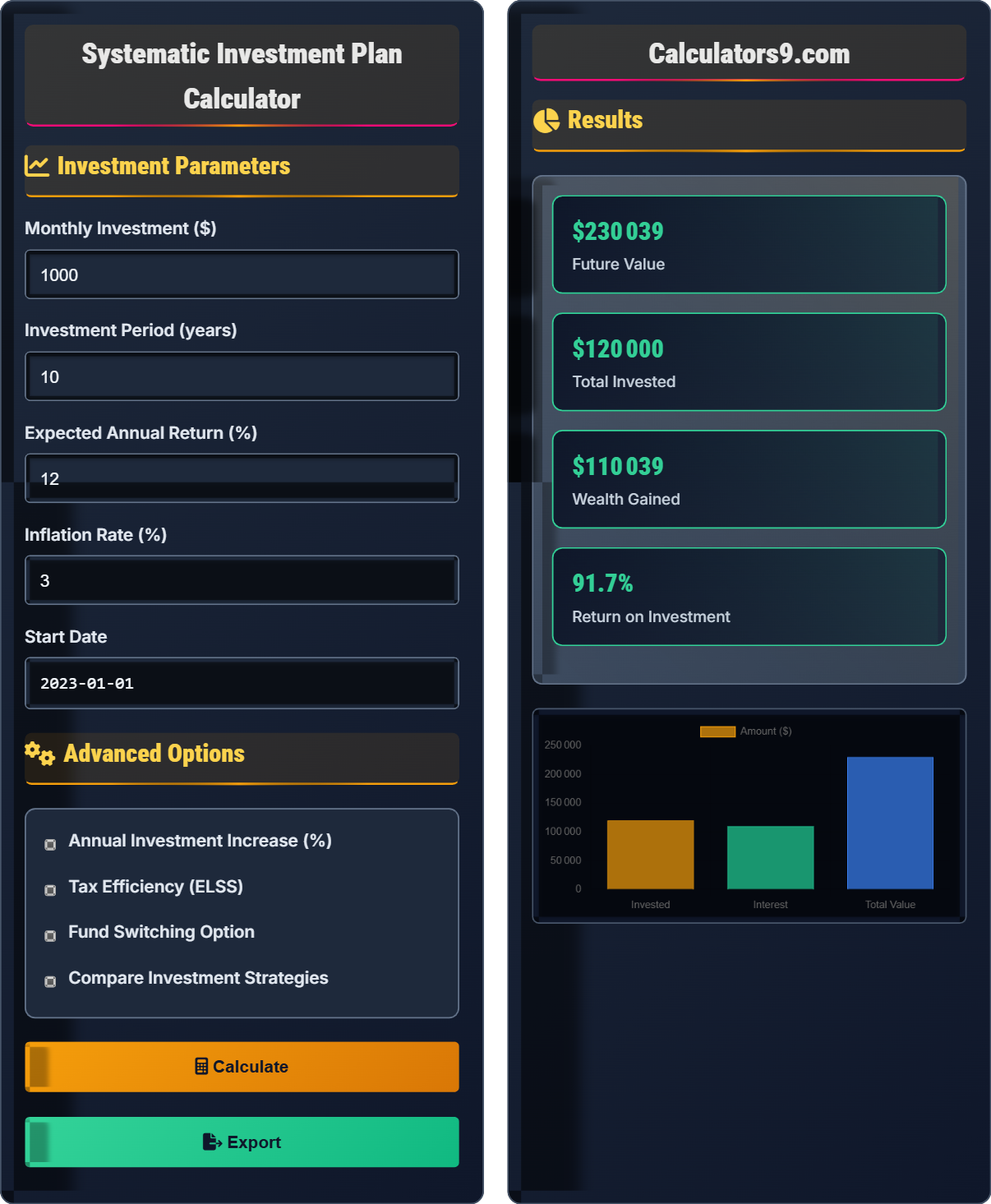
Example: Investing $500 monthly for 10 years at 12% annual return: FV = $500 × ((1.01^120 - 1)/0.01) = $116,300
For inflation-adjusted returns: \( Real\ FV = \frac{FV}{(1 + i)^n} \) where i is inflation rate.
Investment Parameters
Advanced Options
Results
| Component | Amount | % of Total |
|---|
| Year | Invested | Interest | Balance |
|---|
| Scenario | Future Value | Wealth Gained |
|---|
Comprehensive SIP Investment Guide
Systematic Investment Plans (SIPs) allow investors to make regular investments in mutual funds, promoting disciplined investing and rupee-cost averaging. This strategy helps mitigate market volatility by spreading investments over time, potentially lowering the average purchase cost during market fluctuations. SIPs are ideal for long-term wealth creation with relatively small monthly contributions.
The standard SIP calculation uses the future value of annuity formula:
Where:
- \(FV\) = Future Value
- \(P\) = Periodic investment amount
- \(r\) = Periodic interest rate
- \(n\) = Number of periods
Various SIP strategies can optimize returns:
- Regular SIP: Fixed amount invested at regular intervals
- Step-up SIP: Increasing investment amount annually
- Flexible SIP: Variable investment amounts based on market conditions
- Multi-fund SIP: Diversified investments across different fund types
- Start Early: Leverage compounding over longer periods
- Stay Consistent: Continue investments during market downturns
- Diversify: Spread investments across asset classes
- Review Periodically: Adjust investments based on changing goals
- Consider ELSS: Tax-saving funds with 3-year lock-in
SIP Investment Learning Quiz
How does rupee cost averaging benefit SIP investors?
The answer is B) Reduces average cost per unit over time. Rupee cost averaging works by purchasing more units when prices are low and fewer units when prices are high, resulting in a lower average cost per unit over time. This strategy helps smooth out market volatility.
This question tests understanding of the core benefit of rupee cost averaging. When markets fluctuate, SIP investors buy more shares at lower prices and fewer at higher prices, which results in a lower average cost per share over time. This doesn't guarantee profits but helps reduce the impact of market timing.
Rupee cost averaging: Strategy of investing fixed amounts regularly regardless of market conditions
Average cost: Total investment divided by total units purchased
Market volatility: Degree of price fluctuations over time
• Fixed investment buys more units when prices are low
• Fixed investment buys fewer units when prices are high
• Averaging occurs over time, not instantly
• Stay consistent with investment schedule
• Don't try to time the market
• Focus on long-term goals over short-term fluctuations
• Expecting immediate benefits from averaging
• Stopping SIP during market downturns
• Confusing averaging with guaranteed returns
If you invest $1,000 monthly in a SIP for 15 years at an annual return of 10%, what would be the approximate future value? Show your calculation.
Using the SIP formula: \(FV = P \times \frac{(1 + r)^n - 1}{r}\)
Where:
- P = $1,000 (monthly investment)
- r = 10%/12 = 0.00833 (monthly rate)
- n = 15 × 12 = 180 (number of months)
Step 1: Calculate (1 + r)^n = (1.00833)^180 = 4.454
Step 2: Calculate numerator = 4.454 - 1 = 3.454
Step 3: Calculate FV = $1,000 × (3.454 ÷ 0.00833) = $1,000 × 414.6 = $414,600
Therefore, the future value would be approximately $414,600.
This problem demonstrates the power of compound interest over long periods. The calculation shows how monthly investments of $1,000 over 15 years can grow to over $400,000 at a 10% annual return. This illustrates the exponential growth potential of systematic investing with compounding returns.
Compound interest: Interest earned on both principal and accumulated interest
Future value: Value of an investment at a future date
Time value of money: Concept that money today is worth more than in the future
• Convert annual rate to monthly rate
• Convert years to months for n
• Ensure consistent time units
• Remember: 12 months in a year
• Divide annual rate by 12 for monthly rate
• Use financial calculators for complex computations
• Forgetting to convert annual rate to monthly
• Using years instead of months for n
• Arithmetic errors in exponent calculations
Raj starts a SIP of $500 per month at age 25 with an expected return of 12% annually. If he continues until age 60, how much will he have accumulated? If he had started at age 35 instead, how much would he have missed out on?
For investment from age 25 to 60 (35 years):
n = 35 × 12 = 420 months
r = 12%/12 = 1% = 0.01
FV = $500 × ((1.01^420 - 1) ÷ 0.01) = $500 × 8,137.7 = $4,068,850
For investment from age 35 to 60 (25 years):
n = 25 × 12 = 300 months
FV = $500 × ((1.01^300 - 1) ÷ 0.01) = $500 × 1,878.8 = $939,400
Difference = $4,068,850 - $939,400 = $3,129,450
Raj would miss out on approximately $3.13 million by starting 10 years later.
This example demonstrates the dramatic impact of starting age on long-term investment returns. The 10-year difference results in missing over $3 million due to the power of compounding over time. This illustrates why starting early is crucial for retirement planning and long-term wealth creation.
Time horizon: Length of time investments are held
Compounding effect: Exponential growth from earning returns on returns
Opportunity cost: Benefit lost by not starting earlier
• Earlier investments have more time to compound
• Small differences in start time can have large impacts
• Consistency is more important than timing
• Start investing as soon as possible
• Even small amounts benefit from long time horizons
• Use employer matching if available
• Underestimating the impact of time on returns
• Delaying investment start date
• Not considering inflation in long-term planning
Compare the post-tax returns of a regular mutual fund SIP vs. an ELSS (tax-saving) fund SIP. Both offer 12% returns, with a 30% tax rate on gains. The ELSS has a 3-year lock-in. Which performs better after taxes over a 10-year period?
For regular mutual fund:
After 10 years, assuming $100 monthly investment:
FV = $100 × ((1.01^120 - 1) ÷ 0.01) = $23,260
Total invested = $100 × 120 = $12,000
Gains = $23,260 - $12,000 = $11,260
Tax on gains = $11,260 × 30% = $3,378
Post-tax value = $23,260 - $3,378 = $19,882
For ELSS (with tax deduction):
Tax saved annually = $1,200 × 30% = $360
Value of tax savings invested at 8% = $360 × 14.487 (FVIFA) = $5,215
ELSS value after 10 years = $23,260
Total benefit = $23,260 + $5,215 = $28,475
The ELSS provides $8,593 more value due to tax benefits.
This demonstrates how tax-efficient investing can significantly enhance returns. The ELSS provides dual benefits: tax deduction on investment amount and long-term capital gains treatment. Though it has a 3-year lock-in, the tax savings often outweigh this limitation.
Tax-saving instruments: Investments that provide tax deductions
Lock-in period: Time during which investment cannot be withdrawn
Capital gains tax: Tax on profits from investment sales
• ELSS provides 3-year lock-in but 80C tax benefit
• LTCG on equity funds is taxed at 10% above ₹1 lakh
• Consider post-tax returns in investment decisions
• Maximize 80C deductions with ELSS
• Consider your tax bracket in investment choices
• Factor in inflation-adjusted returns
• Ignoring tax implications in return calculations
• Not considering lock-in periods
• Forgetting about indexation benefits
Which factor has the most significant impact on SIP returns over a 20-year period?
The answer is B) Average rate of return. Over a 20-year period, the average rate of return has the most significant impact on SIP returns. While fees and timing matter, the compounding effect of returns over two decades dwarfs the impact of minor differences in timing or fees.
This question highlights the primary driver of long-term investment success. While market timing and expense ratios are important considerations, the average rate of return over a long period is the most significant factor. This emphasizes the importance of selecting quality funds with strong long-term performance potential.
Time horizon: Length of investment period
Compounding effect: Growth acceleration over time
Primary driver: Most influential factor in outcomes
• Returns compound exponentially over time
• Longer time horizons reduce timing impact
• Consistent returns beat volatile returns
• Focus on fund quality over short-term performance
• Consider asset allocation based on age
• Review and rebalance periodically
• Chasing short-term returns
• Ignoring fund quality for low fees
• Not considering risk tolerance
SIP Basics
Regular investment in mutual funds for disciplined wealth creation.
\(FV = P \times \frac{(1 + r)^n - 1}{r}\)
Where FV=future value, P=payment, r=rate, n=periods.
- Invest regularly regardless of market conditions
- Stay invested for long-term wealth creation
- Review fund performance annually
Investment Strategies
Optimizing SIP returns through intelligent investment choices.
- Asset allocation based on age
- Regular portfolio rebalancing
- Tax-loss harvesting
- Step-up investment increases
- Match investments to risk tolerance
- Consider tax implications
- Factor in inflation
- Maintain emergency fund
FAQ
Q: Should I start with a large SIP amount or start small and increase over time?
A: It's generally better to start with an amount you can consistently maintain, even if it's small. The key to SIP success is discipline and continuity. Starting with $100-200 monthly is perfectly acceptable.
Once you've established the habit, consider increasing your investment annually through step-up SIPs. A 10-15% annual increase can significantly boost your final corpus. For example, starting with $200 and increasing by 10% annually would result in $477 monthly investment by year 10.
The compounding effect works better with consistency than with large initial amounts that are hard to sustain.
Q: How does SIP compare to PPF for long-term wealth creation?
A: SIPs and PPF serve different purposes:
SIP Advantages:
- Higher potential returns (8-15% vs PPF's 7-8%)
- Market-linked growth potential
- More flexible withdrawal options
- Better inflation protection
PPF Advantages:
- Guaranteed returns
- Government backing
- Longer tax-free period (15 years)
- Loan facility available
For wealth creation, SIPs typically outperform PPF over 20+ year periods. For risk-averse investors, PPF provides stability. A balanced approach allocates 60-70% to SIPs and 30-40% to PPF for optimal results.