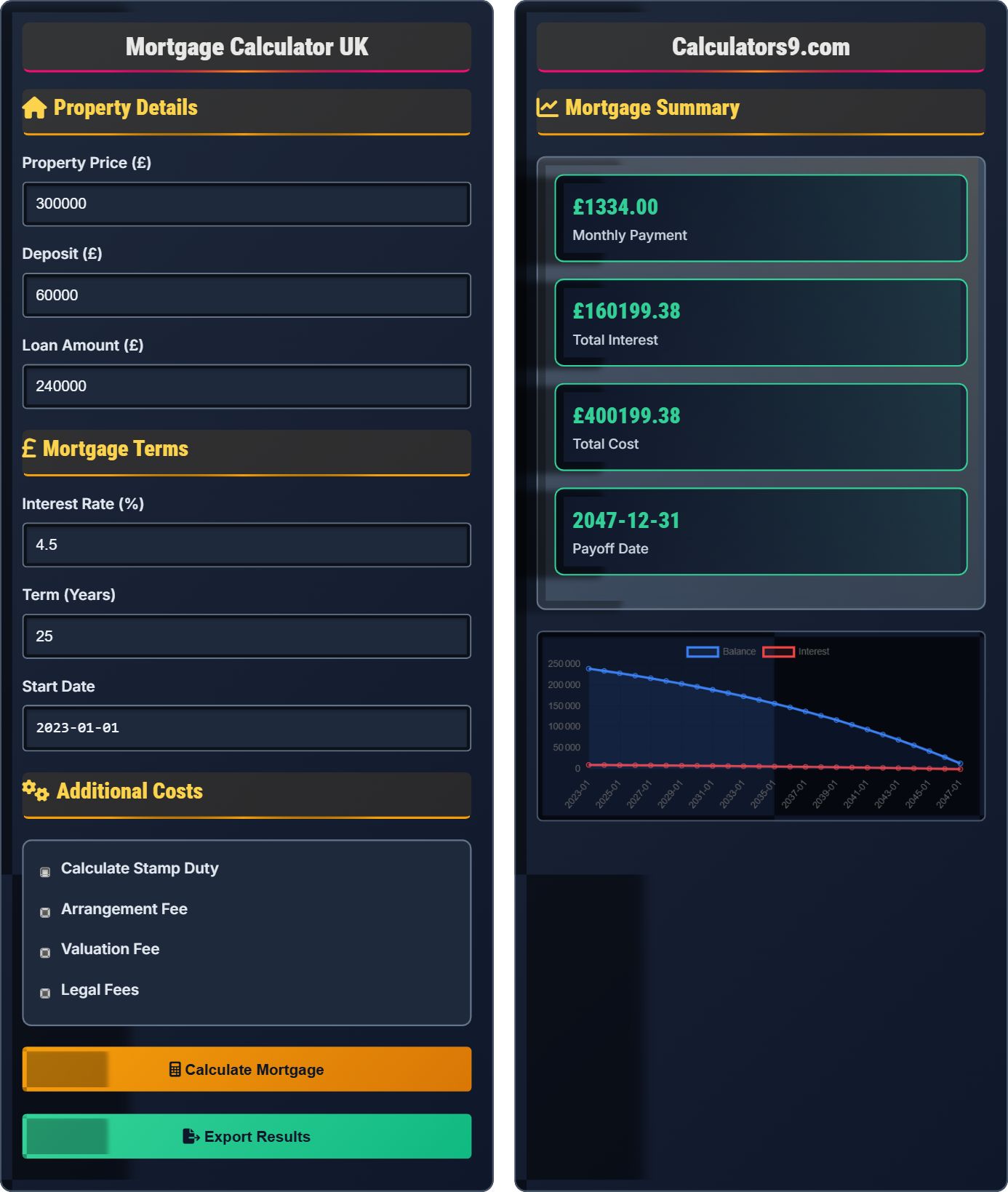
Mortgage Calculator UK
Fast payment calculator • 2026 rates
Property Details
Mortgage Terms
Additional Costs
Mortgage Summary
| Month | Payment | Principal | Interest | Balance |
|---|
| Year | Total | Principal | Interest | Balance |
|---|
UK Mortgage Guide
A UK mortgage is a loan specifically used to purchase real estate in the United Kingdom. The borrower receives funds from a lender to buy a property and agrees to repay the loan over a specified period, typically 25-30 years. The property itself serves as collateral for the loan. In the UK, mortgages are regulated by the Financial Conduct Authority (FCA) and must comply with strict lending criteria.
The standard UK mortgage payment calculation uses the following formula:
Where:
- \(M\) = Monthly payment
- \(P\) = Principal loan amount
- \(r\) = Monthly interest rate (annual rate divided by 12)
- \(n\) = Total number of payments (loan term in years multiplied by 12)
When purchasing a home in the UK, consider these additional costs:
- Stamp Duty Land Tax: Tax on property purchases above £250,000 (England/Wales) or £145,000 (Scotland)
- Arrangement Fees: Lender charges for setting up the mortgage (typically £1,000-£2,000)
- Valuation Fees: Cost for lender to assess property value (£200-£1,500)
- Legal Fees: Solicitor/conveyancer costs (£800-£1,500)
- Survey Fees: Homebuyer survey costs (£300-£1,000)
- Mortgage Insurance: Required if deposit is less than 20% (LTV > 80%)
- Overpayments: Most UK mortgages allow 10% annual overpayments without penalty
- Offset Accounts: Link savings to mortgage to reduce interest charged
- Switching Mortgages: Remortgage at end of fixed term to avoid SVR rates
- Payment Holidays: Available under certain circumstances (COVID-19 protections)
- Capital Repayment: Most common option, pays both interest and principal
- Interest Only: Lower monthly payments but must repay capital separately
UK Mortgage Learning Quiz
Which regulatory body oversees UK mortgage lending?
The answer is B) Financial Conduct Authority. The FCA regulates mortgage lending in the UK, ensuring lenders follow responsible lending practices and protecting consumers. They set rules for affordability assessments, disclosure requirements, and conduct standards for mortgage advisors and lenders.
Understanding regulatory oversight is crucial for UK mortgage borrowers. The FCA's regulations protect consumers from irresponsible lending practices and ensure transparency in mortgage terms. Their rules require lenders to assess borrowers' affordability thoroughly and provide clear information about mortgage products and associated risks.
FCA: Financial Conduct Authority - UK financial regulator
Responsible Lending: Lending practices that ensure borrowers can afford repayments
Affordability Assessment: Evaluation of borrower's financial capacity to repay mortgage
• All UK mortgage lenders must be authorized by the FCA
• Lenders must perform affordability checks
• Consumers have rights to fair treatment and clear information
• Verify your lender is FCA authorized before proceeding
• Understand your rights under FCA regulations
• Keep records of all communications with lenders
• Assuming all lenders follow the same standards
• Not verifying lender authorization status
Calculate the stamp duty for a £400,000 property in England. Show your work.
UK Stamp Duty Land Tax bands for residential properties in England (2026 rates):
0% on portion up to £250,000 = £0
5% on portion from £250,001 to £925,000 = (£400,000 - £250,000) × 0.05 = £150,000 × 0.05 = £7,500
Total stamp duty = £0 + £7,500 = £7,500
Stamp duty is calculated on a tiered system where different rates apply to different portions of the property value. It's important to understand this progressive structure because moving into a higher band only affects the portion above the threshold. This differs from income tax where the higher rate applies to the entire amount.
SDLT: Stamp Duty Land Tax - tax on property purchases
Tiered System: Different rates apply to different price bands
Threshold: Property value limits that determine applicable rate
• SDLT is calculated on a progressive basis
• First £250,000 is tax-free (as of 2026)
• Different rates apply in Scotland (LBTT) and Wales (LTT)
• Use online calculators to verify calculations
• Consider timing of purchase around tax changes
• First-time buyers may qualify for additional relief
• Applying highest rate to entire property value
• Forgetting to check current thresholds
Sarah has a £250,000 mortgage at 4.0% interest with 20 years remaining. Her monthly payment is £1,515. She wants to make extra payments to pay off the mortgage in 15 years. How much extra should she pay monthly?
Step 1: Calculate new monthly payment for 15-year term
r = 0.04/12 = 0.003333, n = 15×12 = 180
New payment = £250,000[0.003333(1.003333)^180]/[(1.003333)^180-1]
= £250,000[0.003333×1.820754]/[0.820754] = £250,000×0.007457 = £1,864.25
Step 2: Calculate extra monthly payment needed
Extra payment = £1,864.25 - £1,515 = £349.25
Therefore, Sarah needs to pay an extra £349.25 monthly to pay off her mortgage in 15 years instead of 20.
This problem demonstrates the relationship between loan term and monthly payment. By shortening the term, Sarah increases her monthly payment but significantly reduces the total interest paid. The key concept is that the same principal must be paid back in fewer months, requiring higher payments. This also reduces interest accumulation over the life of the loan.
Overpayment: Extra payment made toward mortgage principal
Loan Term: Duration over which loan is repaid
Principal Reduction: Decrease in outstanding loan balance
• Most UK mortgages allow 10% annual overpayments without penalty
• Overpayments directly reduce principal balance
• Shorter terms mean higher monthly payments but less interest
• Check your mortgage terms for overpayment allowances
• Ensure extra payments go to principal, not interest
• Consider offset accounts for flexible overpayments
• Not verifying overpayment terms in mortgage agreement
• Assuming all extra payments automatically go to principal
James has a £300,000 mortgage at 5.0% with 20 years remaining. His current monthly payment is £1,976. He finds a new deal at 3.5% for 20 years. What would his new monthly payment be, and how much would he save over the remaining term?
Step 1: Calculate new monthly payment at 3.5%
r = 0.035/12 = 0.002917, n = 20×12 = 240
New payment = £300,000[0.002917(1.002917)^240]/[(1.002917)^240-1]
= £300,000[0.002917×2.009661]/[1.009661] = £300,000×0.005807 = £1,742.10
Step 2: Calculate monthly savings
Monthly savings = £1,976 - £1,742.10 = £233.90
Step 3: Calculate total savings over remaining term
Total savings = £233.90 × 240 = £56,136
Therefore, James would save £233.90 monthly and £56,136 over the remaining 20 years by remortgaging.
This demonstrates the significant impact of interest rates on mortgage costs. A 1.5 percentage point reduction (from 5.0% to 3.5%) results in substantial monthly and total savings. This illustrates why remortgaging at the end of fixed-rate periods is often beneficial when rates are lower. The calculation shows how the mortgage formula works with different interest rates.
Remortgaging: Switching mortgage to a different lender or product
Fixed Rate Period: Time period with guaranteed interest rate
Standard Variable Rate (SVR): Lender's default rate after fixed period ends
• Remortgage when fixed rate period ends to avoid SVR
• Early repayment charges may apply during fixed periods
• Compare APR across different products for true cost
• Start comparing deals 3-6 months before fixed period ends
• Factor in arrangement fees when comparing products
• Consider portability if planning to move
• Staying on SVR after fixed period ends
• Not considering arrangement fees in comparison
What is the maximum loan-to-value ratio typically available for first-time buyers in the UK?
The answer is D) 95%. First-time buyers in the UK can often access mortgages with loan-to-value ratios up to 95%, meaning they need only a 5% deposit. This is facilitated by government schemes like Help to Buy (though this has ended) and lenders offering high-LTV products. However, 95% LTV mortgages typically come with higher interest rates and may require mortgage insurance.
Understanding LTV ratios is crucial for UK homebuyers. A 95% LTV means the borrower finances 95% of the property value, requiring only a 5% deposit. While this makes homeownership more accessible, higher LTV loans carry more risk for lenders, resulting in higher interest rates and often requiring mortgage insurance. Lower LTV ratios (higher deposits) typically qualify for better rates.
LTV: Loan-to-Value ratio - loan amount as percentage of property value
Deposit: Initial payment made by buyer (100% - LTV)
Mortgage Insurance: Insurance required for high LTV loans
• Higher LTV = higher interest rates
• LTV > 80% often requires mortgage insurance
• 95% LTV is maximum for most first-time buyer mortgages
• Save for at least 10% deposit for better rates
• Consider government schemes for first-time buyers
• Higher deposits reduce monthly payments and total interest
• Not understanding how LTV affects interest rates
• Ignoring mortgage insurance costs with high LTV
UK Mortgage Basics
Loan for real estate with property as collateral, regulated by FCA.
\(M = P\frac{r(1+r)^n}{(1+r)^n-1}\)
Where M=monthly payment, P=loan amount, r=monthly rate, n=payments.
- Interest calculated on remaining balance
- Most allow 10% annual overpayments
- 95% LTV maximum for first-time buyers
UK Strategies
Switch at end of fixed term to avoid SVR, typically saves £££.
- Calculate stamp duty accurately
- Budget for arrangement fees
- Factor legal costs
- Consider offset accounts
- Check for early repayment charges
- Compare APR, not just interest rate
- Consider arrangement fees
- Plan for 3-6 months before expiry
FAQ
Q: What's the minimum deposit for a UK mortgage?
A: Minimum is 5% (95% LTV), though 10%+ gets better rates. Some government schemes help with smaller deposits.
Q: When should I remortgage?
A: Start comparing 3-6 months before fixed term ends. Don't wait until end to avoid SVR rates.