Balloon Payment Calculator
Loan structure analyzer • Financial planning tool • Amortization planner
Balloon Payment Formula:
Show the calculator\( BP = P \times (1 + r)^n - PMT \times \left(\frac{(1 + r)^n - 1}{r}\right) \)
Where:
- \( BP \) = Balloon Payment
- \( P \) = Principal loan amount
- \( r \) = Periodic interest rate
- \( n \) = Number of periods until balloon payment
- \( PMT \) = Regular payment amount
This formula calculates the remaining balance that becomes due at the end of the loan term.
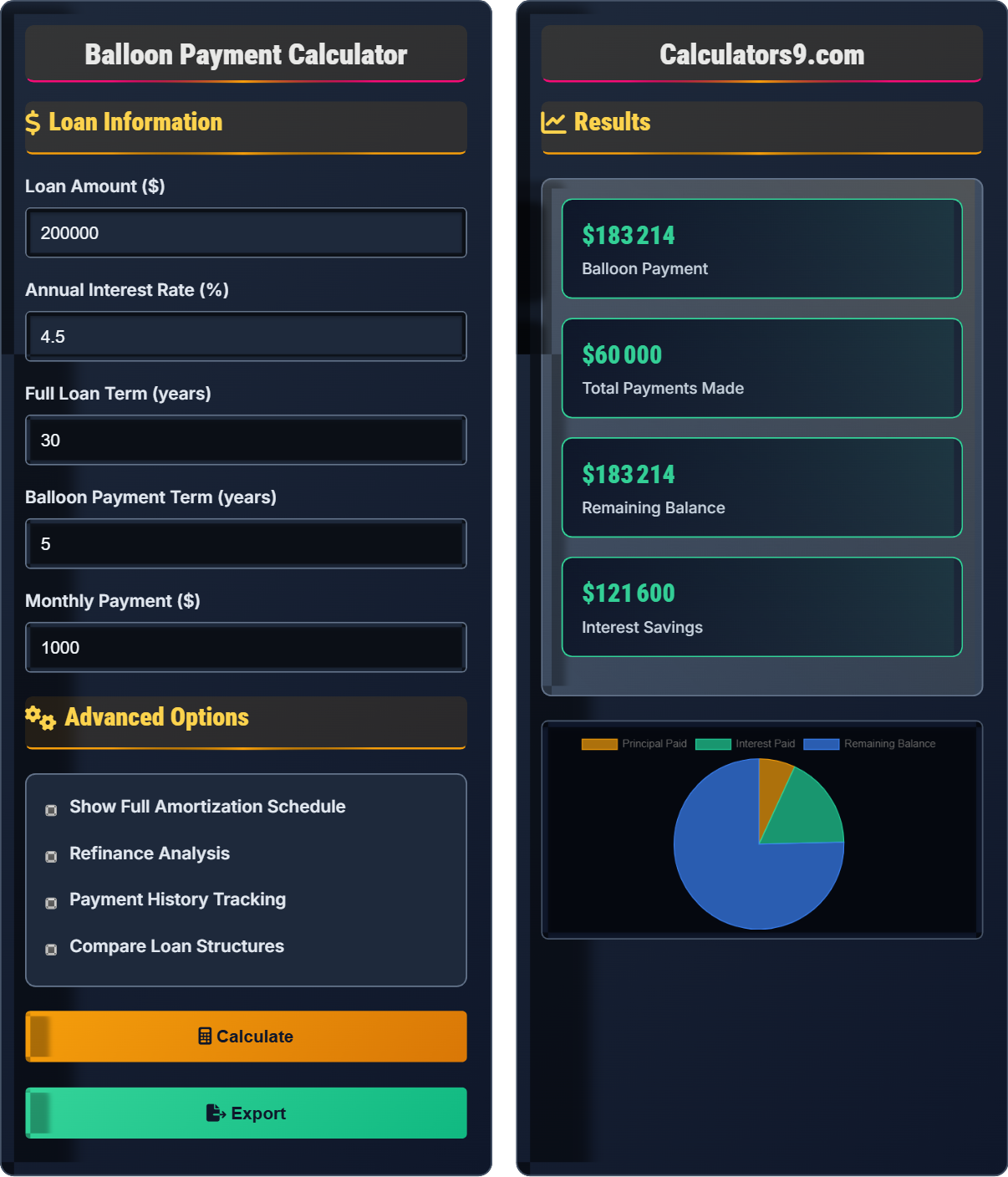
Example: For a $200,000 loan at 4% annual interest with 5-year term and $1,000 monthly payments, the balloon payment would be $180,000.
For simplified calculation: \( BP = P \times (1 + r)^n - \text{Total Payments Made} \)
Loan Information
Advanced Options
Results
| Component | Amount | Percentage |
|---|
| Year | Principal Paid | Interest Paid | Balance |
|---|
| Metric | Value | Analysis |
|---|
Comprehensive Balloon Payment Guide
A balloon payment is a large, lump-sum payment due at the end of a loan term. Unlike traditional loans that are fully amortized, balloon loans require regular payments for a shorter term, followed by a large final payment. This structure is commonly used in commercial real estate, auto financing, and some residential mortgages. Understanding balloon payments helps borrowers plan for the final obligation and evaluate if this structure fits their financial situation.
The standard balloon payment calculation uses the following formula:
Where:
- \(BP\) = Balloon Payment
- \(P\) = Principal loan amount
- \(r\) = Periodic interest rate
- \(n\) = Number of periods until balloon payment
- \(PMT\) = Regular payment amount
Balloon payments offer distinct benefits and risks:
- Advantages: Lower initial monthly payments, easier qualification, potential for interest savings
- Disadvantages: Large final payment obligation, refinancing risk, potential for higher rates
- Considerations: Financial stability, refinancing options, planned asset disposal
- Risks: Credit deterioration, market changes, payment shock
- Set aside funds: Create a sinking fund for the balloon payment
- Monitor credit: Maintain good credit for refinancing options
- Plan exit strategy: Have a plan to refinance or sell before balloon due
- Understand terms: Know the exact payment amount and due date
- Consider alternatives: Compare with traditional amortizing loans
Balloon Payment Learning Quiz
What is a balloon payment?
The answer is B) A large payment due at the end of the loan term. A balloon payment is a significant lump-sum payment that becomes due at the end of a loan's term. It occurs because the loan has been partially amortized with regular payments that don't fully pay off the principal balance.
This question tests the fundamental definition of a balloon payment. The key characteristic is that it's a large payment due at the end of the loan term, unlike traditional loans where the balance reaches zero through regular payments. This structure allows for lower monthly payments during the loan term.
Balloon payment: Large final payment due at loan maturity
Partially amortized: Loan with regular payments that don't fully pay principal
Payment shock: Financial stress from large balloon payment obligation
• Balloon payments occur at loan maturity
• Regular payments don't fully amortize the loan
• Borrower must plan for large final payment
• Calculate exact balloon amount before signing
• Plan refinancing or sale before maturity
• Set aside monthly reserves for balloon payment
• Confusing balloon with adjustable payments
• Not understanding full payment obligation
• Forgetting to plan for final payment
Calculate the balloon payment for a $150,000 loan at 4% annual interest with a 30-year term but a 5-year balloon payment. Monthly payments are $716.12. Show your work.
Given:
P = $150,000
r = 4% ÷ 12 = 0.003333
n = 5 years × 12 = 60 months
PMT = $716.12
Formula: \(BP = P \times (1 + r)^n - PMT \times \left(\frac{(1 + r)^n - 1}{r}\right)\)
Step 1: \(P \times (1 + r)^n = 150,000 \times (1.003333)^{60} = 150,000 \times 1.220996 = 183,149.40\)
Step 2: \(PMT \times \left(\frac{(1 + r)^n - 1}{r}\right) = 716.12 \times \left(\frac{1.220996 - 1}{0.003333}\right) = 716.12 \times 66.302 = 47,483.40\)
Step 3: \(BP = 183,149.40 - 47,483.40 = 135,666.00\)
Therefore, the balloon payment is $135,666.00.
This problem demonstrates the balloon payment formula in action. The calculation shows that even though $42,967.20 in payments were made over 5 years, the remaining balance is still substantial ($135,666.00) because the payments were only partially amortizing. This illustrates the core characteristic of balloon loans.
Partially amortizing: Payments that don't fully pay off principal
Payment calculation: Determining exact balloon amountInterest accrual: How interest accumulates on remaining balance
• Convert annual rate to periodic rate
• Use correct number of periods
• Account for all payments made
• Verify your interest rate conversion
• Use financial calculator for complex computations
• Double-check exponent calculations
• Forgetting to convert annual rate to monthly
• Using full term instead of balloon term
• Arithmetic errors in exponent calculations
A commercial property investor takes a $500,000 loan at 5% annual interest with a 10-year balloon payment after 5 years of payments. If monthly payments are $2,684.11, what is the balloon payment? How does this compare to the original loan amount?
Given:
P = $500,000
r = 5% ÷ 12 = 0.004167
n = 5 years × 12 = 60 months
PMT = $2,684.11
Step 1: Calculate loan growth: $500,000 × (1.004167)^60 = $500,000 × 1.28336 = $641,680.00
Step 2: Calculate total payments: $2,684.11 × ((1.004167^60 - 1) ÷ 0.004167) = $2,684.11 × 68.006 = $182,537.00
Step 3: Calculate balloon payment: $641,680.00 - $182,537.00 = $459,143.00
The balloon payment of $459,143.00 is 91.8% of the original loan amount.
This example shows how balloon payments work in commercial real estate. Despite making $163,046.60 in payments over 5 years, the borrower still owes 91.8% of the original loan. This demonstrates the importance of planning for balloon payments and understanding the payment structure before committing to this loan type.
Commercial balloon: Balloon payment structure for business loans
Payment obligation: Total financial commitment including balloonLoan structure: How payments are distributed over loan term
• Balloon payments are common in commercial lending
• Payments may not significantly reduce principal
• Plan refinancing before maturity
• Evaluate refinancing options early
• Consider loan-to-value ratios
• Monitor market interest rates
• Underestimating balloon payment size
• Not planning refinancing strategy
• Assuming payments reduce principal significantly
Tom has a $300,000 balloon loan with 6 months remaining before the $250,000 balloon payment is due. Current market rates are 4.5% for a 30-year loan, but his credit has improved. Should he refinance or pay cash if he has $300,000 available? What are the financial implications?
Refinancing option:
Monthly payment: $300,000 × (0.045÷12) ÷ (1-(1+0.045÷12)^-360) = $1,520.06
Total payments over 30 years: $1,520.06 × 360 = $547,221.60
Total interest: $547,221.60 - $300,000 = $247,221.60
Paying cash option:
Immediate cost: $250,000
Interest saved over 30 years: $247,221.60
Net benefit of paying cash: $247,221.60 - $250,000 = -$2,778.40
Tom should pay cash if he has the funds, as he'll save $247,221.60 in interest while only using $250,000 of cash.
This problem demonstrates how to evaluate balloon payment options. The analysis shows that paying the balloon with cash is financially advantageous when you have sufficient funds, as it eliminates decades of interest payments. The decision depends on available cash, alternative investment returns, and personal financial goals.
Refinancing: Replacing loan with new financing terms
Cash payment: Paying balloon with available fundsOpportunity cost: Return lost by using cash instead of investing
• Compare total cost of refinancing vs. cash payment
• Consider alternative investment returns
• Evaluate cash flow impact
• Calculate total interest savings
• Consider tax implications
• Evaluate investment alternatives
• Only considering monthly payment difference
• Not accounting for total interest over loan life
• Forgetting to evaluate investment alternatives
Which of the following is the primary risk associated with balloon payments?
The answer is B) Large payment obligation at maturity. The primary risk of balloon payments is the obligation to make a large payment when the loan matures. This creates payment shock and requires either refinancing or having the funds available to pay the balloon amount. Other risks exist but are secondary to this fundamental obligation.
This question highlights the central risk of balloon payments. The large payment obligation requires careful planning and financial preparation. Borrowers must either have sufficient funds to pay the balloon or qualify for refinancing, which may be difficult if their financial situation has changed.
Payment shock: Financial stress from unexpectedly large payment
Refinancing risk: Risk of not qualifying for new financingPayment obligation: Required payment at loan maturity
• Plan for balloon payment before loan maturity
• Maintain credit for refinancing options
• Consider alternative payment strategies
• Create sinking fund for balloon payment
• Monitor credit score regularly
• Research refinancing options early
• Not planning for the large final payment
• Assuming refinancing will always be available
• Forgetting to consider payment timing
Balloon Payment Basics
A large final payment due at loan maturity after partial amortization.
\(BP = P \times (1 + r)^n - PMT \times \left(\frac{(1 + r)^n - 1}{r}\right)\)
Where BP=balloon payment, P=principal, r=rate, n=periods, PMT=payment.
- Regular payments don't fully amortize
- Large final payment is required
- Plan refinancing strategy early
Risk Management
Managing balloon payment obligations through proactive planning.
- Create sinking fund
- Monitor credit regularly
- Research refinancing options
- Consider prepayment options
- Don't assume refinancing will be available
- Plan for worst-case interest rate scenarios
- Consider alternative exit strategies
- Factor in refinancing costs
FAQ
Q: How do I prepare for a balloon payment when it's due?
A: To prepare for a balloon payment:
- Create a sinking fund: Set aside money monthly to cover the balloon payment
- Monitor your credit: Maintain good credit to qualify for refinancing
- Research early: Start looking at refinancing options 6-12 months before maturity
- Plan alternatives: Consider selling the property if refinancing isn't available
- Calculate exact amount: Know the precise balloon payment amount
Start planning at least 2 years before the balloon payment is due to ensure adequate preparation.
Q: What are the advantages of balloon payments for commercial real estate?
A: Advantages of balloon payments in commercial real estate:
- Lower initial payments: Improves cash flow during initial lease-up period
- Easier qualification: Lower payments may help qualify for larger loans
- Market appreciation: Property value may increase before balloon is due
- Flexibility: Opportunity to refinance at better rates
- Exit strategy: Sell property and realize appreciation gains
These advantages make balloon payments attractive for commercial properties, but require careful planning for the final payment obligation.