EMI Calculator
Fast payment calculator • 2026 rates
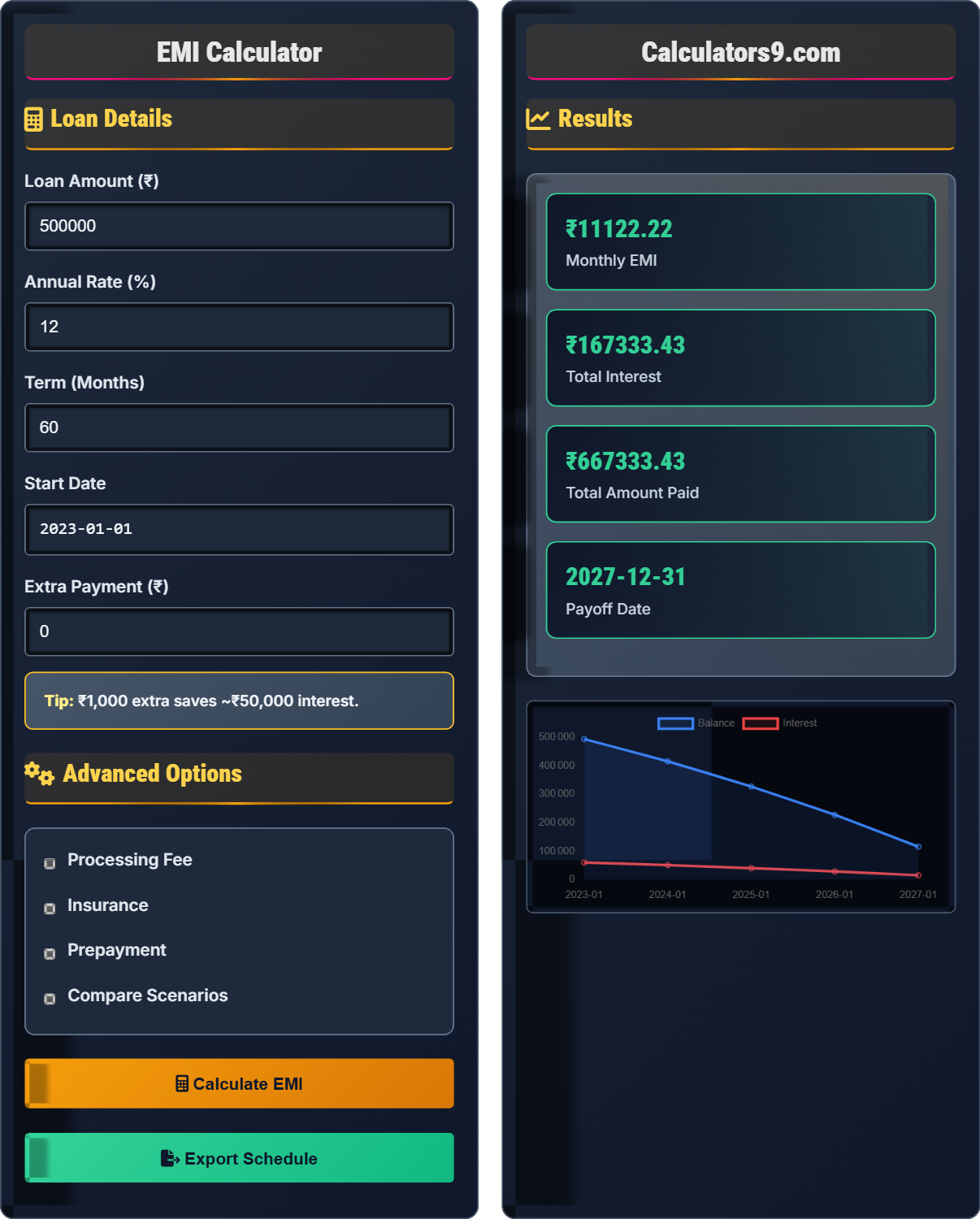
Loan Details
Advanced Options
Results
| Month | EMI | Principal | Interest | Balance |
|---|
| Year | Total EMI | Principal | Interest | Balance |
|---|
Comprehensive EMI Guide
EMI stands for Equated Monthly Installment. It is a fixed amount that borrowers pay every month to repay their loan within a specified tenure. The EMI consists of both principal and interest components, with the proportion of each changing over time. Initially, a larger portion goes towards interest, but as the loan progresses, more of the EMI goes towards principal repayment.
The standard EMI calculation uses the following formula:
Where:
- \(EMI\) = Equated Monthly Installment
- \(P\) = Principal loan amount
- \(r\) = Monthly interest rate (annual rate divided by 12)
- \(n\) = Total number of monthly payments (loan term in months)
Your EMI typically includes several components depending on the loan type:
- Principal: Portion that reduces the outstanding loan balance
- Interest: Cost of borrowing money, paid to the lender
- Processing Fee: One-time fee charged by the lender
- Insurance: Life or property insurance coverage
- Tax Deductions: Applicable in some loan categories
- Make extra payments: Reduces principal faster, saving thousands in interest over the loan term
- Round up payments: Round your monthly payment up to the nearest thousand rupees
- Make prepayments: Lump sum payments during bonus season or tax refunds
- Switch to shorter tenure: While EMI increases, total interest paid decreases substantially
- Negotiate interest rates: Good credit score can help secure better rates
EMI Learning Quiz
Which of the following is NOT included in a typical EMI calculation?
The answer is D) Entertainment Expenses. A typical EMI calculation includes Principal (the portion that pays down the loan), Interest (the cost of borrowing), and sometimes Processing Fees. Entertainment expenses are personal expenses unrelated to the loan EMI calculation.
Understanding the components of an EMI is crucial because many people confuse EMI with total monthly obligations. The actual EMI formula only considers the principal amount, interest rate, and loan tenure. Other fees like processing fees or insurance are separate and may be added to the loan amount or paid upfront.
EMI: Equated Monthly Installment - fixed payment amount
Principal: The original loan amount being repaid
Interest: The cost of borrowing money
• EMI calculations include Principal and Interest components
• Processing fees may be added to loan amount or paid separately
• Personal expenses like entertainment are not part of EMI
• Remember: EMI = Principal + Interest
• Use the mnemonic "Equal Money Installment" to remember EMI
• Confusing EMI with total monthly loan-related expenses
• Forgetting that processing fees and insurance are separate
Calculate the monthly EMI for a ₹400,000 loan at 10% annual interest over 5 years (60 months). Show your work.
Using the EMI formula: \(EMI = P \times \frac{r(1+r)^n}{(1+r)^n-1}\)
Given:
- P = ₹400,000
- r = 0.10 ÷ 12 = 0.008333
- n = 60 months
Step 1: Calculate (1+r)^n = (1.008333)^60 = 1.6453
Step 2: Calculate numerator: r(1+r)^n = 0.008333 × 1.6453 = 0.013711
Step 3: Calculate denominator: (1+r)^n - 1 = 1.6453 - 1 = 0.6453
Step 4: Calculate EMI = P × (numerator/denominator) = ₹400,000 × (0.013711/0.6453) = ₹400,000 × 0.02125 = ₹8,500
This problem demonstrates the power of compound interest in EMI calculations. Notice that the monthly EMI is relatively low compared to the total loan amount, but over 5 years, the total interest paid will be significant. The calculation involves converting the annual rate to a monthly rate and using the exact loan term in months.
Compound Interest: Interest calculated on both the principal and previously accumulated interest
Monthly Rate: Annual interest rate divided by 12
Number of Payments: Loan term in months
• Always convert annual interest rates to monthly rates for calculations
• Use exact number of months for accurate EMI calculations
• The EMI formula accounts for compound interest over time
• Remember: r = annual rate ÷ 12
• Remember: n = loan months
• Use a calculator for complex exponent calculations
• Forgetting to convert annual rates to monthly rates
• Using years instead of months for the number of payments
• Making calculation errors with large exponents
Rahul takes out a 3-year personal loan for ₹300,000 at an interest rate of 15%. His monthly EMI is ₹10,200. What is the total interest he will pay over the life of the loan?
Step 1: Calculate total number of payments = 3 years × 12 months/year = 36 payments
Step 2: Calculate total amount paid = ₹10,200 × 36 = ₹367,200
Step 3: Calculate total interest = Total paid - Principal = ₹367,200 - ₹300,000 = ₹67,200
Therefore, Rahul will pay ₹67,200 in interest over the life of his loan.
This example shows how interest can add significantly to the original loan amount, especially for higher-interest personal loans. In this case, Rahul will pay about 22% of the principal amount as interest. This demonstrates why paying off a loan early can save substantial amounts of money. The calculation shows the relationship between monthly EMIs, loan term, and total interest.
Total Interest: The sum of all interest payments over the life of the loan
Loan Term: The length of time to repay the loan
Principal: The original loan amount
• Total interest = (Monthly EMI × Number of payments) - Principal
• Higher interest rates result in more total interest paid
• Even with fixed EMIs, most early payments go toward interest
• Remember: Total paid = Monthly EMI × Total number of payments
• Total interest is always Total paid minus Principal
• Use this calculation to compare different loan scenarios
• Forgetting to multiply monthly EMI by total number of payments
• Subtracting the wrong amounts when calculating interest
• Confusing monthly interest with total interest over the loan term
Anita has a 4-year car loan for ₹600,000 at 12% interest. Her regular monthly EMI is ₹15,700. She decides to pay an extra ₹2,000 each month toward principal. How much will this save her in interest over the life of the loan? (Hint: Calculate how many months early she'll pay off the loan and estimate interest savings)
Step 1: Regular scenario - Total payments over 48 months = ₹15,700 × 48 = ₹753,600
Step 2: With extra payments - Each month, Anita pays ₹15,700 + ₹2,000 = ₹17,700
Step 3: With extra payments, the loan will be paid off earlier due to reduced principal
Step 4: Using amortization calculations, the loan would be paid off approximately 8 months earlier (around 40 months)
Step 5: Total paid with extra payments ≈ ₹15,700 × 40 = ₹628,000
Step 6: Interest savings = ₹753,600 - ₹628,000 = ₹125,600
Therefore, Anita saves approximately ₹125,600 in interest by paying an extra ₹2,000 monthly.
This demonstrates the power of paying extra toward principal. Since interest is calculated on the remaining principal balance, reducing the principal early significantly reduces the total interest paid. The extra ₹2,000 per month doesn't just reduce the final payment - it reduces interest charges on all future payments. This is why even small extra payments can result in substantial savings over time.
Principal Reduction: Paying extra toward the loan balance to decrease interest charges
Amortization: The process of gradually paying off a debt through regular payments
Interest Savings: The difference between total interest paid with and without extra payments
• Extra payments go directly to principal reduction
• Principal reduction decreases future interest charges
• Small extra payments can result in significant long-term savings
• Round up your monthly EMI to the next thousand rupees
• Make an extra payment once a year (equivalent to bi-monthly payments)
• Use tax refunds or bonuses for extra principal payments
• Thinking extra payments only affect the final payment
• Not realizing that extra payments reduce interest on all future payments
• Confusing interest-only savings with principal reduction benefits
Which of the following statements about a 3-year loan versus a 5-year loan is TRUE?
The answer is C) The 3-year loan saves more in total interest. Although 3-year loans have higher monthly EMIs, they have shorter terms which result in significantly less total interest paid over the life of the loan. For example, a ₹500,000 loan at 12% would pay approximately ₹165,000 in interest over 5 years but only ₹98,000 over 3 years.
While 3-year loans have higher monthly EMIs than 5-year loans, they offer substantial interest savings. This is because interest accrues over a shorter period, and lenders often offer slightly lower rates for shorter terms. The trade-off is between affordability (lower monthly payments) and long-term savings (less total interest). Understanding this relationship helps borrowers make informed decisions based on their financial situation.
Loan Term: The length of time to repay the loan
Interest Rate Risk: The risk that interest rates will change during the loan term
Payment Affordability: The ability to make regular monthly payments
• Shorter loan terms generally have lower total interest costs
• Shorter terms result in higher monthly EMIs but lower total interest
• The longer the loan term, the more interest accumulates
• Consider a 5-year loan with plans to pay extra (gives flexibility)
• If you can afford higher EMIs, 3-year loans save significant interest
• Compare total interest costs between different loan terms
• Focusing only on monthly EMIs and ignoring total interest costs
• Assuming longer terms always have higher interest rates
• Not considering how income growth might affect payment affordability
EMI Basics
Fixed monthly payment to repay loan with interest.
\(EMI = P \times \frac{r(1+r)^n}{(1+r)^n-1}\)
Where EMI=monthly payment, P=loan amount, r=monthly rate, n=payments.
- Interest calculated on remaining balance
- Early payments save more interest
- Small rate changes = big savings
Strategies
Early payments are mostly interest, later payments are mostly principal.
- Round up payments
- Extra annual payment
- Bi-monthly payments
- Apply windfalls
- Processing fees
- Prepayment penalties
- APR vs interest rate
- Tax implications
FAQ
Q: How do extra payments save money?
A: Extra payments reduce principal immediately, lowering interest on future payments. ₹1,000 extra monthly saves ~₹50K on 5-year loan.
Q: 3 vs 5-year loan?
A: 5-year: ₹165K interest. 3-year: ₹98K interest. Higher monthly payments but significant savings.