Interest Only Mortgage Calculator
IO payment calculator • 2026 rates
IO Loan Details
Advanced Options
Results
| Year | Payment Type | Payment Amount | Principal | Interest |
|---|
| Year | Principal Balance | Interest Paid | Principal Paid |
|---|
Comprehensive Interest Only Guide
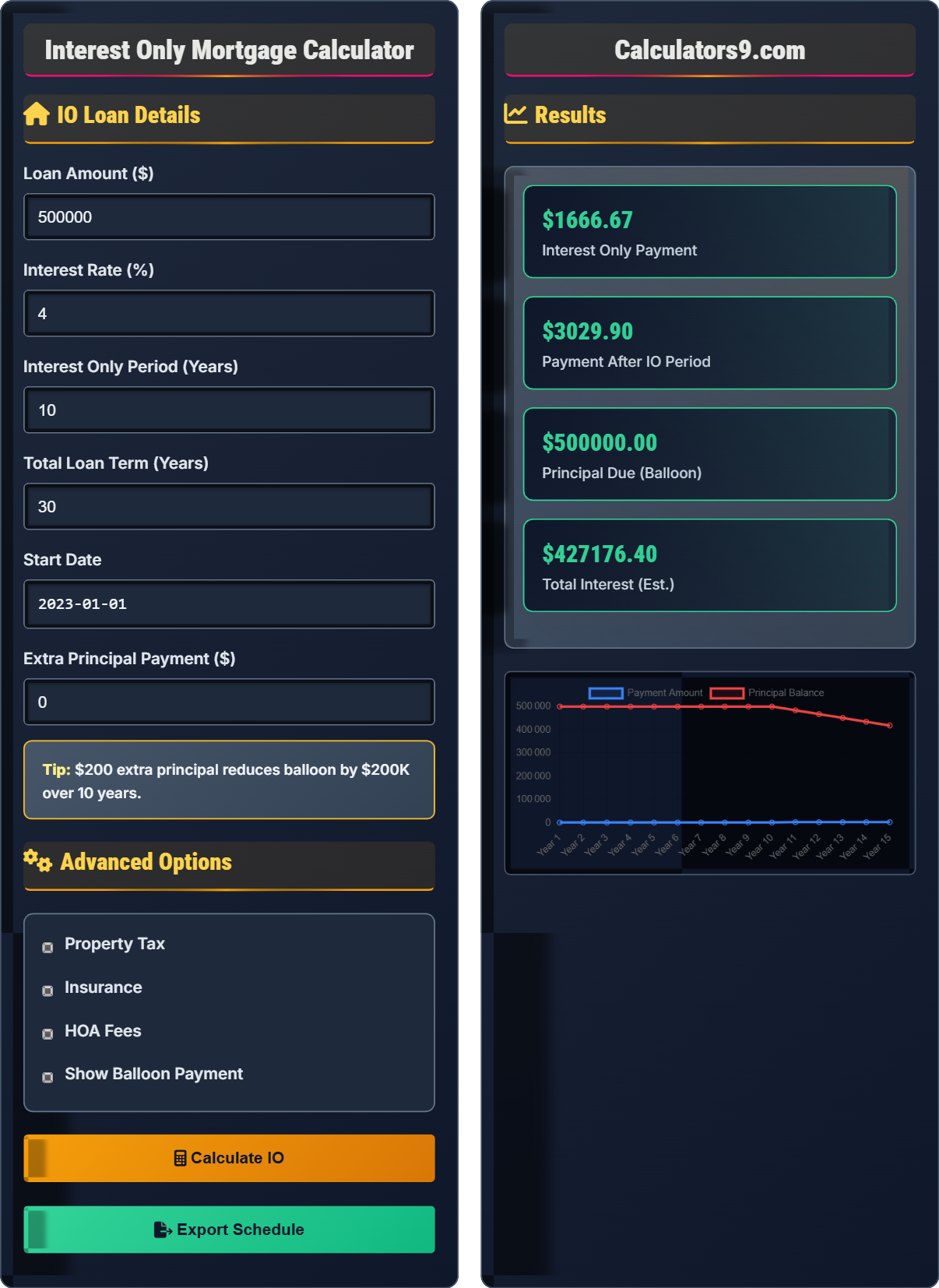
An Interest Only (IO) mortgage is a loan where the borrower pays only the interest on the loan for a specified period, typically 5-10 years. During the interest-only period, the monthly payments are lower because they don't include principal repayment. After the IO period ends, the borrower must pay both principal and interest, resulting in significantly higher monthly payments. Some IO loans require a balloon payment at the end of the IO period.
During the interest-only period, the monthly payment is calculated simply as:
After the IO period, the payment becomes a standard amortizing payment calculated over the remaining term with the remaining principal balance.
Key considerations for interest-only mortgages:
- Advantages: Lower initial payments, more cash flow for investments, potential for property appreciation
- Disadvantages: Payment shock after IO period, no equity buildup during IO period, risk of negative amortization
- Payment Shock: Significant payment increase when principal payments begin
- Equity Concerns: No equity buildup during interest-only period
- Refinancing Risk: Need to refinance or sell before balloon payment due
- Budget for Payment Increase: Plan for significantly higher payments after IO period
- Investment Strategy: Use savings from lower payments to invest in appreciating assets
- Sale Timeline: Plan to sell before payment increase if not refinancing
- Refinancing Plan: Prepare alternative financing options before IO period ends
- Emergency Fund: Maintain reserves to handle payment increases or unexpected events
IO Learning Quiz
During the interest-only period of an IO mortgage, what happens to the principal balance?
The answer is B) It remains unchanged. During the interest-only period, the borrower only pays the interest portion of the loan, so the principal balance stays the same. No principal is being repaid, which is why the monthly payments are lower during this period.
This is a fundamental concept of interest-only mortgages. Many borrowers mistakenly think they're paying down their loan during the IO period, but in reality, they're only covering the cost of borrowing. Understanding this is crucial for financial planning and avoiding surprises when the principal repayment begins.
Interest Only (IO): Payment covers only interest charges, not principal
Principal Balance: The outstanding loan amount
Payment Shock: Significant increase in payments after IO period
• IO payments = Interest only, no principal reduction
• Principal balance remains constant during IO period
• Payments increase significantly after IO period
• Remember: IO = Interest Only, Principal Stays Same
• Plan for payment increase after IO period
• Use savings from lower payments wisely
• Thinking IO payments reduce the loan balance
• Not planning for payment shock after IO period
Calculate the monthly interest-only payment for a $400,000 loan at 3.5% annual interest. Show your work.
Monthly Payment = Principal × (Annual Rate ÷ 12)
Given:
- Principal = $400,000
- Annual Rate = 3.5% = 0.035
- Monthly Rate = 0.035 ÷ 12 = 0.002917
Calculation: $400,000 × 0.002917 = $1,166.67
The monthly interest-only payment is $1,166.67.
The interest-only calculation is straightforward since it only involves multiplying the principal by the monthly interest rate. This simplicity is what makes IO payments attractive initially, but borrowers must understand that the principal remains unchanged, requiring a plan for eventual repayment.
Monthly Rate: Annual rate divided by 12 months
Interest Calculation: Principal × Monthly Rate
Payment Structure: IO payments = Interest Only
• IO payment = Principal × (Annual Rate ÷ 12)
• No principal reduction during IO period
• Convert annual rate to monthly for calculations
• Divide annual rate by 12 for monthly calculation
• Same payment each month during IO period
• Remember: Principal remains unchanged
• Forgetting to divide annual rate by 12
• Including principal in IO payment calculation
Sarah has a $600,000 IO loan at 4.25% for 10 years interest-only, then 20 years amortizing. What will her monthly payment be after the IO period ends? By what percentage will her payment increase?
Step 1: Calculate initial IO payment
• IO Payment = $600,000 × (0.0425 ÷ 12) = $600,000 × 0.003542 = $2,125
Step 2: Calculate payment after IO period (20 years remaining)
• Remaining Principal = $600,000 (unchanged)
• Remaining Months = 20 × 12 = 240
• Monthly Rate = 0.0425 ÷ 12 = 0.003542
Using amortization formula: M = P[r(1+r)^n]/[(1+r)^n-1]
• (1+r)^n = (1.003542)^240 = 2.3692
• Numerator = $600,000 × 0.003542 × 2.3692 = $5,031.42
• Denominator = 2.3692 - 1 = 1.3692
• New Payment = $5,031.42 ÷ 1.3692 = $3,674.64
Step 3: Calculate payment increase percentage
• Increase = $3,674.64 - $2,125 = $1,549.64
• Percentage Increase = ($1,549.64 ÷ $2,125) × 100 = 72.9%
After the IO period, Sarah's payment will be $3,674.64, representing a 72.9% increase.
This example demonstrates the significant "payment shock" that occurs after an IO period ends. Sarah's payment increases by over 70%, which is why careful financial planning is essential. The principal hasn't decreased during the IO period, so the full balance must be amortized over the remaining term, resulting in much higher payments.
Payment Shock: Significant increase in payments after IO period
Amortization: Process of paying off loan with scheduled payments
Remaining Term: Years left after IO period ends
• IO period doesn't reduce principal
• Post-IO payment uses remaining term
• Payment shock can be substantial (50-100%+)
• Calculate post-IO payment before committing to IO loan
• Plan for payment increase during IO period
• Consider refinancing options before IO ends
• Not calculating post-IO payment amount
• Underestimating payment shock magnitude
• Failing to plan for increased payments
Mike is comparing a 30-year traditional mortgage at 4% vs a 10-year IO mortgage at 4% followed by 20 years of amortization. Both are for $500,000. How much does Mike save monthly during the IO period, and what is his total payment difference over 30 years?
Step 1: Calculate traditional mortgage payment
• M = P[r(1+r)^n]/[(1+r)^n-1]
• r = 0.04 ÷ 12 = 0.003333
• n = 30 × 12 = 360
• (1+r)^n = (1.003333)^360 = 3.2434
• Traditional Payment = $500,000 × [0.003333 × 3.2434] ÷ [3.2434 - 1] = $2,387.08
Step 2: Calculate IO payment for first 10 years
• IO Payment = $500,000 × (0.04 ÷ 12) = $1,666.67
• Monthly savings during IO = $2,387.08 - $1,666.67 = $720.41
Step 3: Calculate payment after IO period (20 years remaining)
• Remaining Principal = $500,000
• Remaining Months = 20 × 12 = 240
• Post-IO Payment = $500,000 × [0.003333 × (1.003333)^240] ÷ [(1.003333)^240 - 1] = $3,078.44
Step 4: Calculate total payments over 30 years
• Traditional: $2,387.08 × 360 = $859,348.80
• IO: ($1,666.67 × 120) + ($3,078.44 × 240) = $200,000 + $738,825.60 = $938,825.60
• Difference = $938,825.60 - $859,348.80 = $79,476.80
Mike saves $720.41 monthly during the IO period but pays $79,476.80 more over 30 years.
This demonstrates the trade-off of IO mortgages: lower payments during the IO period but higher total interest over the loan life. The IO option provides cash flow benefits in the short term but costs more in the long term. This is why IO loans are best suited for borrowers who plan to sell or refinance before the IO period ends.
Payment Trade-off: Lower initial payments for higher total cost
Total Interest Cost: Amount paid beyond principal
Cash Flow Benefit: Short-term liquidity advantage
• IO loans have higher total interest costs
• Lower payments during IO period
• Better for short-term ownership
• Compare total costs, not just monthly payments
• Focusing only on monthly payments, ignoring total cost
• Not considering total interest over loan life
• Assuming IO is always better due to lower payments
Which borrower profile is most suitable for an interest-only mortgage?
The answer is C) Investor planning to sell before IO period ends. Interest-only mortgages are ideal for borrowers who plan to sell their property before the IO period ends, avoiding the payment shock. This allows them to take advantage of lower initial payments while owning the property short-term.
IO mortgages are fundamentally designed for short-term ownership or specific financial strategies. They're not suitable for long-term homeownership due to the payment shock and lack of equity buildup. The ideal candidate has a clear exit strategy before the IO period ends, whether through sale, refinancing, or other means.
Exit Strategy: Plan for dealing with loan after IO period
Payment Shock: Significant payment increase after IO period
Equity Building: Principal reduction over time
• IO loans require exit strategy before IO ends
• Not suitable for long-term homeowners
• Best for short-term ownership or investment
• Have refinancing plan ready before IO ends
• Consider selling before payment increase
• Ensure income will support higher payments
• Taking IO loan without exit strategy
• Assuming payment will be affordable after IO
• Expecting property value to solve payment issue
IO Basics
Mortgage where borrower pays only interest for specified period.
Monthly Payment = Principal × (Annual Rate ÷ 12)
Simple calculation during interest-only period.
- Principal balance remains unchanged during IO
- Payment increases significantly after IO period
- Higher total interest over loan life
IO Strategies
Best for short-term ownership, high-income earners, or those planning to sell/refinance before IO period ends.
- Plan for payment increase after IO period
- Have refinancing strategy ready
- Consider selling before payment shock
- Build emergency reserves
- Payment shock risk
- No equity buildup during IO
- Higher total interest cost
- Need exit strategy
FAQ
Q: When does my payment increase?
A: Payment increases when interest-only period ends. If you have 10-year IO, payments increase in year 11. Exact timing depends on your loan terms.
Q: Is IO still available?
A: Yes, though less common. Available primarily for jumbo loans, investment properties, and high-income earners. Requirements are stricter than pre-2008.