Mortgage Overpayment Calculator
Early payment savings • Mortgage acceleration tracker • Payoff planner
Mortgage Overpayment Formula:
Show the calculator\( S = \sum_{i=1}^{n} (I_i - I_{i,overpayment}) \)
Where:
- \( S \) = Total interest savings
- \( I_i \) = Interest payment in period \( i \) without overpayment
- \( I_{i,overpayment} \) = Interest payment in period \( i \) with overpayment
- \( n \) = Total number of periods
This formula calculates interest savings by comparing scheduled vs accelerated payments.
Example: With $200,000 mortgage at 4.5% over 30 years, $100 monthly overpayment saves ~$32,000 in interest and pays off 5 years early.
For lump sum: \( New\ Balance = Original\ Balance - Lump\ Sum \)
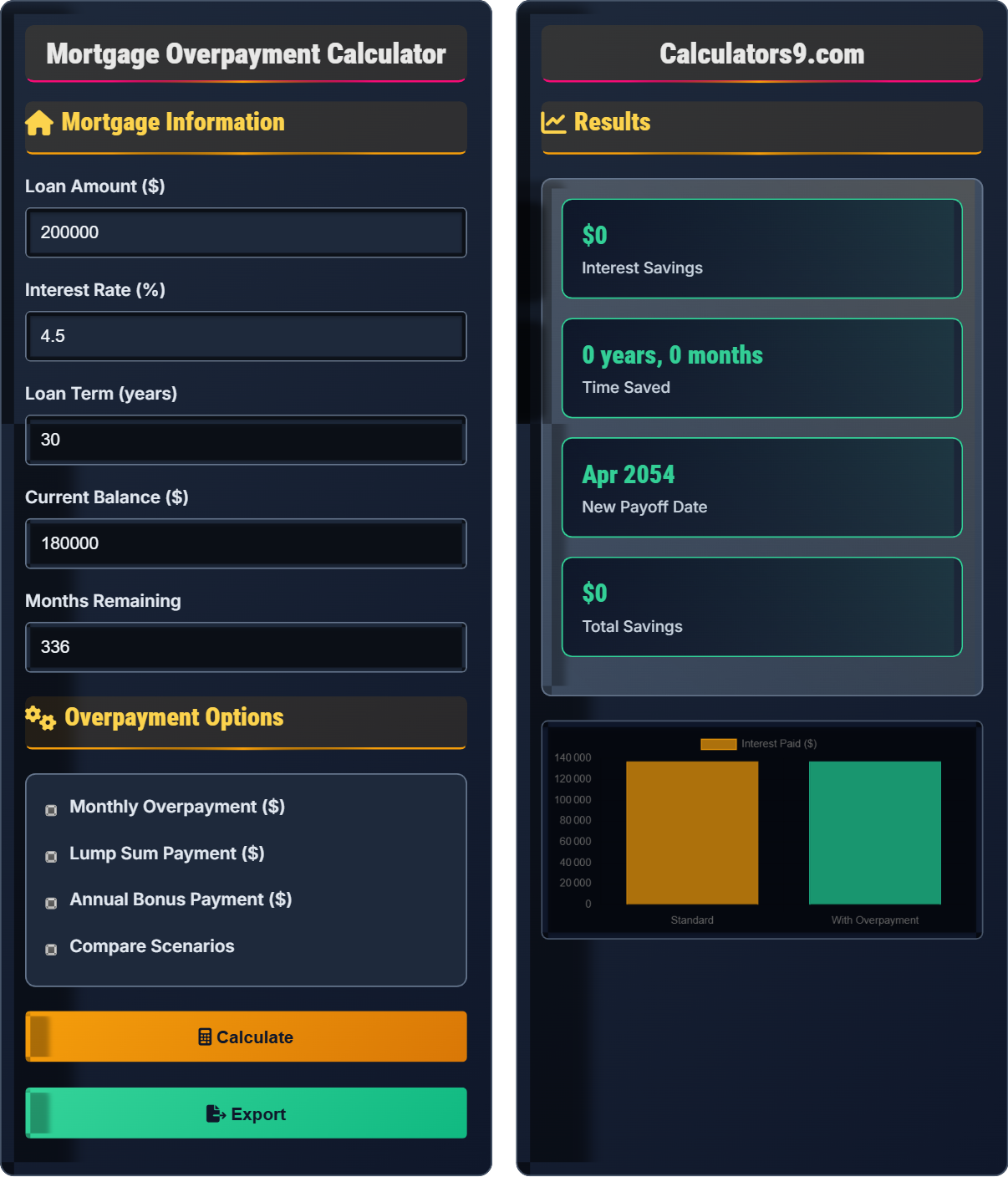
Mortgage Information
Overpayment Options
Results
| Scenario | Payoff Date | Interest Paid | Monthly Payment |
|---|
| Year | Principal | Interest | Balance |
|---|
| Component | Original | With Overpayment | Savings |
|---|
Comprehensive Mortgage Overpayment Guide
Mortgage overpayment is a powerful financial strategy that allows homeowners to pay off their mortgage earlier and save significantly on interest payments. By making additional payments toward the principal, you reduce the outstanding balance faster, which in turn reduces the amount of interest charged over the life of the loan. This strategy can save tens of thousands of dollars and years of payments.
The standard mortgage overpayment calculation uses the following formula:
Where:
- \(S\) = Total interest savings
- \(I_i\) = Interest payment in period \(i\) without overpayment
- \(I_{i,overpayment}\) = Interest payment in period \(i\) with overpayment
- \(n\) = Total number of periods
Mortgage overpayment provides several financial advantages:
- Interest Savings: Reduce total interest paid over the loan term
- Shorter Loan Term: Pay off mortgage years earlier
- Equity Building: Increase home equity faster
- Debt Reduction: Become debt-free sooner
- Refinancing Opportunities: Higher equity enables better refinancing terms
- Automate payments: Set up automatic overpayments to ensure consistency
- Check for prepayment penalties: Verify your loan terms
- Maximize tax deductions: Mortgage interest deduction phases out at higher incomes
- Consider investment returns: Compare overpayment returns to investment opportunities
- Emergency fund first: Maintain 3-6 months expenses before overpaying
Mortgage Overpayment Learning Quiz
How does mortgage overpayment primarily save money?
The answer is B) By reducing the principal balance faster. When you make overpayments, they go directly to the principal balance. This reduces the amount on which interest is calculated, saving money over time. The interest rate remains unchanged, but the principal balance decreases more rapidly.
This question tests the fundamental understanding of how mortgage interest works. Interest is calculated on the remaining principal balance, so reducing the principal faster means less interest accrues over time. This is the core mechanism behind mortgage overpayment savings.
Principal balance: The outstanding loan amount excluding interest
Interest calculation: Interest charged on remaining principal balance
Amortization: Process of paying off debt over time through regular payments
• Interest is calculated on remaining principal
• Overpayments reduce principal directly
• Less principal = less interest charged
• Ensure overpayments go to principal, not future payments
• Request confirmation from lender
• Keep records of all overpayments
• Assuming overpayments reduce interest rate
• Not confirming how lender applies overpayments
• Confusing interest savings with payment reductions
If you're 10 years into a 30-year mortgage and start making $200 monthly overpayments, approximately how much time could you save on your mortgage? Show your work.
For a 30-year mortgage with 20 years remaining, adding $200 monthly overpayment typically saves 4-6 years off the mortgage term. The exact time depends on the original loan amount and interest rate.
Approximate calculation: $200 × 12 = $2,400 annual overpayment. Over 20 years, this would contribute to principal reduction that could eliminate 4-6 years of payments, as the interest component decreases significantly in later years.
This question demonstrates how overpayment effectiveness changes over the loan term. Early in a mortgage, more of each payment goes to interest, so overpayments are most effective later in the loan when more goes to principal. However, the compounding effect of early overpayments can be substantial.
Amortization schedule: Timeline showing how payments are applied to principal and interest
Principal reduction: Decrease in outstanding loan balanceTime leverage: How early payments have greater impact on total time saved
• Earlier overpayments have greater time impact
• Time savings increase with higher overpayment amounts
• Interest rate affects time savings calculation
• Use online calculators for precise time savings
• Consider making overpayments when interest rate is high
• Large lump sums early in loan term are most effective
• Assuming linear time savings (it's exponential)
• Not accounting for loan specifics in estimation
• Forgetting that interest rate affects savings
Sarah has a $250,000 mortgage at 4.25% for 30 years. She plans to make $150 monthly overpayments and a $3,000 lump sum payment at the start of year 3. How much interest will she save compared to the standard payment plan?
Standard mortgage details:
Monthly payment ≈ $1,229
Total interest ≈ $192,500
With $150 monthly overpayment:
New payoff ≈ 26 years (4 years early)
Total interest ≈ $158,000
Interest savings ≈ $34,500
Adding $3,000 lump sum in year 3:
Additional interest savings ≈ $2,000
Total interest savings ≈ $36,500
This example shows how multiple overpayment strategies work together. The monthly overpayment creates consistent principal reduction, while the lump sum provides a significant boost at a strategic time. The combined effect is greater than the sum of individual strategies due to the compounding nature of interest savings.
Combined strategies: Using multiple overpayment approaches simultaneously
Compounding effect: How early savings amplify over timeStrategic timing: Making payments at optimal moments for maximum benefit
• Multiple strategies enhance each other
• Lump sums are most effective early in loan term
• Consistent monthly overpayments provide steady progress
• Start with consistent monthly overpayments
• Apply windfalls to principal when possible
• Use tax refunds strategically
• Not considering the compounding effect of combined strategies
• Applying lump sums too late in loan term
• Inconsistent application of overpayments
Mike has two mortgages: a $150,000 loan at 5.5% and a $100,000 loan at 3.25%. If he has $200 extra monthly for overpayment, which loan should he prioritize for maximum savings? Explain your reasoning.
Mike should prioritize the 5.5% loan. Higher interest rate loans benefit more from overpayments because:
Interest saved on 5.5% loan: $200 × 0.055 ÷ 12 = $0.92 per dollar per month
Interest saved on 3.25% loan: $200 × 0.0325 ÷ 12 = $0.54 per dollar per month
Higher rate = more interest savings per dollar overpaid.
Additionally, the 5.5% loan likely has a higher absolute interest charge each month, making overpayments more impactful.
This demonstrates the mathematical principle that higher interest rates create greater savings opportunities with overpayments. The interest calculation is based on the remaining principal balance multiplied by the interest rate, so a higher rate means more interest is eliminated with each dollar of principal reduction.
Rate prioritization: Focusing overpayments on highest interest rate debts first
Opportunity cost: Benefit lost by not applying funds optimallyInterest rate differential: Gap between different loan rates affecting savings
• Higher rate loans provide greater overpayment savings
• Apply extra payments to highest interest rate first
• Consider loan terms and remaining balances
• Use the "avalanche method" (highest rate first)
• Consider refinancing higher rate loans
• Track savings from each strategy
• Equal distribution of overpayments across loans
• Not considering interest rate impact
• Focusing on smallest balance instead of highest rate
What should you check before implementing a mortgage overpayment strategy?
The answer is B) Prepayment penalty clause. Some mortgages include prepayment penalties that charge fees for paying off the loan early or making large principal reductions within the first few years. Before implementing overpayment strategies, verify that your loan doesn't have such penalties that could offset your savings.
This question highlights an important legal/contractual consideration. Prepayment penalties were more common in the past and can significantly impact the effectiveness of overpayment strategies. Understanding your loan terms is crucial before implementing any debt reduction strategy.
Prepayment penalty: Fee charged for paying loan early
Loan terms: Conditions and restrictions in mortgage agreementContract compliance: Following terms specified in loan documents
• Review loan documents before overpayment
• Check for prepayment penalties
• Understand how lender applies overpayments
• Request written confirmation of overpayment policy
• Ask about annual overpayment limits
• Keep documentation of all payments
• Not reviewing loan documents before overpayment
• Assuming all loans allow penalty-free overpayments
• Not confirming how payments are applied
Mortgage Basics
Making extra payments toward principal to reduce interest and payoff time.
\(S = \sum_{i=1}^{n} (I_i - I_{i,overpayment})\)
Where S=interest savings, I=interest payments, n=periods.
- Extra payments reduce principal directly
- Less principal = less interest charged
- Check for prepayment penalties
Overpayment Strategies
Optimizing mortgage payoff through smart payment strategies.
- Monthly overpayments
- Lump sum payments
- Annual bonuses
- Bi-weekly payments
- Ensure overpayments go to principal
- Verify no prepayment penalties
- Consider investment alternatives
- Keep emergency fund intact
FAQ
Q: How do I ensure my overpayments go to principal instead of future payments?
A: To ensure overpayments go to principal:
- Specify "apply to principal": Include this instruction with payments
- Contact your servicer: Confirm their process for handling overpayments
- Check statements: Verify overpayments appear as principal reduction
- Request written confirmation: Get documentation of payment application
- Use online portals: Many lenders have specific fields for overpayments
Some lenders automatically apply extra payments to principal, while others may apply them to future payments unless specifically directed otherwise.
Q: Should I overpay my mortgage or invest the money?
A: The decision depends on several factors:
- Interest rate comparison: If mortgage rate is 4% and expected investment return is 7%, investing may be better
- Risk tolerance: Mortgage overpayment is risk-free savings; investments carry risk
- Tax implications: Mortgage interest may be tax-deductible
- Personal preference: Some prefer being debt-free
- Emergency fund: Ensure adequate reserves before overpaying
Consider a hybrid approach: allocate some funds to mortgage overpayment and some to investments based on your risk tolerance and financial goals.