Affordability Calculator
Budget & Purchase Decision Tool • 2026 rates
Affordability Formula:
Show the calculator\( \text{Affordability Index} = \frac{\text{Available Funds}}{\text{Total Cost}} \times 100 \)
Where:
- \( \text{Available Funds} \) = Disposable income after essential expenses
- \( \text{Total Cost} \) = Purchase price + associated costs (taxes, fees, etc.)
- \( \text{Affordability Index} \) = Percentage indicating financial capacity
This formula evaluates whether a purchase is financially feasible. An index above 100% indicates sufficient funds, while below 100% suggests the purchase exceeds available resources. The calculation considers both immediate costs and ongoing financial commitments.
Example: For a purchase costing $10,000 with $15,000 in available funds:
Affordability Index = ($15,000 / $10,000) × 100 = 150%
Thus, the purchase is affordable with 150% of the required funds available.
Financial Situation
Purchase Details
Advanced Options
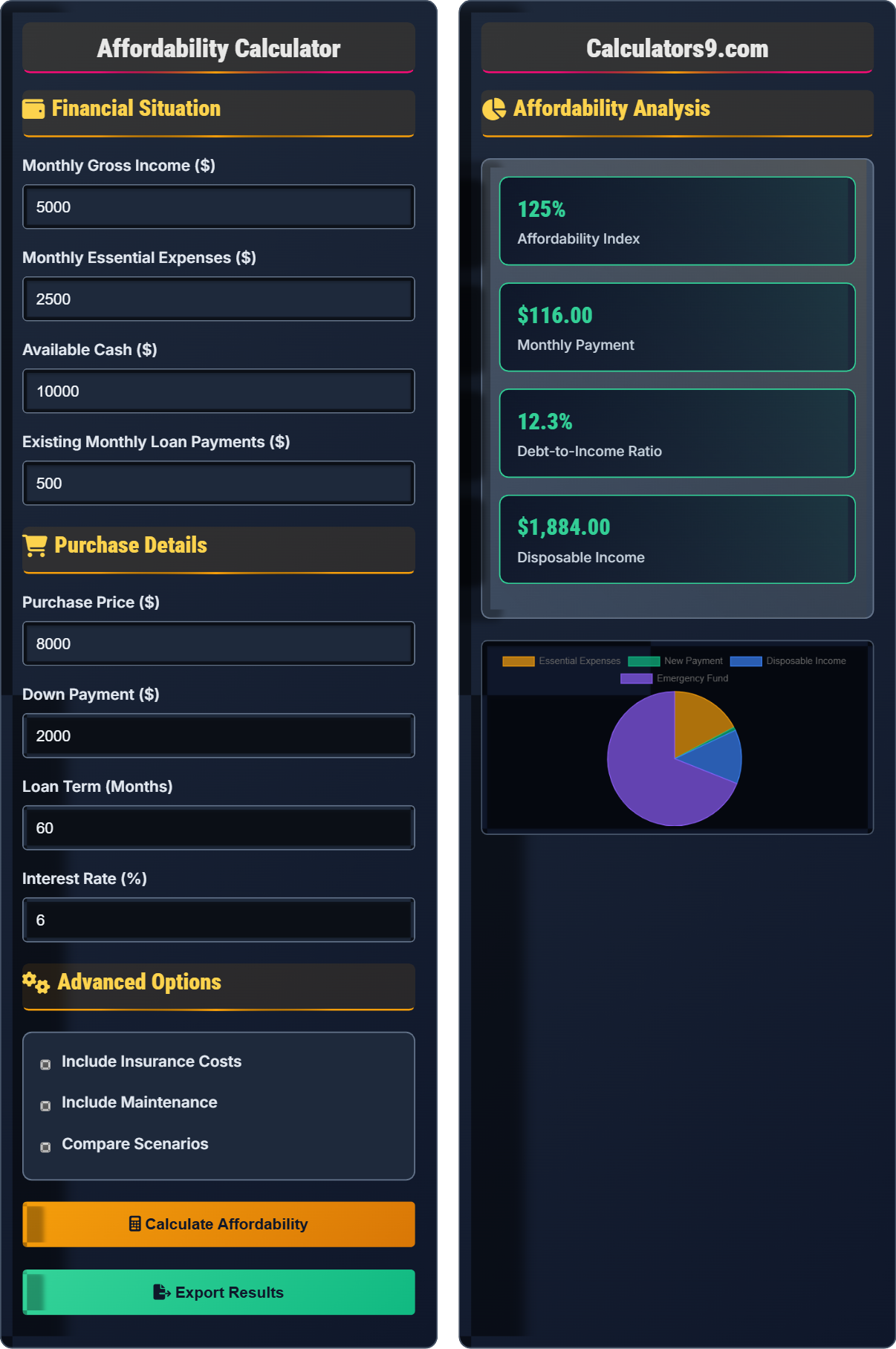
Affordability Analysis
| Item | Amount | Notes |
|---|---|---|
| Purchase Price | $8,000.00 | Initial cost |
| Down Payment | $2,000.00 | Upfront payment |
| Loan Amount | $6,000.00 | Financed amount |
| Interest | $900.00 | Over loan term |
| Insurance | $0.00 | Annual cost |
| Maintenance | $0.00 | Annual cost |
| Total Cost | $9,800.00 | Over lifetime |
| Metric | Value | Recommendation |
|---|---|---|
| Disposable Income | $2,000.00 | Good |
| Monthly Payment | $120.00 | Affordable |
| DTI Ratio | 35% | Acceptable |
| Emergency Fund | $5,000.00 | Adequate |
| Overall Affordability | Good | Proceed with caution |
Comprehensive Affordability Guide
Affordability refers to the financial capacity to make a purchase without compromising your financial stability. It considers not only the immediate cost but also ongoing expenses, opportunity costs, and the impact on your overall financial health. True affordability means you can make the purchase without sacrificing essential needs or significantly impacting your financial goals.
Key metrics to evaluate affordability include:
Where:
- Total Monthly Debt Payments: All recurring debt obligations
- Monthly Gross Income: Pre-tax monthly earnings
- Acceptable DTI: Below 36% is generally recommended
Financial experts recommend the following guidelines for maintaining affordability:
- Debt-to-Income Ratio: Keep below 36% of gross income
- Housing Expenses: Less than 28% of gross income
- Emergency Fund: 3-6 months of expenses saved
- Discretionary Spending: Limit to 15-20% of income
- Wait and Save: Delay purchases to build adequate funds
- Negotiate Terms: Seek better financing options or discounts
- Trade Down: Consider less expensive alternatives
- Bundle Purchases: Combine related expenses for savings
- Timing: Make purchases during promotional periods
Affordability Learning Quiz
If your monthly gross income is $6,000 and your total monthly debt payments (including the new purchase) are $2,400, what is your debt-to-income ratio?
The answer is B) 40%. Using the formula: DTI = (Total Monthly Debt / Monthly Gross Income) × 100. So DTI = ($2,400 / $6,000) × 100 = 0.4 × 100 = 40%. This ratio is approaching the upper limit of what's considered acceptable.
The debt-to-income ratio is a critical financial metric that lenders use to assess your ability to manage debt. A DTI of 40% means 40% of your income goes toward debt payments. Financial experts generally recommend keeping DTI below 36% for optimal financial health, though some lenders accept up to 43% for qualified borrowers.
Debt-to-Income Ratio (DTI): Percentage of income going to debt payments
Gross Income: Income before taxes and deductions
Total Monthly Debt: All recurring debt obligations
• DTI = (Total Monthly Debt / Monthly Gross Income) × 100
• Ideal DTI is below 36%
• Lenders often accept up to 43%
• Calculate DTI before making major purchases
• Pay down existing debt to improve DTI
• Consider income increases to improve ratio
• Forgetting to include all debt obligations
• Using net instead of gross income
• Not considering future debt obligations
If you have $12,000 in disposable funds and the total cost of a purchase is $10,000, what is the affordability index? Show your work.
Step 1: Use the formula: Affordability Index = (Available Funds / Total Cost) × 100
Step 2: Plug in values: Affordability Index = ($12,000 / $10,000) × 100
Step 3: Calculate: Affordability Index = 1.2 × 100 = 120%
Therefore, the affordability index is 120%.
The affordability index is a simple ratio that compares your available resources to the cost of a purchase. An index above 100% indicates you have more than enough funds to cover the cost. An index below 100% suggests the purchase exceeds your available resources. This metric helps quantify whether a purchase is financially feasible.
Affordability Index: Percentage measure of financial capacity
Available Funds: Money available after essential expenses
Total Cost: Full cost of the purchase including fees
• Affordability Index = (Available Funds / Total Cost) × 100
• Index > 100% = Affordable
• Index < 100% = Unaffordable
• Include all associated costs in total cost
• Consider opportunity cost of funds
• Factor in emergency fund needs
• Underestimating total cost
• Not accounting for ongoing expenses
• Using total income instead of disposable income
You earn $4,500 per month and have $1,800 in essential expenses. You're considering a purchase that would add $400 in monthly payments. What percentage of your disposable income would this consume?
Step 1: Calculate disposable income = $4,500 - $1,800 = $2,700
Step 2: Calculate percentage of disposable income = ($400 / $2,700) × 100
Step 3: Calculate = 0.148 × 100 = 14.8%
Therefore, the monthly payment would consume 14.8% of your disposable income.
This calculation helps determine if a monthly payment is reasonable relative to your available funds. A general rule is that major purchases shouldn't consume more than 10-15% of your disposable income. In this case, 14.8% is close to the upper limit, suggesting you should carefully consider the purchase.
Disposable Income: Income after essential expenses
Essential Expenses: Necessary living costs
Monthly Payment: Recurring cost of purchase
• Major purchases should be 10-15% of disposable income
• Calculate disposable income first
• Consider all monthly impacts
• Track your actual spending patterns
• Leave buffer room for unexpected expenses
• Consider seasonal variations in income
• Forgetting to subtract essential expenses
• Not considering other variable expenses
• Assuming income will remain constant
You're considering buying a car for $25,000 cash instead of investing the money. If you could earn 7% annually on investments, how much would you miss out on over 5 years by purchasing the car instead of investing?
Using the future value formula: FV = PV(1+r)^n
Where: PV = $25,000, r = 0.07, n = 5
Step 1: Calculate future value = $25,000 × (1.07)^5
Step 2: Calculate (1.07)^5 = 1.403
Step 3: Calculate FV = $25,000 × 1.403 = $35,075
Step 4: Calculate opportunity cost = $35,075 - $25,000 = $10,075
Therefore, you would miss out on $10,075 in potential investment returns.
Opportunity cost represents the potential benefits you give up when choosing one option over another. In this case, the opportunity cost of buying the car is the investment returns you could have earned. This concept is crucial in affordability analysis as it helps evaluate the true cost of a purchase beyond its sticker price.
Opportunity Cost: Value of next best alternative forgone
Future Value: Value of investment after growth
Compounding: Growth on principal and previous gains
• Consider opportunity cost in major purchase decisions
• Compound growth increases opportunity cost
• Higher returns = Higher opportunity cost
• Calculate opportunity cost for large purchases
• Consider both tangible and intangible benefits
• Factor in depreciation of purchased items
• Not considering the time value of money
• Forgetting to account for inflation
• Overlooking alternative uses of funds
According to financial experts, what is the recommended emergency fund size relative to monthly expenses?
The answer is B) 3-6 months. Financial experts consistently recommend maintaining an emergency fund of 3-6 months of essential expenses. This provides a safety net for unexpected events like job loss, medical emergencies, or major repairs while ensuring you don't tie up too much money in low-yielding accounts.
The emergency fund recommendation balances security with opportunity cost. Three months provides basic protection, while six months offers more comprehensive coverage for most people. Those with irregular income or higher job insecurity might consider even more. The fund should be easily accessible but not so large that it significantly impacts other financial goals.
Emergency Fund: Liquid savings for unexpected expenses
Essential Expenses: Minimum living costsFinancial Security: Protection against unforeseen events
• Maintain 3-6 months of essential expenses
• Keep fund in accessible account
• Rebuild after use
• Start with small amounts and build gradually
• Prioritize emergency fund before investments
• Consider higher amounts for irregular income
• Having no emergency fund
• Using emergency fund for non-emergencies
• Not rebuilding after using the fund
Affordability Fundamentals
Affordability Index = (Available Funds / Total Cost) × 100
DTI Ratio = (Total Monthly Debt / Monthly Gross Income) × 100
Keep below 36% for optimal financial health.
- DTI ratio should be below 36%
- Major purchases should be 10-15% of disposable income
- Maintain 3-6 months emergency fund
- Consider opportunity cost of large purchases
Advanced Affordability Strategies
Evaluate the potential returns lost when choosing to make a purchase instead of investing.
- Improve debt-to-income ratio
- Build emergency fund
- Optimize income and expenses
- Shop for better financing terms
- Consider timing of major purchases
- Impact on other financial goals
- Future income stability
- Depreciation of purchased items
- Insurance and maintenance costs
FAQ
Q: How do I know if I can afford a major purchase without hurting my finances?
A: Before making a major purchase, evaluate these key factors:
Financial Health Indicators:
- Debt-to-income ratio: Keep below 36% of gross income
- Emergency fund: Maintain 3-6 months of essential expenses
- Disposable income: Ensure you have sufficient funds after essential expenses
- Payment impact: New payment shouldn't exceed 10-15% of disposable income
Additional Considerations:
- Opportunity cost: Could the money generate better returns invested?
- Depreciation: Will the item lose significant value over time?
- Insurance and maintenance: Factor in ongoing costs
- Timing: Consider your job stability and future financial goals
Our affordability calculator helps you assess all these factors simultaneously.
Q: Should I use cash or finance a major purchase?
A: The decision depends on several factors:
Use Cash When:
- You have adequate emergency funds
- The purchase price is less than 10-20% of your liquid assets
- You'd pay more in interest than you'd earn investing the cash
- The item appreciates or provides significant utility
Finance When:
- Interest rates are low (below 4-5%)
- You can earn more investing than paying interest
- Cash flow is tight but manageable
- Keeping cash liquid provides flexibility
Consider the opportunity cost of tying up cash in a depreciating asset. If you can invest the cash at a higher rate than your financing cost, financing may be advantageous.