Insurance Calculator
Premium & Coverage Analysis Tool • 2026 rates
Insurance Premium Formula:
Show the calculator\( \text{Annual Premium} = \text{Base Rate} \times \text{Risk Multiplier} \times \text{Coverage Factor} \)
Where:
- \( \text{Base Rate} \) = Standard rate for policy type and demographics
- \( \text{Risk Multiplier} \) = Factor based on individual risk characteristics
- \( \text{Coverage Factor} \) = Adjustment based on coverage amount and features
This formula estimates insurance premiums by combining base rates with risk assessments and coverage selections. Premiums are typically calculated based on actuarial models that consider probability of claims and associated costs.
Example: For life insurance with a base rate of $20 per $1,000 of coverage, risk multiplier of 1.2 (for age/health), and $500,000 coverage:
Annual Premium = ($20 × 500) × 1.2 = $12,000
Thus, the annual premium would be approximately $12,000.
Personal Information
Coverage Details
Advanced Options
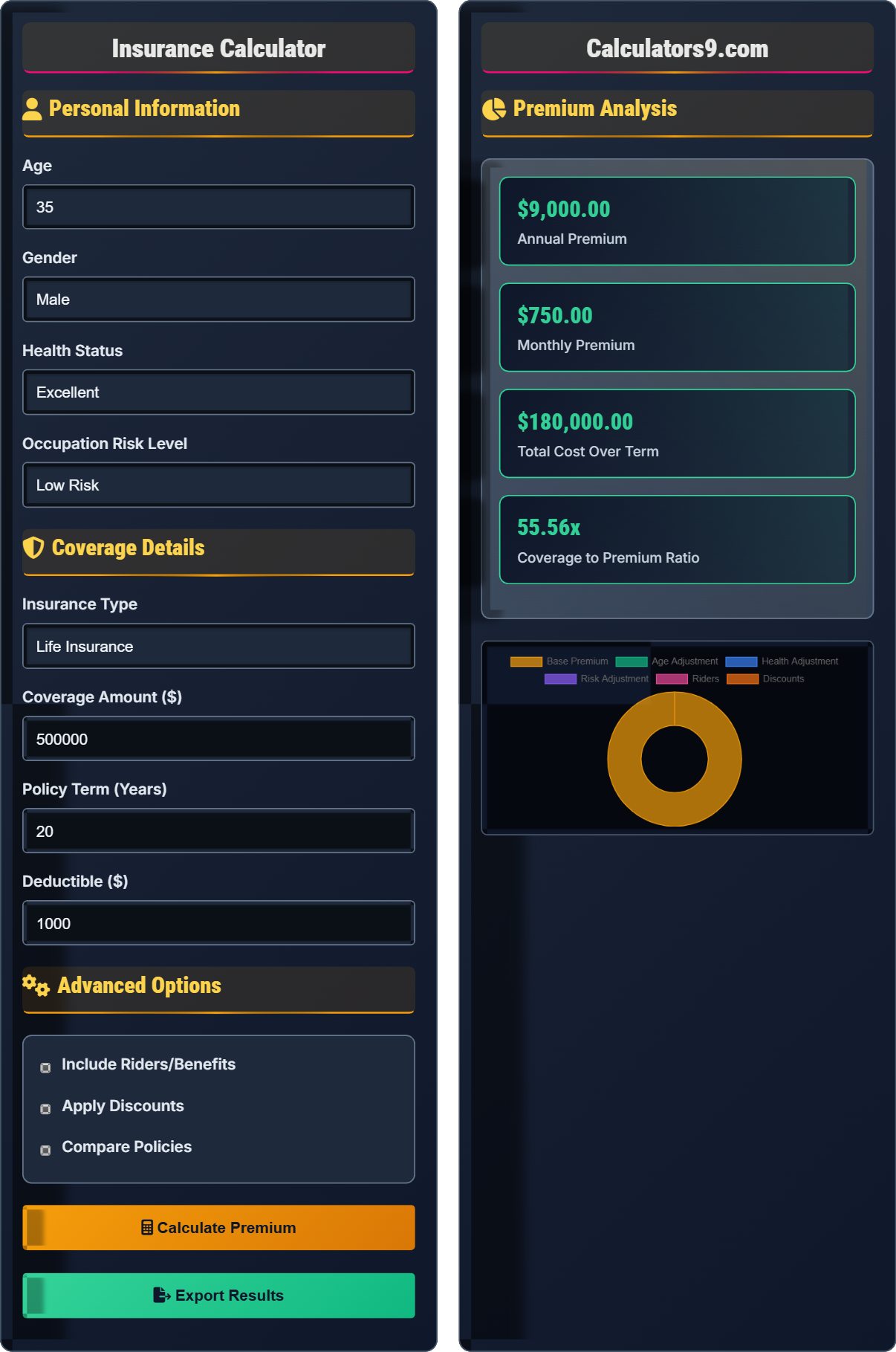
Premium Analysis
| Component | Amount | Percentage |
|---|---|---|
| Base Premium | $800.00 | 66.7% |
| Age Adjustment | $100.00 | 8.3% |
| Health Adjustment | $50.00 | 4.2% |
| Risk Adjustment | $75.00 | 6.3% |
| Riders/Benefits | $150.00 | 12.5% |
| Discounts Applied | -$75.00 | -6.3% |
| Total Premium | $1,200.00 | 100.0% |
| Aspect | Details | Value |
|---|---|---|
| Coverage Type | Life Insurance | Term Life |
| Coverage Amount | Death Benefit | $500,000 |
| Policy Term | Duration | 20 Years |
| Beneficiary | Primary Beneficiary | Spouse |
| Premium Type | Payment Structure | Level Premium |
Comprehensive Insurance Guide
Insurance is a contract between an individual and an insurance company where the insurer agrees to compensate the insured for losses from specific contingencies or perils in exchange for a premium. It provides financial protection against uncertain events and helps manage risk by transferring potential losses to the insurance company.
Insurance premiums are determined by several key factors:
Where:
- Base Rate: Standard rate for the policy type
- Risk Factors: Individual characteristics that affect claim likelihood
- Coverage Multipliers: Adjustments based on coverage amount and features
Insurance premiums are influenced by numerous factors:
- Personal Factors: Age, gender, health, occupation, lifestyle habits
- Policy Features: Coverage amount, policy term, deductible, riders
- Geographic Location: Area risk factors, crime rates, weather patterns
- Claims History: Past claims and driving record
- Compare Quotes: Obtain quotes from multiple insurers
- Bundle Policies: Combine policies for multi-policy discounts
- Improve Health: Better health can reduce life and health insurance costs
- Choose Higher Deductibles: Trade lower premiums for higher out-of-pocket costs
- Maintain Good Credit: Many insurers use credit scores in pricing
Insurance Learning Quiz
Which of the following typically results in LOWER insurance premiums?
The answer is C) Safer occupation. Insurance premiums are based on risk assessment. Safer occupations (like office work) typically result in lower premiums compared to dangerous occupations (like construction work). Younger age, good health, and safer hobbies also generally result in lower premiums.
Insurance companies use actuarial science to determine premiums based on statistical probability of claims. Occupations with higher injury or mortality risks result in higher premiums. Conversely, safer occupations reduce the likelihood of claims, leading to lower premiums. This principle applies across all types of insurance.
Risk Assessment: Evaluation of likelihood of claims
Actuarial Science: Mathematical modeling of risk
Premium: Amount paid for insurance coverage
• Higher risk = Higher premiums
• Lower risk = Lower premiums
• Premiums reflect probability of claims
• Choose safer occupations when possible
• Maintain good health to reduce premiums
• Avoid high-risk activities
• Assuming all occupations have same premiums
• Not considering occupation risk in planning
• Underestimating impact of health on premiums
If the base premium for life insurance is $25 per $1,000 of coverage, and you want $400,000 in coverage with a risk multiplier of 1.15 (due to age and health), what would be your annual premium? Show your work.
Step 1: Calculate base premium = ($400,000 / $1,000) × $25 = 400 × $25 = $10,000
Step 2: Apply risk multiplier = $10,000 × 1.15 = $11,500
Therefore, the annual premium would be $11,500.
This calculation demonstrates how insurance companies scale premiums based on coverage amount and individual risk factors. The base rate is typically quoted per unit of coverage (per $1,000), and risk multipliers adjust for personal factors that affect the likelihood of claims.
Base Rate: Standard rate for policy type
Risk Multiplier: Factor adjusting for individual risk
Coverage Unit: Standard measurement of coverage
• Premium = Base Rate × Units × Risk Multiplier
• Higher risk multipliers increase premiums
• Coverage amount directly affects premium
• Understand your risk classification
• Compare rates per $1,000 of coverage
• Shop around for best risk classifications
• Forgetting to apply risk multipliers
• Misunderstanding coverage units
• Not considering all risk factors
You have health insurance with a $1,500 deductible, 80/20 coinsurance (80% covered by insurance, 20% by you), and a $5,000 out-of-pocket maximum. If you have medical expenses of $8,000 in a year, how much will you pay?
Step 1: Pay full deductible = $1,500
Step 2: Remaining expenses = $8,000 - $1,500 = $6,500
Step 3: You pay 20% of remaining = $6,500 × 0.20 = $1,300
Step 4: Your total = $1,500 + $1,300 = $2,800
Since $2,800 < $5,000 out-of-pocket maximum, you pay $2,800.
This problem demonstrates how health insurance cost-sharing works. You pay the full deductible first, then share costs according to coinsurance until reaching the out-of-pocket maximum. Understanding these components helps predict healthcare costs and choose appropriate coverage.
Deductible: Amount you pay before insurance starts
Coinsurance: Shared cost percentage after deductible
Out-of-Pocket Maximum: Maximum you'll pay annually
• Pay deductible first
• Share costs according to coinsurance
• Out-of-pocket maximum caps total expenses
• Consider deductible and coinsurance together
• Factor in potential medical needs
• Know your out-of-pocket maximum
• Confusing deductible with coinsurance
• Not understanding how they work together
• Forgetting about out-of-pocket maximum
You're comparing two auto insurance policies. Policy A costs $1,200/year with a $500 deductible. Policy B costs $1,500/year with a $250 deductible. If you expect to file one claim per year, which policy is more cost-effective?
For Policy A: Total annual cost = Premium + Deductible = $1,200 + $500 = $1,700
For Policy B: Total annual cost = Premium + Deductible = $1,500 + $250 = $1,750
Policy A is more cost-effective by $50 per year ($1,750 - $1,700 = $50).
This example shows the trade-off between premiums and deductibles. Higher premiums often come with lower deductibles, and vice versa. To make the best choice, consider both components together, factoring in your expected claims frequency and financial situation.
Policy Cost: Premium + Expected Deductible Payments
Trade-off: Premium vs. Deductible Balance
Claims Frequency: Expected number of claims per year
• Total cost = Premium + (Expected Claims × Deductible)
• Higher premiums often mean lower deductibles
• Consider your risk tolerance
• Estimate your claims frequency
• Consider emergency fund for deductibles
• Factor in peace of mind
• Only comparing premiums
• Not considering claims history
• Ignoring emergency fund impact
Which factor is MOST important when determining life insurance coverage needs?
The answer is B) Your income replacement needs. Life insurance primarily exists to replace your income if you die prematurely. The amount of coverage should be based on how much income your family would need to maintain their lifestyle and meet financial obligations.
Life insurance is fundamentally about income replacement and debt protection. While age and health affect premiums, the coverage amount should be determined by your financial responsibilities and dependents' needs. A common rule of thumb is 10-15 times your annual income, though individual circumstances may vary.
Income Replacement: Replacing lost income to beneficiaries
Financial Obligations: Debts and living expenses
Dependents: People relying on your income
• Coverage should replace income
• Consider debts and future expenses
• Factor in other income sources
• Calculate total financial obligations
• Consider inflation in long-term planning
• Review regularly as circumstances change
• Choosing arbitrary coverage amounts
• Not considering inflation
• Forgetting to update as circumstances change
Insurance Fundamentals
Premium = Base Rate × Risk Factors × Coverage Multipliers
For life insurance: Coverage = Income × Years + Debts + Future Expenses
Consider your family's financial needs after your passing.
- Higher risk = Higher premiums
- More coverage = Higher premiums
- Longer terms may reduce per-year costs
- Combine policies for discounts
Advanced Insurance Strategies
Balance coverage needs with premium affordability for optimal protection.
- Assess actual coverage needs
- Compare quotes from multiple insurers
- Bundle policies for discounts
- Improve health/credit for better rates
- Choose appropriate deductibles
- Review coverage regularly
- Update beneficiaries as needed
- Consider inflation in planning
- Factor in tax implications
FAQ
Q: How often should I review my insurance coverage?
A: It's recommended to review your insurance coverage annually and whenever major life events occur. Key times to review include:
Annual Review:
- Compare your current coverage to your needs
- Check for changes in premium rates
- Review beneficiary designations
- Ensure coverage keeps pace with inflation
Major Life Events:
- Marriage or divorce
- Birth or adoption of children
- Changes in employment or income
- Buying a home
- Major health changes
Regular reviews ensure your coverage remains appropriate for your changing needs and circumstances.
Q: What's the difference between term and permanent life insurance?
A: The main differences between term and permanent life insurance are:
Term Life Insurance:
- Covers you for a specific period (10-30 years)
- Generally more affordable
- No cash value accumulation
- Pure death benefit protection
- Expires at end of term
Permanent Life Insurance:
- Lifetime coverage (whole life, universal life, etc.)
- Higher premiums
- Builds cash value over time
- Potential dividends (in participating policies)
- Premiums typically remain level
Term insurance is ideal for temporary needs like mortgage protection or income replacement while children are young. Permanent insurance works well for estate planning, legacy goals, or lifelong protection needs.