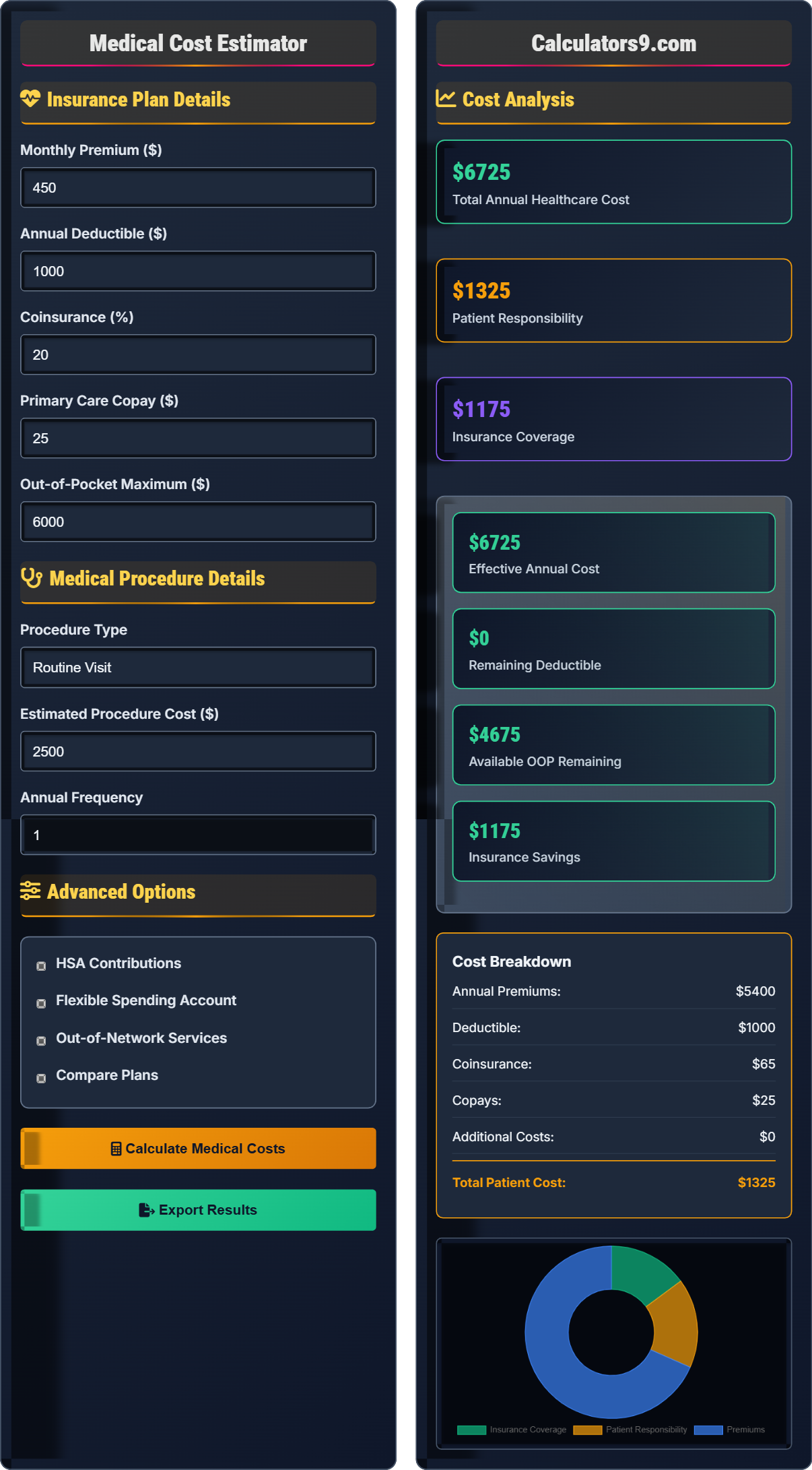
Medical Cost Estimator
Healthcare Expense Calculator • 2026 Costs
Medical Cost Estimation Formulas:
Show the calculatorTotal Medical Cost: \( \text{Total Cost} = \text{Deductible} + (\text{Medical Expense} - \text{Deductible}) \times \frac{\text{Coinsurance}}{100} + \text{Copays} \)
Out-of-Pocket Maximum: \( \text{OOP Max} = \text{Deductible} + \text{Copays} + (\text{Medical Expense} - \text{Deductible}) \times \frac{\text{Coinsurance}}{100} \)
Insurance Coverage: \( \text{Insurance Pays} = (\text{Medical Expense} - \text{Deductible}) \times (1 - \frac{\text{Coinsurance}}{100}) \)
Effective Cost: \( \text{Effective Cost} = \text{Premiums} + \text{Out-of-Pocket Costs} \)
These formulas help calculate patient responsibility for medical expenses under various insurance plans. The deductible is paid first, then coinsurance applies to remaining costs until reaching the out-of-pocket maximum.
Example: For a $10,000 medical procedure with a $1,000 deductible, 20% coinsurance, and $2,000 OOP maximum:
- Deductible: $1,000 (patient pays first)
- Remaining: $10,000 - $1,000 = $9,000
- Coinsurance: $9,000 × 0.20 = $1,800
- Total Patient Responsibility: $1,000 + $1,800 = $2,800
- Insurance Pays: $10,000 - $2,800 = $7,200
Insurance Plan Details
Medical Procedure Details
Advanced Options
Cost Analysis
Cost Breakdown
Comprehensive Healthcare Cost Guide
Healthcare costs in America involve multiple components that patients must navigate. Understanding how insurance works is crucial for effective healthcare planning. The Affordable Care Act established out-of-pocket maximums to protect consumers, but costs continue to rise faster than inflation. Healthcare spending reached $4.3 trillion in 2021, representing 18.3% of GDP.
Healthcare costs consist of several distinct elements:
- Premiums: Monthly payments for insurance coverage
- Deductible: Amount paid before insurance begins covering costs
- Coinsurance: Percentage of costs paid after deductible is met
- Copayments: Fixed amounts paid for specific services
- Out-of-Pocket Maximum: Maximum annual patient responsibility
Multiple factors influence healthcare expenses:
- Age: Older individuals typically have higher healthcare costs
- Location: Healthcare costs vary significantly by geographic region
- Health Status: Chronic conditions increase ongoing care needs
- Insurance Type: Different plans have varying cost-sharing structures
- Provider Networks: Out-of-network care costs more
- Choose Appropriate Plan: Match plan to expected healthcare usage
- Use Preventive Care: Free preventive services can prevent costly treatments
- Shop Around: Compare costs for non-emergency procedures
- Utilize HSA/FSA: Tax-advantaged accounts for medical expenses
- Generic Medications: Choose generics when available and appropriate
Insurance Concepts Explained
Amount paid before insurance begins covering costs. Higher deductibles mean lower premiums but higher initial costs.
Before insurance pays, you pay the full deductible amount. After meeting the deductible, coinsurance applies.
- Deductibles reset annually
- Family plans have individual and family deductibles
- Some services don't count toward deductible
Cost-Saving Strategies
Tax-advantaged account for high-deductible health plan holders to save for medical expenses.
- Contributions are tax-deductible
- Growth is tax-free
- Withdrawals for qualified expenses are tax-free
- Requires HDHP enrollment
- Contribution limits apply
- Unused funds roll over annually
- Can invest HSA funds after age 65
Healthcare Cost Learning Quiz
What happens after you meet your annual deductible?
The answer is B) You start paying coinsurance for covered services. After meeting your deductible, insurance begins covering a percentage of costs, and you pay the coinsurance portion. This continues until you reach your out-of-pocket maximum.
The deductible is the first layer of cost-sharing in health insurance. It's designed to reduce moral hazard by making patients partially responsible for their care. Once the deductible is satisfied, the coinsurance mechanism kicks in, sharing costs between the insurer and the patient according to predetermined percentages.
Deductible: The amount you pay for covered health care before your insurance plan starts to pay
Coinsurance: Your share of the costs of a covered health care service
Cost-Sharing: The portion of costs covered by the patient rather than insurance
• Deductibles reset annually on January 1st
• Some services (like preventive care) don't require meeting the deductible
• Family plans have individual and aggregate deductible limits
• Track your deductible progress through your insurance portal
• Plan major procedures after meeting your deductible to minimize costs
• Consider the total cost (premiums + deductible) when choosing plans
• Assuming insurance pays 100% after meeting the deductible
• Forgetting that some services don't count toward the deductible
• Not understanding the difference between deductible and out-of-pocket maximum
Calculate the total patient cost for a $8,000 medical procedure with a $1,500 deductible, 20% coinsurance, and a $6,000 out-of-pocket maximum. Assume this is the first medical procedure of the year.
Using healthcare cost formulas:
Given:
- Medical Procedure Cost: $8,000
- Deductible: $1,500
- Coinsurance: 20%
- OOP Maximum: $6,000
Step 1: Pay deductible first = $1,500
Step 2: Remaining after deductible = $8,000 - $1,500 = $6,500
Step 3: Coinsurance payment = $6,500 × 0.20 = $1,300
Step 4: Total patient responsibility = $1,500 + $1,300 = $2,800
Step 5: Verify against OOP maximum = $2,800 < $6,000, so patient pays $2,800
Therefore, the patient pays $2,800 and insurance pays $5,200.
This calculation demonstrates the sequential nature of healthcare cost-sharing. First, the deductible is applied to the total cost. Then, coinsurance applies to the remaining balance. The out-of-pocket maximum serves as a cap on total patient responsibility, protecting against catastrophic medical expenses.
Deductible: Amount paid before insurance coverage begins
Coinsurance: Percentage of costs paid after deductible is met
Out-of-Pocket Maximum: Maximum annual patient responsibility
• Deductible is paid first, then coinsurance applies
• Out-of-pocket maximum caps total patient responsibility
• These amounts reset annually
• Remember: Deductible → Coinsurance → Out-of-pocket maximum
• Use the formula: Patient cost = Deductible + (Remaining × Coinsurance %)
• Always verify against out-of-pocket maximum
• Adding coinsurance to the full procedure cost instead of the remaining amount
• Forgetting that deductible must be paid first
• Not considering the out-of-pocket maximum as a cap
Sarah has a health insurance plan with a $2,000 deductible, 30% coinsurance, and a $7,000 out-of-pocket maximum. She expects to have $15,000 in medical expenses this year, including routine visits and a planned surgery. What will be her total out-of-pocket costs for the year?
Step 1: Pay the full deductible = $2,000
Step 2: Remaining expenses after deductible = $15,000 - $2,000 = $13,000
Step 3: Calculate coinsurance = $13,000 × 0.30 = $3,900
Step 4: Calculate total patient responsibility = $2,000 + $3,900 = $5,900
Step 5: Verify against OOP maximum = $5,900 < $7,000, so within limit
Therefore, Sarah's total out-of-pocket costs for the year will be $5,900.
This example shows how to plan for annual healthcare expenses using insurance parameters. The calculation follows the same pattern as individual procedures but applied to the total expected annual expenses. Understanding these calculations helps in budgeting and choosing appropriate insurance plans.
Annual Deductible: The deductible amount resets each year
Total Annual Expenses: Sum of all expected medical costs in a year
Out-of-Pocket Maximum: Annual cap on patient responsibility
• Deductible applies to annual expenses, not per procedure
• Once OOP maximum is reached, insurance pays 100%
• These calculations are specific to each calendar year
• Plan expensive procedures after meeting deductible to minimize costs
• Track progress toward OOP maximum throughout the year
• Consider spreading procedures across years if beneficial
• Forgetting that deductibles reset annually
• Not considering the impact of multiple procedures in one year
• Confusing annual OOP maximum with per-incident limits
Mike is choosing between two health insurance plans. Plan A has a $1,000 deductible, 20% coinsurance, $400 monthly premium, and $5,000 OOP maximum. Plan B has a $3,000 deductible, 10% coinsurance, $200 monthly premium, and $6,000 OOP maximum. If Mike expects $12,000 in medical expenses this year, which plan would be cheaper for him?
For Plan A:
Step 1: Annual premiums = $400 × 12 = $4,800
Step 2: Deductible = $1,000
Step 3: Remaining after deductible = $12,000 - $1,000 = $11,000
Step 4: Coinsurance = $11,000 × 0.20 = $2,200
Step 5: Total patient responsibility = $1,000 + $2,200 = $3,200
Step 6: Total cost = $4,800 + $3,200 = $8,000
For Plan B:
Step 1: Annual premiums = $200 × 12 = $2,400
Step 2: Deductible = $3,000
Step 3: Remaining after deductible = $12,000 - $3,000 = $9,000
Step 4: Coinsurance = $9,000 × 0.10 = $900
Step 5: Total patient responsibility = $3,000 + $900 = $3,900
Step 6: Total cost = $2,400 + $3,900 = $6,300
Therefore, Plan B would be cheaper for Mike, saving him $1,700.
This example demonstrates the complexity of health insurance plan selection. Lower premiums don't necessarily mean lower total costs if you expect significant medical expenses. The optimal plan depends on your expected utilization and the balance between premiums, deductibles, and coinsurance. This is why it's crucial to estimate your annual medical expenses when choosing a plan.
Expected Medical Expenses: Projected healthcare costs for the upcoming year
Plan Selection: Choosing the most cost-effective insurance plan based on projected usage
Total Cost of Insurance: Premiums plus out-of-pocket expenses
• Total cost = Annual premiums + Out-of-pocket expenses
• High-deductible plans may be better for healthy individuals
• Low-deductible plans may be better for those expecting high usage
• Calculate total expected costs for each plan option
• Consider HSA eligibility with high-deductible plans
• Factor in preventive care benefits (usually free)
• Choosing plans based only on premium costs
• Not considering expected medical utilization
• Forgetting to factor in copayments and coinsurance
Which of the following is NOT a benefit of a Health Savings Account (HSA)?
The answer is C) Unlimited contribution amounts. HSAs have annual contribution limits set by the IRS. For 2023, the limits are $3,850 for individuals and $7,750 for families, with an additional $1,000 catch-up contribution allowed for those 55 and older.
HSAs offer unique triple tax advantages, making them valuable tools for healthcare cost management. However, they come with specific requirements and limitations. To qualify for an HSA, you must be enrolled in a High Deductible Health Plan (HDHP). The account is owned by the individual, not the employer, and funds roll over year to year.
Health Savings Account (HSA): Tax-advantaged medical savings account for HDHP holders
Triple Tax Advantage: Tax deduction, tax-free growth, tax-free withdrawals for medical expenses
High Deductible Health Plan (HDHP): Required plan type for HSA eligibility
• Must be enrolled in an HDHP to contribute to an HSA
• Annual contribution limits apply
• Funds can be invested for growth after a threshold
• Contribute the maximum amount if financially feasible
• Keep receipts for medical expenses to reimburse yourself later
• After age 65, use like a traditional IRA for non-medical expenses
• Contributing to an HSA without an eligible HDHP
• Exceeding annual contribution limits
• Not keeping receipts for potential future reimbursement
FAQ
Q: What's the difference between copay and coinsurance in health insurance?
A: Copay and coinsurance are both forms of cost-sharing but work differently:
Copay: A fixed dollar amount you pay for a specific service (e.g., $25 for a doctor visit, $10 for generic prescriptions). This amount is typically paid at the time of service and doesn't count toward your deductible.
Coinsurance: A percentage of the cost you pay after meeting your deductible (e.g., 20% of the cost after the deductible is met). For example, if your coinsurance is 20% and the service costs $100, you pay $20 and insurance pays $80.
Mathematically: \( \text{Copay} = \text{Fixed Amount} \) and \( \text{Coinsurance Payment} = \text{Service Cost} \times \frac{\text{Coinsurance \%}}{100} \)
Q: When should I consider a high-deductible health plan?
A: High-deductible health plans (HDHPs) may be suitable in several situations:
- Low expected healthcare usage: If you're generally healthy and don't anticipate frequent medical care
- Ability to pay higher out-of-pocket costs: When you can afford to pay the deductible if needed
- Want HSA benefits: If you want to take advantage of the triple tax benefits of an HSA
- Budget constraints: When premium costs are a primary concern
HDHPs typically have lower premiums but higher deductibles (at least $1,500 for individuals, $3,000 for families in 2023). The key is matching the plan to your expected healthcare utilization and financial capacity.