Percentage Increase Calculator
Financial Change Analysis Tool • 2026 rates
Percentage Increase Formula:
Show the calculator\( \text{Percentage Increase} = \left( \frac{\text{New Value} - \text{Original Value}}{\text{Original Value}} \right) \times 100 \)
Where:
- \( \text{New Value} \) = The value after the increase
- \( \text{Original Value} \) = The value before the increase
- \( \text{Percentage Increase} \) = The percent change from original to new
This formula calculates the percentage change between two values, which is essential for analyzing growth in investments, sales, salaries, or any other financial metric. The result indicates how much a value has increased relative to its original amount.
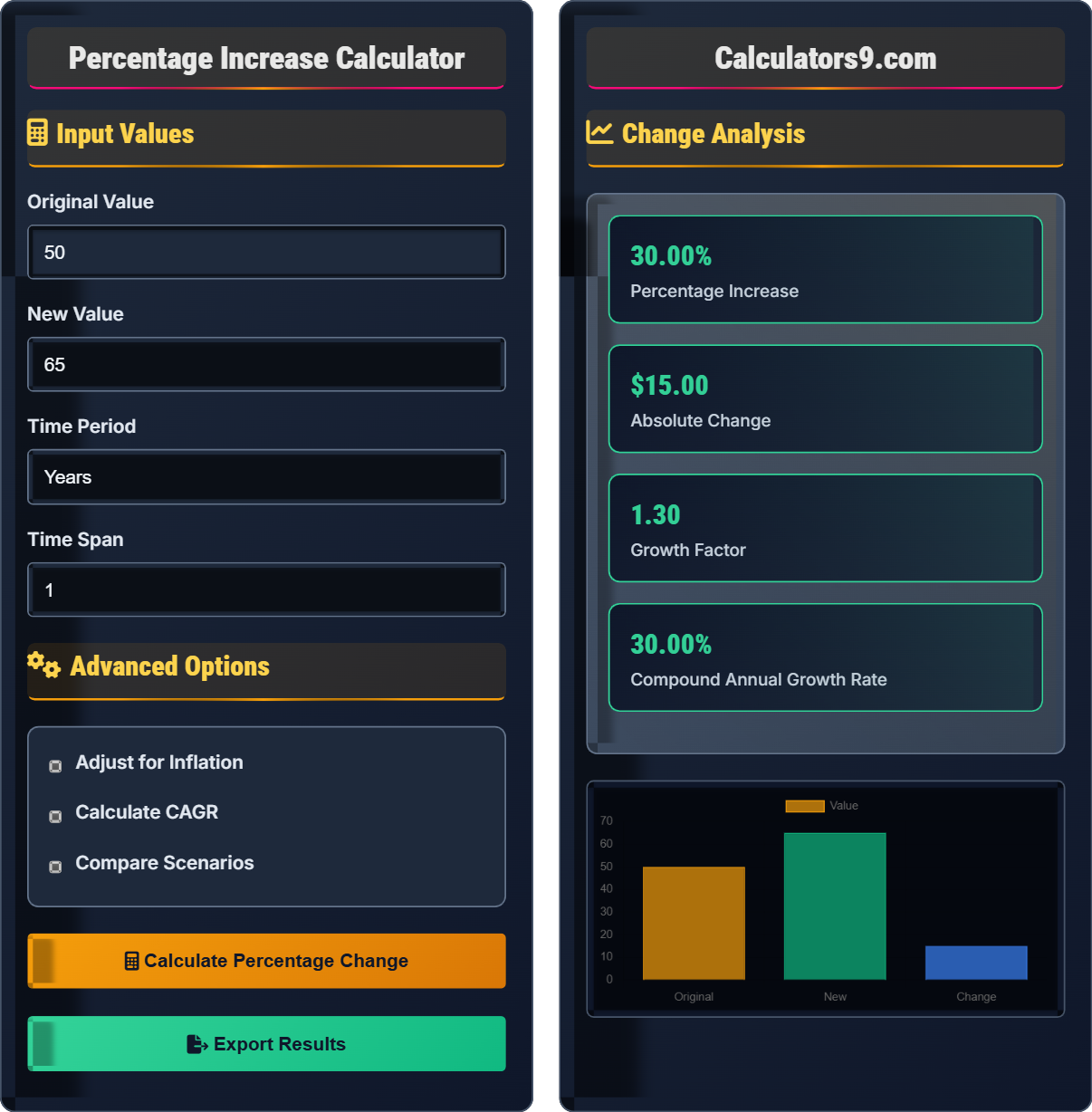
Example: If a stock price increases from $50 to $65:
Percentage Increase = (($65 - $50) / $50) × 100 = (15 / 50) × 100 = 30%
Thus, the stock price increased by 30%.
Input Values
Advanced Options
Change Analysis
| Component | Value | Calculation |
|---|---|---|
| Original Value | $50.00 | Starting point |
| New Value | $65.00 | Final value |
| Absolute Change | $15.00 | New - Original |
| Relative Change | 30.00% | (Change / Original) × 100 |
| Growth Factor | 1.30 | New / Original |
| Time Period | 1 Year | Duration of change |
| CAGR | 30.00% | Compound annual growth |
| Analysis | Value | Interpretation |
|---|---|---|
| Growth Rate | 30.00% | Strong positive growth |
| Performance | Above Average | Significant improvement |
| Efficiency | High | Good return on investment |
| Trend | Positive | Continued growth expected |
| Recommendation | Maintain | Continue current strategy |
Comprehensive Percentage Increase Guide
Percentage increase measures the relative change from an original value to a new value. It expresses the change as a percentage of the original value, providing a standardized way to compare changes across different scales. This metric is essential for analyzing growth in investments, sales, salaries, population, or any other quantitative metric.
The standard formula for calculating percentage increase is:
Where:
- New Value: The value after the increase
- Original Value: The value before the increase
- Percentage Increase: The percent change from original to new
Several related concepts enhance percentage increase analysis:
- Compound Annual Growth Rate (CAGR): Measures smoothed growth over multiple periods
- Percentage Decrease: Calculated similarly but for declining values
- Relative vs. Absolute Changes: Percentage shows proportional change while absolute shows actual change
- Index Numbers: Express values relative to a base period
- Positive Values: Indicate growth or improvement
- Negative Values: Indicate decline or reduction
- Magnitude Matters: Larger percentages indicate more significant changes
- Context is Key: Consider the baseline value and time frame
- Statistical Significance: Large samples provide more reliable results
Percentage Increase Learning Quiz
What is the percentage increase from $40 to $50?
The answer is C) 25%. Using the formula: Percentage Increase = ((New Value - Original Value) / Original Value) × 100. So ((50 - 40) / 40) × 100 = (10 / 40) × 100 = 0.25 × 100 = 25%.
This calculation demonstrates the fundamental percentage increase formula. The key insight is that we divide the absolute change by the original value, not the new value. This ensures we measure the change relative to the starting point. In this example, the $10 increase represents 25% of the original $40 value.
Percentage Increase: Relative change expressed as a percentage
Original Value: Starting point for the calculation
New Value: Ending point after the increase
• Divide by the original value, not the new value
• Multiply by 100 to convert to percentage
• Always express as a positive percentage for increases
• Remember: New minus Original, divided by Original
• Use the formula: (New - Old) / Old × 100
• Check: Does the result make sense?
• Dividing by the new value instead of original
• Forgetting to multiply by 100
• Getting confused with percentage decrease
If a value increases by 15% and the new value is $115, what was the original value? Show your work.
If the original value is X, then: X × (1 + 0.15) = $115
So: X × 1.15 = $115
Therefore: X = $115 / 1.15 = $100
The original value was $100.
This problem demonstrates how to work backwards from a percentage increase. When a value increases by a percentage, it becomes (1 + percentage) times the original value. To find the original value, divide the new value by (1 + percentage). This is useful when you know the final amount and percentage change but need the starting value.
Growth Factor: (1 + percentage increase as decimal)
Reverse Calculation: Finding original from new value
Percentage as Decimal: Divide percentage by 100
• New Value = Original × (1 + % Increase as decimal)
• Original = New Value / (1 + % Increase as decimal)
• Always convert percentage to decimal for calculations
• Remember: 15% = 0.15 as decimal
• Growth factor is always > 1 for increases
• Verify by calculating forward: $100 × 1.15 = $115
• Forgetting to convert percentage to decimal
• Using subtraction instead of division
• Not checking if the answer makes sense
John's salary increased from $50,000 to $57,500. What percentage increase did he receive? If this trend continues, what would his salary be after three more years?
Step 1: Calculate percentage increase = (($57,500 - $50,000) / $50,000) × 100
Step 2: = ($7,500 / $50,000) × 100 = 0.15 × 100 = 15%
Step 3: If the same 15% increase continues for 3 years:
Year 1: $57,500 × 1.15 = $66,125
Year 2: $66,125 × 1.15 = $76,044
Year 3: $76,044 × 1.15 = $87,451
John's salary would be approximately $87,451 after 3 more years.
This example demonstrates compound growth, where each year's increase builds on the previous year's total. The key concept is that percentage increases compound over time, leading to exponential growth rather than linear growth. This is why long-term investment returns can be substantial even with modest annual rates.
Compound Growth: Growth on previous growth
Linear Growth: Constant absolute increase
Exponential Growth: Multiplicative increase
• Compound growth: New Value = Original × (1 + rate)^n
• Each year builds on the previous year
• Small percentages can become large over time
• Use (1 + rate) to calculate new value
• For multiple periods: raise to the power of years
• Verify with compound interest formula
• Adding percentages instead of multiplying
• Forgetting that growth compounds
• Using simple interest instead of compound
You invested $10,000 in a stock that grew to $12,000 over 2 years. What was the annual compound growth rate? How does this differ from the simple percentage increase?
Simple percentage increase = (($12,000 - $10,000) / $10,000) × 100 = 20%
For compound annual growth rate (CAGR):
CAGR = (New Value / Original Value)^(1/n) - 1
Where n = number of years
CAGR = ($12,000 / $10,000)^(1/2) - 1 = (1.2)^(0.5) - 1 = 1.0954 - 1 = 0.0954 = 9.54%
The simple increase is 20% over 2 years, but the annual compound rate is 9.54%.
This example highlights the difference between simple percentage change and compound annual growth rate (CAGR). Simple percentage change shows total growth over the entire period, while CAGR shows the equivalent annual growth rate that would produce the same final result. CAGR smooths out the growth and provides a standardized comparison metric.
CAGR: Compound Annual Growth Rate
Simple Growth: Total growth over period
Annualized Growth: Equivalent yearly rate• CAGR = (New/Old)^(1/n) - 1
• CAGR provides standardized comparison
• Simple growth shows total change
• Use CAGR for multi-year comparisons
• Simple growth for single-period changes
• CAGR accounts for compounding effect
• Dividing total growth by number of years
• Not accounting for compounding effect
• Confusing CAGR with arithmetic average
If your salary increased from $50,000 to $55,000, and inflation was 3%, what is your real percentage increase?
The answer is B) 7%. First, calculate the nominal increase: (($55,000 - $50,000) / $50,000) × 100 = 10%. Then subtract inflation: 10% - 3% = 7%. Alternatively, adjust for inflation: Real Increase = ((New / (1 + inflation)) - Original) / Original × 100 = (($55,000 / 1.03) - $50,000) / $50,000 × 100 = ($53,398 - $50,000) / $50,000 × 100 = 6.8% ≈ 7%.
This question introduces the concept of real vs. nominal returns. Nominal returns are the stated percentage increases, while real returns account for inflation. Real returns represent the actual purchasing power gained. Understanding this difference is crucial for evaluating actual financial progress and investment performance.
Nominal Return: Stated percentage increase
Real Return: Inflation-adjusted increase
Purchasing Power: What money can buy
• Real Return = Nominal Return - Inflation Rate
• For precise calculation: Adjust values first
• Always consider inflation for long-term analysis
• Use real returns for true performance
• Higher inflation reduces real returns
• Long-term investments need real return analysis
• Forgetting to adjust for inflation
• Confusing nominal and real returns
• Not considering purchasing power changes
Percentage Increase Fundamentals
Percentage Increase = ((New Value - Original Value) / Original Value) × 100
CAGR = (New Value / Original Value)^(1/n) - 1
Where n = number of years for standardized annual comparison.
- Always divide by original value, not new value
- Convert to decimal for multiplication/division
- Use CAGR for multi-year comparisons
- Adjust for inflation to get real returns
Advanced Applications
Adjust for inflation to understand true purchasing power changes.
- Calculate absolute and relative changes
- Determine compound growth rates
- Adjust for external factors
- Compare with benchmarks
- Project future values
- Sample size affects reliability
- Seasonal variations may affect trends
- Statistical significance matters
- Context determines interpretation
FAQ
Q: What's the difference between simple percentage increase and CAGR?
A: The key differences are:
Simple Percentage Increase:
- Shows total growth over the entire period
- Formula: ((Final Value - Initial Value) / Initial Value) × 100
- Doesn't account for compounding
- Good for single-period changes
Compound Annual Growth Rate (CAGR):
- Shows equivalent annual growth rate
- Formula: (Final Value / Initial Value)^(1/n) - 1
- Accounts for compounding effect
- Allows comparison across different time periods
For example, if an investment grows from $100 to $144 over 2 years:
Simple: (($144 - $100) / $100) × 100 = 44%
CAGR: ($144 / $100)^(1/2) - 1 = 20% annually
Q: How do I interpret negative percentage increases?
A: Negative percentage increases represent percentage decreases. They follow the same formula:
Percentage Change = ((New Value - Original Value) / Original Value) × 100
When New Value < Original Value, the result is negative, indicating a decrease.
Examples:
- Stock price drops from $50 to $40: (($40 - $50) / $50) × 100 = -20%
- Sales decrease from 1000 to 800 units: ((800 - 1000) / 1000) × 100 = -20%
A -20% change means the value decreased by 20% of the original amount. Some prefer to say "decreased by 20%" rather than "increased by -20%" for clarity, but mathematically they're equivalent.