Personal Training Cost Calculator
Fitness Investment Planner • 2026 Rates
Personal Training Cost Formulas:
Show the calculatorIndividual Session Cost: \( \text{Total Cost} = \text{Session Rate} \times \text{Number of Sessions} \)
Package Discount: \( \text{Package Cost} = \text{Session Rate} \times \text{Sessions} \times (1 - \frac{\text{Discount \%}}{100}) \)
Per-Session Package Rate: \( \text{Per Session Rate} = \frac{\text{Package Cost}}{\text{Number of Sessions}} \)
Savings Calculation: \( \text{Savings} = (\text{Individual Rate} - \text{Package Rate}) \times \text{Sessions} \)
Monthly Investment: \( \text{Monthly Cost} = \frac{\text{Total Package Cost}}{\text{Months Duration}} \)
These formulas help calculate the true cost of personal training services, factoring in package discounts, session frequency, and long-term investment planning. Package deals typically offer 10-30% discounts compared to individual sessions.
Example: For a trainer charging $80/session with a 20% discount on 10-session packages:
- Individual cost: $80 × 10 = $800
- Package cost: $80 × 10 × 0.80 = $640
- Per-session package rate: $640 ÷ 10 = $64
- Savings: ($80 - $64) × 10 = $160
- Monthly cost (over 3 months): $640 ÷ 3 = $213.33
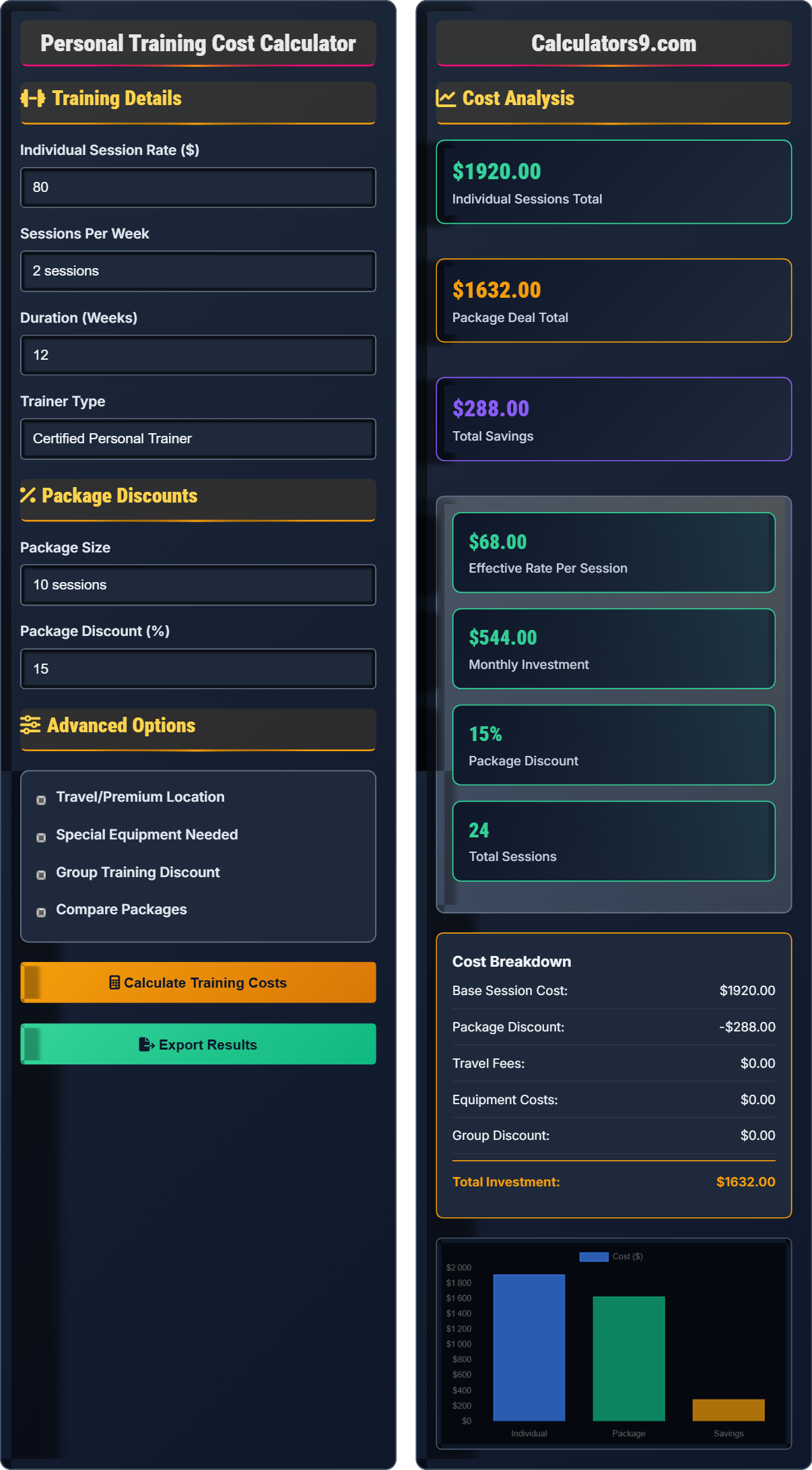
Training Details
Package Discounts
Advanced Options
Cost Analysis
Cost Breakdown
Comprehensive Personal Training Investment Guide
Personal training represents one of the most valuable investments in health and wellness. The average cost of personal training ranges from $40 to $150 per session depending on location, trainer credentials, and specialization. According to industry reports, certified personal trainers charge an average of $50-70 per session, while specialty trainers (nutrition, sports performance) command higher rates of $80-120 per session.
Personal training costs include several elements:
- Base Session Rate: Standard hourly fee charged by the trainer
- Package Discounts: Reduced rates for bulk session purchases
- Specialization Premium: Additional fees for specialized certifications
- Location Premium: Higher rates for travel or premium facilities
- Equipment Costs: Specialized equipment or materials fees
Multiple factors influence personal training pricing:
- Location: Urban areas typically command higher rates
- Experience: More experienced trainers charge premium rates
- Certifications: Additional specializations justify higher fees
- Session Type: In-person vs. online training affects pricing
- Package Size: Larger packages often include greater discounts
- Buy Packages: Most trainers offer 10-30% discounts for bulk purchases
- Group Training: Share costs with friends or family
- Off-Peak Hours: Some trainers offer discounts for non-prime times
- Corporate Programs: Many employers subsidize fitness programs
- Introductory Offers: New client packages often include discounts
Training Investment Analysis
Buying training sessions in packages typically offers significant savings compared to individual sessions.
Package pricing = Individual rate × Sessions × (1 - Discount %)
Effective per-session rate = Package total ÷ Number of sessions
- Package discounts typically range from 10-30%
- Larger packages usually offer better per-session rates
- Most packages expire after 6-12 months
Value Proposition
Personal training provides both monetary and non-monetary returns including improved health outcomes.
- Track fitness improvements and goal achievement
- Measure health markers (weight, blood pressure, etc.)
- Consider healthcare cost savings from prevention
- Evaluate increased energy and productivity
- Quality of instruction matters more than cost
- Consistency is key to seeing results
- Investment in health prevents future medical costs
- Match trainer expertise to your specific goals
Personal Training Investment Quiz
If a personal trainer charges $75 per session individually but offers a 20% discount on a 10-session package, what is the effective per-session rate in the package?
The answer is A) $60 per session. To calculate: Individual total = $75 × 10 = $750. Package total = $750 × (1 - 0.20) = $750 × 0.80 = $600. Effective rate = $600 ÷ 10 = $60 per session.
Package deals are a common pricing strategy in personal training that benefits both trainers and clients. Trainers receive guaranteed revenue and reduced administrative overhead, while clients receive discounted rates. The discount percentage is applied to the total package value, not per individual session.
Package Discount: A percentage reduction applied to the total cost of multiple training sessions
Effective Rate: The per-session cost after applying package discounts
Bulk Purchase: Buying multiple sessions together for a reduced rate
• Discount is applied to the total package value
• Effective rate = Total package cost ÷ Number of sessions
• Packages often expire after a set period
• Calculate the effective per-session rate to compare packages
• Consider your commitment level before buying large packages
• Factor in expiration dates when purchasing packages
• Confusing the discount percentage with the per-session savings amount
• Not calculating the true per-session rate after discount
• Forgetting to consider package expiration dates
Calculate the total cost and savings for a 15-session package where the individual session rate is $85 and the package discount is 18%. Also, find the effective per-session rate.
Using personal training cost formulas:
Given:
- Individual Session Rate: $85
- Number of Sessions: 15
- Package Discount: 18%
Step 1: Calculate individual total cost = $85 × 15 = $1,275
Step 2: Calculate package discount amount = $1,275 × 0.18 = $229.50
Step 3: Calculate package total cost = $1,275 - $229.50 = $1,045.50
Step 4: Calculate effective per-session rate = $1,045.50 ÷ 15 = $69.70
Step 5: Calculate total savings = $1,275 - $1,045.50 = $229.50
Therefore, the package costs $1,045.50, saves $229.50, and has an effective rate of $69.70 per session.
This calculation demonstrates the mathematical relationship between individual rates, package discounts, and effective per-session costs. The savings are realized immediately upon purchasing the package, and the effective rate remains consistent throughout the package duration.
Effective Rate: The per-session cost after applying package discounts
Package Savings: The difference between individual and package pricingDiscount Amount: The dollar value of the package discount
• Discount is calculated on the total package value
• Effective rate = Package total ÷ Number of sessions
• Savings = Individual total - Package total
• Use the formula: Effective rate = (Individual rate × (1 - Discount %))
• Compare effective rates across different package sizes
• Calculate monthly cost by dividing total by package duration
• Applying discount percentage directly to the per-session rate
• Forgetting to divide total package cost by number of sessions
• Calculating savings incorrectly as discount % × per-session rate
Sarah wants to train twice a week for 3 months (12 weeks). Her trainer charges $70 per session individually but offers a 15% discount on a 24-session package. If she purchases the package, what will be her monthly investment in personal training, and how much will she save compared to paying per session?
Step 1: Calculate total sessions needed = 2 sessions/week × 12 weeks = 24 sessions
Step 2: Calculate individual total cost = $70 × 24 = $1,680
Step 3: Calculate package discount = $1,680 × 0.15 = $252
Step 4: Calculate package total cost = $1,680 - $252 = $1,428
Step 5: Calculate monthly investment = $1,428 ÷ 3 months = $476
Step 6: Calculate total savings = $1,680 - $1,428 = $252
Therefore, Sarah's monthly investment will be $476, and she will save $252 compared to paying per session.
This example demonstrates how to plan personal training investments over time. By calculating the monthly cost, clients can better budget for their fitness investments. The savings calculation shows the immediate financial benefit of purchasing packages.
Monthly Investment: The average monthly cost of a fitness program
Duration Planning: Matching package size to training schedule
Cost Per Month: Total package cost divided by months of service
• Match package size to your training schedule
• Calculate monthly cost for budget planning
• Consider your commitment level before purchasing large packages
• Plan package size based on your training frequency and duration
• Calculate monthly cost to compare with other budget items
• Factor in package expiration when planning
• Not considering package expiration dates in planning
• Forgetting to calculate the monthly budget impact
Mike is comparing two personal training packages. Package A offers 10 sessions for $680 (originally $80/session). Package B offers 20 sessions for $1,200 (originally $80/session). Which package offers a better per-session rate, and what is the percentage discount for each package?
For Package A:
Step 1: Original cost = $80 × 10 = $800
Step 2: Per-session rate = $680 ÷ 10 = $68
Step 3: Discount = (($800 - $680) ÷ $800) × 100 = (120 ÷ 800) × 100 = 15%
For Package B:
Step 1: Original cost = $80 × 20 = $1,600
Step 2: Per-session rate = $1,200 ÷ 20 = $60
Step 3: Discount = (($1,600 - $1,200) ÷ $1,600) × 100 = (400 ÷ 1,600) × 100 = 25%
Therefore, Package B offers a better per-session rate of $60 compared to Package A's $68, with a higher discount of 25% versus 15%.
This example shows how to compare different package options mathematically. Larger packages often offer better per-session rates and higher discount percentages. This is a common pricing strategy that rewards client commitment with greater savings.
Package Comparison: Evaluating different package options based on per-session cost
Volume Discount: Greater discounts for larger package purchases
Effective Rate Comparison: Comparing true per-session costs
• Always calculate the effective per-session rate for comparison
• Larger packages often have better per-session rates
• Consider your ability to use all sessions before expiration
• Calculate per-session rate for accurate comparison
• Look for volume discounts in larger packages
• Consider your scheduling ability when choosing package size
• Comparing total package costs instead of per-session rates
• Not considering the discount percentage
• Choosing packages based only on total cost without considering value
Which of the following is NOT a valid consideration when evaluating the value of a personal training investment?
The answer is C) Lowest possible per-session rate regardless of quality. While cost is a factor, prioritizing lowest price over quality can lead to poor instruction, injury risk, and lack of progress toward fitness goals. The value of personal training comes from expertise, safety, motivation, and results, not just low cost.
Personal training is an investment in health and safety. The value proposition extends beyond just the per-session rate to include expertise, injury prevention, goal achievement, and accountability. Quality instruction from certified professionals often justifies higher rates through better results and safety.
Value Proposition: The combination of benefits received relative to the cost paid
Quality vs. Cost: Balancing price with the value received
Investment in Health: Viewing fitness expenses as long-term health investments
• Quality of instruction should be weighed against cost
• Consider the value of injury prevention
• Match trainer expertise to your specific goals
• Interview trainers to assess compatibility with your goals
• Consider the long-term value of proper instruction
• Factor in potential healthcare savings from injury prevention
• Choosing trainers based solely on price
• Not considering the risk of injury from poor instruction
• Undervaluing the expertise and accountability provided by trainers
FAQ
Q: Is it worth buying a personal training package or should I pay per session?
A: The decision depends on your commitment level and budget. Packages typically offer 10-30% discounts compared to individual sessions. For example, if individual sessions cost $80 each, a 10-session package might cost $680 ($68 per session), saving $120.
Mathematically: \( \text{Package Savings} = (\text{Individual Rate} - \text{Package Rate}) \times \text{Sessions} \)
Consider a package if you plan to train consistently for several months. If uncertain about your commitment, start with fewer sessions to evaluate the trainer and your progress.
Q: How much should I expect to pay for a quality personal trainer?
A: Personal training costs vary significantly based on location, experience, and specialization:
- Certified Personal Trainers: $40-70 per session
- Specialty Certified: $60-90 per session (nutrition, sports performance)
- Elite/Pro Athlete Trainers: $100-150+ per session
- Online/Remote Trainers: $30-60 per session
Urban areas typically command higher rates. Specialty certifications and extensive experience justify premium pricing. The national average is around $50-70 per session.