Home Value Estimator
Property valuation tool • 2026 edition
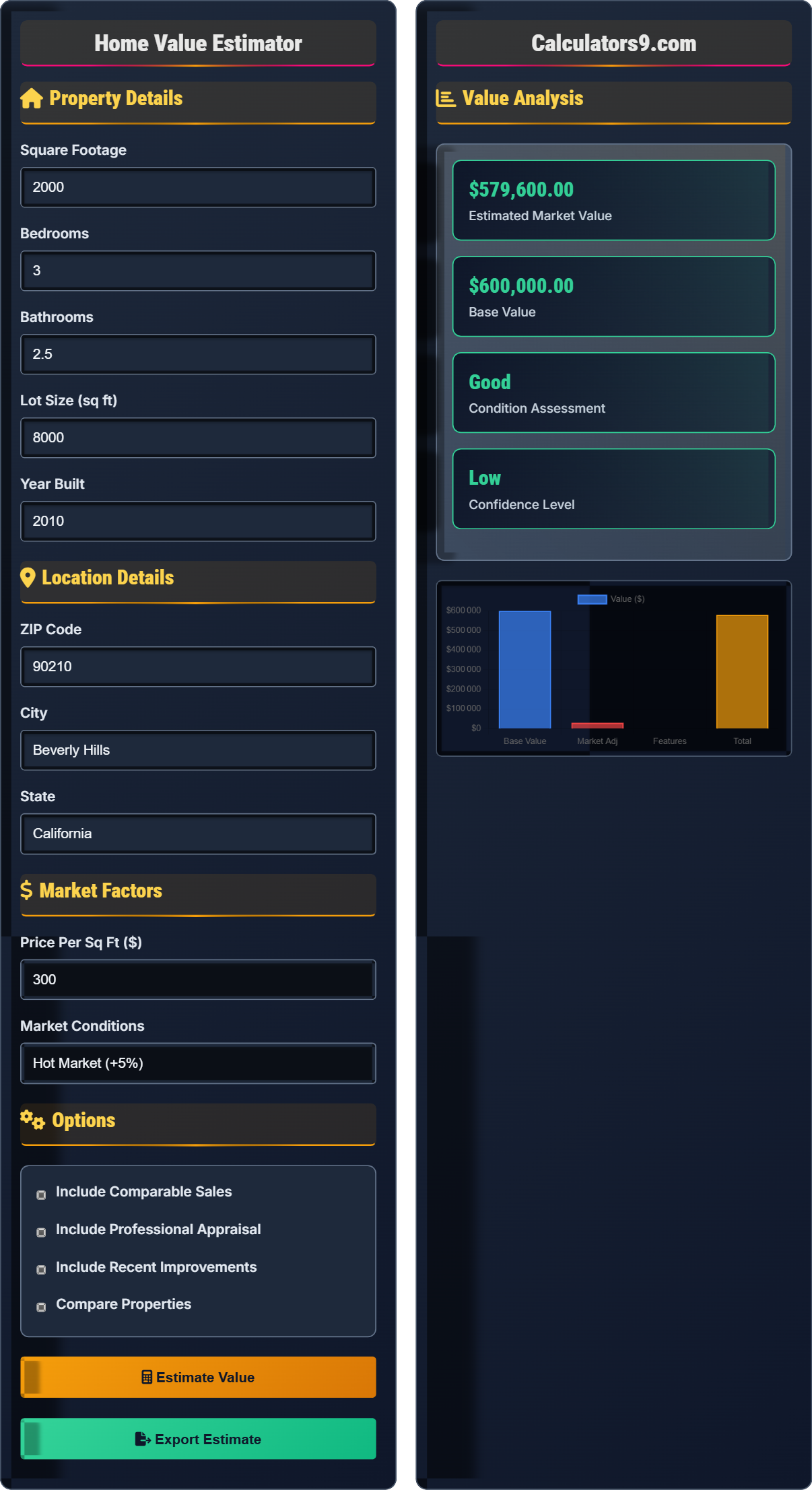
Home Value Estimation Formula:
Show the calculator\( Estimated Value = Base Value \times (1 + Market Adjustment) \times (1 + Feature Multiplier) \)
Where:
- \( Base Value = Square Footage \times Price Per Square Foot\)
- \( Market Adjustment = Local Market Conditions\)
- \( Feature Multiplier = Quality & Condition Factors\)
This formula calculates the estimated market value based on comparable sales, property features, and market conditions.
Example: For a 2,000 sq ft home with $150/sq ft in a normal market with average condition:
Base Value = 2,000 × $150 = $300,000
Estimated Value = $300,000 × (1 + 0) × (1 + 0) = $300,000
Thus, the estimated home value is $300,000.
Property Details
Location Details
Market Factors
Options
Value Analysis
| Component | Value | Notes |
|---|
| Address | Size | Price | Distance |
|---|
Comprehensive Home Value Estimation Guide
Home value estimation is the process of determining the approximate market value of a residential property. This value is influenced by numerous factors including location, physical characteristics, market conditions, and comparable sales. Accurate home value estimation is crucial for buyers, sellers, investors, and lenders to make informed decisions.
The most common methods for home value estimation include:
Where:
- \(Base Value = Square Footage \times Price Per Square Foot\)
- \(Market Adjustment = Local Market Conditions\)
- \(Feature Multiplier = Quality & Condition Factors\)
Different approaches to home value estimation:
- Comparative Market Analysis (CMA): Based on recent sales of similar properties
- Replacement Cost: Cost to rebuild the property minus depreciation
- Income Approach: For rental properties, based on potential rental income
- Automated Valuation Models (AVM): Computer algorithms using large datasets
- Research comparables: Look for similar properties sold within last 6 months
- Consider condition: Adjust for unique features or needed repairs
- Check market trends: Understand local market direction
- Get multiple estimates: Compare values from different sources
- Hire professionals: For accurate valuations, consider licensed appraisers
Home Value Estimation Learning Quiz
Which of the following factors has the MOST significant impact on home value?
The answer is B) Location. Real estate professionals often say "location, location, location" is the most important factor in property value. Location affects access to schools, employment centers, transportation, shopping, and other amenities. A house in a desirable neighborhood will typically hold its value better than a similar house in a less desirable area, regardless of the condition of the property.
Location is considered the most important factor because it's permanent and cannot be changed. While other features can be renovated or upgraded, the location remains fixed. Properties in growing neighborhoods with good schools, low crime rates, and convenient access to employment centers typically appreciate faster and maintain value better during market downturns.
Location Value: Premium associated with desirable neighborhood characteristics
Comparable Sales: Similar properties recently sold in the same area
Market Value: Price property would likely sell for in current market
• Location typically accounts for 70-80% of property value
• Physical improvements can enhance but not override location
• Neighborhood trends affect all properties in the area
• Research neighborhood appreciation rates
• Check school district ratings
• Consider future development plans
• Overvaluing property improvements relative to location
• Not researching comparable sales in the specific area
• Ignoring neighborhood crime statistics
Calculate the price per square foot for a 2,500 sq ft home that sold for $750,000. Then, if a similar home in the same area is 1,800 sq ft, estimate its value using the calculated price per square foot. Show your work.
Step 1: Calculate price per square foot
Price per sq ft = Sale Price ÷ Square Footage
Price per sq ft = $750,000 ÷ 2,500 = $300 per sq ft
Step 2: Estimate value of second home
Estimated Value = Square Footage × Price per sq ft
Estimated Value = 1,800 × $300 = $540,000
Therefore, the 1,800 sq ft home is estimated to be worth $540,000.
Price per square foot is a common metric used in real estate to compare properties of different sizes. However, it's important to note that this is a simplified method that doesn't account for other factors like lot size, condition, or unique features. It works best when comparing homes that are very similar in all aspects except size.
Price Per Square Foot: Sale price divided by total square footage
Comparable Sales: Recent sales of similar properties
Market Rate: Price properties typically sell for in current market
• Price per sq ft = Sale Price ÷ Square Footage
• Estimate Value = Square Footage × Price per sq ft
• Only use for similar properties in same area
• Compare properties built in similar time periods
• Consider only recent sales (within 6 months)
• Adjust for significant differences in features
• Using price per sq ft from different neighborhoods
• Not accounting for significant property differences
Sarah is trying to estimate the value of her 2,200 sq ft home with 4 bedrooms and 2.5 bathrooms. Three similar homes in her neighborhood sold recently: Home A (2,100 sq ft, 4 bed/2.5 bath) sold for $630,000, Home B (2,300 sq ft, 4 bed/2.5 bath) sold for $690,000, and Home C (2,000 sq ft, 3 bed/2 bath) sold for $580,000. Calculate the average price per square foot and estimate Sarah's home value.
Step 1: Calculate price per square foot for each comparable
Home A: $630,000 ÷ 2,100 = $300 per sq ft
Home B: $690,000 ÷ 2,300 = $300 per sq ft
Home C: $580,000 ÷ 2,000 = $290 per sq ft (adjust for fewer bedrooms)
Step 2: Calculate average price per sq ft (excluding Home C due to bedroom difference)
Average = ($300 + $300) ÷ 2 = $300 per sq ft
Step 3: Estimate Sarah's home value
Estimated Value = 2,200 × $300 = $660,000
Therefore, Sarah's home is estimated to be worth $660,000.
This example demonstrates the importance of selecting truly comparable properties. Home C had fewer bedrooms than Sarah's home, so it wasn't directly comparable despite similar square footage. When conducting a comparative market analysis, it's important to adjust for differences in features and only use properties that are truly similar to the subject property.
Comparative Market Analysis (CMA): Valuation method using recent comparable sales
Comparable Property: Similar property used for valuation purposes
Subject Property: Property being valued
• Only use properties sold within 6 months
• Match size, age, and features as closely as possible
• Adjust for significant differences in features
• Look for 3-5 recent comparable sales
• Consider properties within 1 mile radius
• Adjust for features like pools, garages, or views
• Using properties that are too different in size/features
• Not adjusting for significant property differences
• Using outdated comparable sales data
John owns a 2,500 sq ft home in a neighborhood where comparable homes are selling for $320 per square foot. However, the local market has been cooling, and recent sales are trending 8% below the previous peak. Additionally, John's home is in excellent condition, which typically adds 5% to value compared to average condition homes. Calculate the estimated value of John's home considering these market factors.
Step 1: Calculate base value
Base Value = Square Footage × Price per sq ft
Base Value = 2,500 × $320 = $800,000
Step 2: Apply market adjustment (cooling market = -8%)
Market Adjusted Value = $800,000 × (1 - 0.08) = $800,000 × 0.92 = $736,000
Step 3: Apply condition adjustment (excellent condition = +5%)
Final Estimated Value = $736,000 × (1 + 0.05) = $736,000 × 1.05 = $772,800
Therefore, John's home is estimated to be worth $772,800.
This example shows how multiple factors influence home value. Market conditions can significantly impact property values, sometimes more than physical features. John's excellent condition helped offset some of the market decline, but couldn't completely counteract the broader market trend. Understanding these dynamics helps in timing property sales or purchases.
Market Adjustment: Modification based on current market conditions
Condition Adjustment: Value modification based on property statePeak Market Value: Highest value during recent market cycle
• Market adjustments reflect supply and demand
• Condition adjustments typically range 3-10%
• Apply market adjustment first, then condition
• Monitor local market reports regularly
• Consider seasonal market variations
• Factor in economic indicators
• Overestimating condition improvements
• Not considering broader market trends
• Ignoring economic factors affecting the area
Which of the following scenarios would generally produce the MOST accurate home value estimate?
The answer is B) Local realtor's CMA with 5 comparables. A Comparative Market Analysis conducted by a local real estate professional who understands the specific neighborhood and has access to detailed information about recent sales will typically provide the most accurate estimate. Local knowledge of market conditions, property features, and neighborhood trends is crucial for accurate valuation.
Local expertise is crucial for accurate home value estimation because online tools may miss important neighborhood-specific factors. A local realtor understands the nuances of the area, recent market activity, and can make appropriate adjustments for property differences. The accuracy of any estimate depends heavily on the quality and relevance of the comparable sales data used.
Automated Valuation Model (AVM): Computer-generated property estimate
Comparative Market Analysis (CMA): Valuation by real estate professional
Accuracy Factors: Data quality, local expertise, market knowledge
• Local expertise improves accuracy significantly
• More recent comparable sales are better
• Physical inspection adds value to estimates
• Get multiple estimates for comparison
• Consider hiring a licensed appraiser for accuracy
• Compare online estimates with local assessments
• Relying solely on automated valuations
• Not considering local market knowledge
• Using outdated or irrelevant comparable sales
Valuation Fundamentals
Estimated market price based on comparable sales, features, and market conditions.
\( Estimated Value = Base Value \times (1 + Market Adjustment) \times (1 + Feature Multiplier) \)
Where Estimated Value=final estimate, Base Value=square footage × price per sq ft, Market Adjustment=local conditions, Feature Multiplier=property features.
- Location is most important factor
- Use recent comparable sales
- Adjust for property differences
Analysis Factors
Valuation based on recent sales of similar properties in the same area.
- Research comparable sales
- Adjust for differences
- Apply market conditions
- Validate with multiple methods
- Neighborhood affects all properties
- Recent sales data is most reliable
- Property condition matters
- Market trends influence value
FAQ
Q: How accurate are home value estimators compared to professional appraisals?
A: Home value estimators, including online tools, typically have a margin of error of 10-20% compared to professional appraisals. Professional appraisals are generally more accurate because they involve:
- Detailed interior and exterior inspections
- Accurate measurements of the property
- Consideration of unique features and condition
- Access to more comprehensive comparable sales data
- Adjustments for property-specific differences
Online estimators rely on public records and algorithms that may not capture property-specific details like recent renovations, unique features, or condition issues. For important decisions like buying, selling, or refinancing, a professional appraisal is recommended.
Q: What's the difference between assessed value and market value?
A: Assessed value and market value serve different purposes:
- Assessed Value: Determined by local government for tax purposes, usually updated annually or every few years. It's often lower than market value.
- Market Value: The price a willing buyer would pay and a willing seller would accept in an open market. It fluctuates with market conditions.
Assessed value is used to calculate property taxes, while market value is what you'd likely get if you sold the property today. Market value is generally more relevant for buying/selling decisions, while assessed value affects your tax obligations.