Real Estate Investment Calculator
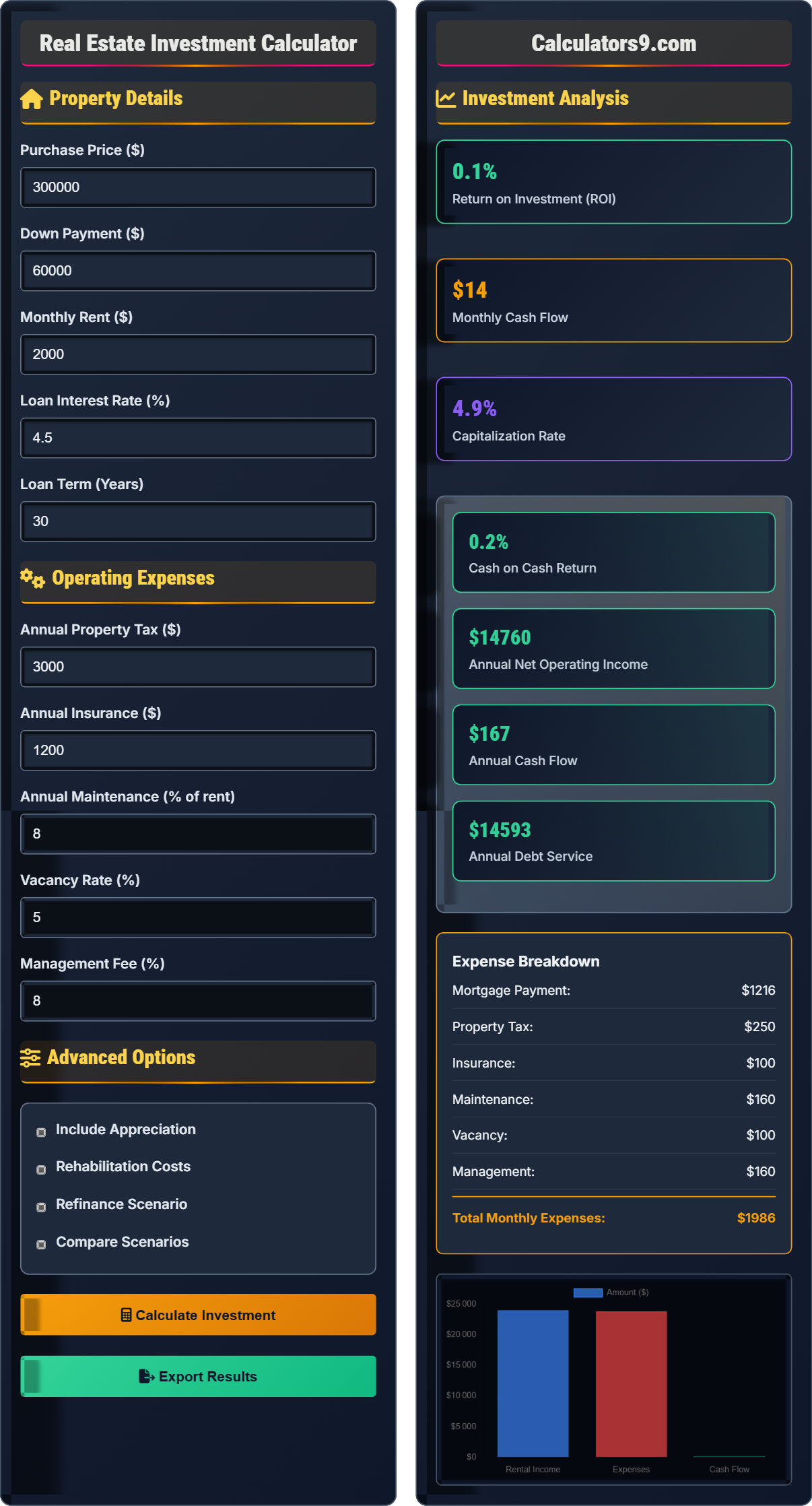
ROI & Cash Flow Analysis • 2026 Market Trends
Real Estate Investment Formulas:
Show the calculatorReturn on Investment (ROI): \( ROI = \frac{\text{Net Profit}}{\text{Total Investment}} \times 100 \)
Cash Flow: \( \text{Cash Flow} = \text{Rental Income} - \text{Total Expenses} \)
Capitalization Rate (Cap Rate): \( \text{Cap Rate} = \frac{\text{Net Operating Income}}{\text{Property Value}} \times 100 \)
Net Operating Income (NOI): \( \text{NOI} = \text{Rental Income} - \text{Operating Expenses} \)
Cash on Cash Return: \( \text{Cash on Cash} = \frac{\text{Annual Pre-Tax Cash Flow}}{\text{Total Cash Invested}} \times 100 \)
These formulas help investors evaluate the profitability and performance of real estate investments. ROI measures overall return, cash flow indicates monthly profit, and cap rate assesses property value efficiency.
Example: For a property purchased at $300,000 with $2,000 monthly rent, $800 monthly expenses, and $50,000 down payment:
- Annual Rental Income: $2,000 × 12 = $24,000
- Annual Expenses: $800 × 12 = $9,600
- Annual Cash Flow: $24,000 - $9,600 = $14,400
- ROI: ($14,400 / $300,000) × 100 = 4.8%
- Cash on Cash: ($14,400 / $50,000) × 100 = 28.8%
Property Details
Operating Expenses
Advanced Options
Investment Analysis
Expense Breakdown
Comprehensive Real Estate Investment Guide
Real estate investment involves purchasing, owning, managing, renting, or selling real estate for profit. Unlike other investments, real estate is a tangible asset that can provide multiple streams of income including rental income, appreciation, and tax benefits. Investors can participate in real estate through direct ownership, real estate investment trusts (REITs), or crowdfunding platforms.
Successful real estate investing requires understanding key metrics:
- Return on Investment (ROI): Measures total return relative to investment cost
- Cash Flow: Monthly income after all expenses
- Capitalization Rate: Measures return on investment property
- Cash on Cash Return: Annual return based on actual cash invested
- Gross Rent Multiplier: Ratio of property price to gross rental income
Property values are influenced by numerous factors:
- Location: Neighborhood quality, proximity to amenities, schools, and transportation
- Economic Conditions: Employment rates, income levels, and economic growth
- Interest Rates: Affects buyer affordability and demand
- Supply and Demand: Housing inventory levels relative to buyer demand
- Government Policies: Zoning laws, tax incentives, and housing regulations
- BRRRR Strategy: Buy, Rehab, Rent, Refinance, Repeat - build portfolio through equity
- Hold Long-Term: Buy and hold for appreciation and rental income
- House Hacking: Live in part of property while renting other units
- Wholesaling: Contract properties and assign rights to other investors
- REIT Investing: Passive real estate investment without property management
Investment Metrics Explained
Measures total return relative to investment cost, including appreciation and cash flow.
\( ROI = \frac{\text{Net Profit}}{\text{Total Investment}} \times 100 \)
Where Net Profit = (Rental Income + Appreciation) - (Expenses + Down Payment + Closing Costs).
- ROI above 8% is generally considered good
- Compare against other investment options
- Include all costs in calculation
Cash Flow Analysis
When rental income exceeds all operating expenses and debt service.
- Calculate total monthly rental income
- Subtract all monthly expenses
- Subtract monthly mortgage payment
- Result is monthly cash flow
- Account for vacancy periods
- Include maintenance reserves
- Factor in property management fees
- Consider tax implications
Real Estate Investment Learning Quiz
Which of the following best describes Return on Investment (ROI) in real estate?
The answer is B) The percentage return relative to the total investment made. ROI measures the efficiency of an investment by comparing the net profit to the total investment cost. It includes all returns (rental income, appreciation, tax benefits) relative to the money invested.
ROI is a fundamental metric in real estate investment that helps investors compare different properties and investment opportunities. It considers all sources of return including rental income, property appreciation, and tax advantages, providing a standardized way to measure investment performance regardless of property size or price.
Return on Investment (ROI): A performance measure used to evaluate the efficiency of an investment
Net Profit: Total returns minus all costs and expenses
Total Investment: All money put into the investment including down payment, closing costs, and rehab expenses
• ROI is expressed as a percentage
• Higher ROI indicates better investment performance
• Include all costs in ROI calculation for accuracy
• Use the formula: ROI = (Net Profit / Total Investment) × 100
• Compare ROI across different investment types
• Consider ROI alongside other metrics like cash flow
• Calculating ROI based only on rental income without considering appreciation
• Forgetting to include closing costs and rehab expenses in total investment
• Confusing ROI with cash flow yield
Calculate the ROI for a property purchased for $250,000 with a $50,000 down payment, generating $24,000 annual rental income, and having $10,000 in annual expenses. Assume no appreciation for this calculation.
Using the ROI formula: \( ROI = \frac{\text{Net Profit}}{\text{Total Investment}} \times 100 \)
Given:
- Purchase Price: $250,000
- Down Payment: $50,000
- Annual Rental Income: $24,000
- Annual Expenses: $10,000
Step 1: Calculate Net Profit = Annual Rental Income - Annual Expenses = $24,000 - $10,000 = $14,000
Step 2: Calculate Total Investment = Down Payment + Closing Costs + Other Initial Expenses
Assuming closing costs of $5,000: Total Investment = $50,000 + $5,000 = $55,000
Step 3: Calculate ROI = ($14,000 / $55,000) × 100 = 25.45%
Therefore, the ROI is 25.45%.
This calculation demonstrates the importance of leverage in real estate investing. By using a down payment of only 20% of the purchase price, the investor achieves a much higher ROI than if they had paid cash. This leverage effect amplifies returns when property values rise or generate positive cash flow.
Leverage: Using borrowed money to increase the potential return of an investment
Net Profit: Income after subtracting all expenses
Total Investment: All capital invested including down payment and acquisition costs
• Always include all acquisition costs in total investment
• Consider both cash flow and appreciation in ROI calculations
• Account for financing costs when calculating net profit
• Remember to include closing costs in total investment
• Factor in all expenses including management, maintenance, and vacancy
• Consider the impact of depreciation on taxes
• Forgetting to include closing costs in total investment
• Not accounting for all operating expenses
• Calculating ROI based only on purchase price instead of cash invested
Sarah purchases a rental property for $300,000 with a 20% down payment. Her monthly rent is $2,200, and her monthly expenses (including mortgage, taxes, insurance, maintenance, and management) total $1,450. What is her annual cash flow, and what percentage of her cash investment does this represent?
Step 1: Calculate monthly cash flow = Monthly rent - Monthly expenses = $2,200 - $1,450 = $750
Step 2: Calculate annual cash flow = Monthly cash flow × 12 = $750 × 12 = $9,000
Step 3: Calculate cash investment = Purchase price × Down payment percentage = $300,000 × 0.20 = $60,000
Step 4: Calculate cash on cash return = (Annual cash flow / Cash investment) × 100 = ($9,000 / $60,000) × 100 = 15%
Therefore, Sarah's annual cash flow is $9,000, representing a 15% cash-on-cash return on her $60,000 investment.
This example illustrates the concept of cash-on-cash return, which measures the return on the actual cash invested rather than the total property value. This metric is particularly important for leveraged investments where only a portion of the purchase price is paid in cash. The 15% return is quite favorable compared to other investment options.
Cash Flow: The net income generated by a property after all expenses
Cash on Cash Return: Annual pre-tax cash flow divided by total cash invested
Leverage: Using borrowed money to increase potential returns
• Cash flow = Rental income - All expenses including debt service
• Cash on cash return focuses on actual cash invested
• Positive cash flow indicates the property pays for itself
• Always budget for vacancy periods (typically 5-10% of rent)
• Include maintenance reserves (typically 1% of property value annually)
• Consider seasonal variations in rental income
• Forgetting to include mortgage payments in expenses
• Not accounting for vacancy periods and maintenance costs
• Confusing cash flow with profit after taxes
Mike is evaluating two properties in the same neighborhood. Property A is listed at $400,000 with expected annual net operating income of $28,000. Property B is listed at $350,000 with expected annual net operating income of $24,500. Calculate the cap rate for each property and determine which offers a better return on investment.
Using the cap rate formula: \( \text{Cap Rate} = \frac{\text{Net Operating Income}}{\text{Property Value}} \times 100 \)
For Property A:
Step 1: Cap Rate = ($28,000 / $400,000) × 100 = 7.0%
For Property B:
Step 1: Cap Rate = ($24,500 / $350,000) × 100 = 7.0%
Both properties have the same cap rate of 7.0%, indicating they offer the same return relative to their purchase prices. However, Property B costs $50,000 less, allowing Mike to potentially acquire more properties with the same investment capital.
The capitalization rate (cap rate) is a crucial metric for comparing properties in the same market. It normalizes returns by property value, allowing investors to compare apples-to-apples regardless of purchase price. A 7% cap rate is generally considered attractive in most markets, though it varies by location and property type. When cap rates are equal, consider other factors like appreciation potential, tenant quality, and property condition.
Capitalization Rate (Cap Rate): Expected rate of return on a real estate investment
Net Operating Income (NOI): Annual rental income minus operating expenses (excluding debt service)
Market Comparison: Using cap rates to compare similar properties in the same area
• Cap rate excludes debt service from calculations
• Research typical cap rates for your target market
• Higher cap rates often indicate higher risk or better deals
• Consider future cap rate compression when analyzing
• Including mortgage payments in NOI calculation
• Comparing cap rates across different markets or property types
• Not verifying the accuracy of stated NOI figures
Which real estate investment strategy typically involves buying a property below market value, improving it, and selling it quickly for profit?
The answer is B) Fix and Flip. This strategy involves purchasing properties that need repairs or are undervalued, renovating them to increase value, and selling them for a profit within a relatively short timeframe (usually 6-12 months). This strategy focuses on creating immediate value through improvements rather than long-term appreciation.
Fix and flip is a popular real estate investment strategy that requires careful analysis of after-repair value (ARV), renovation costs, and market timing. Success depends on accurately estimating repair costs, understanding local market values, and efficiently managing the renovation process. This strategy differs significantly from buy-and-hold approaches that focus on long-term appreciation and rental income.
Fix and Flip: Purchasing undervalued properties, renovating, and selling for profit
After Repair Value (ARV): Estimated property value after renovations are completed
70% Rule: Maximum purchase price should be 70% of ARV minus repair costs
• Follow the 70% rule: Purchase price ≤ (0.7 × ARV) - Repair costs
• Budget for unexpected renovation costs (add 10-20% buffer)
• Understand local market trends and buyer preferences
• Focus on kitchens and bathrooms for highest ROI renovations
• Network with contractors before starting projects
• Have financing lined up before finding properties
• Underestimating renovation costs and timeline
• Over-improving properties beyond neighborhood standards
• Not accounting for holding costs during renovation
FAQ
Q: What's the difference between cash flow and return on investment in real estate?
A: Cash flow and return on investment (ROI) are both critical metrics but measure different aspects of real estate investment performance.
Cash Flow: This is the monthly or annual income remaining after all expenses and debt service are paid. It represents the actual money going into your pocket. For example, if your rental income is $2,000/month and your total expenses (including mortgage) are $1,500/month, your cash flow is $500/month or $6,000 annually.
Return on Investment (ROI): This measures the total return relative to your investment cost. It includes cash flow, appreciation, and tax benefits as a percentage of your total investment. Using the same example: If you invested $50,000 as a down payment and closing costs, and your total annual return (cash flow + appreciation) is $7,000, your ROI would be ($7,000/$50,000) × 100 = 14%.
Mathematically: \( \text{Cash Flow} = \text{Rental Income} - \text{All Expenses} \) and \( ROI = \frac{\text{Net Profit}}{\text{Total Investment}} \times 100 \)
Q: What is a good cap rate for investment properties?
A: A "good" cap rate varies significantly based on location, property type, and market conditions. Generally speaking:
- 8-12%: Typically considered attractive for most markets
- 4-6%: More common in expensive, high-barrier-to-entry markets (like NYC or San Francisco)
- 10-15%: Found in emerging markets or areas with higher risk/reward profiles
However, cap rates should be evaluated within context. A 6% cap rate in Manhattan might be perfectly acceptable due to appreciation potential and stability, while the same rate in a smaller city might be too low. The cap rate formula is: \( \text{Cap Rate} = \frac{\text{Net Operating Income}}{\text{Property Value}} \times 100 \). Always compare cap rates to similar properties in the same submarket.