401k Early Withdrawal Penalty Calculator
Avoid unnecessary fees • 2026 rates
401k Early Withdrawal Penalties:
Show the calculatorEarly withdrawal penalty: 10% of withdrawn amount before age 59½, plus ordinary income tax.
For 2026, the standard penalty is 10% of the withdrawn amount plus applicable federal and state income taxes. However, several exceptions exist including first-time home purchases, qualified education expenses, and financial hardships.
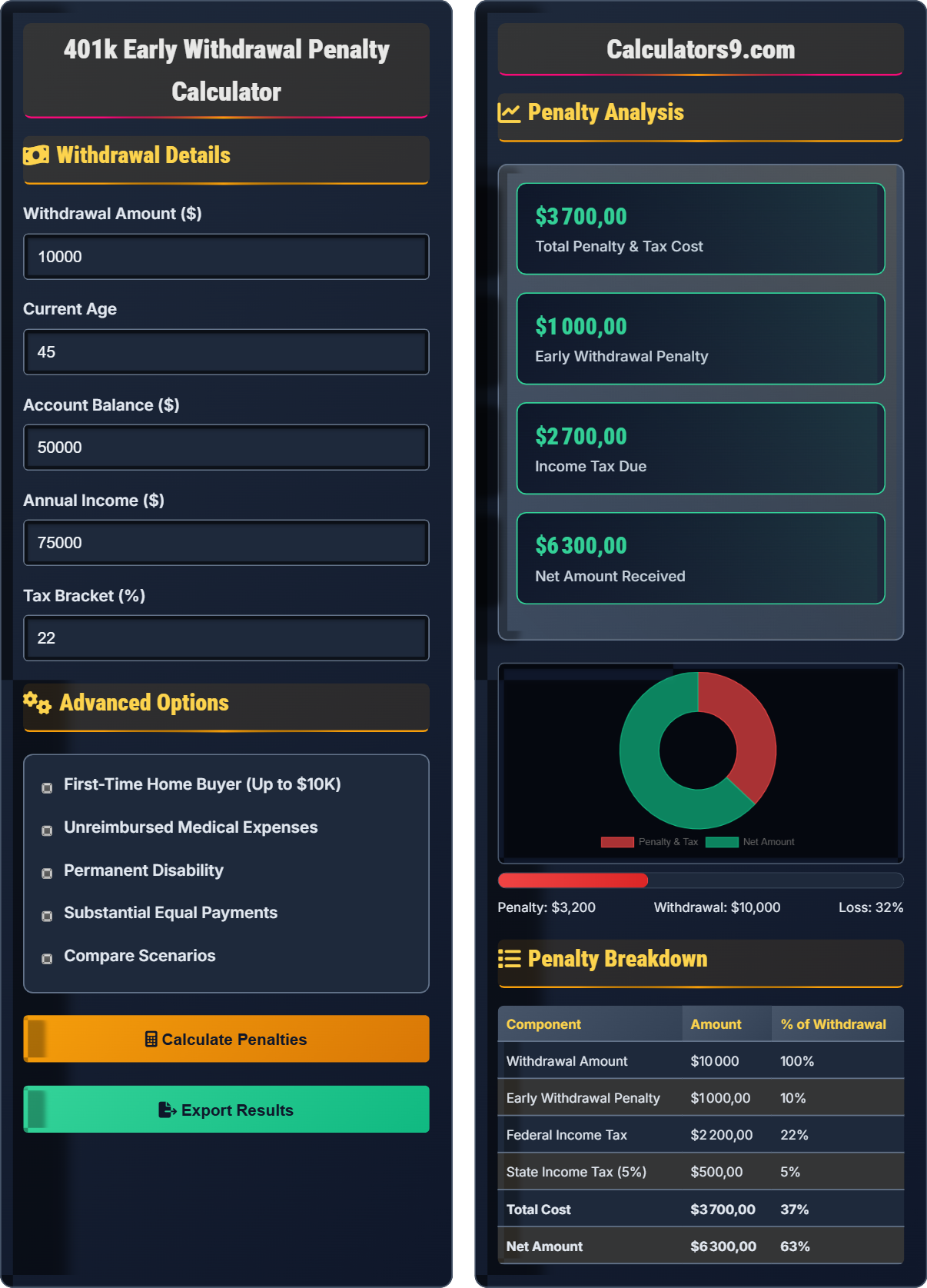
Example: For a $10,000 early withdrawal by someone in the 22% tax bracket:
- Penalty: $10,000 × 10% = $1,000
- Federal tax: $10,000 × 22% = $2,200
- Total cost: $3,200
Thus, early withdrawal of $10,000 would cost $3,200 in penalties and taxes.
Withdrawal Details
Advanced Options
Penalty Analysis
Penalty Breakdown
| Component | Amount | % of Withdrawal |
|---|---|---|
| Withdrawal Amount | $10,000 | 100% |
| Early Withdrawal Penalty | $1,000 | 10% |
| Federal Income Tax | $2,200 | 22% |
| State Income Tax (5%) | $500 | 5% |
| Total Cost | $3,700 | 37% |
| Net Amount | $6,300 | 63% |
Comprehensive 401k Guide
A 401k early withdrawal penalty is a 10% tax imposed by the IRS on distributions taken from a 401k account before the account holder reaches age 59½. In addition to the penalty, the withdrawn amount is subject to ordinary income tax. This double taxation can result in significant financial losses.
The total cost of an early withdrawal can be calculated as:
Where:
- 10% = Early withdrawal penalty rate
- Tax Rate = Combined federal and state tax rate
Before taking an early withdrawal, consider these alternatives:
- 401k Loan: Borrow from your account (typically up to $50K or 50%)
- Hardship Withdrawal: May waive penalty but still subject to tax
- Roth Conversion: Convert traditional to Roth for future flexibility
- Emergency Fund: Use non-retirement savings first
- Other Retirement Accounts: Consider SEP-IRA or Traditional IRA
- Maximize Employer Match: Contribute enough to get full company match
- Take Advantage of Catch-up: Additional $7,500 for those 50+
- Vesting Schedule: Understand your employer's vesting requirements
- Asset Allocation: Adjust based on age and risk tolerance
- Fee Awareness: Minimize administrative and investment fees
401k Basics
Employer-sponsored retirement account with tax advantages and employer matching.
Total Cost = (Withdrawal × 10%) + (Withdrawal × Tax Rate)
Where penalty is 10% plus applicable income taxes.
- Penalty applies before age 59½
- Exceptions exist for specific circumstances
- Taxes apply regardless of penalty
Strategies
Use penalty exceptions to access funds without 10% penalty.
- Explore alternative funding sources
- Check for qualifying exceptions
- Consider 401k loan option
- Plan for emergency fund
- Lost compound growth opportunity
- Double taxation effect
- Impact on retirement timeline
- Alternative funding availability
Penalty Exceptions
401k Penalty Learning Quiz
What is the standard early withdrawal penalty for taking money from a 401k before age 59½?
The answer is B) 10% penalty plus ordinary income tax. The IRS imposes a 10% early withdrawal penalty on distributions from retirement accounts before age 59½, in addition to ordinary income tax on the withdrawn amount.
This is known as the "double taxation" effect of early withdrawals. Not only do you lose the tax-deferred growth potential, but you also face immediate tax consequences. The penalty is designed to discourage premature retirement account withdrawals and preserve funds for retirement.
Early Withdrawal Penalty: 10% tax on distributions before age 59½
Ordinary Income Tax: Tax on withdrawn amount at regular income tax rate
Double Taxation Effect: Penalty plus income tax on withdrawal
• Standard penalty is 10% regardless of age (before 59½)
• Income tax applies in addition to penalty
• Exceptions exist for specific circumstances
• Remember "10% + tax" for early withdrawals
• Plan ahead to avoid penalties
• Explore exceptions before withdrawing
• Forgetting that income tax applies in addition to penalty
• Assuming younger individuals have lower penalties
• Not considering penalty exceptions
Calculate the total cost of an early withdrawal of $15,000 for someone in the 24% federal tax bracket with 5% state tax. Show your work.
Step 1: Calculate early withdrawal penalty = $15,000 × 10% = $1,500
Step 2: Calculate federal income tax = $15,000 × 24% = $3,600
Step 3: Calculate state income tax = $15,000 × 5% = $750
Step 4: Calculate total cost = $1,500 + $3,600 + $750 = $5,850
Step 5: Calculate net amount received = $15,000 - $5,850 = $9,150
Therefore, the total cost of the early withdrawal is $5,850.
This calculation demonstrates the significant cost of early withdrawals. The penalty alone ($1,500) represents 10% of the withdrawal, while taxes add another $4,350. This means 39% of the withdrawal is lost to penalties and taxes, leaving only $9,150 to be used.
Early Withdrawal Penalty: 10% tax on premature distributions
Federal Income Tax: Tax at federal marginal rate
State Income Tax: Tax at state marginal rate
• Penalty is always 10% regardless of tax bracket
• Income tax is based on marginal tax rate
• State tax varies by state of residence
• Always calculate total cost (penalty + tax)
• Consider state tax implications
• Compare with alternative funding options
• Forgetting to include state income tax
• Calculating only the penalty without taxes
• Not considering the percentage loss
Sarah is 52 years old and recently separated from her job. She needs $20,000 for a down payment on a house. Can she withdraw from her 401k without the 10% penalty? If so, what would be the tax implications?
Step 1: Check for age 55 exception - Sarah is 52, which is under 55, so the age 55 rule does not apply
Step 2: Check for first-time home buyer exception - She can withdraw up to $10,000 without the 10% penalty
Step 3: Calculate penalty for $10,000 withdrawal = $0 (no penalty)
Step 4: Calculate tax on $10,000 = $10,000 × tax rate
Step 5: For remaining $10,000, penalty = $10,000 × 10% = $1,000
Step 6: Tax on remaining $10,000 = $10,000 × tax rate
Therefore, Sarah can withdraw $10,000 penalty-free but would face a $1,000 penalty on the remaining $10,000.
This example illustrates the importance of understanding specific penalty exceptions. The age 55 rule requires separation from service in the year you turn 55 or later. The first-time home buyer exception allows up to $10,000 lifetime penalty-free withdrawals. Sarah would need to carefully consider if the partial exception is worth it.
Age 55 Rule: Penalty exception for separation at 55+
First-Time Home Buyer Exception: Up to $10K penalty-free withdrawal
Lifetime Limit: $10,000 limit across all transactions
• Age 55 rule requires separation in year of turning 55+
• First-time home buyer limit is $10,000 lifetime
• Remaining withdrawal subject to penalty
• Check all applicable exceptions before withdrawing
• Consider partial withdrawals to maximize exceptions
• Verify your eligibility for each exception
• Confusing age 55 rule with age 59½ rule
• Thinking first-time home buyer exception is unlimited
• Not considering partial exceptions
Mike withdraws $25,000 from his 401k at age 40. If he had left the money invested with an average annual return of 7%, how much would it have been worth at retirement (age 65)? What is the total cost including penalties and lost growth?
Using compound growth formula: FV = PV × (1 + r)^n
Where PV = $25,000, r = 0.07, n = 25 years
Step 1: Calculate future value = $25,000 × (1.07)^25 = $25,000 × 5.4274 = $135,685
Step 2: Calculate early withdrawal penalty = $25,000 × 10% = $2,500
Step 3: Calculate income tax (assuming 22%) = $25,000 × 22% = $5,500
Step 4: Calculate total direct cost = $2,500 + $5,500 = $8,000
Step 5: Calculate total cost including lost growth = $8,000 + $135,685 = $143,685
Therefore, Mike loses $143,685 by withdrawing early instead of waiting.
This demonstrates the concept of opportunity cost. The direct penalties and taxes represent immediate costs, but the real cost is the lost compound growth over decades. This is why early withdrawals can be devastating to long-term retirement security.
Compound Growth: Exponential growth of investments over time
Opportunity Cost: Value of what you give up by choosing one option
Time Value of Money: Money available now is worth more than same amount later• Lost growth compounds over time
• Opportunity cost increases with time horizon
• Early withdrawal affects long-term retirement security
• Calculate opportunity cost of early withdrawals
• Consider long-term impact before withdrawing
• Use time value of money calculations
• Only considering immediate penalties and taxes
• Not accounting for lost compound growth
• Underestimating long-term impact
Which of the following is NOT a viable alternative to taking an early 401k withdrawal?
The answer is C) Roth conversion and withdrawal from converted amount. While Roth conversions are possible, the converted amount is subject to the 5-year rule - you must wait 5 years after the conversion before withdrawing earnings penalty-free. Additionally, the conversion itself is a taxable event.
Understanding alternatives is crucial for retirement planning. 401k loans allow you to borrow from your account without penalties, though they must be repaid. Hardship withdrawals may waive the 10% penalty but still incur income tax. Waiting until 59½ eliminates all penalties.
401k Loan: Borrow against your account balance
Hardship Withdrawal: Withdrawal for immediate financial need
5-Year Rule: Time requirement for Roth conversion withdrawals
• 401k loans typically limited to $50K or 50% of balance
• Compare costs of all alternatives
• Consider loan options before withdrawals
• Plan for emergencies separately from retirement
• Thinking Roth conversions eliminate all penalties immediately
• Not considering loan alternatives
• Forgetting about 5-year rule for conversions
FAQ
Q: Are there any ways to withdraw from my 401k before 59½ without penalty?
A: Yes, there are several exceptions to the 10% early withdrawal penalty:
- Age 55 Rule: If you separate from service in the year you turn 55 or older (for 401k, not IRAs)
- First-Time Home Purchase: Up to $10,000 lifetime penalty-free
- Disability: Permanent and total disability
- Substantial Equal Payments: Series of substantially equal periodic payments
- Medical Expenses: Unreimbursed expenses exceeding 7.5% of AGI
Even with penalty exceptions, the withdrawn amount remains subject to ordinary income tax. The formula remains: Total Cost = (Withdrawal × 0%) + (Withdrawal × Tax Rate) for penalty-free exceptions.
Q: How does a 401k loan compare to an early withdrawal in terms of costs?
A: A 401k loan typically costs much less than an early withdrawal:
For a $10,000 withdrawal at age 45 in the 22% tax bracket:
- Early Withdrawal Cost: $1,000 penalty + $2,200 tax = $3,200
- 401k Loan Cost: Typically 1-2% interest rate charged to yourself
However, loans must be repaid within 60 days of leaving employment, and you miss out on potential investment growth during the loan period. The loan interest rate is typically prime + 1%.