Barista FIRE Calculator
Flexible early retirement • 2026 rates
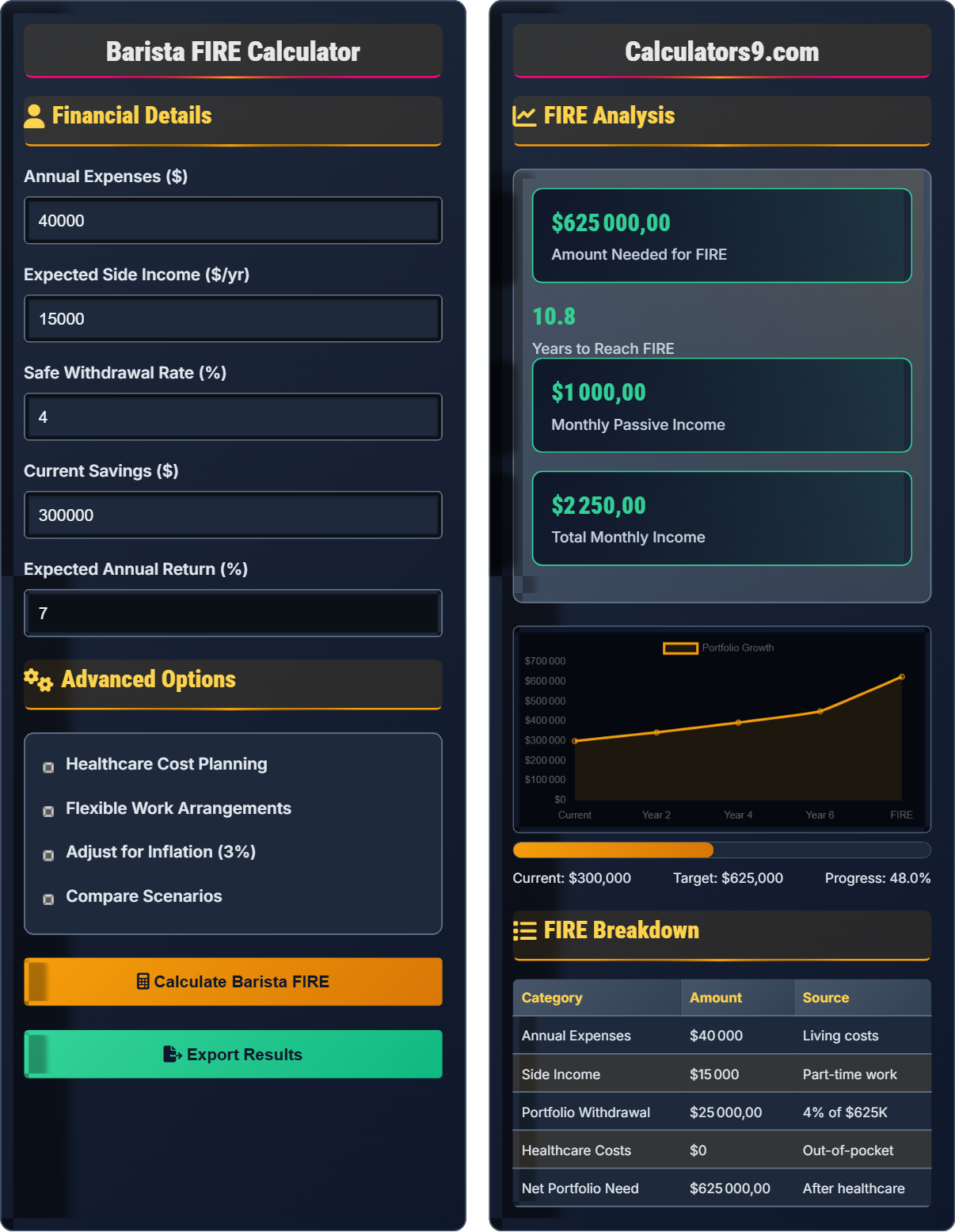
Barista FIRE Formula:
Show the calculatorBarista FIRE = (Annual Expenses - Side Income) ÷ Safe Withdrawal Rate
Barista FIRE (Financial Independence, Retire Early) is a strategy where you work part-time (like at Starbucks) to maintain health insurance and supplement your investment income. The formula calculates how much you need saved to retire early while earning supplemental income from part-time work.
Example: For $40,000 annual expenses with $15,000 part-time income at 4% SWR:
- Investment needed = ($40,000 - $15,000) ÷ 0.04
- Investment needed = $25,000 ÷ 0.04
- Investment needed = $625,000
So you'd need $625,000 to cover expenses with part-time work.
Financial Details
Advanced Options
FIRE Analysis
FIRE Breakdown
| Category | Amount | Source |
|---|---|---|
| Annual Expenses | $40,000 | Living costs |
| Side Income | $15,000 | Part-time work |
| Portfolio Withdrawal | $25,000 | 4% of $625K |
| Healthcare Costs | $5,000 | Out-of-pocket |
| Net Portfolio Need | $500,000 | After healthcare |
Comprehensive Barista FIRE Guide
Barista FIRE (Financial Independence, Retire Early) is a strategy where you work part-time (like a barista at Starbucks) to maintain health insurance benefits while living off investment income. This approach allows early retirement before age 65 while accessing employer-provided health insurance, addressing one of the biggest challenges of early retirement.
The Barista FIRE calculation determines how much you need saved:
Where:
- Annual Expenses = Your yearly living expenses
- Side Income = Expected part-time earnings
- Safe Withdrawal Rate = Conservative rate (typically 3-4%)
Key healthcare considerations for Barista FIRE:
| Age | Option | Cost Estimate |
|---|---|---|
| Under 26 | Parent's plan | $0-200/mo |
| 26-35 | Part-time work | $150-300/mo |
| 36-45 | Part-time work | $200-400/mo |
| 46-55 | Part-time work | $300-600/mo |
| 55-65 | Part-time work | $400-800/mo |
| 65+ | Medicare | $150-400/mo |
- Healthcare-Focused Jobs: Prioritize employers with good benefits
- Flexible Scheduling: Choose positions with flexible hours
- Low-Stress Work: Select jobs that don't interfere with retirement lifestyle
- Supplemental Income: Develop multiple part-time income streams
- Gradual Transition: Phase into part-time work gradually
FIRE Basics
Early retirement strategy combining part-time work with investment income for health insurance and supplemental income.
FIRE Amount = (Expenses - Side Income) ÷ SWR
Calculate the investment needed to retire early with part-time work.
- Part-time work maintains health insurance
- Lower SWR for safety margin
- Focus on low-stress employment
Strategies
Secure health insurance through part-time employment to bridge to Medicare.
- Calculate your FIRE number with side income
- Research part-time opportunities with benefits
- Build emergency fund for transition
- Gradually transition to part-time work
- Healthcare costs increase with age
- Not truly retired (still working)
- Job satisfaction and flexibility important
- Medicare eligibility at 65
FIRE Learning Quiz
What is the primary advantage of the Barista FIRE strategy over traditional FIRE?
The answer is B) Access to employer-provided health insurance. Barista FIRE specifically addresses the challenge of obtaining affordable health insurance before age 65 when Medicare begins. By working part-time at companies that offer health benefits, practitioners can secure coverage while maintaining their early retirement lifestyle.
One of the biggest obstacles to traditional early retirement is healthcare coverage. Before Medicare eligibility at age 65, securing affordable health insurance can be extremely expensive on the individual market. Barista FIRE solves this by utilizing part-time employment primarily for benefits, allowing continued access to employer-sponsored plans.
Barista FIRE: Working part-time for health insurance while living off investments
Healthcare Gap: Period before Medicare eligibility
Employer Benefits: Health insurance through part-time work
• Healthcare costs are a primary concern in early retirement
• Employer benefits often include health insurance
• Barista FIRE is about benefits, not just income
• Research companies with excellent part-time benefits
• Consider multiple part-time positions for better coverage
• Plan healthcare costs in your FIRE calculations
• Focusing only on income and ignoring benefits
• Underestimating healthcare costs in early retirement
• Not researching actual benefit packages thoroughly
Calculate the FIRE amount needed for someone with $50,000 annual expenses who expects $20,000 in part-time income with a 4% safe withdrawal rate. Show your work.
Using the Barista FIRE formula: FIRE Amount = (Expenses - Side Income) ÷ SWR
Where: Expenses = $50,000, Side Income = $20,000, SWR = 0.04
Step 1: Calculate net amount needed = $50,000 - $20,000 = $30,000
Step 2: Calculate FIRE Amount = $30,000 ÷ 0.04 = $750,000
Therefore, you would need $750,000 to achieve FIRE with $20,000 part-time income.
This calculation shows how part-time income reduces the required investment amount. Without part-time income, the same person would need $1.25 million ($50,000 ÷ 0.04). With $20,000 in part-time income, they only need $750,000, representing a $500,000 reduction in required savings.
Safe Withdrawal Rate (SWR): Percentage withdrawn annually from portfolio
Net Amount Needed: Expenses minus side income
Portfolio Size: Total investment required for FIRE
• Higher side income reduces required portfolio size
• Conservative SWR increases required portfolio
• The relationship is inverse and proportional
• Maximize part-time income to minimize required savings
• Consider multiple part-time income streams
• Factor in raises and income growth over time
• Adding side income to expenses instead of subtracting
• Forgetting to convert SWR percentage to decimal
• Not accounting for taxes on part-time income
Maria plans to achieve Barista FIRE at age 45 with $45,000 annual expenses. She expects $18,000 in part-time income and plans to use a 4% withdrawal rate. If healthcare costs are $6,000 annually, how much additional savings does she need compared to the basic calculation?
Basic calculation: ($45,000 - $18,000) ÷ 0.04 = $27,000 ÷ 0.04 = $675,000
Calculation including healthcare: ($45,000 + $6,000 - $18,000) ÷ 0.04 = $33,000 ÷ 0.04 = $825,000
Additional savings needed: $825,000 - $675,000 = $150,000
Therefore, Maria needs an additional $150,000 to account for healthcare costs.
This example demonstrates the significant impact of healthcare costs on FIRE calculations. Healthcare expenses must be added to living expenses when calculating the required portfolio size. This is especially important in Barista FIRE where healthcare costs may not be fully covered by employer benefits.
Out-of-Pocket Costs: Healthcare expenses not covered by insurance
Pre-Medicare Planning: Healthcare costs before age 65
Benefits vs. Reality: Gap between employer benefits and actual needs
• Healthcare costs increase with age
• Employer benefits may not cover all expenses
• Plan for worst-case healthcare scenarios
• Research actual healthcare costs in your area
• Consider HSA contributions for tax-advantaged healthcare savings
• Factor in potential catastrophic healthcare costs
• Assuming employer benefits cover all healthcare costs
• Not accounting for increasing healthcare costs with age
• Forgetting about dental, vision, and other non-covered services
David currently has $250,000 saved and plans Barista FIRE with $35,000 annual expenses and $12,000 part-time income. He expects 7% annual returns and uses a 4% withdrawal rate. How long will it take him to reach his FIRE number?
Step 1: Calculate FIRE amount = ($35,000 - $12,000) ÷ 0.04 = $23,000 ÷ 0.04 = $575,000
Step 2: Calculate time using compound growth formula
FV = PV × (1 + r)^t
$575,000 = $250,000 × (1.07)^t
$575,000 ÷ $250,000 = (1.07)^t
2.3 = (1.07)^t
ln(2.3) = t × ln(1.07)
t = ln(2.3) ÷ ln(1.07) = 0.833 ÷ 0.0677 = 12.3 years
Therefore, David will reach FIRE in approximately 12.3 years.
This calculation demonstrates how to determine the time needed to reach your FIRE number using compound growth. The formula shows that with 7% annual returns, David's current $250,000 will grow to his required $575,000 in about 12 years, assuming no additional contributions.
Future Value (FV): Target amount needed for FIRE
Present Value (PV): Current savings
Time to FIRE: Years needed to reach target
• Higher returns reduce time to FIRE
• Higher savings rate reduces time to FIRE
• The relationship is logarithmic, not linear
• Use financial calculators for complex logarithms
• Consider additional contributions during the period
• Factor in potential market volatility
• Using simple interest instead of compound interest
• Forgetting to convert percentage to decimal
• Not accounting for continued contributions during growth period
Which of the following is NOT a potential risk of the Barista FIRE strategy?
The answer is C) Guaranteed retirement income for life. This is not a risk but rather an incorrect assumption. Barista FIRE does not provide guaranteed retirement income for life. Instead, it relies on a combination of part-time work and investment withdrawals, which carry various risks including market volatility and potential job changes.
Barista FIRE is not a completely risk-free strategy. Participants still face investment risks, employment risks, and healthcare cost risks. The strategy requires ongoing management and adjustment as circumstances change. Understanding these risks is crucial for successful implementation.
Employment Risk: Risk of losing part-time job and benefits
Investment Risk: Risk of portfolio losses affecting FIRE sustainability
Healthcare Risk: Risk of rising healthcare costs or benefit changes
• Barista FIRE still involves various financial risks
• Employment is not guaranteed even in part-time positions
• Healthcare costs can increase significantly
• Maintain emergency fund for job transitions
• Research multiple part-time options before retiring
• Plan for potential changes in health status
• Assuming part-time jobs are completely stable
• Not planning for potential job changes
• Underestimating the complexity of managing multiple income sources
FAQ
Q: How does Barista FIRE differ from traditional early retirement?
A: Traditional early retirement typically involves complete withdrawal from the workforce, while Barista FIRE involves working part-time primarily for health insurance benefits. The core differences:
- Traditional FIRE: No work, self-funded health insurance
- Barista FIRE: Part-time work for benefits, supplemented by investments
- Investment Needs: Barista FIRE typically requires less saved
- Lifestyle: Barista FIRE maintains some work-life balance
Formula comparison: Traditional FIRE = Expenses ÷ SWR vs Barista FIRE = (Expenses - Side Income) ÷ SWR.
Q: What types of part-time jobs are best for Barista FIRE?
A: Ideal part-time jobs for Barista FIRE provide health benefits with minimal stress:
- Retail: Companies like Starbucks, Trader Joe's with good benefits
- Education: Teaching, tutoring, or school support staff
- Healthcare: Administrative roles in hospitals or clinics
- Government: Library, park services, or municipal positions
- Technology: Help desk or customer support with remote options
Key factors: Benefits eligibility at 20+ hours/week, flexible scheduling, low-stress environment, and potential for raises or advancement.