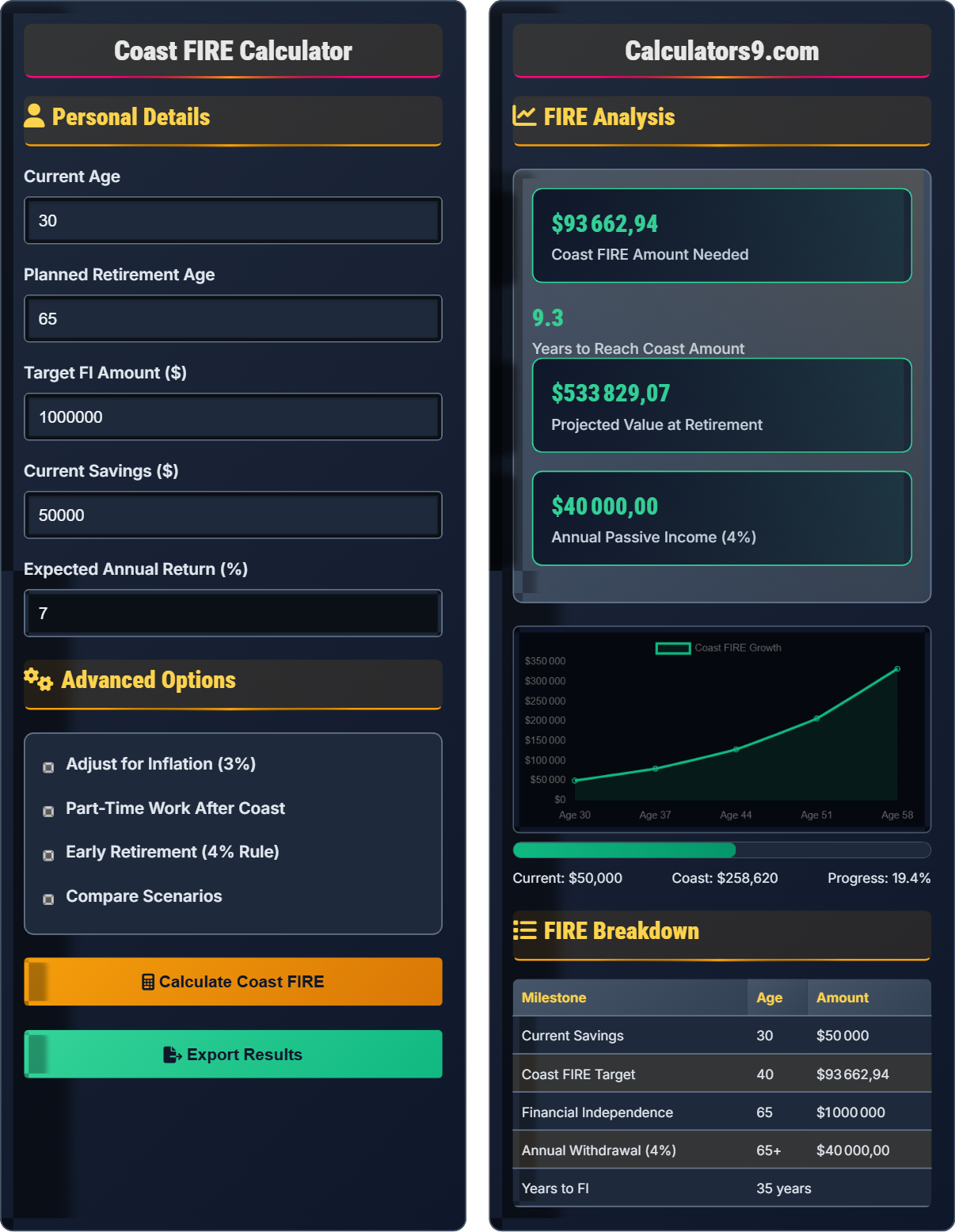
Coast FIRE Calculator
Financial independence planning • 2026 rates
Coast FIRE Formula:
Show the calculatorCoast FIRE = (Target FI Amount) ÷ (1 + Growth Rate)Years Until Retirement
Coast FIRE (Coast Financial Independence, Retire Early) is a strategy where you save enough money early in life to reach financial independence by letting it grow through compound interest without additional contributions. The formula calculates the lump sum needed today to reach your target amount by retirement age.
Example: For $1,000,000 at age 65 with 7% growth over 20 years:
- Coast FIRE = $1,000,000 ÷ (1.07)20
- Coast FIRE = $1,000,000 ÷ 3.87
- Coast FIRE = $258,620
So you'd need $258,620 today to reach $1M by age 65 with 7% growth.
Personal Details
Advanced Options
FIRE Analysis
FIRE Breakdown
| Milestone | Age | Amount |
|---|---|---|
| Current Savings | 30 | $50,000 |
| Coast FIRE Target | 45 | $258,620 |
| Financial Independence | 65 | $1,000,000 |
| Annual Withdrawal (4%) | 65+ | $40,000 |
| Years to FI | 35 years | |
Comprehensive FIRE Guide
Coast FIRE (Coast Financial Independence, Retire Early) is a strategy where you save and invest a lump sum early in your career that grows through compound interest to reach financial independence by your target retirement age, without needing to make additional contributions. It leverages the power of time and compound growth to achieve financial freedom.
The Coast FIRE calculation uses the present value formula:
Where:
- Target FI Amount = Your desired financial independence portfolio
- Expected Return = Annual rate of return on investments
- Years Until Retirement = Time until planned retirement age
Key financial independence milestones throughout your journey:
| Age | Milestone | Target Amount |
|---|---|---|
| 30 | 1x Annual Salary | $75,000 |
| 35 | 2x Annual Salary | $150,000 |
| 40 | 3x Annual Salary | $225,000 |
| 45 | Coast FIRE Target | $258,620 |
| 50 | 5x Annual Salary | $375,000 |
| 55 | 7x Annual Salary | $525,000 |
| 60 | 9x Annual Salary | $675,000 |
| 65 | Financial Independence | $1,000,000 |
- Maximize Early Contributions: Take advantage of compound growth
- Low-Cost Index Investing: Minimize fees to maximize returns
- Aggressive Savings Rate: Save 50%+ when possible
- Coast FIRE Strategy: Stop contributing once target reached
- Flexible Withdrawal: Adjust spending based on market conditions
FIRE Basics
Financial Independence, Retire Early - achieve financial freedom through aggressive saving and investing.
Coast FIRE = Target ÷ (1 + Return)Years
Calculate the lump sum needed to reach FI by retirement age.
- 4% rule for sustainable withdrawals
- Time is your greatest asset
- Compound growth accelerates over time
Strategies
Save a lump sum early, then let it grow through compound interest.
- Calculate your Coast FIRE target
- Save aggressively to reach target
- Stop contributing after reaching target
- Let investments grow passively
- Market volatility affects projections
- Inflation impacts purchasing power
- Healthcare costs in early retirement
- Psychological challenges of not working
FIRE Learning Quiz
What is the primary goal of the Coast FIRE strategy?
The answer is B) Save a lump sum early and let it grow without additional contributions. Coast FIRE involves reaching a specific savings target early in your career that will grow through compound interest to reach financial independence by your target retirement age.
The Coast FIRE strategy leverages the power of time and compound growth. By saving a significant amount early in your career, you can take advantage of decades of compound growth without needing to continue contributing. This strategy is particularly effective for young professionals who can reach their Coast FIRE target in their 30s or 40s.
Coast FIRE: Coast Financial Independence, Retire Early
Compound Growth: Exponential growth of investments over time
Financial Independence: Having enough passive income to cover living expenses
• Time is the most critical factor in Coast FIRE success
• Requires early and aggressive saving
• Depends on consistent market returns
• Start saving as early as possible
• Focus on high-growth, low-cost investments
• Calculate your Coast FIRE target regularly
• Underestimating the time needed for growth
• Being too conservative with return assumptions
• Not accounting for inflation in projections
Calculate the Coast FIRE amount needed for $1.2 million at age 65 with a 7% expected return over 25 years. Show your work.
Using the Coast FIRE formula: Coast FIRE = Target ÷ (1 + r)^t
Where: Target = $1,200,000, r = 0.07, t = 25
Step 1: Calculate (1 + r)^t = (1.07)^25 = 5.4274
Step 2: Calculate Coast FIRE = $1,200,000 ÷ 5.4274 = $221,081
Therefore, you would need $221,081 today to reach $1.2 million by age 65 with 7% growth.
This calculation demonstrates the power of compound growth over time. The exponentiation in the denominator shows how returns compound exponentially. With 25 years of growth at 7%, a relatively modest initial investment can grow to a substantial sum.
Present Value: Today's value of a future amount
Discount Rate: Rate used to calculate present value
Time Value of Money: Concept that money today is worth more than later
• Higher returns reduce required initial investment
• More time reduces required initial investment
• The relationship is exponential, not linear
• Use financial calculators for complex exponents
• Verify calculations with online tools
• Consider multiple scenarios with different returns
• Adding instead of dividing in the formula
• Using simple interest instead of compound interest
• Forgetting to convert percentage to decimal
David, age 30, wants $1 million by age 65. If he starts at age 30, he needs $100,000 to Coast FIRE. If he waits until age 40, how much would he need to save for the same goal? Assume 7% annual returns.
At age 30: 35 years to retirement (65-30)
At age 40: 25 years to retirement (65-40)
Using Coast FIRE formula: Target ÷ (1 + r)^t
At age 40: $1,000,000 ÷ (1.07)^25 = $1,000,000 ÷ 5.4274 = $184,250
Therefore, David would need $184,250 at age 40, compared to $100,000 at age 30.
Delaying by 10 years increases the required amount by $84,250.
This example highlights the time sensitivity of the Coast FIRE strategy. Each year of delay requires a significantly larger initial investment to reach the same goal. This demonstrates the exponential nature of compound growth and the value of starting early.
Time Sensitivity: How sensitive investments are to timing
Exponential Growth: Growth that accelerates over time
Compounding Period: Time interval for interest calculation
• Each year of delay significantly increases required savings
• Start Coast FIRE calculations as soon as possible
• Use this analysis to motivate early saving
• Consider the opportunity cost of delay
• Underestimating the impact of delayed start
• Thinking Coast FIRE can be started anytime with same results
• Not accounting for the exponential nature of growth
Sarah reaches Coast FIRE at age 45 with $300,000 invested. If she lets it grow until age 65 at 7% annually, what will be her portfolio value? How much can she withdraw annually using the 4% rule? Is this likely to sustain her through retirement?
Step 1: Calculate portfolio value at age 65
Using compound growth: FV = PV × (1 + r)^t
FV = $300,000 × (1.07)^20 = $300,000 × 3.87 = $1,161,000
Step 2: Calculate 4% rule withdrawal
Annual withdrawal = $1,161,000 × 4% = $46,440
Step 3: Sustainability assessment
Historical data suggests the 4% rule has a high probability of success over 30-year periods, even with market volatility.
Therefore, Sarah would have $1.16M at retirement allowing $46,440 annually using the 4% rule.
This demonstrates the complete Coast FIRE cycle: saving early, letting investments grow, and eventually drawing sustainable income. The 4% rule is based on historical market data showing that withdrawing 4% annually has a high probability of lasting 30 years or more.
4% Rule: Safe withdrawal rate for 30-year retirement
Portfolio Value: Total investment account value
Sustainable Withdrawal: Amount that preserves capital long-term
• 4% rule assumes 30-year retirement period
• Success rate is high but not guaranteed
• Adjustments may be needed based on market conditions
• Consider flexible withdrawal strategies
• Plan for healthcare and other unexpected costs
• Factor in inflation adjustments over time
• Assuming 4% rule works in all market conditions
• Not accounting for sequence of returns risk
• Forgetting about taxes on withdrawals
Which of the following is NOT a risk factor for the Coast FIRE strategy?
The answer is C) Guaranteed returns ensuring target achievement. The Coast FIRE strategy relies on market returns which are not guaranteed. In fact, the assumption of guaranteed returns would eliminate the risks associated with the strategy.
The Coast FIRE strategy involves market risk because it depends on investment returns over potentially long periods. While historical returns suggest the strategy can work, there are no guarantees. Investors must consider various risks including market volatility, inflation, and sequence of returns risk.
Market Risk: Risk of investment losses due to market fluctuations
Sequence of Returns Risk: Risk that poor returns occur at bad times
Volatility: Degree of variation in investment returns
• Investment returns are never guaranteed
• Past performance doesn't guarantee future results
• Risk increases with longer time horizons
• Build in buffer for market downturns
• Consider conservative return assumptions
• Plan for adjustments if targets aren't met
• Assuming historical returns will repeat exactly
• Not accounting for potential market crashes
• Ignoring the impact of inflation
FAQ
Q: How does Coast FIRE differ from traditional FIRE approaches?
A: Traditional FIRE focuses on maximizing savings rates (often 50-70%) to reach financial independence quickly. Coast FIRE is different:
- Coast FIRE: Save a target amount early, then stop contributing
- Traditional FIRE: Continue high savings rates until FI
- Time Focus: Coast FIRE leverages time and compound growth
- Freedom: Coast FIRE allows you to pursue other interests after reaching target
Mathematically: Coast FIRE = Target ÷ (1 + r)t vs continuous savings in traditional FIRE.
Q: What happens if the market performs poorly during the coast phase?
A: Market downturns during the coast phase can significantly impact your projected retirement value. For example, if you have $250,000 at age 45 expecting 7% returns for 20 years to reach $1M:
- Expected: $250,000 × (1.07)20 = $967,150
- With 30% drop: $175,000 × (1.07)20 = $677,005
- Recovery needed: Additional $290,145 to reach original target
Strategies include adjusting expectations, returning to saving, or extending retirement age.