FIRE Calculator
Achieve Financial Independence & Retire Early • 2026 rates
FIRE Formula:
Show the calculator\( \text{Years to FIRE} = \frac{\log(\text{Target Amount}/\text{Current Savings})}{\log(1 + \text{Return Rate})} \)
Where:
- \( \text{Target Amount} \) = Annual Expenses × 25 (for 4% rule)
- \( \text{Current Savings} \) = Current investment portfolio value
- \( \text{Return Rate} \) = Expected annual investment return rate
This formula calculates the time needed to reach financial independence based on the 4% rule, which suggests you can safely withdraw 4% of your portfolio annually in retirement. The calculation incorporates compound growth and consistent savings rates.
Example: For annual expenses of $40,000, current savings of $100,000, and 7% return rate:
Target Amount = $40,000 × 25 = $1,000,000
Years to FIRE = log($1,000,000/$100,000) / log(1.07) ≈ 34 years
Thus, it would take approximately 34 years to reach FIRE.
Current Financial Status
Investment Parameters
Advanced Options
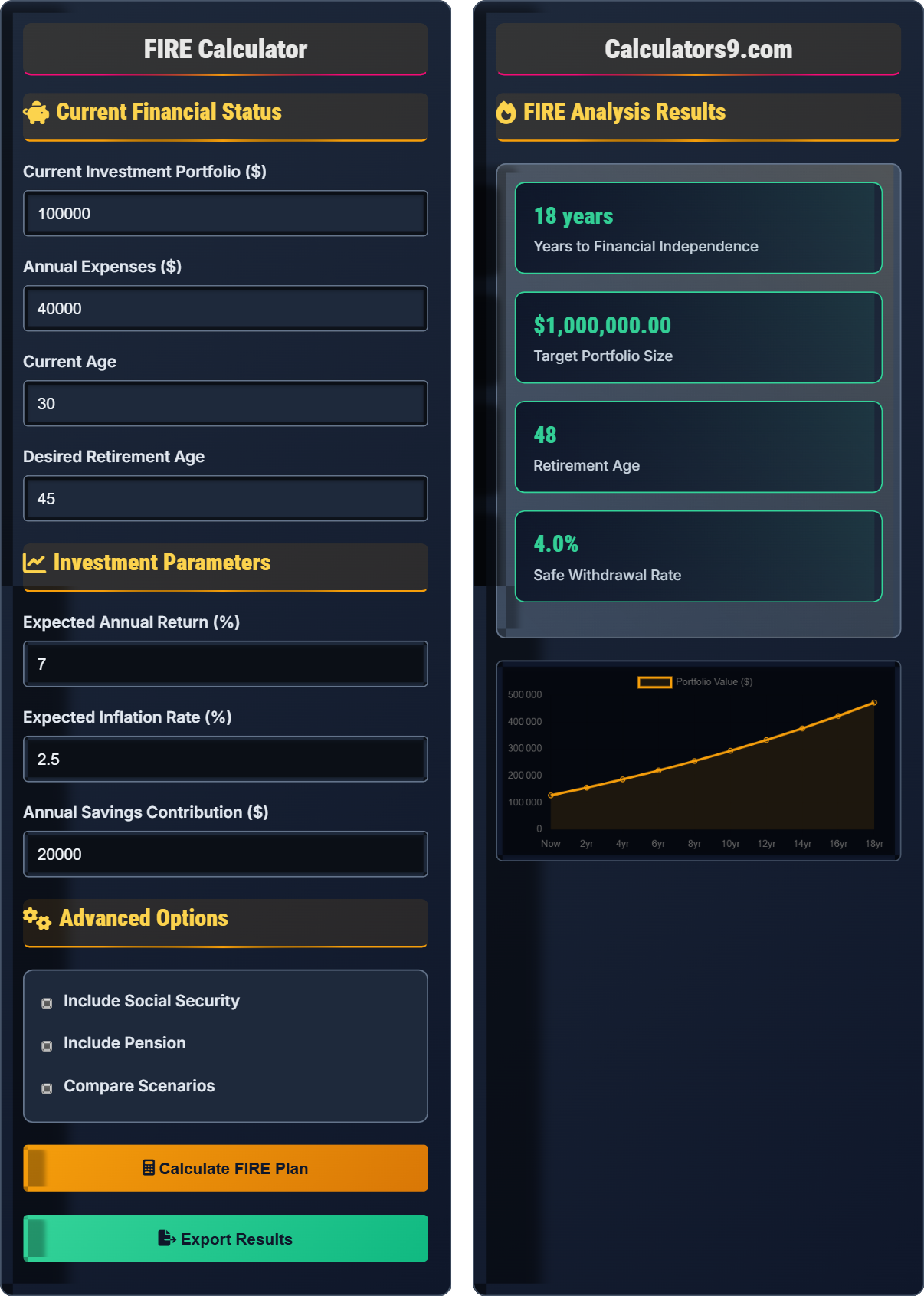
FIRE Analysis Results
| Year | Age | Portfolio Value | Annual Savings |
|---|---|---|---|
| 2024 | 30 | $100,000.00 | $20,000.00 |
| 2025 | 31 | $127,000.00 | $20,000.00 |
| 2026 | 32 | $156,090.00 | $20,000.00 |
| 2027 | 33 | $187,418.00 | $20,000.00 |
| 2028 | 34 | $221,147.00 | $20,000.00 |
| Metric | Value | Description |
|---|---|---|
| Annual Expenses | $40,000.00 | Your annual spending needs |
| Target Portfolio | $1,000,000.00 | 25x annual expenses (4% rule) |
| Savings Rate | 50.0% | Percentage of income saved |
| Safe Withdrawal | $40,000.00 | Annual amount you can safely withdraw |
| Years to FIRE | 15 years | Time to reach financial independence |
Comprehensive FIRE Guide
FIRE stands for Financial Independence, Retire Early. It's a movement focused on achieving financial independence through aggressive saving and investing, allowing individuals to retire much earlier than traditional retirement age. The goal is to build a portfolio large enough to sustainably withdraw from without running out of money, typically using the 4% rule as a guideline.
The 4% rule suggests that retirees can safely withdraw 4% of their portfolio annually in retirement, adjusting for inflation, without running out of money for at least 30 years. This rule is based on historical market data and assumes a diversified portfolio of stocks and bonds.
Where:
- Annual Expenses: Your yearly living expenses
- 25: Reciprocal of 4% withdrawal rate (1/0.04)
- Target Portfolio: Amount needed for financial independence
There are several approaches to FIRE, each suited to different circumstances:
- Lean FIRE: Minimalist approach, targeting lower expenses (often $25,000-$40,000/year)
- Normal FIRE: Moderate lifestyle, targeting mid-range expenses ($40,000-$70,000/year)
- Fat FIRE: Comfortable lifestyle, targeting higher expenses ($70,000+/year)
- Coast FIRE: Stop contributing to retirement accounts, let investments grow passively
- Maximize tax-advantaged accounts: Use 401(k), IRA, HSA for tax benefits
- Live below your means: Keep expenses low relative to income
- Side hustles: Increase income through additional work streams
- Investment optimization: Focus on low-cost, diversified investments
- Debt elimination: Pay off high-interest debt quickly
FIRE Learning Quiz
If your annual expenses are $50,000, what portfolio size would you need to achieve FIRE according to the 4% rule?
The answer is B) $1,250,000. According to the 4% rule, you need 25 times your annual expenses to achieve FIRE. So $50,000 × 25 = $1,250,000. This portfolio would allow you to withdraw $50,000 annually (4% of $1,250,000) indefinitely based on historical market returns.
The 4% rule is a cornerstone of FIRE planning. The multiplier of 25 comes from the reciprocal of 4% (1/0.04 = 25). This rule assumes a diversified portfolio lasting 30+ years of retirement. The calculation is simple: multiply your annual expenses by 25 to determine your target portfolio size.
4% Rule: Safe withdrawal rate for retirement portfolios
Annual Expenses: Yearly living costs in retirement
Target Portfolio: Savings needed for financial independence
• Target Portfolio = Annual Expenses × 25
• 4% of portfolio = Safe annual withdrawal
• Based on historical market performance
• Track your expenses accurately
• Consider inflation in long-term planning
• Diversify investments to reduce risk
• Underestimating annual expenses in retirement
• Forgetting to account for inflation
• Not diversifying investment portfolio
If you earn $100,000 annually and spend $40,000, what is your savings rate? Show your work.
Step 1: Calculate annual savings = $100,000 - $40,000 = $60,000
Step 2: Calculate savings rate = ($60,000 / $100,000) × 100 = 60%
Therefore, your savings rate is 60%.
Savings rate is critical to FIRE success. It represents the percentage of your income that goes toward savings and investments. Higher savings rates dramatically reduce the time to reach financial independence. The formula is: (Income - Expenses) / Income × 100. In this example, a 60% savings rate is excellent for FIRE.
Savings Rate: Percentage of income saved
Annual Income: Total yearly earnings
Annual Expenses: Total yearly spending
• Savings Rate = (Income - Expenses) / Income × 100
• Higher savings rate = Faster FIRE
• 50%+ savings rate is ideal for FIRE
• Track income and expenses monthly
• Automate savings to increase rate
• Look for ways to increase income
• Calculating savings rate incorrectly
• Including non-recurring income
• Forgetting to account for taxes
You currently have $200,000 invested with an expected annual return of 7%. If you add $30,000 per year, how much will you have in 10 years? (Assume no inflation adjustment)
Using the future value of a series formula with compound growth:
Future Value = PV(1+r)^n + PMT[((1+r)^n - 1)/r]
Where: PV = $200,000, r = 0.07, n = 10, PMT = $30,000
Step 1: Calculate growth of initial amount = $200,000 × (1.07)^10 = $200,000 × 1.967 = $393,400
Step 2: Calculate growth of contributions = $30,000 × [((1.07)^10 - 1) / 0.07] = $30,000 × [0.967 / 0.07] = $30,000 × 13.82 = $414,600
Step 3: Total = $393,400 + $414,600 = $808,000
Therefore, you will have approximately $808,000 in 10 years.
This problem demonstrates compound growth with regular contributions. Both your initial investment and your annual additions grow over time. The exponential nature of compound interest means that time is your greatest ally in wealth building. Starting early with consistent contributions can lead to substantial growth over decades.
Compound Growth: Growth on both principal and previous gains
Present Value (PV): Current investment amount
Payment (PMT): Annual contribution amount
• Time amplifies compound growth effect
• Consistent contributions accelerate growth
• Higher returns increase final amount
• Start investing as early as possible
• Maintain consistent contributions
• Reinvest all dividends and interest
• Underestimating compound growth power
• Stopping contributions during market downturns
• Not accounting for fees and expenses
Compare the portfolio requirements for Lean FIRE (annual expenses of $30,000) versus Fat FIRE (annual expenses of $80,000). How much more would Fat FIRE require?
Step 1: Calculate Lean FIRE target = $30,000 × 25 = $750,000
Step 2: Calculate Fat FIRE target = $80,000 × 25 = $2,000,000
Step 3: Calculate difference = $2,000,000 - $750,000 = $1,250,000
Step 4: Calculate percentage difference = ($1,250,000 / $750,000) × 100 = 167%
Therefore, Fat FIRE requires $1,250,000 more than Lean FIRE, which is 167% more.
This example illustrates how dramatically different FIRE approaches affect required portfolio size. The difference between Lean and Fat FIRE is more than proportional to the expense difference. While Fat FIRE expenses are 2.67 times higher ($80,000 vs $30,000), the required portfolio is 2.67 times larger. This emphasizes the importance of defining your FIRE lifestyle goals early.
Lean FIRE: Minimalist approach to financial independence
Fat FIRE: Comfortable lifestyle in early retirement
Normal FIRE: Middle-ground approach
• Portfolio size = Annual expenses × 25
• Higher expenses = Much larger portfolio
• Lifestyle choices greatly impact FIRE timeline
• Define your FIRE lifestyle early
• Consider compromise options
• Plan for unexpected expenses
• Assuming one FIRE approach fits all
• Not planning for healthcare costs
• Forgetting about inflation over decades
Which of the following has the GREATEST impact on reducing the time to reach FIRE?
The answer is B) Increasing savings rate from 20% to 40%. While all factors matter, the savings rate has the most dramatic impact on FIRE timeline. Doubling your savings rate (from 20% to 40%) roughly halves the time to FIRE, as it directly affects how quickly you accumulate the target portfolio. Investment returns and time are important, but the rate of accumulation matters most initially.
The relationship between savings rate and FIRE timeline is exponential. The higher your savings rate, the faster you reach your target portfolio. A 40% savings rate means you're saving twice as much each year compared to a 20% rate, which significantly accelerates progress. This is why FIRE advocates focus heavily on increasing savings rates through income maximization and expense minimization.
Savings Rate: Critical factor in FIRE timeline
Compound Growth: Accelerates with time and returnsPortfolio Target: Determined by expenses
• Savings rate is most impactful factor
• Higher rates = Exponentially faster FIRE
• Time and returns amplify growth
• Focus on increasing savings rate first
• Combine multiple strategies for fastest FIRE
• Automate savings to maintain discipline
• Relying solely on market returns
• Not focusing on savings rate enough
• Underestimating impact of expenses
FIRE Fundamentals
Target Portfolio = Annual Expenses × 25
Savings Rate = (Annual Income - Annual Expenses) / Annual Income × 100
Higher savings rates accelerate FIRE timeline exponentially.
- Target portfolio = 25x annual expenses (4% rule)
- 50%+ savings rate is ideal for FIRE
- Time and compound growth are essential
- Expense reduction is as valuable as income increase
Advanced FIRE Strategies
Choose the approach that matches your lifestyle goals and risk tolerance.
- Maximize tax-advantaged accounts
- Minimize investment fees
- Reduce unnecessary expenses
- Increase income through side hustles
- Invest in low-cost index funds
- Healthcare costs in early retirement
- Market volatility and sequence of returns
- Longevity risk and inflation protection
- Social security optimization
FAQ
Q: How realistic is the 4% rule given recent market volatility?
A: The 4% rule has historically been quite robust, having been tested against various market conditions including the Great Depression, stagflation of the 1970s, and the 2008 financial crisis. However, recent research suggests some modifications:
- For retiring during high-valuation markets, consider starting with 3.5%
- Adjust the withdrawal rate based on market conditions
- Have a flexible spending strategy that can adapt to poor returns
- Consider a "guardrails" approach that adjusts withdrawals based on portfolio performance
While the 4% rule provides a solid starting point, it's wise to build in flexibility and have contingency plans for market downturns during early retirement.
Q: What's the difference between Coast FIRE and traditional FIRE?
A: Coast FIRE is a strategy where you save enough today so that your investments can grow to your FIRE number by your target retirement date, without needing to make additional contributions. Here's how they differ:
Traditional FIRE:
- Continue saving and investing until you reach your target
- Requires ongoing high savings rates
- More predictable timeline
Coast FIRE:
- Stop contributing to retirement accounts at a certain point
- Let investments grow passively until retirement
- Requires significant early savings
- Relies heavily on compound growth
Coast FIRE can be attractive for those who achieve a high savings rate early in their careers, but it requires careful planning and may involve more risk due to longer investment horizons.