HSA Contribution Optimizer
Maximize tax benefits • 2026 limits
HSA Tax Advantages:
Show the calculatorTriple Tax Advantage: Contributions are tax-deductible, earnings grow tax-free, withdrawals for qualified medical expenses are tax-free.
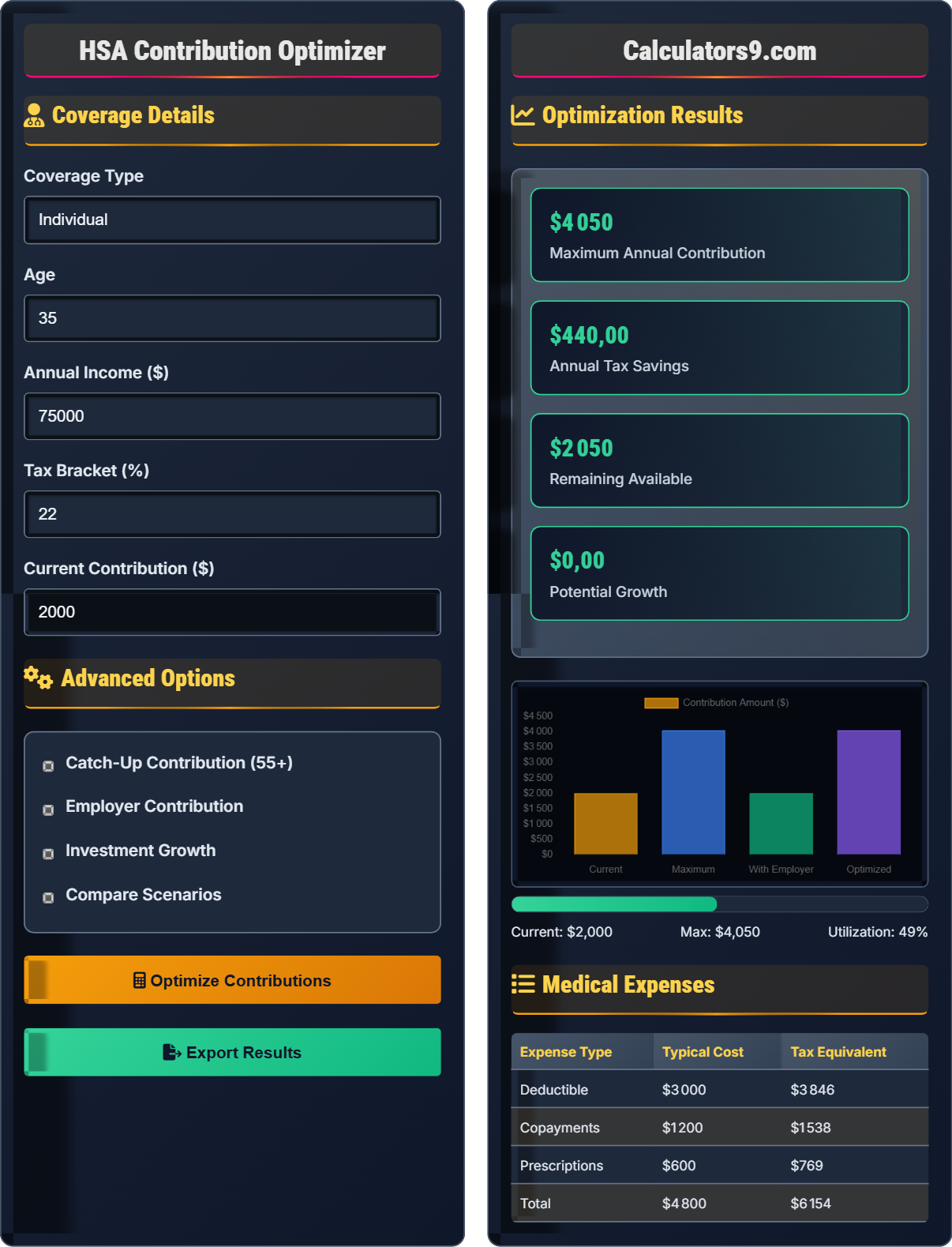
For 2026, HSA contribution limits are $4,050 for individual coverage and $8,100 for family coverage. Individuals 55+ can contribute an additional $1,000 catch-up contribution.
Example: For an individual in the 22% tax bracket contributing $4,050:
- Tax savings: $4,050 × 22% = $891 annually
- Earnings grow tax-free indefinitely
- Qualified withdrawals remain tax-free
Thus, the effective tax rate on HSA contributions can exceed 22% when accounting for state taxes and long-term growth.
Coverage Details
Advanced Options
Optimization Results
Medical Expenses
| Expense Type | Typical Cost | Tax Equivalent |
|---|---|---|
| Deductible | $3,000 | $3,846 |
| Copayments | $1,200 | $1,538 |
| Prescriptions | $600 | $769 |
| Total | $4,800 | $6,154 |
Comprehensive HSA Guide
A Health Savings Account (HSA) is a tax-advantaged medical savings account available to taxpayers enrolled in an HSA-qualified high-deductible health plan (HDHP). HSAs allow individuals to deposit money into an account for paying qualified medical expenses, with triple tax advantages: contributions are tax-deductible, earnings grow tax-free, and withdrawals for qualified medical expenses are tax-free.
The effective tax rate savings from HSA contributions can be calculated as:
Where:
- Federal Tax Rate: Your marginal federal tax rate
- State Tax Rate: Your marginal state tax rate (varies by state)
- Long-term Growth Benefit: Tax-free investment growth over time
HSAs offer unique triple tax advantages that make them powerful financial tools:
- Tax-Deductible Contributions: Reduce your taxable income for the year
- Tax-Free Growth: Investment earnings accumulate without taxation
- Tax-Free Withdrawals: Qualified medical expenses are never taxed
- Maximize Early: Contribute the maximum amount early in the year to maximize investment growth
- Save Receipts: Keep documentation for qualified expenses to reimburse yourself later
- Invest Long-term: After age 65, use HSA as a retirement account with tax-free medical withdrawals
- Stack Benefits: Combine with FSA for additional tax savings (limited combinations allowed)
- Emergency Fund: HSA can serve as a backup emergency fund after age 65
HSA Basics
Tax-advantaged account for medical expenses with triple tax benefits.
Effective Rate = Fed Rate + State Rate + Growth Benefit
Where contributions reduce taxable income immediately.
- Must have HDHP to contribute
- Triple tax advantage applies
- Unused funds roll over annually
Strategies
After age 65, HSA becomes a powerful retirement tool.
- Contribute maximum early
- Invest in index funds
- Save receipts for reimbursement
- Use after age 65
- High deductible requirement
- Qualified expense rules
- Penalty for non-medical use before 65
- Required minimum distributions after 65
HSA Learning Quiz
Which of the following best describes the triple tax advantage of HSAs?
The answer is A) Contributions are tax-deductible, earnings grow tax-free, withdrawals for qualified medical expenses are tax-free. This is known as the "triple tax advantage" of HSAs, making them uniquely powerful financial tools.
The triple tax advantage makes HSAs one of the most tax-advantaged accounts available. Unlike traditional IRAs (tax-deductible contributions only) or Roth IRAs (tax-free withdrawals only), HSAs combine all three benefits. This makes them particularly valuable for individuals in higher tax brackets who expect to have significant medical expenses.
Triple Tax Advantage: Three distinct tax benefits of HSAs
Qualified Medical Expenses: IRS-approved medical costs that can be withdrawn tax-free
HDHP: High Deductible Health Plan required for HSA eligibility
• Must have HDHP to contribute to HSA
• Contributions reduce taxable income immediately
• Investment gains are never taxed
• Remember "DEDUCT-GROW-WITHDRAW": Deductible, Grows tax-free, Withdraw tax-free
• HSA is the only account with all three tax advantages
• Confusing HSA with FSA (which doesn't have triple tax advantage)
• Thinking HSA withdrawals for any purpose are tax-free
Calculate the maximum HSA contribution for a 35-year-old with individual coverage in 2026. Show your work.
For 2026:
Step 1: Individual coverage limit = $4,050
Step 2: Age is 35 (under 55), so no catch-up contribution
Step 3: Maximum contribution = $4,050
If the person were 55+, they could contribute an additional $1,000 catch-up contribution, totaling $5,050.
HSA contribution limits are set annually by the IRS and are adjusted for inflation. The limits differ based on coverage type (individual vs. family) and include catch-up contributions for those 55 and older. These limits are crucial for optimization since contributions above the limit face penalties.
Contribution Limit: Maximum annual amount allowed by IRS
Catch-up Contribution: Additional amount for those 55+
Proration: Partial-year contribution based on months eligible
• Limits change annually based on inflation
• Catch-up contributions available at age 55+
• Proration may apply for partial-year eligibility
• Check IRS Publication 969 for current limits
• Set up automatic contributions to reach maximum
• Consider front-loading contributions early in year
• Using outdated contribution limits
• Forgetting to adjust for proration
• Missing catch-up contributions for eligible individuals
Sarah, who is in the 24% federal tax bracket and lives in a state with 5% income tax, contributes the maximum $4,050 to her HSA in 2026. What is her immediate tax savings?
Step 1: Calculate federal tax savings = $4,050 × 24% = $972
Step 2: Calculate state tax savings = $4,050 × 5% = $202.50
Step 3: Calculate total immediate tax savings = $972 + $202.50 = $1,174.50
Therefore, Sarah saves $1,174.50 in taxes by contributing the maximum to her HSA.
This calculation shows the immediate tax benefit of HSA contributions. The effective tax rate on HSA contributions equals the sum of federal and state marginal tax rates. This makes HSAs particularly attractive for residents of high-tax states, where the combined tax rate can exceed 40%.
Marginal Tax Rate: Highest tax rate applied to your income
Effective Tax Rate: Average rate paid on all incomeTax Deduction: Amount subtracted from taxable income
• HSA contributions reduce AGI (Adjusted Gross Income)
• State tax savings vary by state
• Some states don't recognize federal tax deductions
• Calculate your effective tax rate for HSA benefits
• Consider timing contributions for optimal tax year benefit
• Use tax software to verify deduction amount
• Forgetting to include state tax savings
• Confusing marginal vs. effective tax rates
• Not accounting for phase-outs in some situations
Mark contributes $4,050 to his HSA annually for 30 years. If he invests the funds and earns an average of 7% annually, what will be the account value at retirement? (Assume he stops contributing at retirement and uses funds for medical expenses.)
Using the future value of annuity formula: FV = PMT × [((1 + r)^n - 1) / r]
Where PMT = $4,050, r = 0.07, n = 30
Step 1: Calculate (1 + r)^n = (1.07)^30 = 7.6123
Step 2: Calculate numerator = 7.6123 - 1 = 6.6123
Step 3: Calculate FV = $4,050 × (6.6123 / 0.07) = $4,050 × 94.4614 = $382,569
Therefore, Mark's HSA will be worth approximately $382,569 at retirement, all tax-free for qualified medical expenses.
This demonstrates the power of tax-free compounding over long periods. The combination of tax-deductible contributions and tax-free growth creates a powerful wealth-building vehicle. After age 65, HSA funds can be used for any purpose without penalty (though non-medical withdrawals are taxable).
Future Value of Annuity: Value of a series of equal payments
Tax-Free Compounding: Growth without taxation
Retirement Planning: Using HSA as supplementary retirement account
• Investment options vary by HSA provider
• Invest HSA funds beyond the minimum needed for current expenses
• Choose low-cost index funds for HSA investments
• Save receipts to reimburse yourself later
• Leaving HSA funds in low-yield savings accounts
• Not understanding post-65 withdrawal rules
• Forgetting to track investment performance
Which of the following is NOT required to be eligible for HSA contributions?
The answer is C) Having a specific income level. There are no income restrictions for HSA eligibility, unlike Roth IRAs. Anyone enrolled in an HSA-qualified HDHP can contribute to an HSA regardless of income level, as long as other eligibility requirements are met.
Unlike many tax-advantaged accounts, HSAs do not have income limits for contributions. This makes them accessible to high earners who might be phased out of other retirement accounts. However, eligibility is tied to having HDHP coverage, which requires meeting specific deductible and out-of-pocket limits.
HDHP: High Deductible Health Plan with minimum deductibles
Eligibility Requirements: Conditions for HSA participation
Income Limits: Restrictions based on adjusted gross income
• No income limits for HSA contributions
• Must have HDHP to contribute
• Cannot have other disqualifying coverage
• HSAs are available to anyone with qualifying HDHP regardless of income
• Verify your plan meets HDHP requirements
• Consider HSA eligibility when choosing health plans
• Assuming HSA has income limits like Roth IRA
• Contributing while enrolled in Medicare
• Not verifying HDHP compliance
FAQ
Q: What happens to my HSA if I change jobs or health plans?
A: Your HSA is portable and belongs to you, not your employer. You can take it with you when you change jobs. However, you can only contribute to an HSA while enrolled in an HSA-qualified high-deductible health plan (HDHP).
For example, if you had contributed $2,000 to your HSA and then switched to a traditional PPO plan, you would still keep your $2,000 balance and continue to enjoy its triple tax advantages. However, you couldn't make additional contributions until you're back in an HDHP.
Mathematically, the account balance remains yours:
Account Balancefuture = Account Balancecurrent × (1 + r)t
Where r is the investment return rate and t is time in years.
Q: Can I invest my HSA funds, and what are the best investment options?
A: Yes, most HSA providers offer investment options once your account reaches a minimum balance (usually $1,000-$2,000).
For a 35-year-old with $4,050 annual contributions, investing in low-cost index funds maximizes the tax-free growth potential. A common strategy is:
- Current Expenses: Keep 1-2 years of medical expenses in savings
- Long-term Growth: Invest remainder in diversified index funds
- Asset Allocation: Similar to 401(k) allocation based on age
Using the compound growth formula, $4,050 annually for 30 years at 7% returns approximately $382,569 tax-free for medical expenses.