Lean FIRE Calculator
Minimalist early retirement • 2026 rates
Lean FIRE Formula:
Show the calculatorLean FIRE = Annual Expenses ÷ Safe Withdrawal Rate
Lean FIRE (Financial Independence, Retire Early) is a strategy focused on achieving financial independence with a minimalist lifestyle and low annual expenses. The formula calculates how much you need saved to retire early while maintaining a simple, frugal lifestyle.
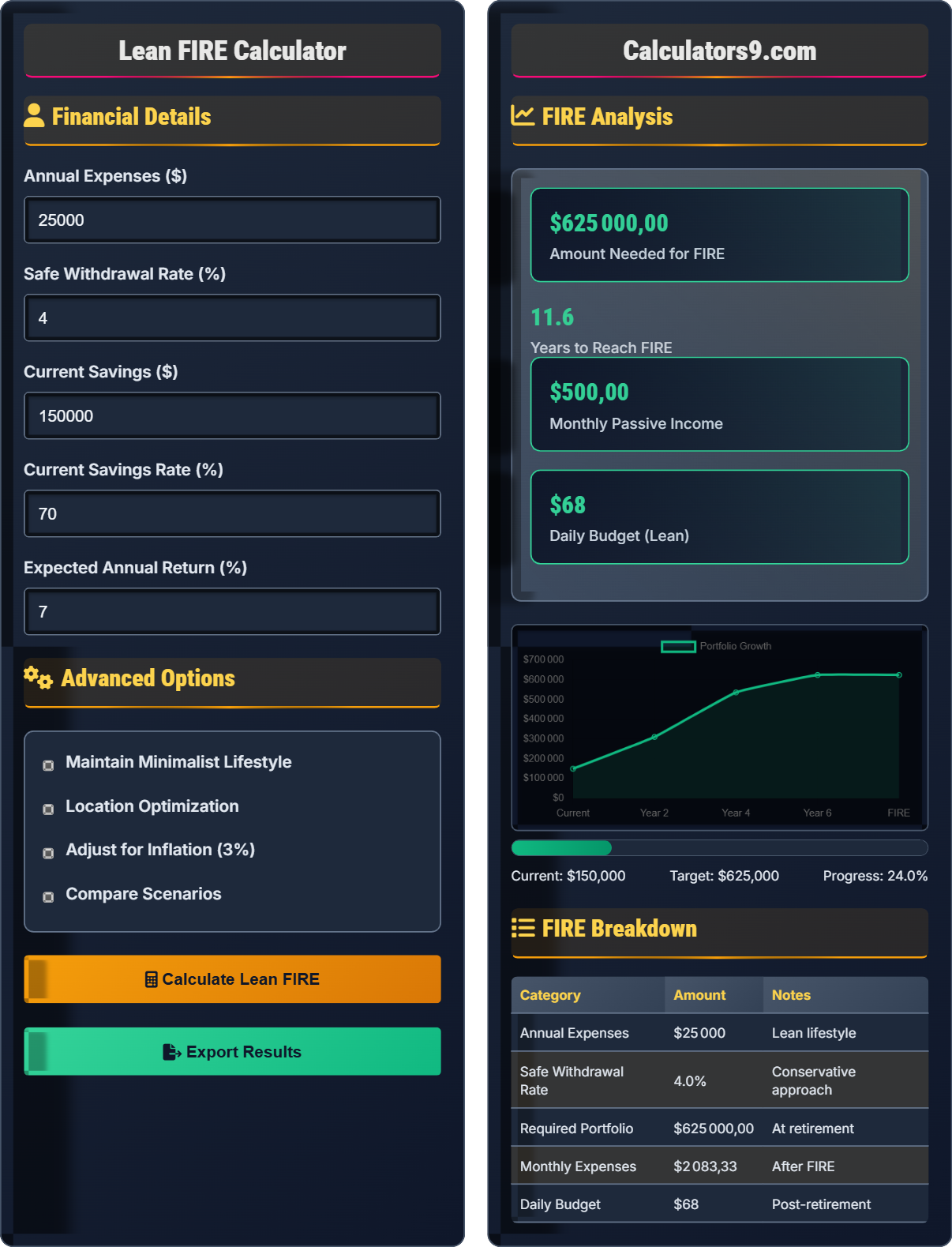
Example: For $25,000 annual expenses with 4% SWR:
- Investment needed = $25,000 ÷ 0.04
- Investment needed = $625,000
So you'd need $625,000 to achieve Lean FIRE with $25K annual expenses.
Financial Details
Advanced Options
FIRE Analysis
FIRE Breakdown
| Category | Amount | Notes |
|---|---|---|
| Annual Expenses | $25,000 | Lean lifestyle |
| Safe Withdrawal Rate | 4.0% | Conservative approach |
| Required Portfolio | $625,000 | At retirement |
| Monthly Expenses | $2,083 | After FIRE |
| Daily Budget | $68 | Post-retirement |
Comprehensive Lean FIRE Guide
Lean FIRE (Financial Independence, Retire Early) is a strategy focused on achieving financial independence with a minimalist lifestyle and low annual expenses. Practitioners prioritize frugality, simplicity, and intentional spending to dramatically reduce their annual expenses, allowing them to retire early with a smaller portfolio.
The Lean FIRE calculation determines how much you need saved:
Where:
- Annual Expenses = Your lean, minimalist yearly spending
- Safe Withdrawal Rate = Conservative rate (typically 3-4%)
Typical annual expense breakdown for Lean FIRE:
| Category | Percentage | Example Amount ($) |
|---|---|---|
| Housing | 25% | $6,250 |
| Food | 15% | $3,750 |
| Transportation | 10% | $2,500 |
| Healthcare | 15% | $3,750 |
| Utilities | 8% | $2,000 |
| Entertainment | 5% | $1,250 |
| Personal Care | 3% | $750 |
| Other | 19% | $4,750 |
- Extreme Frugality: Eliminate unnecessary expenses
- Location Optimization: Move to lower-cost areas
- DIY Everything: Do tasks yourself instead of paying others
- Minimalist Living: Own fewer possessions
- Intentional Consumption: Buy only what adds value
FIRE Basics
Early retirement achieved through extreme frugality and low annual expenses, requiring smaller portfolio.
FIRE Amount = Expenses ÷ SWR
Calculate investment needed with minimalist spending approach.
- Focus on minimizing expenses
- High savings rates (60%+) required
- Conservative withdrawal rates
Strategies
Drastically reduce expenses to achieve FIRE with smaller portfolio.
- Track and analyze current expenses
- Identify areas for reduction
- Implement frugal habits
- Maximize savings rate
- Quality of life in retirement
- Healthcare costs
- Unexpected expenses
- Social and psychological impacts
FIRE Learning Quiz
What is the primary characteristic that distinguishes Lean FIRE from other FIRE strategies?
The answer is B) Extremely low annual expenses. Lean FIRE is characterized by maintaining a minimalist lifestyle with very low annual expenses, which allows practitioners to retire early with a smaller portfolio compared to other FIRE strategies.
Lean FIRE differs from other FIRE strategies primarily in its focus on minimizing expenses rather than maximizing income. By living on significantly less money (often 50-70% less than average), Lean FIRE practitioners can achieve financial independence with a smaller investment portfolio. This approach requires discipline but can lead to earlier retirement.
Lean FIRE: Early retirement with minimal expenses
Frugality: Extreme cost-consciousness and thrift
Minimalist Lifestyle: Living with few possessions and expenses
• Expense reduction is the primary focus of Lean FIRE
• Lower expenses mean smaller portfolio needed
• Requires significant lifestyle changes
• Start with small expense reductions to build habits
• Focus on eliminating recurring expenses first
• Track every dollar spent to identify waste
• Confusing Lean FIRE with traditional budgeting
• Not accounting for occasional large expenses
• Underestimating the psychological impact of extreme frugality
Calculate the FIRE amount needed for someone with $30,000 annual expenses using a 3.5% safe withdrawal rate. Show your work.
Using the Lean FIRE formula: FIRE Amount = Annual Expenses ÷ SWR
Where: Annual Expenses = $30,000, SWR = 0.035
Step 1: Calculate FIRE Amount = $30,000 ÷ 0.035
Step 2: Calculate FIRE Amount = $857,143
Therefore, you would need $857,143 to achieve FIRE with $30K annual expenses.
This calculation shows how the safe withdrawal rate affects the required portfolio size. A more conservative 3.5% rate requires a larger portfolio than a 4% rate. The relationship is inverse: lower withdrawal rates require larger portfolios.
Safe Withdrawal Rate (SWR): Percentage withdrawn annually from portfolio
Portfolio Size: Total investment required for FIRE
Conservative Approach: Lower SWR for greater safety
• Lower SWR increases required portfolio size
• Higher SWR increases risk of running out of money
• The relationship is inversely proportional
• Use 3-4% SWR for conservative planning
• Consider adjusting SWR based on market conditions
• Factor in potential changes to expenses over time
• Forgetting to convert SWR percentage to decimal
• Using too aggressive SWR (above 4%)
• Not accounting for inflation in calculations
Sarah currently spends $50,000 annually and plans to achieve FIRE with a 4% withdrawal rate. If she reduces her expenses to $25,000 through frugal living, how much does this reduce her required investment amount? What percentage reduction is this?
Current calculation: $50,000 ÷ 0.04 = $1,250,000 required
Reduced calculation: $25,000 ÷ 0.04 = $625,000 required
Reduction in required amount: $1,250,000 - $625,000 = $625,000
Percentage reduction: ($625,000 ÷ $1,250,000) × 100 = 50%
Therefore, reducing expenses by 50% reduces the required investment by 50%.
This demonstrates the powerful leverage of expense reduction in FIRE planning. Each dollar reduced in annual expenses directly reduces the required portfolio by 25 dollars (at 4% SWR) or 33 dollars (at 3% SWR). This is why Lean FIRE practitioners focus so heavily on minimizing expenses.
Expense Leverage: How expense reduction affects portfolio needs
Portfolio Reduction: How much less is needed with lower expenses
Financial Efficiency: Getting same lifestyle with less money
• Expense reduction has direct proportional impact on portfolio size
• The leverage effect is strongest with lower SWR
• Every dollar saved reduces portfolio need by 1/SWR multiple
• Focus on eliminating recurring expenses first
• Look for expenses that provide little value
• Consider the portfolio impact of each expense
• Not calculating the portfolio impact of expense changes
• Focusing on small expenses instead of large ones
• Underestimating the impact of recurring expenses
Mike currently saves 60% of his $80,000 income and has $100,000 saved. He follows a Lean FIRE approach with $20,000 annual expenses and expects 7% returns. How long will it take him to reach his FIRE number? How does this compare to someone with 30% savings rate?
Step 1: Calculate FIRE amount = $20,000 ÷ 0.04 = $500,000
Step 2: Calculate annual savings = $80,000 × 60% = $48,000
Step 3: Calculate time using compound growth with contributions
Using financial calculator or iterative approach:
Future Value = Present Value × (1 + r)^t + Annual Contribution × [((1 + r)^t - 1) ÷ r]
$500,000 = $100,000 × (1.07)^t + $48,000 × [((1.07)^t - 1) ÷ 0.07]
Solving iteratively: t ≈ 5.8 years
With 30% savings rate: Annual savings = $24,000, t ≈ 9.2 years
Therefore, higher savings rate reduces time by 3.4 years.
This demonstrates how both high savings rates and low expenses accelerate FIRE timelines. Mike's 60% savings rate combined with low expenses allows him to reach FIRE in under 6 years. The non-linear relationship between savings rate and time to FIRE means that small increases in savings rate can lead to significant time reductions.
Time to FIRE: Years needed to reach financial independence
Savings Rate Impact: How much savings rate affects timelineCompound Growth: Exponential growth of investments
• High savings rates accelerate FIRE timeline significantly
• The relationship between savings rate and time is non-linear
• Both high savings and low expenses work together
• Maximize both savings rate and expense reduction simultaneously
• Use online calculators for complex time calculations
• Consider the impact of raises on savings rate
• Forgetting to account for ongoing contributions
• Using simple interest instead of compound interest
• Not considering the impact of increasing expenses with income
Which of the following is NOT a typical challenge associated with Lean FIRE?
The answer is C) Higher portfolio requirements than other FIRE strategies. This is incorrect. Lean FIRE actually requires LOWER portfolio requirements than other FIRE strategies because of the significantly reduced annual expenses. The formula (Expenses ÷ SWR) shows that lower expenses result in smaller required portfolios.
Lean FIRE's defining characteristic is achieving financial independence with a smaller portfolio through extreme expense reduction. This is the opposite of strategies that rely on high income or large portfolios. The main challenges of Lean FIRE are lifestyle-related rather than financial.
Portfolio Requirements: Total investment needed for FIRE
Expense Reduction Strategy: Focus on lowering spending
Income Strategy: Focus on increasing earnings
• Lean FIRE requires smaller portfolios than other strategies
• The strategy focuses on expenses, not income
• Quality of life is subjective in Lean FIRE
• Define "enough" for your own happiness
• Focus on experiences over material possessions
• Build a supportive community of like-minded individuals
• Confusing Lean FIRE with traditional budgeting approaches
• Assuming it requires more money than other strategies
• Not considering the psychological aspects of frugal living
FAQ
Q: How does Lean FIRE differ from other FIRE strategies?
A: Lean FIRE is distinguished by its focus on minimizing expenses rather than maximizing income:
- Lean FIRE: Low expenses, smaller portfolio needed
- Fat FIRE: Higher expenses, larger portfolio needed
- Barista FIRE: Part-time work for benefits
- Coast FIRE: Early savings, no further contributions
Formula comparison: Lean FIRE = $25K ÷ 0.04 = $625K vs Fat FIRE = $80K ÷ 0.04 = $2M.
Q: What are practical ways to achieve Lean FIRE expenses?
A: Practical strategies for reducing expenses to Lean FIRE levels:
- Housing: Downsize, move to cheaper area, or live with roommates
- Transportation: Use public transit, bike, or buy reliable used cars
- Food: Cook at home, meal prep, buy generic brands
- Entertainment: Free activities, library, hiking, potlucks
- Shopping: Buy only necessities, repair instead of replace
Each $1,000 saved annually reduces required portfolio by $25,000 (at 4% SWR).