Pension Lump Sum vs Annuity Calculator
Fast retirement planning tool • 2026 rates
Pension Formula:
Show the calculator\( PV = PMT \times \frac{1 - (1 + r)^{-n}}{r} \)
Where:
- \( PV \) = Present Value of Annuity
- \( PMT \) = Periodic Payment Amount
- \( r \) = Discount Rate per Period
- \( n \) = Number of Periods
Alternative formulas:
\( BE = \frac{LS}{PMT} \)
\( NPV = LS - PV \)
This formula calculates the present value of an annuity stream to compare against a lump sum offer.
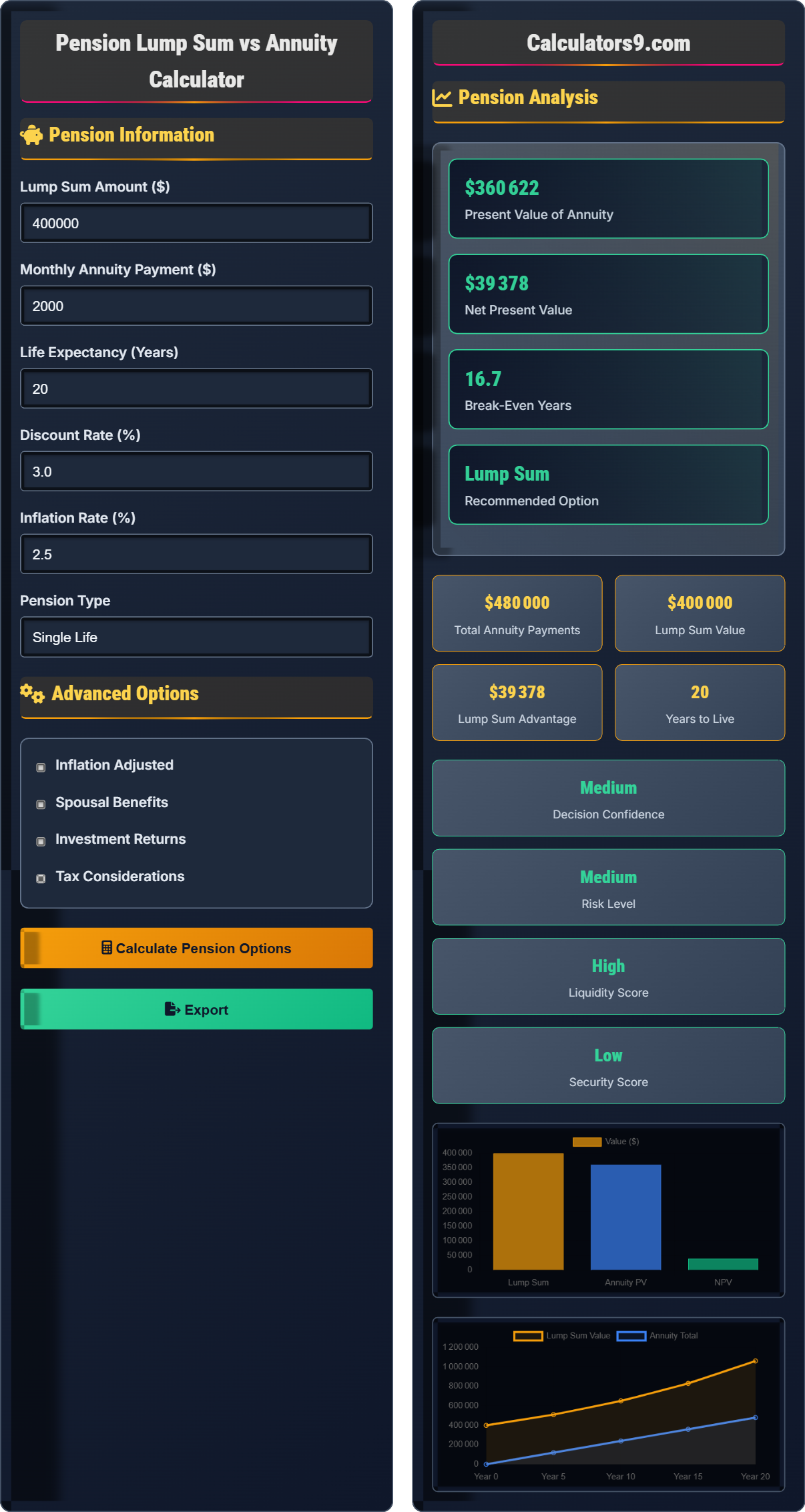
Example: $2,000 monthly annuity for 20 years at 3% discount rate:
\( PV = 2000 \times \frac{1 - (1 + 0.03/12)^{-240}}{0.03/12} = \$372,000 \)
If lump sum is $400,000, it's better to take the lump sum.
Pension Information
Advanced Options
Pension Analysis
Comprehensive Pension Guide
Most defined benefit pension plans offer retirees a choice between receiving their pension as a single lump sum payment or as monthly annuity payments for life. The lump sum option provides immediate access to the entire pension value, while the annuity option provides guaranteed income for life. This decision involves complex financial considerations including present value calculations, life expectancy, investment returns, and risk tolerance.
The fundamental pension comparison calculation uses the present value formula:
Where:
- \(PV\) = Present Value of Annuity
- \(PMT\) = Periodic Payment Amount
- \(r\) = Discount Rate per Period
- \(n\) = Number of Periods
Key considerations for each option:
- Lump Sum: Higher flexibility, investment control, inheritance potential
- Annuity: Guaranteed income, inflation protection, longevity insurance
- Break-Even: Point where total payments equal lump sum value
- Discount Rate: Rate used to calculate present value of future payments
- Time Value: Present value of future payments considering opportunity cost
- Hybrid Approach: Take partial lump sum and partial annuity
- Investment Strategy: Develop plan to generate income from lump sum
- Life Insurance: Use lump sum to purchase insurance for beneficiaries
- Professional Guidance: Consult financial advisors for complex situations
- Regular Review: Reassess decision based on changing circumstances
Pension Basics
Decision between lump sum or monthly payments for life.
\( PV = PMT \times \frac{1 - (1 + r)^{-n}}{r} \)
Where PV=present value, PMT=periodic payment, r=discount rate, n=number of periods.
- Compare present values
- Consider life expectancy
- Factor investment returns
Strategies
Focus on maximizing lifetime value and security.
- Calculate present values
- Assess life expectancy
- Consider investment capabilities
- Factor in legacy planning
- Life expectancy affects decision
- Investment skills matter
- Legacy planning is important
- Professional guidance recommended
Pension Learning Quiz
What is the primary advantage of taking a pension annuity over a lump sum?
The answer is B) Guaranteed income for life. The primary advantage of an annuity is the guaranteed monthly payments that continue for the retiree's lifetime, providing longevity insurance against outliving one's assets. This provides security regardless of how long the retiree lives, which is especially valuable given increasing life expectancies.
The annuity option provides what's called "longevity insurance" - protection against the risk of living longer than expected. While the total lifetime payments may not always be higher than what could be generated from a lump sum, the guaranteed nature of the payments provides security. This is particularly important for those who may not be confident in their investment abilities or who want to ensure a baseline income level.
Longevity Insurance: Protection against outliving your assets
Guaranteed Income: Payments that continue regardless of market conditions
Life Annuity: Payments that continue for the lifetime of the recipient
• Annuities provide guaranteed lifetime income
• Payments continue regardless of market performance
• Provides longevity insurance
• Consider annuities for baseline income security
• Evaluate your investment capabilities honestly
• Factor in life expectancy and health
• Assuming annuities always pay more than lump sums
• Not considering inflation adjustments
• Ignoring spousal benefits
If you receive a monthly annuity of $2,500 for 20 years and use a discount rate of 4%, what is the present value of these payments?
Using the present value formula: \( PV = PMT \times \frac{1 - (1 + r)^{-n}}{r} \)
Given:
- PMT = $2,500 (monthly payment)
- r = 4% ÷ 12 = 0.003333 (monthly discount rate)
- n = 20 × 12 = 240 (number of months)
Step 1: Calculate (1 + r)^(-n) = (1.003333)^(-240) = 0.4493
Step 2: Calculate 1 - (1 + r)^(-n) = 1 - 0.4493 = 0.5507
Step 3: Calculate PV = $2,500 × (0.5507 ÷ 0.003333) = $2,500 × 165.22 = $413,050
Therefore, the present value is approximately $413,050.
This calculation shows how to determine the present value of future annuity payments. The discount rate reflects the opportunity cost of funds and is typically based on expected investment returns. A higher discount rate results in a lower present value, while a lower discount rate results in a higher present value.
Present Value: Current worth of future payments
Discount Rate: Rate used to calculate present value
Opportunity Cost: Return lost by choosing one option over another
• Convert annual rate to monthly for monthly payments
• Use number of periods matching payment frequency
• Discount rate reflects investment opportunity cost
• Always match time periods (monthly payments = monthly rate)
• Not converting annual rates to monthly periods
• Using wrong discount rate
• Forgetting to adjust for payment frequency
You can take a lump sum of $350,000 or monthly annuity payments of $1,800 for life. If you live 18 years, which option provides more total value? At what point do the options break even?
Total value of annuity after 18 years:
Years = 18 × 12 = 216 months
Total = $1,800 × 216 = $388,800
Comparison: $388,800 (annuity) vs $350,000 (lump sum)
After 18 years, the annuity provides $38,800 more in total value.
Break-even calculation:
Break-even months = $350,000 ÷ $1,800 = 194.4 months
Break-even years = 194.4 ÷ 12 = 16.2 years
Therefore, the options break even after 16.2 years, and the annuity is better if you live longer than that.
This break-even analysis helps determine the minimum lifespan needed to make the annuity option financially advantageous. The break-even point is when the total annuity payments equal the lump sum amount. Beyond this point, the annuity becomes more valuable. This analysis is crucial for making an informed decision.
Break-Even Point: When total annuity payments equal lump sum value
Total Value: Sum of all payments received
Minimum Lifespan: Years needed to make annuity advantageous
• Break-even = Lump Sum ÷ Monthly Payment
• Annuity becomes better after break-even
• Life expectancy affects decision
• Calculate break-even for your specific situation
• Consider family health history
• Factor in general life expectancy data
• Not calculating break-even point
• Ignoring life expectancy in decision
• Focusing only on monthly amounts
You have a choice between a $400,000 lump sum or $2,000 monthly annuity. If you invest the lump sum at 6% annually, what would your annual investment return need to be to match the annuity payments over 20 years?
Total annuity payments over 20 years:
Total = $2,000 × 12 × 20 = $480,000
To match this with lump sum investment:
We need to find the rate where $400,000 grows to $480,000 over 20 years
Using the compound interest formula: FV = PV × (1 + r)^n
$480,000 = $400,000 × (1 + r)^20
1.2 = (1 + r)^20
(1.2)^(1/20) = 1 + r
1.0092 = 1 + r
r = 0.0092 or 0.92%
Therefore, you would need to earn approximately 0.92% annually to match the annuity payments.
This calculation shows the investment return needed to generate equivalent income to the annuity. If you can earn more than 0.92% annually, the lump sum becomes more attractive. However, this analysis doesn't consider the risk of investment returns or the guarantee of annuity payments. The calculation assumes all payments are received at the end of the period.
Required Return: Investment rate needed to match annuity
Compound Growth: Growth with reinvested returns
Equivalent Income: Same total value over time period
• Calculate required return for comparison
• Consider risk differences
• Guarantee vs. investment risk
• Compare required return to achievable rates
• Consider risk-adjusted returns
• Factor in investment management
• Not comparing required to achievable returns
• Ignoring investment risk
• Forgetting about management costs
What is the typical difference between a single-life and joint-and-survivor pension annuity?
The answer is D) Joint annuity pays less but continues after death. Joint-and-survivor annuities typically pay less than single-life annuities because they provide payments for two lifetimes instead of one. The survivor (usually spouse) continues receiving payments after the primary annuitant dies, often at a reduced rate (50% or 75% of the original amount).
Joint annuities provide spousal protection by ensuring continued income after the primary annuitant's death. The reduced payment amount reflects the longer expected payment period. The specific reduction and survivor percentage depend on the plan and options chosen. This trade-off between higher payments and continued protection for spouse is crucial for married couples.
Joint Annuity: Payments continue for two lifetimes
Survivor Benefit: Payments to surviving spouse
Single Life: Payments stop at death of primary recipient
• Joint annuities pay less than single life
• Survivor continues receiving payments
• Survivor rate typically 50-100% of original
• Consider spouse's financial needs
• Evaluate other income sources for spouse
• Compare joint vs. single with life insurance
• Assuming joint annuities pay same as single life
• Not considering spouse's other income
• Forgetting to evaluate survivor benefit
FAQ
Q: Should I take the lump sum or annuity payments?
A: The decision depends on several factors:
- Life Expectancy: Longer lives favor annuities
- Investment Skills: Confident investors may prefer lump sum
- Health Status: Affects longevity considerations
- Spousal Needs: Joint annuity protects surviving spouse
Generally, if you expect to live beyond the break-even point (typically 15-20 years), annuities provide better security. However, if you have strong investment skills and want to leave inheritance, lump sum may be better.
Q: What happens to my pension if I die before my spouse?
A: It depends on your pension option choice:
- Single Life: Payments stop at your death
- Joint & Survivor: Spouse continues receiving payments (typically 50-100%)
- Certain Period: Payments continue to beneficiary for guaranteed period
Joint and survivor options provide protection for your spouse but reduce the monthly payment amount. Consider your spouse's financial needs when making this decision.