Required Minimum Distribution Calculator
RMD planning tool • 2026 rates
RMD Calculation Formula:
Show the calculatorRMD = Account Balance ÷ Life Expectancy Factor
For 2026, Required Minimum Distributions (RMDs) must begin at age 73 (increased from 72 in 2023). The RMD is calculated by dividing your retirement account balance as of December 31st of the previous year by the life expectancy factor from the IRS Uniform Lifetime Table.
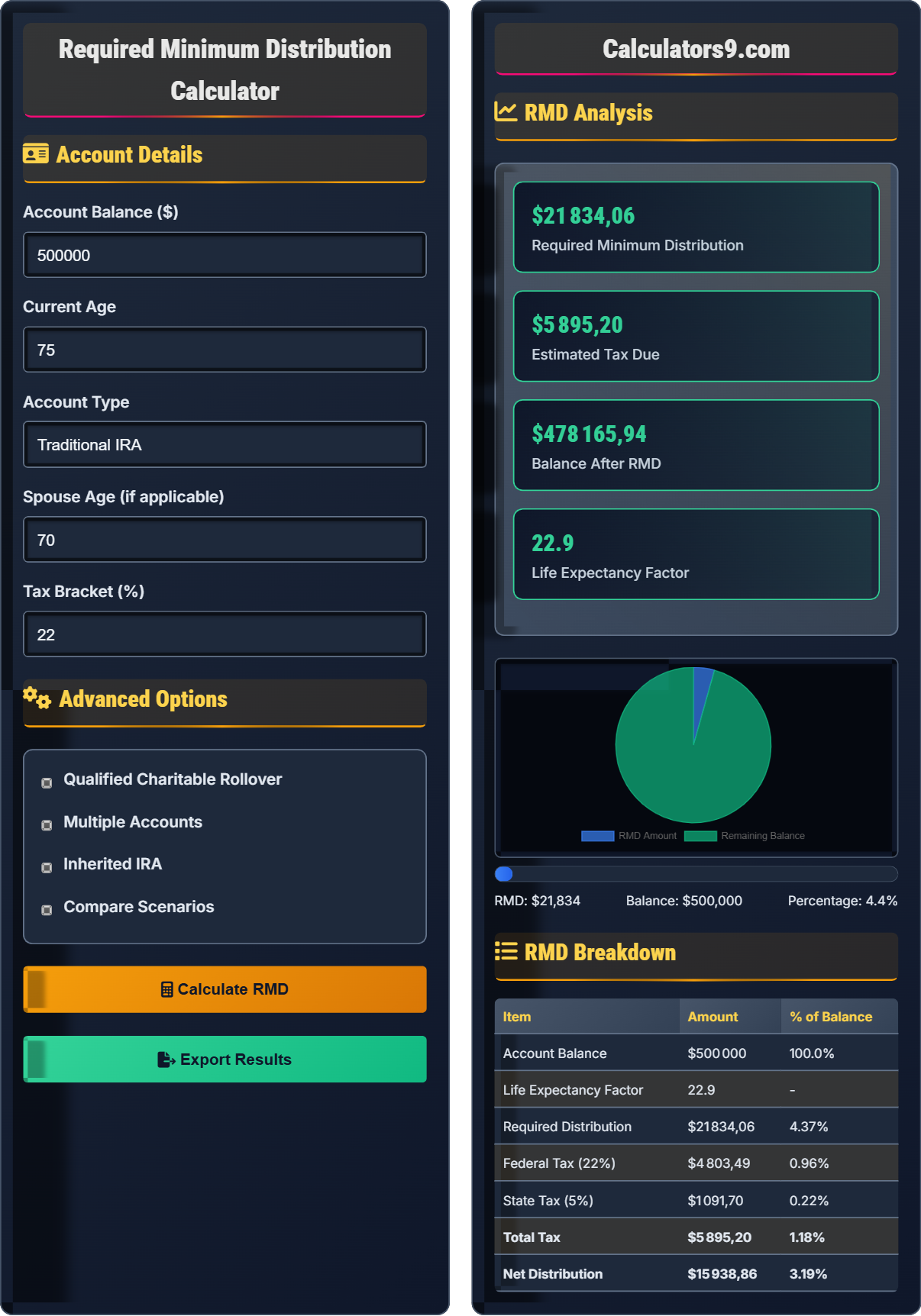
Example: For a 75-year-old with a $500,000 IRA:
- Life expectancy factor for age 75 = 22.9
- RMD = $500,000 ÷ 22.9 = $21,834
- Tax due (at 22% rate) = $21,834 × 22% = $4,803
Thus, the account owner must withdraw at least $21,834 and pay $4,803 in taxes.
Account Details
Advanced Options
RMD Analysis
RMD Breakdown
| Item | Amount | % of Balance |
|---|---|---|
| Account Balance | $500,000 | 100.0% |
| Life Expectancy Factor | 22.9 | - |
| Required Distribution | $21,834 | 4.37% |
| Federal Tax (22%) | $4,803 | 0.96% |
| State Tax (5%) | $1,092 | 0.22% |
| Total Tax | $5,895 | 1.18% |
| Net Distribution | $15,939 | 3.19% |
Comprehensive RMD Guide
Required Minimum Distributions (RMDs) are the minimum amounts that must be withdrawn annually from traditional IRAs, 401(k)s, and other retirement accounts starting at age 73 (increased from 72 in 2023). The SECURE Act changed the RMD age to 73 in 2023, and to 75 in 2033. Failure to take RMDs results in a 50% excise tax on the amount not distributed.
The standard RMD formula is:
Where:
- Account Balance = Value as of December 31 of previous year
- Life Expectancy Factor = From IRS Uniform Lifetime Table
The IRS Uniform Lifetime Table determines the divisor for RMD calculations:
| Age | Factor | Age | Factor |
|---|---|---|---|
| 70 | 27.4 | 85 | 12.8 |
| 72 | 25.6 | 87 | 11.4 |
| 75 | 22.9 | 90 | 9.7 |
| 80 | 18.7 | 95 | 6.5 |
- Charitable Rollovers: Direct transfers to charity count toward RMDs
- Roth Conversions: Convert before RMDs begin to reduce future RMDs
- Asset Location: Hold tax-inefficient assets in tax-advantaged accounts
- Withdrawal Sequencing: Strategically withdraw from different account types
- Early Planning: Plan for RMDs decades before they begin
RMD Basics
Minimum annual withdrawal from tax-deferred retirement accounts after age 73.
RMD = Account Balance ÷ Life Expectancy Factor
Where factor comes from IRS Uniform Lifetime Table.
- RMDs begin at age 73
- 50% penalty for missed distributions
- Applies to traditional retirement accounts
Strategies
Plan RMDs decades before they begin to minimize tax impact.
- Estimate future RMDs
- Consider Roth conversions
- Plan charitable giving
- Sequence withdrawals
- Higher RMDs push into higher tax brackets
- State tax implications vary
- Medicare surcharges may apply
- Required by April 1 of following year
RMD Learning Quiz
At what age must Required Minimum Distributions begin in 2026?
The answer is C) Age 73. The SECURE Act increased the RMD age from 70½ to 72 in 2020, and further to 73 in 2023. For 2026, RMDs must begin at age 73.
It's important to stay updated on changing RMD rules. The SECURE Act has modified the required beginning date multiple times. Understanding these changes helps with retirement planning and avoiding penalties. The age will increase to 75 in 2033.
RMD: Required Minimum Distribution from retirement accounts
SECURE Act: Setting Every Community Up for Retirement Enhancement Act
Required Beginning Date: Age when RMDs must start
• RMDs began at 70½ until 2020
• Changed to 72 in 2020
• Changed to 73 in 2023
• Remember "73 is the new 72" for 2023+
• Check IRS publications for updates
• Plan ahead for tax implications
• Using outdated age requirements
• Forgetting about the SECURE Act changes
• Not planning for tax impact
Calculate the RMD for a 75-year-old with a $450,000 traditional IRA. Show your work.
From the IRS Uniform Lifetime Table, the factor for age 75 is 22.9.
Step 1: RMD = Account Balance ÷ Life Expectancy Factor
Step 2: RMD = $450,000 ÷ 22.9
Step 3: RMD = $19,650.65
Therefore, the required minimum distribution is $19,650.65.
This calculation shows how the life expectancy factor decreases with age, causing RMDs to increase. At age 70, the factor is 27.4, resulting in smaller RMDs than at age 75. This is important for tax planning as RMDs can push retirees into higher tax brackets.
Life Expectancy Factor: Divisor from IRS Uniform Lifetime Table
Account Balance: Value as of December 31 of previous year
Uniform Lifetime Table: IRS table for RMD calculations
• Use December 31st balance of previous year
• Use correct life expectancy factor
• RMDs increase with age due to decreasing factors
• Remember: smaller factor = larger RMD
• RMDs increase as you age
• Check IRS Publication 590-B for tables
• Using current year's balance instead of previous year's
• Using wrong life expectancy table
• Forgetting to divide (doing multiplication instead)
Robert, age 78, has a $600,000 traditional IRA and is in the 24% federal tax bracket with 5% state tax. What is his RMD and the total tax liability?
Step 1: Find life expectancy factor for age 78 = 20.3 (from Uniform Lifetime Table)
Step 2: Calculate RMD = $600,000 ÷ 20.3 = $29,556.65
Step 3: Calculate federal tax = $29,556.65 × 24% = $7,093.60
Step 4: Calculate state tax = $29,556.65 × 5% = $1,477.83
Step 5: Calculate total tax = $7,093.60 + $1,477.83 = $8,571.43
Therefore, Robert's RMD is $29,556.65 with a total tax liability of $8,571.43.
This example demonstrates how RMDs can significantly impact tax liability. The RMD pushes $29,556.65 into Robert's taxable income, potentially affecting other tax calculations and benefits. As RMDs increase with age, tax planning becomes increasingly important.
Tax Liability: Total tax owed on RMD
Marginal Tax Rate: Highest tax rate applied to income
Tax Bracket: Range of income subject to specific tax rate
• RMDs are fully taxable as ordinary income
• Both federal and state taxes apply
• RMDs can affect other tax calculations
• Plan for quarterly estimated taxes
• Consider charitable rollovers to reduce taxable income
• RMDs may affect Medicare premiums
• Forgetting state tax implications
• Not planning for quarterly tax payments
• Underestimating tax impact on other benefits
Susan, age 65, has a $1,000,000 traditional IRA and expects to be in the 22% tax bracket at retirement. If she converts $200,000 to a Roth IRA now, how would this affect her RMDs when she turns 73? Assume a 6% annual growth rate.
Step 1: Calculate traditional IRA value at age 73 (8 years of growth)
Without conversion: $1,000,000 × (1.06)^8 = $1,000,000 × 1.5938 = $1,593,800
With conversion: ($1,000,000 - $200,000) × (1.06)^8 = $800,000 × 1.5938 = $1,275,040
Step 2: Calculate RMDs at age 73 (factor = 24.7)
Without conversion: $1,593,800 ÷ 24.7 = $64,526
With conversion: $1,275,040 ÷ 24.7 = $51,621
Step 3: Calculate tax savings on RMDs = ($64,526 - $51,621) × 22% = $2,838
Therefore, the conversion reduces future RMDs by $12,905 annually, saving $2,838 in taxes.
This demonstrates the Roth conversion strategy's benefit. By converting before RMDs begin, Susan reduces future RMDs. The converted amount grows tax-free and isn't subject to RMDs during her lifetime. This strategy works best when in a lower tax bracket before RMDs begin.
Roth Conversion: Moving funds from traditional to Roth IRA
Tax-Free Growth: Investment gains not subject to tax
Asset Location: Strategic placement of investments
• Roth conversions are taxable in the conversion year
• Converted amounts not subject to RMDs
• Best done in lower tax bracket years
• Consider partial conversions over multiple years
• Convert before RMDs begin for maximum benefit
• Plan conversion timing around tax brackets
• Forgetting that conversions are taxable
• Converting too late (after RMDs begin)
• Not considering the immediate tax impact
What is the penalty for failing to take the required minimum distribution?
The answer is C) 50% of the shortfall. The IRS imposes a 50% excise tax on the amount not distributed that should have been withdrawn as an RMD. This severe penalty emphasizes the importance of taking RMDs on time.
The 50% penalty is one of the highest penalties in the tax code, reflecting the government's interest in collecting taxes on tax-deferred retirement accounts. It's crucial to understand that this penalty applies to the entire shortfall amount, not just a percentage of it.
Excise Tax: Penalty tax on certain activities
Shortfall: Amount not withdrawn as required
IRS Enforcement: Strict compliance requirements
• 50% penalty on entire shortfall amount
• Penalty is in addition to regular income tax
• Penalty can be waived for reasonable cause
• Set up automatic RMDs to avoid missing deadlines
• Contact IRS immediately if you miss an RMD
• Document any reasonable cause for missed RMDs
• Underestimating the severity of the penalty
• Thinking missed RMDs can be made up easily
• Not setting up systems to ensure compliance
FAQ
Q: Can I take my RMD from one account if I have multiple retirement accounts?
A: For traditional IRAs, you can aggregate your balances and take the total RMD from one or more accounts. However, for 401(k)s, 403(b)s, and 457 plans, you must take the RMD from each account separately.
For example, if you have two traditional IRAs with balances of $200,000 and $300,000, and your total RMD calculation results in $20,000, you can take the full $20,000 from either account or split it between them.
Mathematically: Total RMD = Σ(Account Balances) ÷ Life Expectancy Factor
Q: How do Qualified Charitable Distributions (QCDs) work with RMDs?
A: Qualified Charitable Distributions (QCDs) allow you to transfer up to $105,000 directly from your IRA to a qualified charity. The QCD counts toward your RMD and is excluded from your gross income.
For a 75-year-old with a $25,000 RMD who makes a $15,000 QCD:
- RMD satisfied: $15,000
- Taxable income reduced by: $15,000
- Remaining RMD to take: $10,000
- Effective tax savings: $15,000 × tax rate
This strategy can significantly reduce tax liability while supporting charitable causes.