Social Security Break-Even Calculator
Fast retirement planning tool • 2026 rates
SS Break-Even Formula:
Show the calculator\( BE = \frac{E \times (1 - ER)}{LR - ER} \)
Where:
- \( BE \) = Break-Even Age
- \( E \) = Early Filing Age (62)
- \( ER \) = Early Reduction Rate (25-30%)
- \( LR \) = Late Increase Rate (8% per year)
Alternative formulas:
\( EF = BF \times (1 - ER) \)
\( LF = BF \times (1 + LR \times Y) \)
This formula calculates the age at which total benefits equalize between early and late filing strategies.
Example: With Full Retirement Age (FRA) at 67:
Early filing at 62: $1,500 × (1 - 0.30) = $1,050
Late filing at 70: $1,500 × (1 + 0.24) = $1,860
Break-even occurs around age 78-80 depending on life expectancy.
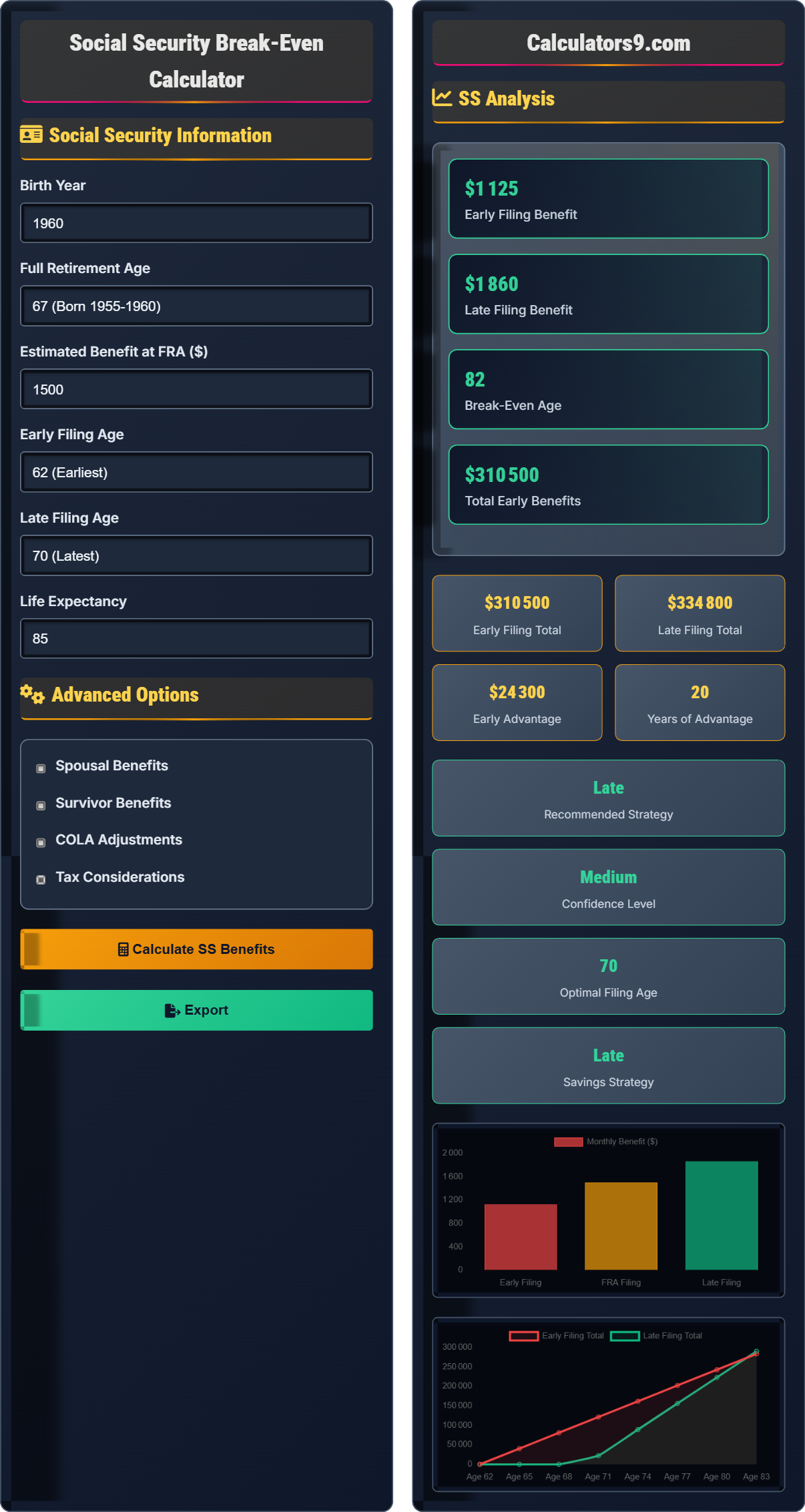
Social Security Information
Advanced Options
SS Analysis
Comprehensive Social Security Guide
Social Security is a federal program that provides monthly benefits to retired workers, their dependents, and survivors. The program is funded by payroll taxes and provides a foundation of income for millions of Americans. Benefits are calculated based on your lifetime earnings and the age at which you choose to begin receiving benefits.
The fundamental SS benefit calculation uses the following formulas:
Where:
- \(PIA\) = Primary Insurance Amount
- \(AIME\) = Average Indexed Monthly Earnings
Key considerations for break-even analysis:
- Life Expectancy: Those expecting longer lives benefit from delayed filing
- Health Status: Health considerations affect optimal filing age
- Financial Need: Immediate income needs may necessitate early filing
- Spousal Considerations: Coordinating benefits with spouse's strategy
- Other Income: Impact of other retirement income on SS benefits
- Early Filing: Beneficial for those with shorter life expectancy or immediate need
- Delayed Filing: Advantageous for those with longer life expectancy
- Spousal Coordination: Strategic timing between spouses
- Continued Work: Working after filing can increase future benefits
- Tax Planning: Managing taxation of SS benefits
SS Basics
Federal retirement income program for workers and families.
\( PIA = 0.9 \times (AIME \leq 1,024) + 0.32 \times (AIME > 1,024 \text{ and } \leq 6,172) + 0.15 \times (AIME > 6,172) \)
Where PIA=Primary Insurance Amount, AIME=Average Indexed Monthly Earnings.
- Early filing reduces benefits permanently
- Late filing increases benefits up to 70
- Break-even analysis depends on life expectancy
Strategies
Focus on optimizing lifetime benefit value.
- Calculate break-even ages
- Consider life expectancy
- Coordinate with spouse
- Factor in health status
- Early filing reduces permanently
- Late filing increases up to 70
- Spousal coordination matters
- Health affects optimal timing
SS Learning Quiz
What is the maximum reduction for filing Social Security benefits at age 62?
The answer is C) 30%. For those born after 1960, filing at age 62 results in a 30% permanent reduction in benefits. This reduction is calculated based on your Full Retirement Age (FRA), which varies by birth year. The reduction is permanent and affects all future payments.
The reduction for early filing is a critical consideration in retirement planning. The 30% reduction means that if your Primary Insurance Amount (PIA) at FRA is $1,500, filing at 62 would reduce it to $1,050 permanently. This reduction remains in effect for life, making the decision of when to file extremely important.
Primary Insurance Amount (PIA): Benefit amount at Full Retirement Age
Full Retirement Age (FRA): Age at which you receive 100% of benefits
Permanent Reduction: Reduction that applies for the rest of your life
• Early filing reduces benefits permanently
• Reduction is 30% for those born after 1960
• Applies to all future payments
• Calculate the exact reduction for your birth year
• Consider the lifetime impact of early filing
• Factor in immediate vs. long-term needs
• Underestimating the permanent impact
• Not considering the lifetime reduction
• Focusing only on immediate needs
If your Primary Insurance Amount at FRA is $2,000 and you file at age 62, what will your monthly benefit be?
Using the early filing reduction formula: \( EF = PIA \times (1 - ER) \)
Given:
- PIA = $2,000
- ER (Early Reduction) = 30% for those born after 1960
Step 1: Calculate reduction factor = 1 - 0.30 = 0.70
Step 2: Calculate early benefit = $2,000 × 0.70 = $1,400
Therefore, your monthly benefit at age 62 would be $1,400.
This calculation demonstrates the immediate impact of early filing. The $600 monthly reduction ($2,000 - $1,400) translates to $7,200 annually. Over many years, this can result in a significant reduction in lifetime benefits. However, the earlier start date means you receive payments for more months.
Early Filing Benefit: Reduced benefit amount for early filing
Reduction Factor: Percentage of full benefit received
Monthly Reduction: Dollar amount lost per month
• Reduction is calculated as percentage of PIA
• Applies to all future payments
• Varies by birth year
• Calculate exact reduction for your situation
• Forgetting the permanent nature of reduction
• Not calculating the full impact
• Assuming all reductions are the same
You have a PIA of $1,800. Filing at 62 gives $1,260/month, filing at 70 gives $2,376/month. If you live to 80, which filing strategy results in higher total lifetime benefits? At what age do the strategies break even?
Early filing (age 62 to 80):
Years of benefits = 18 years × 12 months = 216 months
Total = $1,260 × 216 = $272,160
Late filing (age 70 to 80):
Years of benefits = 10 years × 12 months = 120 months
Total = $2,376 × 120 = $285,120
Break-even calculation:
Let X = number of months after age 70 when benefits equalize
Early strategy total: $1,260 × (X + 96) [including 8 years from 62 to 70]
Late strategy total: $2,376 × X
$1,260 × (X + 96) = $2,376 × X
$1,260X + $120,960 = $2,376X
$120,960 = $1,116X
X = 108.4 months ≈ 9 years
Break-even age = 70 + 9 = 79 years old
Therefore, late filing results in higher total benefits ($285,120 vs $272,160) and breaks even at age 79.
This example shows the complex mathematics behind break-even analysis. The early filer receives more payments but at a lower rate, while the late filer receives fewer payments but at a higher rate. The break-even age is when the total accumulated benefits equalize. Beyond this age, the late filer benefits more significantly.
Break-Even Age: Age when total benefits equalize between strategies
Lifetime Total: Sum of all benefits received
Accumulated Benefits: Total received up to a specific age
• Break-even calculation requires time value consideration
• Longer life expectancy favors late filing
• Break-even age is critical decision point
• Calculate break-even for your specific situation
• Consider your life expectancy
• Factor in health and family history
• Not calculating break-even age
• Ignoring life expectancy in decision
• Focusing only on monthly amounts
A husband has a PIA of $2,500 and a wife has a PIA of $1,200. If the husband files at 62 ($1,750/month) and the wife waits until 70 ($1,488/month), how might spousal benefits affect their total household income?
Spousal benefit calculation:
Maximum spousal benefit = 50% of higher earner's PIA at their FRA
Spousal benefit = $2,500 × 50% = $1,250
Since wife's own benefit ($1,488) is higher than the spousal benefit ($1,250), she won't receive a spousal supplement.
However, if the husband had waited until 70 ($2,950/month), his PIA would have been higher, potentially affecting survivor benefits.
Household income = $1,750 + $1,488 = $3,238/month
Spousal benefits don't apply in this case since the wife's own benefit is higher than the spousal rate.
Spousal benefits are calculated based on the higher earner's PIA at their FRA, not their actual filing amount. The lower earner receives the higher of their own benefit or the spousal benefit. Coordination between spouses is crucial for maximizing household benefits, especially when considering survivor benefits and the timing of each spouse's filing.
Spousal Benefit: Up to 50% of higher earner's PIA at FRA
Higher Earner: Spouse with higher Primary Insurance Amount
Coordination: Strategic timing between spouses
• Spousal benefit based on higher earner's PIA
• Lower earner receives higher of own or spousal benefit
• Coordination maximizes household income
• Calculate spousal benefits for both partners
• Consider survivor benefit implications
• Coordinate filing strategies between spouses
• Confusing spousal benefit calculation basis
• Not coordinating between spouses
• Forgetting survivor benefit considerations
How does the Cost of Living Adjustment (COLA) affect Social Security benefits?
The answer is B) COLA applies to all benefits including reduced early benefits. Cost of Living Adjustments are applied annually to all Social Security benefits regardless of when you filed. The COLA is based on the Consumer Price Index for Urban Wage Earners and Clerical Workers (CPI-W). This means that even if you took a 30% reduction by filing early, future COLAs will apply to your reduced benefit amount.
COLA is crucial for maintaining purchasing power over time. While early filing reduces your base benefit permanently, COLAs help offset inflation effects on all beneficiaries. However, because COLAs are applied to the reduced amount for early filers, they start from a lower base and remain lower than those who delayed filing, even with annual increases.
COLA: Cost of Living Adjustment
CPI-W: Consumer Price Index for Urban Wage Earners
Purchasing Power: Value of benefits over time
• COLA applies to all benefit amounts
• Applied annually based on CPI-W
• Helps maintain purchasing power
• COLA helps all beneficiaries equally
• But early filers start from lower base
• Consider long-term inflation effects
• Thinking COLA fixes early filing reduction
• Assuming COLA only applies to FRA benefits
• Not considering long-term purchasing power
FAQ
Q: Should I take Social Security at 62 or wait until 70?
A: The decision depends on several factors:
- Life Expectancy: Those expecting longer lives benefit from waiting
- Health Status: Health affects optimal timing
- Immediate Need: Financial necessity may require early filing
- Other Income: Other retirement income affects decision
Generally, if you can afford to wait and expect to live past your break-even age (typically 78-80), delaying until 70 provides higher lifetime benefits. However, if you need the income immediately or have health concerns, early filing may be appropriate.
Q: How do spousal benefits work?
A: Spousal benefits allow the lower-earning spouse to claim up to 50% of the higher earner's Primary Insurance Amount at their FRA:
- Eligibility: Spouse must be at least 62 and married for at least 1 year
- Amount: Up to 50% of higher earner's PIA at their FRA
- Own vs. Spousal: Spouse receives higher of own benefit or spousal benefit
- Coordination: Higher earner must file for benefits for spousal to be available
Spousal benefits are not affected by when the higher earner files, but the lower earner's own benefit is affected by their filing age.