Social Security Calculator
Benefits estimator • 2026 projections
Primary Insurance Amount (PIA) Formula:
Show the calculator\( PIA = 0.9 \times (AIME \leq 1,115) + 0.32 \times (AIME - 1,115, \leq 6,721) + 0.15 \times (AIME - 6,721) \)
Where:
- \( PIA \) = Primary Insurance Amount (base monthly benefit)
- \( AIME \) = Average Indexed Monthly Earnings
- \( 1,115 \) = First bend point (2023)
- \( 6,721 \) = Second bend point (2023)
The PIA is then adjusted based on when you start receiving benefits:
- Early retirement (age 62): Reduced by up to 30%
- Full retirement age: Full PIA amount
- Delayed retirement: Increased by up to 8% per year until age 70
Example: For an AIME of $5,000:
\( PIA = 0.9 \times 1,115 + 0.32 \times (5,000 - 1,115) = 1,003.50 + 1,243.20 = \$2,246.70 \)
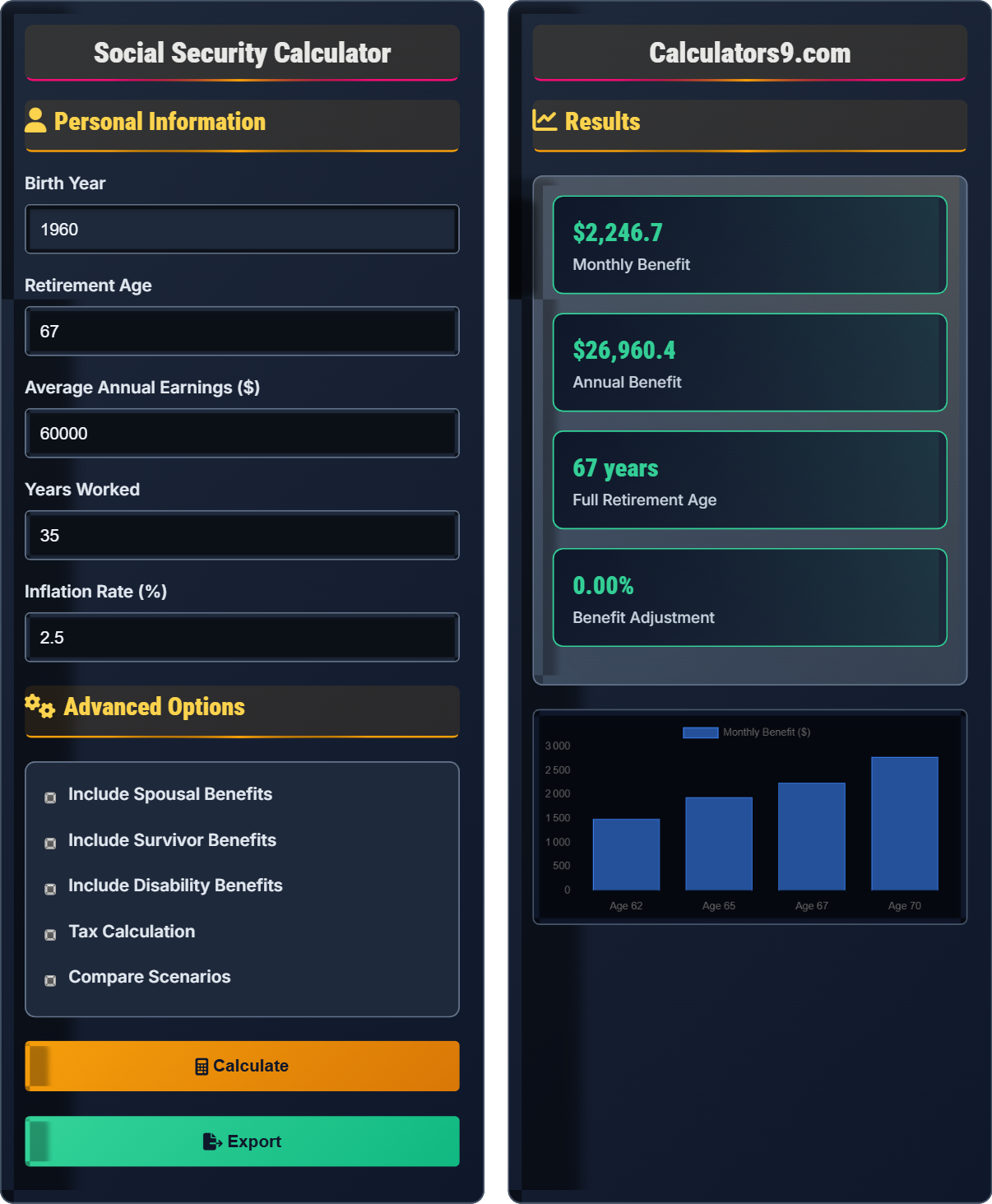
If claimed at full retirement age of 67, the monthly benefit would be approximately $2,247.
Personal Information
Advanced Options
Results
| Retirement Age | Monthly Benefit | Annual Benefit | Reduction/Growth |
|---|
| Year | Age | Benefit | COLA Adjustment | Cumulative |
|---|
Comprehensive Social Security Guide
Social Security is a federal program that provides financial benefits to retired workers, disabled individuals, and survivors of deceased workers. Funded through payroll taxes (FICA), it serves as a foundation of retirement income for millions of Americans. The program was established in 1935 to provide economic security during the Great Depression and continues to evolve to meet changing demographics.
The Primary Insurance Amount (PIA) is calculated using a progressive formula with three brackets:
Where:
- \(PIA\) = Primary Insurance Amount (base monthly benefit)
- \(AIME\) = Average Indexed Monthly Earnings
- \(BP_1\) = First bend point ($1,115 in 2023)
- \(BP_2\) = Second bend point ($6,721 in 2023)
Social Security provides multiple types of benefits:
- Retirement Benefits: For workers who have reached retirement age
- Disability Benefits: For workers unable to work due to medical condition
- Survivor Benefits: For spouses and children of deceased workers
- Spousal Benefits: Up to 50% of spouse's benefit for non-working spouses
- Work Longer: Increases AIME and potentially moves you to higher bracket
- Delay Claiming: 8% annual increase for each year past full retirement age
- Coordinate with Spouse: Strategic claiming can maximize household benefits
- Continue Working: Higher earnings can replace lower indexed years
- Understand Tax Implications: Up to 85% of benefits may be taxable
SS Basics
Federal program providing retirement, disability, and survivor benefits.
\(PIA = 0.9 \times (AIME \leq BP_1) + 0.32 \times (AIME - BP_1, \leq BP_2) + 0.15 \times (AIME - BP_2)\)
Where PIA=Primary Insurance Amount, AIME=Average Indexed Monthly Earnings, BP=Bend Points.
- 40 credits (10 years) required for benefits
- Maximum benefit at age 70
- Benefits increase with inflation (COLA)
Strategies
Claiming age significantly impacts lifetime benefits through reductions or increases.
- Work until age 70
- Replace low-earning years
- Coordinate with spouse
- Consider taxation
- Health affects optimal claiming age
- Taxation impacts net benefits
- Spousal benefits require coordination
- COLA adjustments occur annually
Social Security Learning Quiz
Which of the following best describes the purpose of the "bend points" in the Social Security benefit formula?
The answer is B) To create a progressive benefit system. Bend points are thresholds in the benefit formula that apply different replacement rates to different portions of average monthly earnings. Lower earners receive a higher percentage of their pre-retirement income, while higher earners receive a smaller percentage, making the system progressive.
The bend point system ensures that Social Security provides a higher replacement rate for lower-income workers. The first portion of average monthly earnings (up to the first bend point) is replaced at 90%, the second portion (between the two bend points) at 32%, and any amount above the second bend point at 15%. This structure provides a greater benefit relative to pre-retirement earnings for those who earned less during their working years.
Bend Points: Thresholds in the benefit formula that apply different replacement rates
Progressive System: System that provides higher benefits relative to income for lower earners
Replacement Rate: Percentage of pre-retirement income provided by benefits
• Lower earners get higher replacement rates (90% on first portion)
• Higher earners get lower replacement rates (15% on highest portion)
• Bend points are adjusted annually for inflation
• Remember: 90%-32%-15% structure
• Think of bend points as tax brackets for benefits
• Progressive system helps replace more income for lower earners
• Assuming everyone gets the same percentage of pre-retirement income
• Thinking bend points are fixed dollar amounts (they're adjusted annually)
• Confusing bend points with retirement ages
Calculate the Primary Insurance Amount (PIA) for a worker with an AIME of $4,500. Use bend points of $1,115 and $6,721. Show your work.
Using the PIA formula: \(PIA = 0.9 \times (AIME \leq BP_1) + 0.32 \times (AIME - BP_1, \leq BP_2) + 0.15 \times (AIME - BP_2)\)
Given: AIME = $4,500, BP₁ = $1,115, BP₂ = $6,721
Since AIME ($4,500) is between BP₁ and BP₂:
Step 1: Calculate first bracket: $1,115 × 0.9 = $1,003.50
Step 2: Calculate second bracket: ($4,500 - $1,115) × 0.32 = $3,385 × 0.32 = $1,083.20
Step 3: Calculate third bracket: Since AIME ≤ BP₂, this portion = $0
Step 4: Calculate PIA = $1,003.50 + $1,083.20 + $0 = $2,086.70
Therefore, the monthly benefit at full retirement age is $2,086.70.
This calculation demonstrates how the progressive formula works. The worker receives 90% of the first $1,115 of average monthly earnings, then 32% of earnings between $1,115 and $4,500. The system ensures that regardless of income level, all workers receive the same percentage on their lowest-earning portion, providing a foundation of support.
AIME: Average Indexed Monthly Earnings used to calculate benefits
PIA: Primary Insurance Amount - base monthly benefit at full retirement age
Bend Points: Thresholds that determine different replacement rates
• Apply 90% to earnings up to first bend point
• Apply 32% to earnings between bend points
• Apply 15% to earnings above second bend point
• Break down AIME into segments at each bend point
• Calculate each segment separately
• Sum all segments for total PIA
• Applying the same percentage to all earnings
• Not considering which bracket each portion falls into
• Incorrectly calculating the amount in each bracket
Jane's full retirement age is 67 with a monthly benefit of $2,500. If she claims benefits at age 62, what will her monthly benefit be? If she delays until age 70, what will her monthly benefit be? Calculate the total difference over 5 years.
Step 1: Early retirement (age 62) reduction = 30% for those born in 1960
Early benefit = $2,500 × (1 - 0.30) = $2,500 × 0.70 = $1,750 per month
Step 2: Delayed retirement (age 70) increase = 8% per year × 3 years = 24%
Delayed benefit = $2,500 × (1 + 0.24) = $2,500 × 1.24 = $3,100 per month
Step 3: Difference over 5 years (60 months):
Early: $1,750 × 60 = $105,000
Delayed: $3,100 × 60 = $186,000
Total difference = $186,000 - $105,000 = $81,000
This example shows the dramatic impact of claiming age on lifetime benefits. The 8-year difference between claiming at 62 versus 70 results in a $1,350 monthly difference. Over just 5 years, this represents an $81,000 difference. The penalty for early claiming and bonus for delayed claiming are designed to make the total lifetime benefits roughly equivalent, but actual outcomes depend on individual longevity.
Full Retirement Age: Age at which you receive 100% of your PIA
Early Retirement Reduction: Permanent reduction for claiming before full retirement age
Delayed Retirement Credit: Increase for claiming after full retirement age
• Maximum 30% reduction for early claiming (age 62)
• Maximum 32% increase for delayed claiming (age 70)
• Credits stop accumulating at age 70
• Remember: 8% annual increase for delayed claiming
• Calculate total lifetime benefits, not just monthly amounts
• Consider health and family longevity in planning
• Not understanding that early reductions are permanent
• Thinking you can continue earning delayed credits after age 70
• Focusing only on monthly amounts without considering lifetime totals
Tom's PIA is $2,800 per month, and his wife Mary's PIA is $1,600 per month. If Mary files for spousal benefits at her full retirement age, what will her benefit be? How does this compare to her own benefit? What happens if Tom dies before Mary?
Step 1: Spousal benefit calculation = 50% of Tom's PIA = $2,800 × 0.50 = $1,400
Step 2: Mary will receive her own benefit of $1,600 since it's higher than the spousal benefit of $1,400
Step 3: If Tom dies before Mary, she becomes eligible for survivor benefits equal to 100% of Tom's benefit = $2,800
Step 4: This is higher than her own benefit of $1,600, so she would receive $2,800 as a survivor benefit
Therefore, Mary receives her own benefit of $1,600 while both are alive, but $2,800 if Tom passes away.
This demonstrates how Social Security provides protection against loss of income for surviving spouses. The spousal benefit is calculated as 50% of the higher earner's benefit, but the spouse always receives the higher of their own benefit or the spousal benefit. Upon the death of a spouse, survivor benefits typically provide 100% of the deceased's benefit, offering crucial income replacement.
Spousal Benefit: Up to 50% of higher earner's PIA
Survivor Benefit: Up to 100% of deceased spouse's PIA
Own Benefit: Based on individual's own work record
• Spousal benefit = 50% of higher earner's PIA
• Always receive higher of own benefit or spousal benefit
• Survivor benefit = 100% of deceased spouse's benefit
• Spousal benefits don't reduce the higher earner's benefit
• Coordinate claiming strategies between spouses
• Consider survivor benefit implications in planning
• Thinking spousal benefits reduce the higher earner's benefit
• Not understanding that you receive the higher of two options
• Confusing spousal and survivor benefit calculations
Which of the following best describes how Cost-of-Living Adjustments (COLA) work in Social Security?
The answer is B) Based on Consumer Price Index (CPI-W) changes. COLA adjustments are automatically applied based on changes in the Consumer Price Index for Urban Wage Earners and Clerical Workers (CPI-W). When inflation occurs, benefits are adjusted upward to maintain purchasing power. No adjustment occurs if the CPI-W shows deflation or no change.
COLA (Cost-of-Living Adjustment) protects beneficiaries against inflation by adjusting benefits based on changes in the CPI-W. The adjustment is calculated by comparing the average CPI-W for the third quarter of the current year to the previous year. If there's an increase, benefits are adjusted by that percentage. If there's no increase or a decrease, there's no COLA adjustment for that year.
COLA: Cost-of-Living Adjustment to maintain purchasing power
CPI-W: Consumer Price Index for Urban Wage Earners and Clerical Workers
Purchasing Power: Amount of goods/services that money can buy
• COLA is based on CPI-W, not other inflation measures
• Adjustments are automatic, no action required
• No COLA if CPI-W doesn't increase
• COLA helps maintain benefit value over time
• Higher inflation years result in larger adjustments
• Some years have zero COLA if prices don't rise
• Assuming COLA is guaranteed every year
• Thinking COLA is based on general inflation measures
• Confusing COLA with benefit adjustments for claiming age
FAQ
Q: How does working after starting Social Security benefits affect my payments?
A: If you work while receiving Social Security benefits before your full retirement age, your benefits may be temporarily reduced if your earnings exceed the annual limit. For example, in 2023, $1 in benefits is withheld for every $2 earned above $21,240.
However, once you reach full retirement age, the earnings limit disappears entirely, and your benefits are recalculated to account for the months when benefits were reduced. This recalculation ensures you don't permanently lose benefits due to temporary reductions.
The formula for monthly benefit reduction before full retirement age is:
\( \text{Reduction} = \frac{\text{Earnings above limit}}{2} \)
This policy is designed to encourage retirement at the appropriate age while ensuring that those who continue working still receive benefits once they reach full retirement age.
Q: Should I claim Social Security early or invest the money I would save by waiting?
A: This decision depends on several factors including your health, financial needs, and investment capabilities.
- Claiming early: Provides immediate income but reduces lifetime benefits by up to 30%
- Waiting: Increases benefits by 8% annually (up to age 70), providing guaranteed growth
The break-even point for delaying benefits is typically around age 80-82. If you expect to live beyond this age, delaying usually provides higher lifetime benefits. However, if you need the income immediately or have health concerns, claiming early may be appropriate.
Mathematically, the delayed retirement credit of 8% per year provides a guaranteed return that's difficult to match with other safe investments, making it attractive for those who can afford to wait.