Discount Calculator
Multi-discount & savings calculator • 2026
Discount Formula:
Show the calculator\( \text{Discount Amount} = \text{Original Price} \times \frac{\text{Discount Rate}}{100} \)
\( \text{Discounted Price} = \text{Original Price} - \text{Discount Amount} \)
\( \text{Savings Percentage} = \frac{\text{Discount Amount}}{\text{Original Price}} \times 100 \)
For multiple discounts (sequential):
\( \text{Final Price} = \text{Original Price} \times (1 - \frac{\text{Discount}_1}{100}) \times (1 - \frac{\text{Discount}_2}{100}) \times ... \)
Where:
- Original Price = Price before any discounts
- Discount Rate = Percentage discount applied
- Discount Amount = Dollar value of discount
- Discounted Price = Price after discount
- Final Price = Price after all discounts
This formula calculates discounts sequentially, where each discount is applied to the current price, not the original price. This is the standard method used in retail for multiple discounts. The total savings percentage is not simply the sum of individual discount percentages.
Example: For an item priced at $100 with 20% and 10% discounts applied sequentially:
After 20% discount: $100 × (1 - 0.20) = $80
After additional 10% discount: $80 × (1 - 0.10) = $72
Total savings: $100 - $72 = $28
Effective savings percentage: ($28/$100) × 100 = 28%
Note: This is less than the sum of discounts (20% + 10% = 30%) due to sequential application.
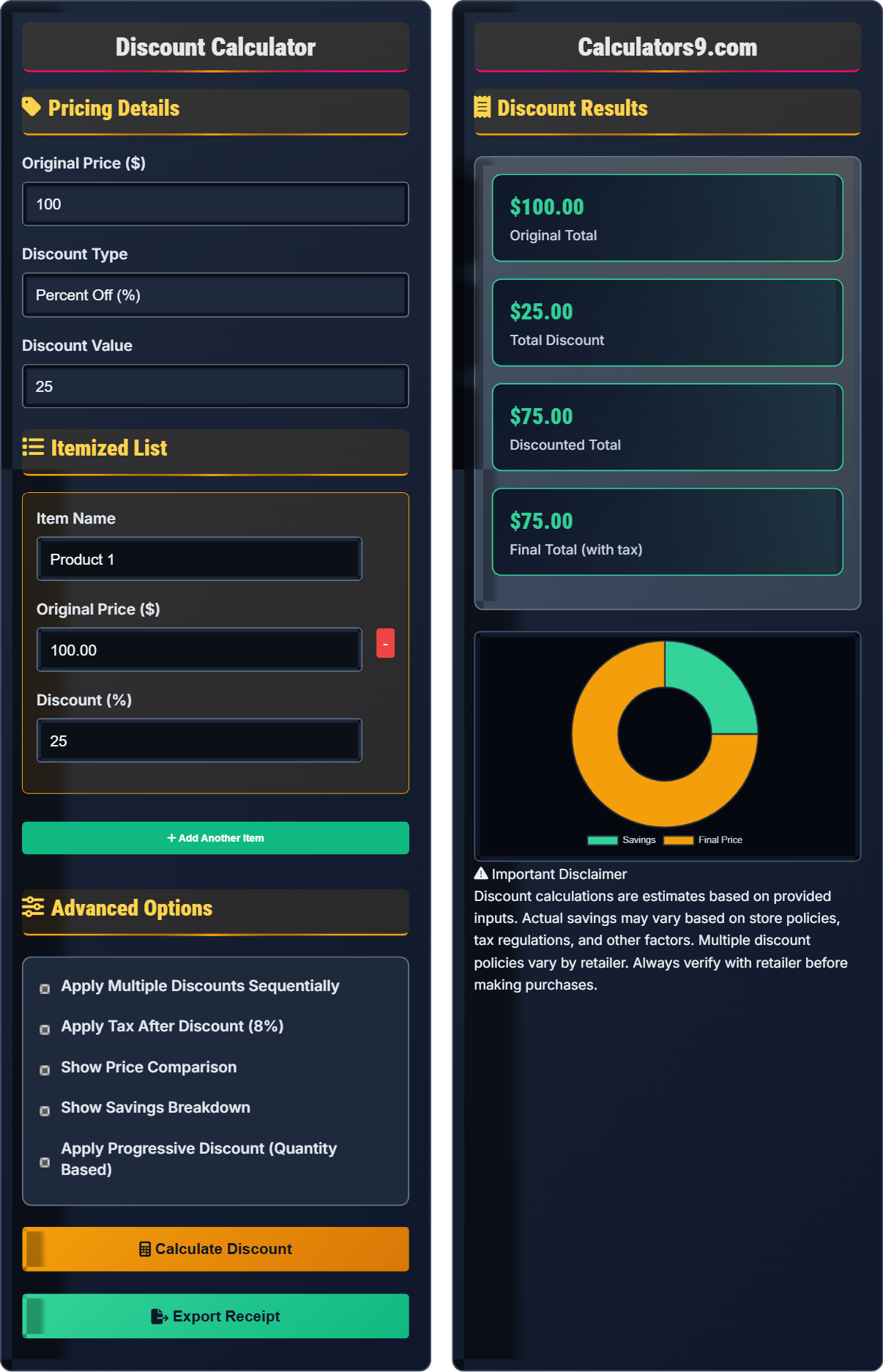
Pricing Details
Itemized List
Advanced Options
Discount Results
Discount calculations are estimates based on provided inputs. Actual savings may vary based on store policies, tax regulations, and other factors. Multiple discount policies vary by retailer. Always verify with retailer before making purchases.
Discount Types
Discounts come in various forms, each with different calculation methods and applications.
Percent Off
Percentage of original price
Fixed Amount
Set dollar reduction
Buy One Get One
Equivalent to 50% off when buying 2
Quantity Discount
Based on purchase volume
- Simple Discount: Single percentage or fixed amount
- Sequential Discount: Multiple discounts applied one after another
- Stacked Discount: Discounts applied to the same base price
- Progressive Discount: Discount increases with quantity
Multi-Discount Scenarios
When multiple discounts are applied, the order and method of application significantly affect the final price.
| Scenario | Discount 1 | Discount 2 | Final Price (on $100) | Total Savings |
|---|---|---|---|---|
| Sequential (20% then 10%) | 20% | 10% | $72.00 | $28.00 |
| Sequential (10% then 20%) | 10% | 20% | $72.00 | $28.00 |
| Sum of Discounts (30%) | 30% | - | $70.00 | $30.00 |
| Fixed + Percent ($10 + 20%) | $10 | 20% | $72.00 | $28.00 |
- Sequential discounts are applied to the current price, not original
- Order of sequential discounts doesn't affect the final price
- Sum of discounts is not equivalent to sequential application
- Fixed discounts are typically applied before percentage discounts
- Not all retailers allow stacking of promotional discounts
Maximizing Savings
Progressive discounts reward larger purchases by offering increasing savings based on quantity or spending thresholds.
Volume Pricing
Discounts increase with purchase quantity
Tiered Discounts
Fixed thresholds for discount levels
Loyalty Rewards
Accumulating discounts over time
Bundle Deals
Discounts for purchasing multiple items
- Calculate effective discount rate to compare deals
- Consider utility of additional items before bulk purchases
- Check expiration dates on discount offers
- Verify minimum purchase requirements
- Be aware of return policies for discounted items
Discount Calculation Learning Quiz
If an item originally priced at $100 receives a 20% discount followed by a 10% discount, what is the final price?
The answer is B) $72. First, apply the 20% discount: $100 × (1 - 0.20) = $80. Then, apply the 10% discount to the new price: $80 × (1 - 0.10) = $72. Note that this is not equivalent to a single 30% discount, which would result in $70.
Sequential discounts are applied one after another, with each discount calculated on the current price, not the original price. This is why two sequential discounts (20% + 10%) result in less total savings than a single equivalent discount (30%). The second discount is applied to a smaller base amount.
Sequential Discounts: Discounts applied one after another
Current Price: Price after previous discounts
Base Amount: Price used for discount calculation
• Apply each discount to the current price, not original
• Sequential discounts don't add linearly
• Order doesn't matter for final result
• Multiply by (1 - discount rate) for each discount
• Sequential: $100 × 0.80 × 0.90 = $72
• Not the same as adding percentages
• Adding discount percentages together
• Applying all discounts to original price
• Confusing sequential with cumulative discounts
Calculate the final price of a $200 item with a $30 fixed discount followed by a 15% discount. Show your work.
Step 1: Apply fixed discount
$200 - $30 = $170
Step 2: Apply percentage discount to new price
$170 × (1 - 0.15) = $170 × 0.85 = $144.50
Step 3: Calculate total savings
$200 - $144.50 = $55.50
Step 4: Calculate effective discount percentage
($55.50 / $200) × 100 = 27.75%
Therefore, the final price is $144.50 with total savings of $55.50 (27.75%).
When combining different types of discounts (fixed + percentage), they are typically applied sequentially. Fixed discounts are often applied first, followed by percentage discounts. The order matters because percentage discounts are calculated on the remaining amount after fixed discounts.
Fixed Discount: Dollar amount reduction
Percentage Discount: Rate applied to current price
Effective Discount: Total savings as percentage
• Fixed discounts applied first in sequence
• Percentage discounts applied to current price
• Calculate effective discount for comparison
• Apply discounts in the specified order
• Calculate effective rate for comparison
• Verify calculations step by step
• Applying percentage discount to original price
• Not following correct discount order
• Forgetting to apply both discounts
A retailer offers tiered discounts: 5% for purchases $100-$199, 10% for purchases $200-$399, and 15% for purchases $400+. If you buy items totaling $350, what is your final price after the appropriate discount?
Step 1: Determine applicable discount tier
$350 falls in the $200-$399 range, so 10% discount applies
Step 2: Calculate discount amount
$350 × 0.10 = $35
Step 3: Calculate final price
$350 - $35 = $315
Step 4: Calculate effective savings percentage
($35 / $350) × 100 = 10%
Therefore, the final price is $315 with a 10% discount.
Tiered discounts are applied based on purchase thresholds. Only one discount rate applies based on which tier the purchase amount falls into. Unlike progressive discounts, the rate doesn't increase incrementally; the entire purchase receives the rate for the tier it qualifies for.
Tiered Discount: Discount based on purchase amount ranges
Threshold: Minimum amount for discount level
Single Rate: One rate applies to entire purchase
• Only one tier rate applies to purchase
• Determine tier based on total purchase
• Entire purchase gets same rate
• Identify correct tier for purchase amount
• Apply single rate to entire purchase
• Consider rounding up to next tier
• Applying multiple tier rates to same purchase
• Confusing with progressive discount structure
• Not identifying correct tier
A store offers a progressive discount where you get 5% off your first item, 6% off your second item, 7% off your third item, and so on, increasing by 1% for each additional item. If you buy 5 items each priced at $50, what is your total cost?
Step 1: Calculate discount for each item
Item 1: $50 × (1 - 0.05) = $50 × 0.95 = $47.50
Item 2: $50 × (1 - 0.06) = $50 × 0.94 = $47.00
Item 3: $50 × (1 - 0.07) = $50 × 0.93 = $46.50
Item 4: $50 × (1 - 0.08) = $50 × 0.92 = $46.00
Item 5: $50 × (1 - 0.09) = $50 × 0.91 = $45.50
Step 2: Calculate total cost
$47.50 + $47.00 + $46.50 + $46.00 + $45.50 = $232.50
Step 3: Calculate total savings
Original total: $50 × 5 = $250
Savings: $250 - $232.50 = $17.50
Effective rate: ($17.50 / $250) × 100 = 7%
Therefore, the total cost is $232.50.
Progressive discounts increase with each additional item purchased. Each item receives its own discount rate based on its position in the sequence. This creates an increasing benefit for buying more items, encouraging larger purchases. The effective average discount is calculated based on total savings versus original total.
Progressive Discount: Rate increases with quantity
Sequence Position: Determines discount rate
Increasing Benefit: More items = higher rates
• Rate increases with each additional item
• Each item gets its own rate
• Encourages bulk purchases
• Calculate discount for each item separately
• Track position for rate determination
• Consider if extra items are worthwhile
• Applying same rate to all items
• Not tracking item positions correctly
• Confusing with tiered discount structure
Which discount presentation is most likely to make consumers perceive greater value?
The answer is C) "$30 savings on $100 item". Research shows that presenting the absolute dollar amount saved creates a stronger perception of value than percentage discounts, especially for higher-priced items. The concrete dollar figure makes the savings more tangible and easier to comprehend than abstract percentages.
Consumer psychology research indicates that people process discount information differently based on presentation format. Dollar savings figures tend to create stronger emotional responses than percentage discounts because they represent concrete, quantifiable benefits. This is particularly true for larger purchases where the absolute savings amount feels more significant.
Consumer Psychology: How people process pricing info
Concrete Benefits: Tangible, measurable advantages
Quantifiable Value: Measurable savings amount
• Dollar savings often perceived as more valuable
• Percentage discounts work better for smaller items
• Presentation affects perceived value
• Look at actual savings amount
• Don't be swayed by presentation format
• Calculate effective discount rate
• Being influenced by presentation format
• Not calculating actual savings
• Confusing perceived vs. actual value
FAQ
Q: How do I calculate the effective discount rate when multiple discounts are applied?
A: To calculate the effective discount rate with multiple discounts:
- Sequential Discounts: Multiply by (1 - each discount rate)
- For discounts d₁, d₂, d₃...: Final multiplier = (1-d₁)×(1-d₂)×(1-d₃)...
- Effective Rate: 1 - Final Multiplier
Example with 20% and 10% discounts:
Final multiplier = (1-0.20) × (1-0.10) = 0.80 × 0.90 = 0.72
Effective rate = 1 - 0.72 = 0.28 = 28%
This is less than the sum (20% + 10% = 30%) due to sequential application.
Q: What's the difference between discount stacking and sequential application?
A: The two methods produce different results:
- Sequential Application: Each discount applies to the current price
- Formula: Price × (1-d₁) × (1-d₂) × ...
- Stacking (if allowed): Sum of discount percentages
- Formula: Price × (1 - (d₁+d₂+...))
For a $100 item with 20% and 10% discounts:
Sequential: $100 × 0.80 × 0.90 = $72
Stacked: $100 × (1 - 0.30) = $70
Most retailers use sequential application and restrict stacking of promotional discounts.