Estate Tax Calculator
Federal & state estate tax estimator • 2026 rates
Estate Tax Formula:
Show the calculator\( \text{Taxable Estate} = \text{Gross Estate} - \text{Deductions} \)
\( \text{Estate Tax Due} = (\text{Taxable Estate} - \text{Exemption}) \times \text{Tax Rate} \)
Where:
- Gross Estate = Total value of all assets at death
- Deductions = Charitable contributions, debts, administrative expenses
- Exemption = Federal estate tax exemption ($13.61 million in 2024)
- Tax Rate = Progressive rate based on taxable estate value (up to 40%)
This formula calculates the federal estate tax liability for estates exceeding the applicable exemption amount. The tax applies only to the portion of the estate above the exemption threshold.
Example: For an estate worth $15 million with $500,000 in deductions and a $13.61 million exemption:
Taxable Estate: $15,000,000 - $500,000 = $14,500,000
Taxable Amount: $14,500,000 - $13,610,000 = $890,000
Tax Due: $890,000 × 40% = $356,000
Plus additional tax on amounts below exemption: $345,800 (base tax)
Total Estate Tax: $356,000 + $345,800 = $701,800
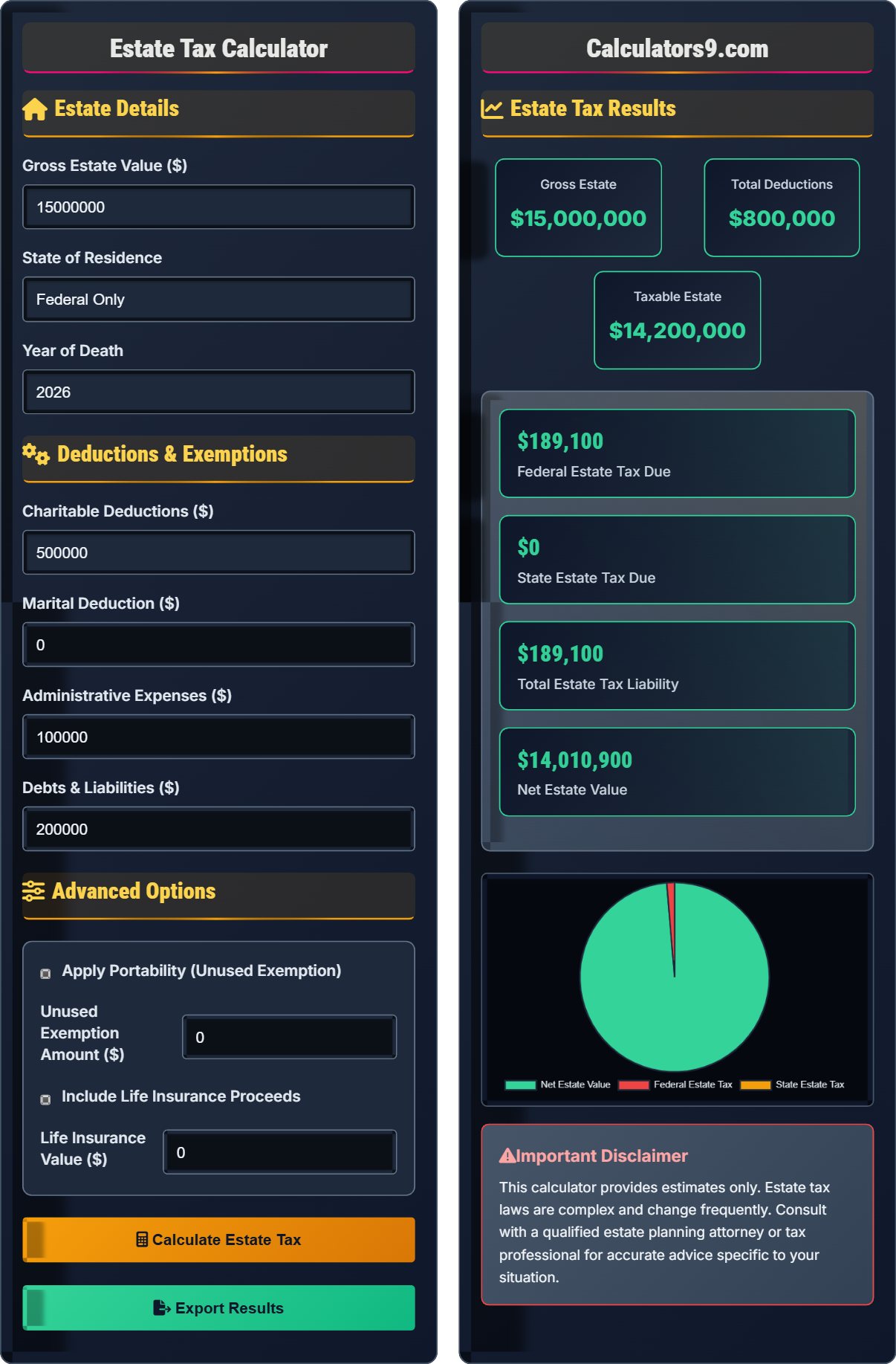
Estate Details
Deductions & Exemptions
Advanced Options
Estate Tax Results
This calculator provides estimates only. Estate tax laws are complex and change frequently. Consult with a qualified estate planning attorney or tax professional for accurate advice specific to your situation.
Estate Tax Basics
The estate tax is a tax on the transfer of property from deceased individuals to their heirs. It applies to the total value of all assets owned by a person at the time of death, including real estate, cash, stocks, bonds, business interests, and other property.
Where deductions include charitable contributions, marital transfers, administrative expenses, and debts.
- 18% on amounts over exemption up to $10,000
- 20% on amounts over $10,000 up to $20,000
- 22% on amounts over $20,000 up to $40,000
- 24% on amounts over $40,000 up to $60,000
- 26% on amounts over $60,000 up to $80,000
- 28% on amounts over $80,000 up to $100,000
- 30% on amounts over $100,000 up to $150,000
- 32% on amounts over $150,000 up to $250,000
- 34% on amounts over $250,000 up to $500,000
- 37% on amounts over $500,000 up to $1,000,000
- 39% on amounts over $1,000,000 up to $1,250,000
- 40% on amounts over $1,250,000
- Federal estate tax exemption is $13.61 million for 2024 (indexed for inflation)
- Only applies to estates exceeding the exemption amount
- Tax is paid by the estate, not the beneficiaries
- Marital deduction allows unlimited transfers to surviving spouse
- Charitable contributions are deductible from the estate value
- Portability allows surviving spouse to use deceased spouse's unused exemption
State Estate Taxes
Twelve states and the District of Columbia impose their own estate taxes with varying exemptions and rates. These taxes are separate from federal estate tax and apply regardless of federal tax liability.
| State | Exemption | Top Rate | Notes |
|---|---|---|---|
| Connecticut | $13.61M | 12% | Same as federal |
| Hawaii | $5.49M | 20% | Lower exemption |
| Maine | $5.88M | 12% | Lower exemption |
| Maryland | $5M | 16% | Also has inheritance tax |
| Massachusetts | $1M | 16% | Very low exemption |
| New York | $6.58M | 16% | Higher exemption |
| Oregon | $1M | 16% | Low exemption |
| Washington | $2.19M | 20% | Mid-range exemption |
- Some states have much lower exemptions than federal law
- State tax credit may apply against federal tax
- Permanent residents of states with estate tax may be liable even if they die elsewhere
- Residency requirements vary by state
Estate Planning Strategies
Several strategies can help minimize estate tax liability while preserving wealth for beneficiaries.
- Annual Gift Tax Exclusion: Gift up to $18,000 per recipient annually (2024) without using lifetime exemption
- Charitable Remainder Trusts: Generate income for life while reducing estate value
- Grantor Retained Annuity Trusts: Transfer assets while retaining income stream
- Family Limited Partnerships: Reduce valuation through discounts for lack of control and marketability
- Life Insurance Trusts: Remove life insurance proceeds from estate
- Qualified Personal Residence Trusts: Transfer residence while retaining use
- Estate planning should begin well before death
- Changes in tax law can affect planning strategies
- Professional advice is essential for complex estates
- Consider both federal and state tax implications
- Regular reviews are necessary as laws and circumstances change
Estate Tax Learning Quiz
What is the federal estate tax exemption for 2024?
The answer is C) $13.61 million. The federal estate tax exemption for 2024 is $13.61 million for individuals and $27.22 million for married couples. This exemption is indexed for inflation annually.
The federal estate tax exemption represents the threshold below which no estate tax is owed. For 2024, only estates valued at more than $13.61 million are subject to federal estate tax. This exemption amount is adjusted annually for inflation, which is why it changes from year to year.
Estate Tax Exemption: The amount of an estate that is exempt from taxation
Indexed for Inflation: Adjusted annually to account for changes in purchasing power
Taxable Estate: The portion of an estate subject to taxation after exemptions and deductions
• Only estates exceeding the exemption amount owe federal estate tax
• The exemption is indexed for inflation annually
• Married couples can combine exemptions (portability)
• Remember the exemption amount changes annually
• The 2024 exemption is $13.61 million per person
• Use the calculator to determine if your estate exceeds the exemption
• Confusing estate tax exemption with gift tax exclusion
• Not accounting for inflation adjustments to the exemption
• Assuming all estates pay estate tax (most don't)
Calculate the federal estate tax for an estate worth $18 million in 2024 with $500,000 in deductions and a $13.61 million exemption. Show your work.
Step 1: Calculate taxable estate = Gross estate - Deductions
$18,000,000 - $500,000 = $17,500,000
Step 2: Calculate taxable amount above exemption
$17,500,000 - $13,610,000 = $3,890,000
Step 3: Apply progressive tax rates to the taxable amount
For amounts over $1,250,000: 40% rate applies to $3,890,000 - $1,250,000 = $2,640,000
Tax on $2,640,000: $2,640,000 × 40% = $1,056,000
Base tax on amounts $1,250,000 and below: $445,800 (from tax brackets)
Total federal estate tax: $1,056,000 + $445,800 = $1,501,800
This calculation demonstrates the progressive nature of estate tax. The tax applies only to the portion of the estate above the exemption threshold. The rate increases progressively based on the size of the taxable estate, with the highest rate of 40% applying to the largest portions.
Progressive Tax: Tax system where rates increase as the taxable amount increases
Tax Bracket: Range of income or estate value subject to a particular tax rate
Base Tax: Minimum tax owed based on lower tax brackets
• Only the amount above the exemption is taxed
• Estate tax rates are progressive
• The top rate of 40% applies to the highest portions
• Remember to subtract deductions from gross estate first
• Then subtract the exemption from the taxable estate
• Apply progressive rates to the amount above exemption
• Applying the top rate to the entire taxable estate
• Forgetting to subtract deductions before applying exemption
• Not accounting for progressive tax brackets
Sarah lives in Massachusetts and has an estate worth $5.5 million with $200,000 in deductions. Massachusetts has a $1 million estate tax exemption and a top rate of 16%. Calculate her state estate tax liability.
Step 1: Calculate taxable estate = Gross estate - Deductions
$5,500,000 - $200,000 = $5,300,000
Step 2: Calculate taxable amount above Massachusetts exemption
$5,300,000 - $1,000,000 = $4,300,000
Step 3: Apply Massachusetts tax rate
$4,300,000 × 16% = $688,000
Therefore, Sarah owes $688,000 in Massachusetts estate tax. Note that she would not owe federal estate tax since her estate is below the federal exemption threshold.
This example illustrates how state estate taxes operate independently of federal estate tax. Massachusetts has a much lower exemption ($1 million) than the federal exemption ($13.61 million), so estates that escape federal tax may still owe state tax. This highlights the importance of considering both federal and state tax implications in estate planning.
State Estate Tax: Tax imposed by individual states on estates
Independent Taxation: State taxes operate separately from federal taxes
Lower Exemptions: Many states have lower exemptions than federal law
• State estate taxes are separate from federal taxes
• Some states have much lower exemptions than federal law
• Residency determines state tax liability
• Research your state's estate tax laws
• States like Massachusetts have very low exemptions
• Consider state tax implications in estate planning
• Only considering federal estate tax
• Not knowing your state has an estate tax
• Confusing state exemptions with federal exemptions
John and Jane have a combined estate worth $25 million. John dies first and leaves everything to Jane. Calculate how the marital deduction affects estate tax for John's estate, assuming a $13.61 million federal exemption.
Step 1: Calculate John's estate value (half of $25 million) = $12.5 million
Step 2: Apply marital deduction for transfer to surviving spouse
John's taxable estate = $12.5 million - $12.5 million (marital deduction) = $0
Step 3: Calculate estate tax due
Since John's taxable estate is $0, the federal estate tax due is $0
Step 4: When Jane dies, her estate will be $25 million, but she can use both her exemption ($13.61 million) and John's unused exemption ($13.61 million) for a total of $27.22 million exemption, eliminating estate tax at the federal level.
The marital deduction is one of the most valuable estate planning tools. It allows unlimited transfers between spouses without incurring estate tax. Additionally, the surviving spouse can elect portability to use the deceased spouse's unused exemption, effectively doubling the exemption for the couple. This strategy can eliminate estate tax for most married couples.
Marital Deduction: Unlimited deduction for transfers to surviving spouse
Portability: Ability to use deceased spouse's unused exemption
Combined Exemption: Total exemption available to married couples
• Unlimited transfers to surviving spouse are deductible
• Portability must be elected on timely filed estate tax return
• Combined exemptions can eliminate tax for most couples
• Always consider the marital deduction in estate planning
• File timely returns to preserve portability election
• Married couples can effectively double their exemption
• Not taking advantage of the marital deduction
• Missing the portability election deadline
• Not understanding how portability works
Which of the following is TRUE about charitable deductions in estate tax planning?
The answer is B) They reduce both the estate value and estate tax liability. Charitable deductions are dollar-for-dollar reductions in the gross estate value, which directly reduces both the taxable estate and the resulting estate tax liability. For example, a $1 million charitable contribution reduces the estate tax by $400,000 at the 40% tax rate.
Charitable deductions are particularly valuable in estate tax planning because they provide a dual benefit. First, they reduce the taxable estate by the full amount of the charitable gift. Second, because estate tax rates are high (up to 40%), every dollar deducted from the estate saves 40 cents in estate tax. This makes charitable giving an effective estate tax reduction strategy.
Charitable Deduction: Dollar-for-dollar reduction in estate value for charitable gifts
Dual Benefit: Reduces both estate value and tax liability
High Marginal Benefit: Greater tax savings due to high estate tax rates
• Charitable deductions reduce taxable estate dollar-for-dollar
• They provide immediate tax savings at high marginal rates
• Must be made to qualified charitable organizations
• Plan charitable gifts as part of estate plan
• Consider charitable remainder trusts for larger estates
• Verify charity qualification before making gifts
• Not understanding the full tax benefit of charitable deductions
• Making gifts to non-qualified organizations
• Not documenting charitable gifts properly
FAQ
Q: How can I reduce my estate tax liability before I pass away?
A: Several strategies can reduce estate tax liability:
- Annual Gifting: Gift up to $18,000 per person annually (2024) without using lifetime exemption
- Charitable Giving: Contributions to qualified charities reduce taxable estate dollar-for-dollar
- Trusts: Irrevocable life insurance trusts, grantor retained annuity trusts, and family limited partnerships can remove assets from estate
- Business Transfers: Gradually transfer business interests to family members
For example, if you gift $1 million over your lifetime using annual exclusions, that amount escapes estate tax entirely. At a 40% tax rate, this saves $400,000 in estate tax. The key is starting early, as these strategies take time to be effective.
Q: Who pays estate tax - the estate or the beneficiaries?
A: The estate pays the estate tax, not the beneficiaries directly. However, beneficiaries ultimately bear the burden since the tax reduces the total amount they receive.
For example, if an estate is worth $20 million and owes $2 million in estate tax, the beneficiaries receive $18 million instead of $20 million. The estate executor pays the tax using estate assets before distributing to beneficiaries.
Some estate planning strategies involve life insurance to pay estate taxes, preserving more assets for beneficiaries. The estate tax is calculated on the gross estate value, then paid before distributions are made.