Finance Calculator
Comprehensive financial planning tool • 2026
Key Financial Formulas:
Show the calculatorFuture Value: \( FV = PV \times (1 + r)^n \)
Present Value: \( PV = \frac{FV}{(1 + r)^n} \)
Compound Interest: \( A = P(1 + \frac{r}{n})^{nt} \)
Net Worth: \( NW = Assets - Liabilities \)
Where:
- \( FV \) = Future Value
- \( PV \) = Present Value
- \( r \) = Interest rate per period
- \( n \) = Number of periods
- \( A \) = Final amount
- \( P \) = Principal amount
- \( t \) = Time in years
- \( n \) = Number of times interest applied per year
These formulas form the foundation of financial planning. Compound interest allows investments to grow exponentially over time. Future value calculations help project investment growth. Net worth provides a snapshot of financial health. Tax calculations ensure accurate financial projections.
Example: For $10,000 invested at 7% annual interest for 10 years:
\( FV = 10,000 \times (1 + 0.07)^{10} = 10,000 \times 1.967 = \$19,671 \)
The investment would grow to $19,671, earning $9,671 in interest.
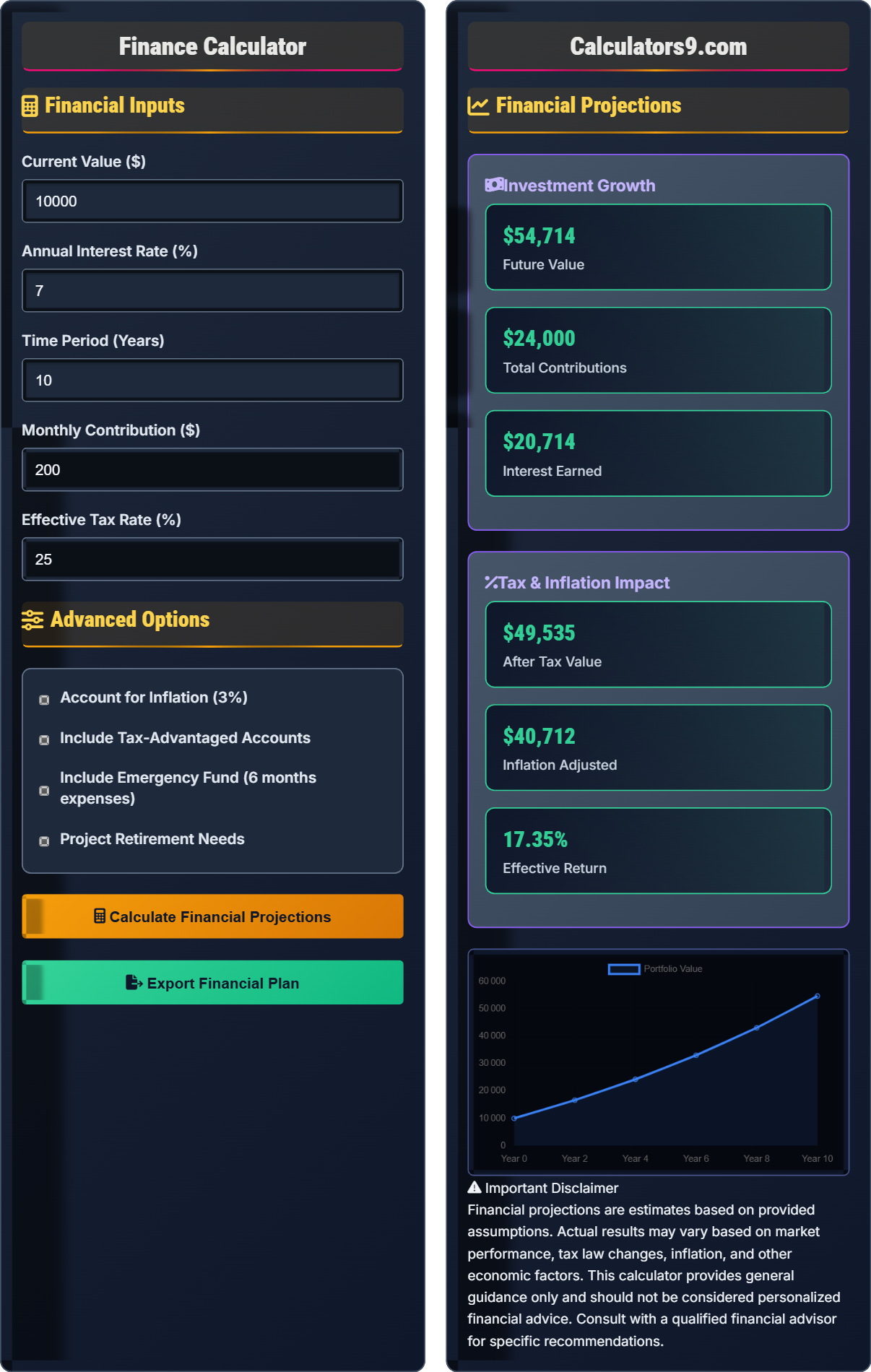
Financial Inputs
Advanced Options
Financial Projections
Financial projections are estimates based on provided assumptions. Actual results may vary based on market performance, tax law changes, inflation, and other economic factors. This calculator provides general guidance only and should not be considered personalized financial advice. Consult with a qualified financial advisor for specific recommendations.
Financial Planning Basics
Effective financial planning involves understanding and applying fundamental concepts that drive wealth accumulation and preservation.
Compound interest is the process where interest earned on an investment generates its own interest over time. This exponential growth occurs because each period's interest is calculated on the previous period's principal plus accumulated interest.
The power of compound interest lies in time - the earlier you start investing, the more dramatic the effect. Even small differences in return rates can result in significantly different outcomes over long periods.
- Future Value: Projects investment growth over time
- Present Value: Calculates today's value of future cash flows
- Net Worth: Assets minus liabilities for financial health
- Debt-to-Income Ratio: Measures financial leverage
- Emergency Fund: Recommended 3-6 months of expenses
Investment Strategies
Asset allocation is the practice of dividing investments among different asset categories to optimize risk-adjusted returns.
| Age Group | Stock Allocation | Bond Allocation | Alternative Assets | Rationale |
|---|---|---|---|---|
| 20s-30s | 80-90% | 10-20% | 0-5% | High growth tolerance |
| 40s | 70-80% | 20-30% | 0-5% | Balanced approach |
| 50s | 60-70% | 30-40% | 0-5% | Conservative shift |
| 60s+ | 40-60% | 40-60% | 0-5% | Capital preservation |
- Diversify across asset classes and geographies
- Invest regularly through dollar-cost averaging
- Keep fees low by choosing low-cost index funds
- Rebalance portfolio annually
- Stay invested for long-term growth
Tax Optimization
Utilizing tax-advantaged accounts can significantly enhance investment returns by reducing or deferring tax obligations.
401(k)
Pre-tax contributions
Annual limit (2024)
IRA
Tax-deferred growth
Annual limit (2024)
Roth IRA
Tax-free withdrawals
Annual limit (2024)
HSA
Triple tax advantage
Annual limit (2024)
- Maximize employer 401(k) match
- Contribute to Roth if in lower tax bracket
- Harvest losses to offset gains
- Consider tax-loss harvesting
- Plan for Required Minimum Distributions
Financial Planning Learning Quiz
Which statement about compound interest is TRUE?
The answer is B) Interest is calculated on principal plus previously earned interest. Compound interest is the process where interest earned on an investment generates its own interest over time. Each period's interest is calculated on the previous period's principal plus accumulated interest, leading to exponential growth.
Compound interest differs from simple interest, where interest is only calculated on the original principal. With compound interest, your money earns interest on interest, creating an accelerating growth effect. This is why starting to invest early is so important - even small amounts can grow significantly over long periods due to compounding.
Compound Interest: Interest calculated on principal and accumulated interest
Exponential Growth: Growth that accelerates over time
Principal: Original investment amount
• Interest compounds on previous interest earnings
• Time significantly amplifies compounding effect
• Higher rates accelerate growth
• Start investing as early as possible
• Reinvest dividends and interest
• Use the "Rule of 72" to estimate doubling time
• Confusing compound with simple interest
• Underestimating time's impact
• Not reinvesting earnings
Calculate the future value of $5,000 invested at 6% annual interest compounded annually for 15 years. Show your work.
Using the compound interest formula: \( A = P(1 + r)^t \)
Where:
- P = $5,000 (principal)
- r = 0.06 (annual interest rate)
- t = 15 (time in years)
Step 1: Calculate (1 + r)^t
(1.06)^15 = 2.397
Step 2: Calculate final amount
A = $5,000 × 2.397 = $11,985
Step 3: Calculate interest earned
Interest = $11,985 - $5,000 = $6,985
Therefore, the future value is $11,985 with $6,985 in interest earned.
This calculation demonstrates the power of compound interest over a 15-year period. The investment more than doubles, with the interest earned ($6,985) exceeding the original principal ($5,000). This illustrates why long-term investing is so effective for wealth building.
Future Value: Value of investment at future date
Compound Interest: Interest on interest
Principal: Initial investment amount
• Convert percentage to decimal for calculations
• Time significantly impacts compound growth
• Higher rates accelerate growth
• Use calculator for exponent calculations
• The Rule of 72: 72 ÷ rate = approximate doubling time
• 72 ÷ 6% = 12 years to double
• Forgetting to convert percentage to decimal
• Not using compound interest formula
• Calculation errors with exponents
Sarah earns $60,000 annually and has monthly expenses of $3,500. She wants to build an emergency fund that covers 6 months of expenses. How much should she aim to save in her emergency fund, and how long will it take if she saves $500 per month?
Step 1: Calculate recommended emergency fund
Monthly expenses: $3,500
Months to cover: 6
Emergency fund target: $3,500 × 6 = $21,000
Step 2: Calculate time to reach target
Monthly savings: $500
Target amount: $21,000
Time needed: $21,000 ÷ $500 = 42 months
Step 3: Express in years
42 months = 3.5 years
Therefore, Sarah should save $21,000 in her emergency fund, which will take 3.5 years at $500 per month.
Emergency funds provide financial security for unexpected expenses like job loss, medical bills, or major repairs. The standard recommendation is 3-6 months of expenses, with 6 months being ideal for single-income households or unstable employment situations. Building this fund gradually makes it more achievable.
Emergency Fund: Liquid savings for unexpected expenses
Monthly Expenses: Recurring costs for living
Financial Security: Protection against emergencies
• Aim for 3-6 months of expenses
• Keep in easily accessible account
• Build gradually over time
• Start with smaller goal (e.g., $1,000)
• Automate monthly contributions
• Use high-yield savings account
• Not having an emergency fund
• Investing emergency funds in risky assets
• Using emergency funds for non-emergencies
John is 35 years old and wants to retire at 65. He estimates needing $50,000 annually in retirement for 20 years. Assuming a 7% annual return and 3% inflation, how much does he need to save monthly to reach his retirement goal?
Step 1: Calculate retirement needs in today's dollars
Annual need: $50,000
Years in retirement: 20
Total need: $50,000 × 20 = $1,000,000
Step 2: Adjust for inflation over 30 years until retirement
Future value needed: $1,000,000 × (1.03)^30 = $1,000,000 × 2.427 = $2,427,000
Step 3: Calculate monthly savings needed
Using future value of annuity formula: PMT = FV × r / [(1+r)^n - 1]
Where: FV = $2,427,000, r = 0.07/12 = 0.005833, n = 30×12 = 360
PMT = $2,427,000 × 0.005833 / [(1.005833)^360 - 1]
PMT = $14,157 / [7.612 - 1] = $14,157 / 6.612 = $2,141
Therefore, John needs to save approximately $2,141 per month.
Retirement planning requires considering multiple factors: time horizon, expected returns, inflation, and desired lifestyle. The calculation shows how much John needs to save monthly to reach his goal, accounting for both growth and inflation. Starting early significantly reduces the monthly savings required.
Retirement Planning: Preparing financially for post-work life
Time Horizon: Years until retirement
Future Value: Required amount at retirement
• Start saving early for compound growth
• Account for inflation in planning
• Use tax-advantaged accounts
• Maximize employer 401(k) match
• Consider catch-up contributions after age 50
• Review and adjust plan annually
• Not accounting for inflation
• Underestimating retirement duration
• Starting too late
According to conventional wisdom, what should be the approximate stock allocation for a 45-year-old investor?
The answer is B) 60-70%. Conventional asset allocation models suggest that a 45-year-old should have 60-70% of their portfolio in stocks, with the remainder in bonds and other fixed-income investments. This balances growth potential with risk management as retirement approaches.
Asset allocation is age-dependent because younger investors can tolerate more risk for higher returns, while older investors need to preserve capital. The "100 minus age" rule suggests the percentage of stocks, but this is a general guideline. Modern approaches consider risk tolerance, time horizon, and financial goals beyond just age.
Asset Allocation: Distribution across investment types
Risk Tolerance: Ability to withstand market volatility
Diversification: Spreading investments across assets
• Reduce stock allocation with age
• Diversify across asset classes
• Rebalance annually
• Use low-cost index funds
• Consider target-date funds
• Adjust for personal risk tolerance
• Too aggressive for age
• Not diversifying enough
• Not rebalancing portfolio
FAQ
Q: How much should I contribute to my 401(k) annually?
A: Financial experts recommend contributing at least enough to capture your employer's full 401(k) match, as this is essentially free money. Beyond that, aim for 10-15% of your annual salary toward retirement savings.
- Minimum: Employer match percentage
- Optimal: 10-15% of salary
- Maximum: Annual contribution limits ($23,000 for 2024, plus $7,500 catch-up if 50+)
For example, if you earn $80,000 and your employer matches 5%, contribute at least $4,000 to get the full match. Ideally, contribute $8,000-$12,000 (10-15%) to stay on track for retirement. Start with the minimum and gradually increase your contribution rate by 1-2% each year.
Q: What's the 4% rule for retirement withdrawals?
A: The 4% rule suggests withdrawing 4% of your retirement portfolio in the first year of retirement, then adjusting that amount annually for inflation. This approach aims to make your savings last for approximately 30 years.
For example, if you have a $1,000,000 retirement portfolio:
- Year 1: Withdraw $40,000 (4%)
- Year 2: Withdraw $41,200 (4% of $1,030,000 after 3% inflation)
- Continue: Adjust annually for inflation
Recent studies suggest the 4% rule may be too conservative in today's environment, and 3-3.5% may be more sustainable. The rule assumes a balanced portfolio of 60% stocks and 40% bonds.