Income Tax Calculator
Federal & state tax • Tax planning
Income Tax Formula:
Show the calculatorTax Liability = Σ(Tax Rate × Taxable Income in Bracket)
Taxable Income = Gross Income - Standard Deduction - Itemized Deductions - Exemptions
Marginal Tax Rate = Tax Rate on Last Dollar Earned
Effective Tax Rate = Total Tax Liability ÷ Total Income
Where:
- Tax Brackets: Progressive tax rates applied to different income ranges
- Standard Deduction: Fixed deduction amount based on filing status
- Itemized Deductions: Specific deductions claimed instead of standard deduction
- Marginal Rate: Rate applied to highest income bracket
- Effective Rate: Average tax rate across all income
This progressive tax system means higher income earners pay higher tax rates on their additional income. For example, a single filer with $50,000 income falls in the 22% marginal tax bracket but has an effective rate closer to 15% due to lower brackets.
Example: For a single filer with $50,000 taxable income in 2026:
10% bracket: $0-$11,000 × 10% = $1,100
12% bracket: $11,001-$44,725 × 12% = $4,047
22% bracket: $44,726-$50,000 × 22% = $1,160
Total tax: $6,307
Effective rate: $6,307 ÷ $50,000 = 12.6%
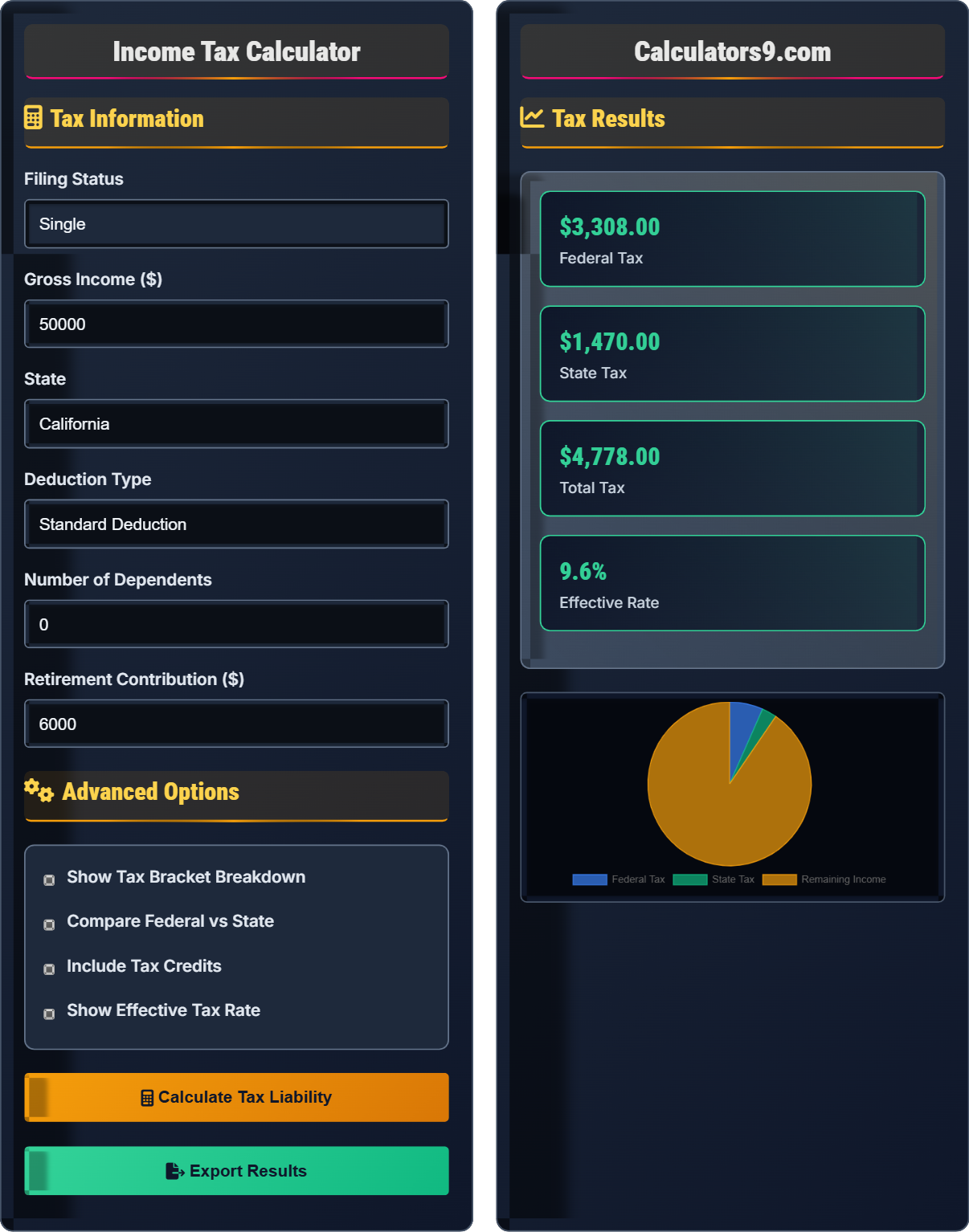
Tax Information
Advanced Options
Tax Results
| Category | Amount | Percentage |
|---|
| Metric | Value | Details |
|---|
Comprehensive Tax Guide
Income tax is a tax levied on individuals and businesses based on their income or profits. The U.S. tax system is progressive, meaning higher earners pay higher tax rates on their additional income. Tax liability is calculated by applying tax rates to taxable income, which is gross income minus deductions and exemptions.
The standard tax calculation follows these steps:
Where:
- Gross Income: Total income from all sources
- Deductions: Expenses subtracted from gross income
- Taxable Income: Income subject to taxation
- Tax Brackets: Progressive rates applied to income ranges
- Tax Liability: Total tax owed
Key advantages of proper tax planning include:
- Reduced Liability: Legally minimize tax burden
- Increased Refunds: Maximize refund amounts
- Improved Cash Flow: Better financial planning
- Compliance: Meet tax obligations efficiently
- Investment Growth: Tax-advantaged accounts
- Keep Detailed Records: Document all income and expenses
- Contribute to Retirement: Reduce taxable income
- Claim All Eligible Credits: Research available credits
- Consider Itemizing: If it exceeds standard deduction
- Plan Major Purchases: Deductible expenses timing
Tax Fundamentals
Progressive system applying different rates to income ranges.
Tax Liability = Σ(Tax Rate × Income in Bracket)
Effective Rate = Total Tax ÷ Total Income
- Higher income = Higher tax rate on marginal income
- Deductions reduce taxable income
- Credits directly reduce tax liability
Strategies
Legally minimizing tax liability through planning strategies.
- Estimate annual income and deductions
- Plan retirement contributions
- Track deductible expenses
- Consider tax-advantaged accounts
- Changes in tax law affect planning
- State taxes vary significantly
- Business income has special rules
- Investment income taxed differently
Tax Planning Learning Quiz
What is the difference between marginal tax rate and effective tax rate?
The answer is B) Marginal rate is on last dollar, effective rate is the average rate. The marginal tax rate is the rate applied to the last dollar earned, while the effective tax rate is the total tax paid divided by total income. For example, someone in the 22% marginal bracket might have an effective rate of 15% after accounting for lower brackets.
This question addresses a common misconception about tax rates. In a progressive tax system, not all income is taxed at the highest marginal rate. Instead, each tax bracket applies only to income within that range. The effective rate represents the average rate across all income, while the marginal rate applies only to additional income earned.
Marginal Tax Rate: Rate applied to the last dollar of income earned
Effective Tax Rate: Average tax rate across all income
Progressive Tax System: Higher rates applied to higher income levels
• Marginal rate = rate on next dollar earned
• Effective rate = total tax ÷ total income
• Effective rate is always ≤ marginal rate
• Your marginal rate is higher than your effective rate
• Only additional income is taxed at marginal rate
• Effective rate provides average tax burden
• Assuming all income is taxed at marginal rate
• Confusing marginal with effective tax rates
• Not understanding progressive tax structure
Calculate the federal tax for a single filer with $75,000 taxable income in 2026. Use the standard brackets: 10% on $0-$11,000, 12% on $11,001-$44,725, and 22% on $44,726-$75,000. Show your work.
First bracket: $11,000 × 10% = $1,100
Second bracket: ($44,725 - $11,000) × 12% = $33,725 × 12% = $4,047
Third bracket: ($75,000 - $44,725) × 22% = $30,275 × 22% = $6,661
Total tax liability: $1,100 + $4,047 + $6,661 = $11,808
Effective rate: $11,808 ÷ $75,000 = 15.7%
Therefore, the federal tax is $11,808 with an effective rate of 15.7%.
This calculation demonstrates how progressive taxation works. Each tax bracket applies only to income within that range. The taxpayer pays 10% on the first $11,000, 12% on the next $33,725, and 22% on the remaining $30,275. This results in an effective rate of 15.7%, which is less than the marginal rate of 22%.
Tax Bracket: Range of income subject to specific tax rate
Taxable Income: Income subject to taxation after deductionsTax Liability: Total amount of tax owed
• Each bracket applies only to income in that range
• Lower brackets always apply to all taxpayers
• Marginal rate applies only to additional income
• Calculate tax for each bracket separately
• Add brackets progressively
• Effective rate is always lower than marginal rate
• Applying marginal rate to all income
• Forgetting to calculate each bracket separately
• Not understanding bracket boundaries
A married couple filing jointly has $100,000 in gross income. Their standard deduction is $28,700, but they have $35,000 in itemized deductions. How much tax will they save by itemizing instead of taking the standard deduction? Assume they're in the 22% marginal tax bracket. (Hint: Calculate tax with both deduction methods)
With Standard Deduction:
Taxable Income = $100,000 - $28,700 = $71,300
Assuming this falls in the 22% bracket, tax savings = ($35,000 - $28,700) × 22% = $6,300 × 22% = $1,386
With Itemized Deduction:
Taxable Income = $100,000 - $35,000 = $65,000
The couple saves $1,386 in taxes by itemizing instead of taking the standard deduction.
This example shows the importance of choosing between standard and itemized deductions. The tax savings equal the difference in deductions multiplied by the marginal tax rate. Since itemized deductions ($35,000) exceed the standard deduction ($28,700), the couple benefits from itemizing.
Standard Deduction: Fixed deduction amount based on filing status
Itemized Deduction: Specific expenses deducted instead of standard
Tax Savings: Reduction in tax liability from deductions
• Choose larger of standard or itemized deduction
• Tax savings = Deduction difference × Marginal rate
• Deductions reduce taxable income
• Track potential itemized deductions throughout year
• Compare with standard deduction amount
• Consider bunching deductions in certain years
• Not comparing standard vs itemized options
• Forgetting to track deductible expenses
• Assuming standard deduction is always best
An individual in the 24% marginal tax bracket contributes $6,500 to a traditional IRA. How much tax will they save this year, and what is the long-term benefit of tax-deferred growth? (Hint: Consider immediate tax savings and compound growth)
Immediate tax savings: $6,500 × 24% = $1,560
The contribution reduces taxable income by $6,500, saving $1,560 in federal taxes this year.
Long-term benefit: The $6,500 grows tax-free until withdrawal. Assuming 7% annual growth for 20 years: $6,500 × (1.07)^20 = $25,167. At withdrawal, only the gains ($25,167 - $6,500 = $18,667) will be taxed at the individual's tax rate at that time.
Therefore, the immediate savings is $1,560, with long-term tax-deferred growth benefits.
This demonstrates the dual benefit of tax-advantaged accounts: immediate tax savings and tax-deferred growth. The contribution reduces current taxable income, and the investment grows without annual tax obligations. This allows for compound growth on the full amount rather than after-tax returns.
Tax-Advantaged Account: Account with tax benefits
Tax-Deferred Growth: Investment growth without annual taxes
Traditional IRA: Pre-tax contribution retirement account
• Pre-tax contributions reduce current tax liability
• Tax-deferred growth compounds faster
• Withdrawals are taxed as ordinary income
• Maximize contributions in higher tax brackets
• Consider Roth vs traditional based on current/future rates
• Take advantage of employer matching
• Not maximizing tax-advantaged accounts
• Forgetting to consider future tax rates
• Not understanding contribution limits
Which statement about tax credits and deductions is TRUE?
The answer is C) Tax credits are more valuable than deductions. Tax credits directly reduce tax liability dollar-for-dollar, while deductions only reduce taxable income. For example, a $1,000 tax credit saves $1,000 in taxes, while a $1,000 deduction in the 22% bracket only saves $220.
This question clarifies the important distinction between tax credits and deductions. Tax credits are more valuable because they directly reduce the tax bill, while deductions only reduce the amount of income subject to taxation. This is why tax credits are often described as "more valuable than deductions."
Tax Credit: Direct reduction in tax liability
Deduction: Reduction in taxable income
Tax Liability: Total tax owed
• Credits = dollar-for-dollar tax reduction
• Deductions = reduction in taxable income
• Credits are more valuable than deductions
• Prioritize credits over deductions
• Research all available credits
• Understand refundable vs non-refundable credits
• Confusing credits with deductions
• Not maximizing available credits
• Assuming all tax benefits are equal
FAQ
Q: What's the difference between tax deductions and tax credits?
A: Tax deductions reduce your taxable income, while tax credits directly reduce your tax liability. For example, a $1,000 deduction in the 22% bracket saves $220 in taxes ($1,000 × 22%), while a $1,000 tax credit saves $1,000 directly.
Using the formula: Tax Liability = Σ(Tax Rate × Taxable Income in Bracket), deductions reduce the "Taxable Income" component, while credits reduce the final "Tax Liability" amount directly.
Q: Should I take the standard deduction or itemize?
A: Choose the larger amount. For example, if your standard deduction is $28,700 (married joint) but your itemized deductions total $32,000, itemizing saves you $3,300 in taxable income.
Using the formula: Taxable Income = Gross Income - Deductions, you want to maximize the deduction amount to minimize your taxable income. However, consider that some tax credits are based on AGI, so sometimes a lower deduction might be beneficial for credit eligibility.