Percent Off Calculator
Discount & sale price calculator • 2026
Percent Off Formula:
Show the calculator\( \text{Discount Amount} = \text{Original Price} \times \frac{\text{Percent Off}}{100} \)
\( \text{Sale Price} = \text{Original Price} - \text{Discount Amount} \)
\( \text{Savings Percentage} = \frac{\text{Discount Amount}}{\text{Original Price}} \times 100 \)
Where:
- Original Price = Price before discount
- Percent Off = Discount percentage
- Discount Amount = Dollar amount of discount
- Sale Price = Final price after discount
- Savings Percentage = Actual percentage saved
This formula calculates the discount amount and final sale price based on the original price and discount percentage. The savings percentage confirms the actual discount received. Retailers often use this calculation for promotional pricing and markdowns.
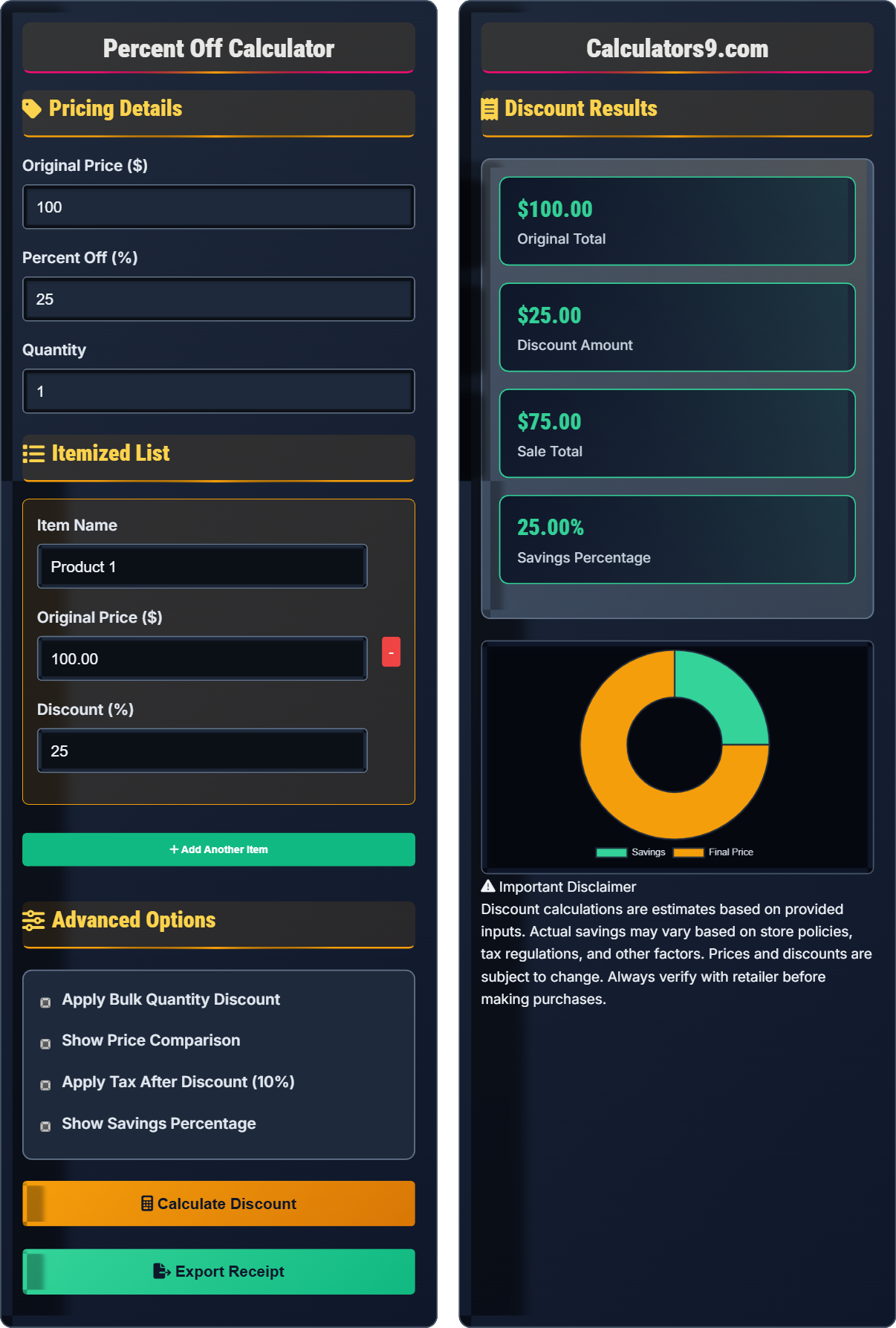
Example: For an item originally priced at $100 with a 25% discount:
Discount Amount = $100 × (25/100) = $25
Sale Price = $100 - $25 = $75
Savings Percentage = ($25/$100) × 100 = 25%
Thus, the customer saves $25 and pays $75 for the item.
Pricing Details
Itemized List
Advanced Options
Discount Results
Discount calculations are estimates based on provided inputs. Actual savings may vary based on store policies, tax regulations, and other factors. Prices and discounts are subject to change. Always verify with retailer before making purchases.
Percent Off Basics
Percent off is a discount expressed as a percentage of the original price. It represents the reduction in price offered by retailers to attract customers, clear inventory, or promote sales. The discount is calculated by multiplying the original price by the discount percentage.
Alternatively: Sale Price = Original Price × (1 - Percent Off/100)
- Discount percentage cannot exceed 100% (that would be free)
- Multiple discounts may not stack in some cases
- Discounts are typically applied before tax
- Bulk discounts may apply to larger quantities
- Seasonal promotions often offer deeper discounts
Common Discount Strategies
Businesses use various discount structures to maximize sales and customer satisfaction while maintaining profitability.
| Discount Type | Typical Range | Best Use Case | Customer Benefit |
|---|---|---|---|
| Opening/Closing Sales | 20-70% | Inventory clearance | Significant savings |
| Seasonal Promotions | 10-40% | Holiday seasons | Timed savings |
| Black Friday | 25-80% | High-volume day | Deep discounts |
| End-of-Season | 30-60% | Clear old stock | Final clearance |
| Bulk Discounts | 5-25% | Large purchases | Volume savings |
| Loyalty Programs | 5-15% | Repeat customers | Long-term value |
| Student/Military | 5-20% | Special groups | Appreciation |
| First-Time Customer | 10-20% | New customer acquisition | Welcome bonus |
- Simple Discount: Single percentage off original price
- Stacked Discount: Multiple discounts applied sequentially
- Buy One Get One (BOGO): Equivalent to 50% off when buying 2
- Bundle Discount: Discount on package of items
- Progressive Discount: Increasing discount with quantity
Maximizing Savings
Bulk discounts offer additional savings for purchasing multiple items. These discounts encourage larger purchases while providing better value to customers.
Quantity Discounts
Discounts increase with quantity purchased (e.g., 5% for 10+, 10% for 20+)
Volume Pricing
Lower per-unit cost for larger purchases
Wholesale Pricing
Special pricing for business customers
Membership Discounts
Exclusive savings for loyalty program members
- Combine manufacturer coupons with store discounts when possible
- Time purchases with seasonal sales for maximum savings
- Check for price matching policies
- Consider bulk purchases for frequently used items
- Join loyalty programs for ongoing benefits
Percent Off Learning Quiz
What is the sale price of an item originally priced at $80 with a 25% discount?
The answer is A) $60. To calculate: First find the discount amount: $80 × 0.25 = $20. Then subtract from original price: $80 - $20 = $60. Alternatively: $80 × (1 - 0.25) = $80 × 0.75 = $60.
This calculation demonstrates the fundamental percent off formula. We first find the dollar amount of the discount by multiplying the original price by the discount rate (expressed as a decimal). Then we subtract that amount from the original price to get the sale price. This approach helps visualize the actual savings.
Percent Off: Discount expressed as a percentage of original price
Discount Amount: Dollar value of the reduction
Sale Price: Final price after discount
• Convert percentage to decimal for calculations
• Discount amount = Original price × (discount % / 100)
• Sale price = Original price - Discount amount
• Remember: 25% off means paying 75% of original price
• Multiply by (1 - discount rate) for direct sale price
• Estimate: 10% of $80 is $8, so 25% is about $20
• Confusing discount amount with sale price
• Forgetting to convert percentage to decimal
• Adding instead of subtracting the discount
Calculate the discount amount and savings percentage for a $150 item with a 30% discount. Show your work.
Step 1: Calculate discount amount
Discount Amount = Original Price × (Percent Off / 100)
Discount Amount = $150 × (30 / 100) = $150 × 0.30 = $45
Step 2: Calculate sale price
Sale Price = Original Price - Discount Amount
Sale Price = $150 - $45 = $105
Step 3: Verify savings percentage
Savings Percentage = (Discount Amount / Original Price) × 100
Savings Percentage = ($45 / $150) × 100 = 30%
Therefore, the discount amount is $45 and the savings percentage is 30%.
This problem reinforces the core percent off calculation. The savings percentage should equal the discount percentage when there's a single discount. The discount amount represents the actual money saved, while the savings percentage shows the proportional benefit. Both metrics are important for understanding the value of a deal.
Discount Amount: Absolute dollar savings
Savings Percentage: Relative measure of savings
Proportional Benefit: Savings relative to original price
• Discount amount = Original price × (discount % / 100)
• Sale price = Original price - Discount amount
• Savings % = (Discount amount / Original price) × 100
• Verify calculations by checking savings percentage
• Use mental math shortcuts for common percentages
• 30% of $150 = 3 × 10% of $150 = 3 × $15 = $45
• Calculating discount amount incorrectly
• Forgetting to subtract discount from original price
• Misplacing decimal points in calculations
A store offers a 20% discount on all items, and you have a coupon for an additional 15% off. If the original price is $200, what is the final price after both discounts? Assume discounts are applied sequentially.
Step 1: Apply first discount (20%)
First discount amount = $200 × 0.20 = $40
Price after first discount = $200 - $40 = $160
Step 2: Apply second discount (15%) to the new price
Second discount amount = $160 × 0.15 = $24
Final price = $160 - $24 = $136
Step 3: Calculate total savings
Total savings = $200 - $136 = $64
Total savings percentage = ($64 / $200) × 100 = 32%
Therefore, the final price is $136 with total savings of 32%.
When discounts are applied sequentially, each discount is calculated on the price remaining after the previous discount. This is different from adding the percentages together (20% + 15% = 35%), which would give a different result. Sequential discounts compound, so the effective total discount is less than the sum of individual discounts.
Sequential Discounts: Discounts applied one after another
Compounded Effect: Each discount affects the base for the next
Effective Total Discount: Actual percentage saved after all discounts
• Apply each discount to the current price, not original price
• Sequential discounts don't add linearly
• Effective discount is less than sum of individual discounts
• Calculate each discount step-by-step
• Remember: 20% off then 15% off ≠ 35% off total
• Use calculator for complex sequential discounts
• Adding discount percentages together
• Applying second discount to original price
• Not understanding sequential vs. cumulative discounts
A store offers a 5% bulk discount when you buy 10 or more items. Each item normally costs $30 with a 15% individual discount. If you buy 12 items, what is your total cost? Calculate both the individual discount and bulk discount effects.
Step 1: Calculate price per item with individual discount
Individual discount per item = $30 × 0.15 = $4.50
Price per item after individual discount = $30 - $4.50 = $25.50
Step 2: Calculate subtotal for 12 items
Subtotal = $25.50 × 12 = $306.00
Step 3: Apply bulk discount (since quantity ≥ 10)
Bulk discount amount = $306.00 × 0.05 = $15.30
Final total = $306.00 - $15.30 = $290.70
Step 4: Calculate effective savings per item
Total savings = $360.00 - $290.70 = $69.30
Effective savings per item = $69.30 / 12 = $5.78
Therefore, the total cost for 12 items is $290.70.
This problem demonstrates how multiple discount types can work together. First, the individual discount is applied to each item, then the bulk discount is applied to the total. This creates a layered savings approach that benefits both the customer and retailer. The effective savings per item increase due to the combination of discounts.
Layered Discounts: Multiple discount types applied together
Threshold Requirement: Minimum purchase for discount eligibility
Effective Savings: Actual savings per unit after all discounts
• Apply individual discounts first
• Check threshold requirements for bulk discounts
• Apply bulk discounts to the subtotal after individual discounts
• Understand the order of discount application
• Check minimum quantities for bulk discounts
• Combine discounts strategically for maximum savings
• Applying bulk discount before individual discounts
• Not meeting threshold requirements
• Confusing discount application order
Which pricing strategy is most likely to make a customer perceive greater value?
The answer is D) $100 marked down to $70 with "SALE" tag. This combines multiple psychological factors: the visual representation of crossed-out price, the numerical savings ($30), the percentage discount (30%), and the sale indicator. Studies show that displaying the original price alongside the discounted price creates a "reference price" that makes the savings more apparent and valuable to consumers.
This question explores the psychology behind discount perception. The way a discount is presented affects how valuable it appears to consumers. The combination of original price, savings amount, and percentage creates a more compelling offer than any single metric alone. Retailers use these techniques to enhance the perceived value of their discounts.
Reference Price: Original price used for comparison
Perceived Value: Subjective assessment of worth
Psychological Pricing: Techniques to influence purchasing decisions
• Present original and discounted prices together
• Show both dollar and percentage savings
• Use visual cues to emphasize savings
• Look for original vs. discounted price displays
• Calculate actual savings percentage
• Don't be swayed by psychological pricing tactics
• Being influenced by presentation rather than actual savings
• Not verifying the authenticity of original prices
• Confusing perceived value with actual value
FAQ
Q: How do I calculate the actual percentage saved when buying multiple items with different discounts?
A: To calculate the actual percentage saved on a multi-item purchase with different discounts:
- Calculate total original cost: Sum all original prices
- Calculate total discount amount: For each item, multiply original price by discount percentage
- Sum all discount amounts to get total savings
- Calculate effective percentage: (Total savings / Total original cost) × 100
For example, if you buy Item A ($50 with 20% off) and Item B ($100 with 10% off):
Total original = $50 + $100 = $150
Item A discount = $50 × 0.20 = $10
Item B discount = $100 × 0.10 = $10
Total savings = $10 + $10 = $20
Effective percentage = ($20/$150) × 100 = 13.33%
Q: What's the difference between markup and discount calculations?
A: Markup and discount calculations use different base values:
- Markup: Calculated on cost price (Cost × (1 + markup %))
- Discount: Calculated on selling price (Selling price × (1 - discount %))
For example, if an item costs $60 and has a 25% markup:
Selling price = $60 × 1.25 = $75
If then discounted by 20%:
Sale price = $75 × 0.80 = $60
The markup was calculated on the $60 cost, but the discount was calculated on the $75 selling price. This distinction is crucial for proper pricing and profit calculations.