FBAR Penalty Calculator
Fast foreign bank account report calculator • 2026 rates
FBAR Penalty Formula:
Show the calculator\( PP = \begin{cases} NWP \times NF \times MV & \text{if non-willful} \\ WP \times MV & \text{if willful} \end{cases} \)
Where:
- \( PP \) = Penalty Amount
- \( NWP \) = Non-Willful Penalty Rate (up to $10,000 per violation)
- \( NF \) = Number of Forms Violated
- \( MV \) = Maximum Value of Account
- \( WP \) = Willful Penalty Rate (up to 50% of account value)
Alternative formulas:
\( TNP = NWP \times Y \)
\( WPP = \min(WP \times MV, 100,000) \)
This formula calculates penalties for FBAR violations based on willfulness determination and account values.
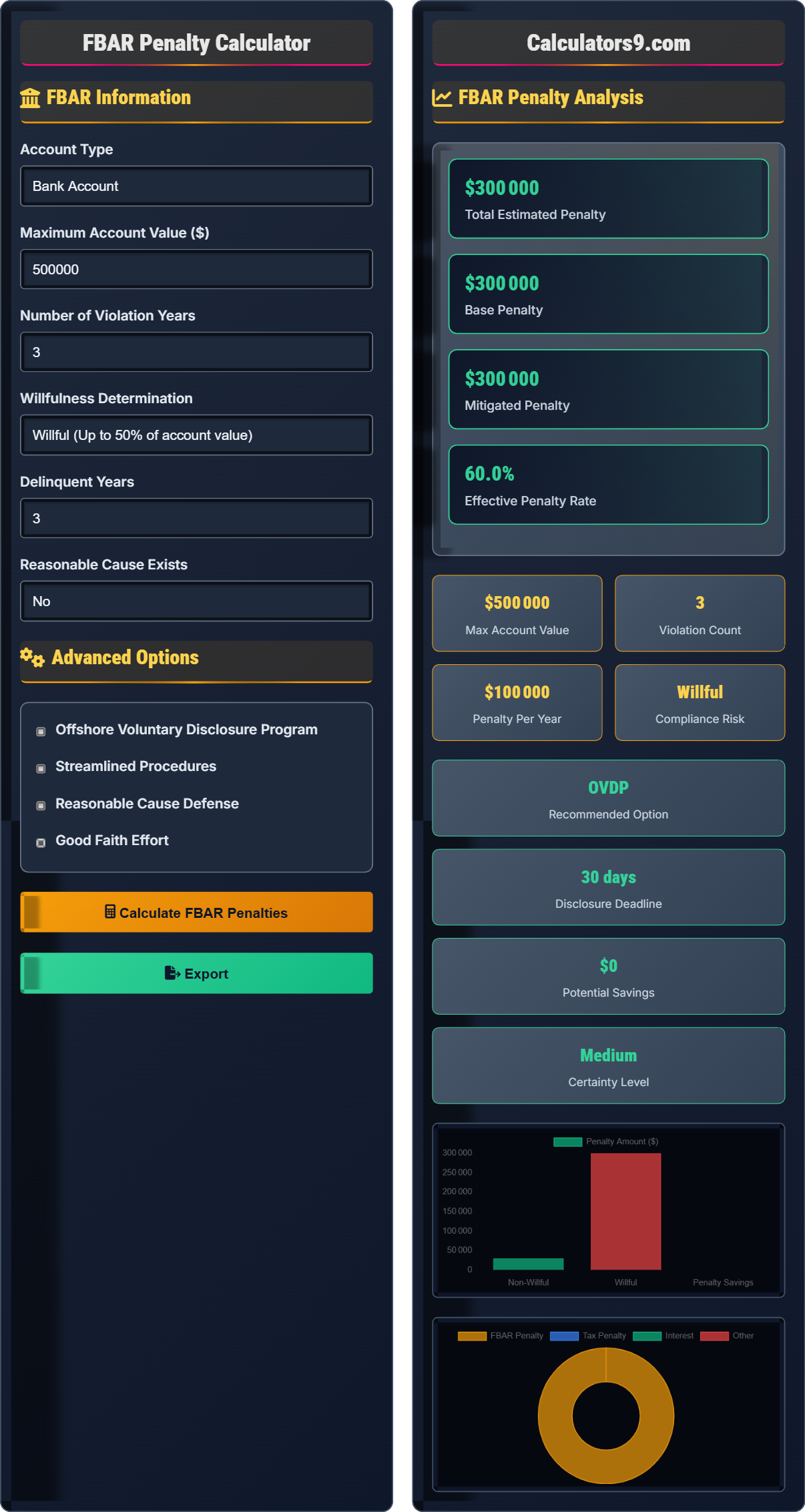
Example: Non-willful violation with $500,000 account value over 3 years:
Penalty = $10,000 × 3 = $30,000 (maximum non-willful penalty)
Willful violation = $500,000 × 50% = $250,000 (or capped at $100,000 if applicable)
FBAR Information
Advanced Options
FBAR Penalty Analysis
Comprehensive FBAR Guide
FBAR (Foreign Bank Account Report) is FinCEN Form 114, required for U.S. persons who have financial interests in or signature authority over foreign financial accounts exceeding $10,000 at any time during the calendar year. Filed separately from tax returns, FBAR is administered by the Financial Crimes Enforcement Network (FinCEN) and is mandatory for qualifying taxpayers.
The fundamental FBAR penalty calculation uses the following formulas:
Where:
- \(PP\) = Penalty Amount
- \(NWP\) = Non-Willful Penalty Rate
- \(NF\) = Number of Forms Violated
- \(MV\) = Maximum Value of Account
- \(WP\) = Willful Penalty Rate
Different disclosure programs available:
- Streamlined Procedures: For non-willful violations with lower penalties
- OVDP (Offshore Voluntary Disclosure Program): For willful violations with higher penalties
- Delinquent FBAR Submission Procedures: For reasonable cause situations
- Reasonable Cause Defense: For good faith compliance efforts
- Quiet Disclosure: Self-correction without formal program participation
- Proactive Filing: File FBAR before detection of non-compliance
- Professional Assistance: Engage tax professionals familiar with FBAR requirements
- Documentation: Maintain records supporting reasonable cause defenses
- Program Selection: Choose appropriate disclosure program based on facts
- Coordinated Approach: Address both FBAR and tax compliance issues simultaneously
FBAR Basics
Foreign Bank Account Report - required for accounts over $10,000.
\( PP = \begin{cases} NWP \times NF \times MV & \text{non-willful} \\ WP \times MV & \text{willful} \end{cases} \)
Where PP=penalty, NWP=non-willful penalty, NF=number of forms, MV=max value, WP=willful penalty.
- File if accounts exceed $10,000
- Annual filing by April 15th
- Separate from tax returns
Strategies
Focus on proactive filing and penalty mitigation.
- Monitor account values regularly
- Engage professional assistance
- Consider disclosure programs
- Document reasonable cause
- Strict filing requirements
- High penalty potential
- Professional guidance recommended
- Coordinated approach needed
FBAR Learning Quiz
At what threshold must U.S. taxpayers file an FBAR?
The answer is C) $10,000. U.S. taxpayers must file an FBAR if they have a financial interest in or signature authority over foreign financial accounts with an aggregate value exceeding $10,000 at any time during the calendar year. This is a threshold requirement that triggers the filing obligation.
The $10,000 threshold is the minimum aggregate value that triggers FBAR filing requirements. This applies to all foreign financial accounts combined, not per individual account. The threshold is evaluated annually, and the obligation exists even if the total falls below $10,000 for part of the year but exceeds it at any point.
Threshold: Minimum value triggering filing requirement
Aggregate Value: Total of all foreign accounts combined
Signature Authority: Power to control account transactions
• $10,000 threshold is aggregate
• Applies to all foreign accounts
• Evaluated annually
• Track all foreign accounts together
• Monitor value throughout year
• Consider signature authority as well
• Thinking threshold is per account
• Not counting signature authority
• Confusing with FATCA thresholds
For a non-willful FBAR violation involving 3 years of non-filing with a maximum account value of $500,000, what is the maximum potential penalty?
For non-willful violations: Maximum penalty is $10,000 per violation.
Given:
- Violation Years = 3
- Account Value = $500,000
- Non-willful violation
Step 1: Maximum penalty per year = $10,000
Step 2: Total maximum penalty = $10,000 × 3 = $30,000
Therefore, the maximum potential penalty is $30,000.
Non-willful FBAR penalties are capped at $10,000 per violation year, regardless of account value. This differs from willful penalties, which can be up to 50% of the account value. The cap provides predictability for taxpayers who genuinely did not know about the filing requirement.
Non-Willful: Lack of knowledge about filing requirement
Penalty Cap: Maximum amount per violation
Violation Year: Each year of non-compliance
• Non-willful = $10,000 max per year
• Cap applies regardless of account value
• Per violation year
• Non-willful cap is predictable
• Thinking penalties scale with account value for non-willful
• Confusing with willful penalty calculations
• Not understanding per-violation structure
A taxpayer with willful FBAR violations has foreign accounts with a maximum value of $800,000 over 2 years. What is the potential maximum penalty, and how does it compare to non-willful penalties for the same situation?
Willful penalty calculation:
Step 1: Willful penalty = 50% of account value = $800,000 × 50% = $400,000 per violation year
Step 2: For 2 years = $400,000 × 2 = $800,000
Non-willful penalty for same situation:
Step 3: Non-willful penalty = $10,000 × 2 = $20,000
Step 4: Difference = $800,000 - $20,000 = $780,000
Willful penalties are $780,000 higher than non-willful penalties for the same situation.
This dramatic difference illustrates why willfulness determination is critical. Willful penalties are based on account value and can be devastating, while non-willful penalties are capped. The determination often depends on whether the taxpayer knew or should have known about the filing requirement.
Willful Violation: Knowledge of filing requirement
Non-Willful Violation: Lack of knowledge
Penalty Differential: Difference between willful and non-willful
• Willful penalties scale with account value
• Non-willful penalties are capped
• Difference can be substantial
• Willfulness determination is crucial
• Professional guidance recommended
• Document good faith efforts
• Underestimating willful penalty severity
• Not understanding willfulness factors
• Assuming all violations are non-willful
A taxpayer failed to file FBAR for 3 years but had a reasonable cause defense. Their foreign accounts had a maximum value of $300,000. How might this affect penalties, and what constitutes reasonable cause?
With reasonable cause, penalties may be abated or reduced:
Step 1: Base non-willful penalty = $10,000 × 3 = $30,000
Step 2: With reasonable cause defense = Potentially $0 penalty
Reasonable cause includes:
• Reliance on professional tax advice
• Physical or mental incapacitation
• Catastrophic events beyond control
• Good faith effort to comply with requirements
Therefore, reasonable cause can eliminate penalties entirely if successfully demonstrated.
The reasonable cause defense provides an important exception to FBAR penalties. Taxpayers must demonstrate they exercised ordinary business care and prudence but were unable to file due to circumstances beyond their control. Documentation of the reasonable cause is essential for successful defense.
Reasonable Cause: Excuse for non-compliance due to circumstances
Abatement: Elimination or reduction of penalties
Ordinary Care: Standard level of attention and effort
• Reasonable cause can eliminate penalties
• Must be documented and justified
• Standard is ordinary business care
• Document all good faith efforts
• Seek professional advice early
• Maintain detailed records
• Not documenting reasonable cause
• Assuming ignorance is reasonable cause
• Failing to act promptly when discovered
Which of the following best describes the Streamlined Filing Compliance Procedures?
The answer is B) For non-willful violations with reduced penalties. The Streamlined Filing Compliance Procedures are designed for taxpayers who have failed to report foreign financial assets and pay tax on foreign income due to non-willful conduct. The program offers reduced penalties compared to the Offshore Voluntary Disclosure Program.
The Streamlined Procedures provide a more lenient option for taxpayers who can certify their non-compliance was due to non-willful conduct. The program requires filing delinquent returns and FBARs along with a certification of non-willful conduct. It's important to accurately assess willfulness before choosing a compliance program.
Streamlined Procedures: Lenient disclosure program for non-willful violations
Non-Willful Conduct: Failure due to negligence, not intentional
Delinquent Filing: Late submission of required documents
• For non-willful violations only
• Requires certification of non-willful conduct
• Lower penalties than OVDP
• Assess willfulness carefully
• Consider professional guidance
• Document non-willful conduct
• Choosing wrong program for situation
• Misrepresenting willfulness
• Not meeting program requirements
FAQ
Q: Do I need to file FBAR if I'm living abroad?
A: Yes, U.S. citizens and residents must file FBAR regardless of where they live if they have foreign financial accounts exceeding $10,000. The filing requirement is based on U.S. citizenship/residence, not location. Living abroad does not exempt you from FBAR requirements.
Additionally, you may also have other reporting requirements such as Form 8938 (FATCA) depending on your situation.
Q: What's the difference between FBAR and Form 8938?
A: The key differences are:
- FBAR (Form 114): Filed with FinCEN, threshold is $10,000, filed separately from tax return
- Form 8938: Filed with tax return, higher thresholds ($50,000-$600,000+ depending on residency), part of tax return
You may need to file both forms if you meet the respective thresholds. The penalties and requirements differ between the two.