Gross Income Calculator
Calculate total earnings before deductions • 2026 rates
Gross Income Formula:
Show the calculator\( \text{Gross Income} = \text{Primary Income} + \text{Secondary Income} + \text{Benefits} + \text{Other Sources} \)
Where:
- \( \text{Primary Income} \) = Main source of income (salary, hourly wage)
- \( \text{Secondary Income} \) = Additional income sources (side jobs, investments)
- \( \text{Benefits} \) = Non-cash compensation with monetary value
- \( \text{Other Sources} \) = Bonuses, commissions, freelance income
This formula calculates the total amount of income before any deductions such as taxes, insurance, or retirement contributions. Gross income includes all forms of compensation received during a specific period.
Example: For a primary salary of $60,000, bonus of $5,000, investment income of $2,000, and benefits worth $8,000:
Gross Income = $60,000 + $5,000 + $2,000 + $8,000 = $75,000
Thus, the gross income would be $75,000 per year.
Primary Income
Additional Income Sources
Advanced Options
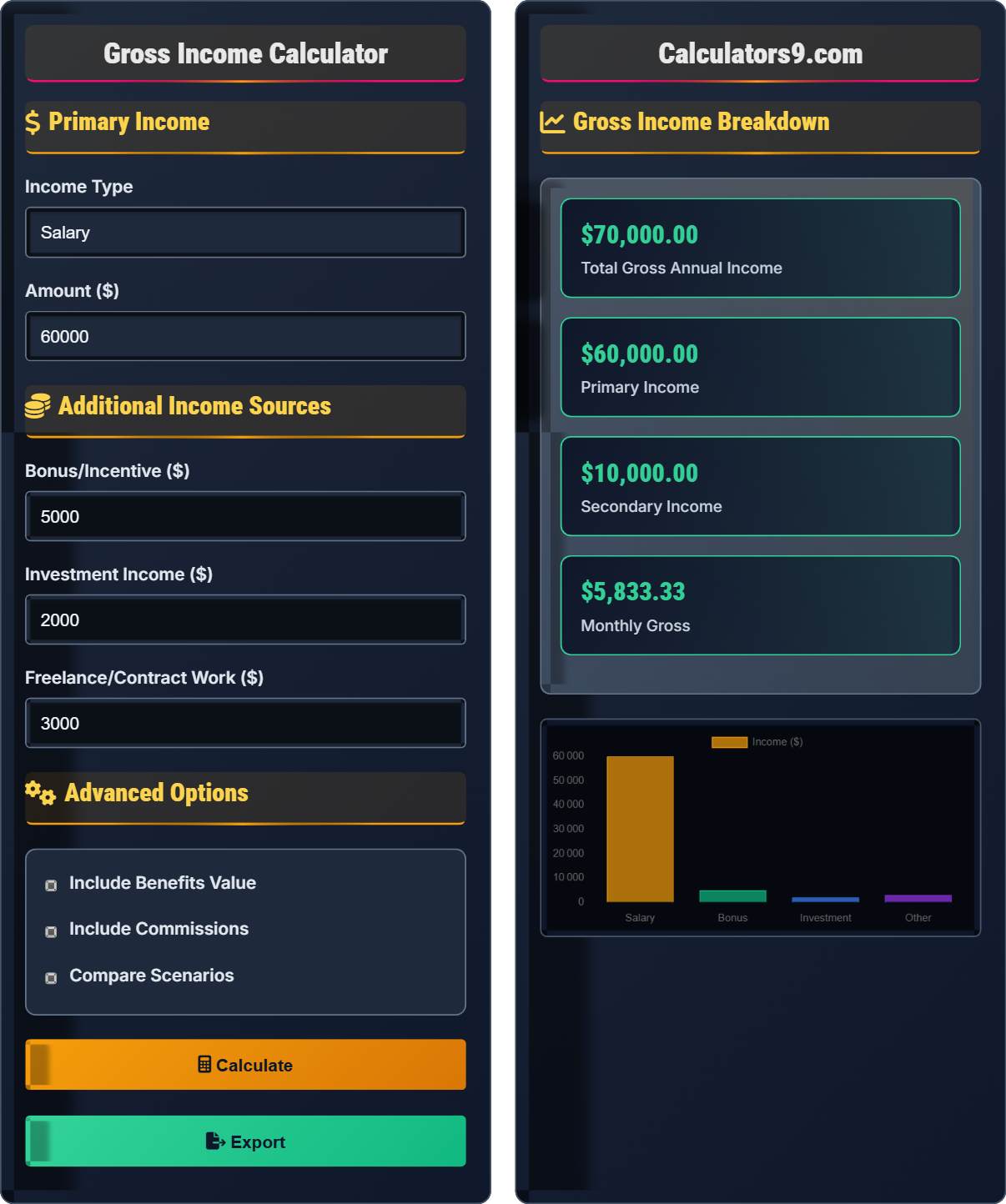
Gross Income Breakdown
| Income Source | Amount | Percentage |
|---|---|---|
| Primary Salary | $60,000.00 | 80.0% |
| Bonus/Incentive | $5,000.00 | 6.7% |
| Investment Income | $2,000.00 | 2.7% |
| Freelance/Contract | $3,000.00 | 4.0% |
| Benefits Value | $0.00 | 0.0% |
| Commissions | $0.00 | 0.0% |
| Total Gross | $70,000.00 | 100.0% |
| Period | Gross Income | Per Month | Per Week |
|---|---|---|---|
| Weekly | $1,346.15 | $307.69 | $307.69 |
| Bi-weekly | $2,692.31 | $615.38 | $615.38 |
| Monthly | $6,250.00 | $6,250.00 | $1,442.31 |
| Annual | $75,000.00 | $6,250.00 | $1,442.31 |
Comprehensive Gross Income Guide
Gross income is the total amount of income earned before any deductions such as taxes, insurance premiums, or retirement contributions. It includes all forms of compensation received from employment, investments, business activities, and other sources. Understanding your gross income is essential for financial planning, tax preparation, and loan applications.
The basic formula for calculating gross income is:
Where:
- Salary/Wages: Regular compensation from employment
- Bonuses: Performance-based or discretionary payments
- Investment Income: Dividends, interest, capital gains
- Business Income: Profit from self-employment or business ownership
- Other Income: Freelance work, rental income, alimony, etc.
Your total compensation package typically includes multiple components beyond just base pay:
- Cash Compensation: Direct monetary payments including salary, wages, bonuses, and commissions
- Non-Cash Benefits: Health insurance, retirement contributions, paid time off with monetary value
- Deferred Compensation: Stock options, pension contributions, and other future payments
- Perquisites: Company car, expense accounts, club memberships provided by employer
- Diversify income streams: Develop multiple sources of income to reduce risk
- Track all income sources: Maintain accurate records of all earnings
- Consider timing: Strategically time income recognition for tax purposes
- Negotiate benefits: Focus on valuable non-cash compensation
- Invest in income-generating assets: Build passive income streams
Gross Income Learning Quiz
Which of the following is NOT included in gross income?
The answer is C) Federal income tax withheld. Gross income includes all income before any deductions, including taxes. Federal income tax withheld is a deduction from gross income, so it's not part of gross income. All other options (salary, dividends, and freelance earnings) are components of gross income.
It's crucial to understand the difference between gross income and net income. Gross income is the starting point before any deductions, while net income is what remains after deductions. Federal income tax withholding is subtracted from gross income to determine net pay, so it's not part of the gross amount. This distinction is important for tax planning and financial calculations.
Gross Income: Total income before any deductions
Net Income: Income after all deductions
Tax Withholding: Amount deducted for taxes
• Gross income includes all forms of compensation
• Tax withholdings are deductions from gross income
• Gross income is reported to the IRS
• Review your W-2 form to see gross income
• Gross income appears on tax returns
• Net income is what you actually receive
• Including tax deductions in gross income calculation
• Confusing gross and net income
• Forgetting to include all income sources
Calculate the gross annual income for someone earning $50,000 salary, receiving $3,000 in bonuses, earning $1,500 in investment income, and making $2,500 from freelance work. Show your work.
Step 1: Add salary = $50,000
Step 2: Add bonuses = $3,000
Step 3: Add investment income = $1,500
Step 4: Add freelance income = $2,500
Step 5: Calculate total = $50,000 + $3,000 + $1,500 + $2,500 = $57,000
Therefore, the gross annual income is $57,000.
This problem demonstrates the additive nature of gross income calculation. All income sources must be included in the total. Each component contributes to the overall gross income, which serves as the basis for tax calculations and other financial metrics. The calculation is straightforward since all amounts are already expressed in the same currency and time period.
Salary: Fixed regular compensation for employment
Bonuses: Additional compensation for performance
Investment Income: Returns from investments
• Add all income sources together
• Include all forms of compensation
• Don't subtract any deductions
• Keep detailed records of all income sources
• Use tax software to track income components
• Consider quarterly reporting for multiple income streams
• Subtracting taxes or other deductions
• Forgetting to include all income sources
• Double-counting income components
Jennifer earns $25.00 per hour and works 35 hours per week for 48 weeks per year. She also receives a $4,000 annual bonus and earns $1,200 in investment income. What is her total gross annual income?
Step 1: Calculate hourly income = $25.00 × 35 hours/week × 48 weeks/year = $42,000
Step 2: Add bonus = $4,000
Step 3: Add investment income = $1,200
Step 4: Calculate total = $42,000 + $4,000 + $1,200 = $47,200
Therefore, Jennifer's total gross annual income is $47,200.
This example combines hourly wage conversion with multiple income sources. First, convert the hourly wage to annual salary by multiplying by hours per week and weeks per year. Then add all other income sources to get the total gross income. This approach is useful for individuals with non-traditional employment arrangements.
Hourly Wage: Compensation per hour worked
Annual Salary Equivalent: Hourly rate converted to yearly
Multiple Income Streams: Various sources of income
• Convert hourly to annual: Hourly × Hours/week × Weeks/year
• Include all income sources in gross calculation
• Account for actual working weeks, not 52
• Remember: 40 hours × 52 weeks = 2,080 hours for full-time
• Adjust for actual working weeks
• Consider overtime in calculations
• Forgetting to convert hourly to annual
• Using 52 weeks instead of actual working weeks
• Not including all income sources
Michael is self-employed and earned $80,000 in business revenue. His business expenses were $25,000. He also earned $5,000 in interest from savings and received $3,000 in dividend payments. What is his gross income?
Step 1: Determine business income = $80,000 (revenue) - $25,000 (expenses) = $55,000
Step 2: Add interest income = $5,000
Step 3: Add dividend income = $3,000
Step 4: Calculate gross income = $55,000 + $5,000 + $3,000 = $63,000
Therefore, Michael's gross income is $63,000.
This example clarifies the difference between business revenue and business income. For self-employed individuals, gross income includes net business profit (revenue minus expenses), not just revenue. Business expenses are deductible in calculating business income, but all sources of income (business, investment, etc.) are added together to get total gross income.
Business Revenue: Total money received from business
Business Income: Revenue minus expenses
Net Business Profit: Business income after expenses
• Business income = Revenue - Expenses
• Include net business income in gross
• Add all income sources together
• Track business expenses for tax deductions
• Business income affects self-employment tax
• Keep separate records for business and personal
• Including business revenue instead of net income
• Forgetting to include investment income
• Not tracking business expenses properly
Which of the following statements about benefits and gross income is TRUE?
The answer is C) The value of some benefits may be included in gross income. Generally, employer-paid health insurance premiums are not included in gross income as they are tax-free benefits. However, some benefits like company cars, housing allowances, or below-market loans may be included in gross income. The tax treatment of benefits varies depending on the type of benefit.
This question addresses the complexity of benefits in gross income calculations. Most standard employee benefits like health insurance, life insurance up to $50,000, and retirement contributions are excluded from gross income. However, certain fringe benefits may be taxable and included in gross income. Understanding which benefits are taxable is important for accurate income reporting.
Fringe Benefits: Compensation other than wages
Tax-Free Benefits: Excluded from gross income
Taxable Benefits: Included in gross income
• Most health benefits are tax-free
• Some fringe benefits are taxable
• Benefit taxation depends on type
• Check your W-2 for taxable benefits
• Consult IRS Publication 15-B
• Keep records of all benefits received
• Including all benefits in gross income
• Not knowing which benefits are taxable
• Forgetting to report taxable benefits
Gross Income Basics
Gross Income = All Income Sources Combined
For most individuals: Gross Income = Salary + Bonuses + Investment Income + Other Sources
Before any deductions like taxes, insurance, or retirement contributions.
- Gross income includes all compensation before deductions
- Taxable benefits are included in gross income
- Most health insurance premiums are excluded
- Self-employment income = Revenue minus expenses
Advanced Considerations
Develop multiple income streams to increase total gross income and reduce financial risk.
- Maintain detailed records of all income sources
- Use accounting software for multiple streams
- Separate business from personal income
- Track seasonal fluctuations
- Report all income to the IRS
- Keep receipts for business expenses
- Understand benefit taxability
- Consider timing of income recognition
FAQ
Q: How do I calculate gross income as a freelancer with irregular income?
A: For freelancers with irregular income, calculate your annual gross income by adding all payments received during the tax year. This includes:
- All client payments (1099-MISC forms)
- Business expenses (subtract these from revenue to get net income)
- Any investment income earned
- Other income sources
For example, if you earned $45,000 in client payments, had $8,000 in business expenses, and earned $1,500 in interest, your gross income would be $37,000 (net business income) + $1,500 = $38,500.
Track all income monthly to help with tax planning and budgeting.
Q: Are investment gains included in gross income?
A: Yes, investment gains are included in gross income. This includes:
- Dividend income from stocks and mutual funds
- Interest from bonds, savings accounts, and CDs
- Capital gains from selling investments
- Qualified dividends (taxed at lower rates)
- Rental income from investment properties
However, unrealized gains (appreciation in value without selling) are not included until the investment is sold. The timing of when you sell investments can impact your gross income for a particular tax year.
Keep detailed records of purchase prices and sale dates for tax purposes.