Inheritance Tax Calculator
Fast inheritance tax calculator • 2026 rates
Inheritance Tax Formula:
Show the calculator\( IT = \max(0, (E - FE - SE) \times TR) \)
Where:
- \( IT \) = Inheritance Tax Owed
- \( E \) = Estate Value
- \( FE \) = Federal Exemption ($13,610,000 in 2026)
- \( SE \) = State Exemption (varies by state)
- \( TR \) = Tax Rate (18-40% federal, 0-20% state)
Alternative formulas:
\( NET = E - IT \)
\( TE = FE + SE \)
This formula calculates inheritance tax based on estate value exceeding federal and state exemptions.
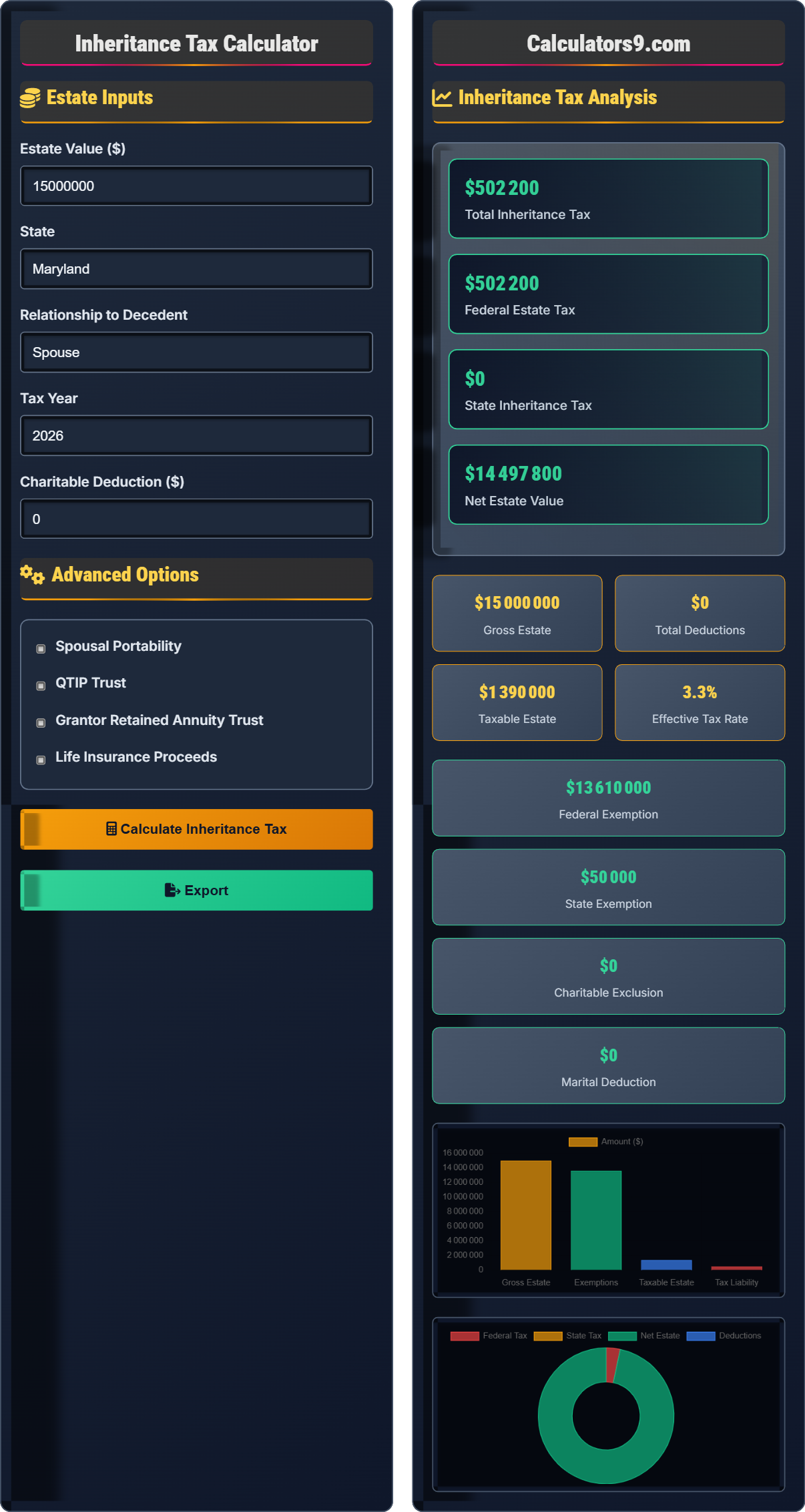
Example: Estate worth $15,000,000 in 2026:
Federal exemption = $13,610,000
Taxable amount = $15,000,000 - $13,610,000 = $1,390,000
Federal tax = $1,390,000 × 40% = $556,000
Plus state tax if applicable.
Estate Inputs
Advanced Options
Inheritance Tax Analysis
Comprehensive Inheritance Tax Guide
Inheritance tax is a tax imposed on the transfer of property from a deceased person to their heirs or beneficiaries. In the United States, there is no federal inheritance tax, but there is a federal estate tax. Additionally, six states impose their own inheritance taxes: Iowa, Kentucky, Maryland, Nebraska, New Jersey, and Pennsylvania. The tax is typically paid by the recipient of the inheritance, not the estate.
The fundamental inheritance tax calculation uses the following formula:
Where:
- \(IT\) = Inheritance Tax
- \(E\) = Estate Value
- \(FE\) = Federal Exemption
- \(SE\) = State Exemption
- \(TR\) = Tax Rate
Federal estate tax rates follow a progressive schedule:
- 18%: On the first $10,000 above the exemption
- 20%: On the next $10,000
- 22%: On the next $20,000
- 24%: On the next $40,000
- 26%: On the next $40,000
- 28%: On the next $50,000
- 30%: On the next $100,000
- 32%: On the next $100,000
- 34%: On the next $100,000
- 37%: On the next $100,000
- 39%: On the next $100,000
- 40%: On amounts over $1,000,000 above the exemption
- Annual Gifting: Take advantage of annual gift tax exclusions
- Trust Structures: Use irrevocable trusts to remove assets from estate
- Life Insurance: Provide liquidity for tax payments
- Charitable Giving: Reduce taxable estate value
- State Residency: Consider moving to avoid state inheritance taxes
Inheritance Tax Basics
Tax on property received from deceased person's estate.
\( IT = \max(0, (E - FE - SE) \times TR) \)
Where IT=inheritance tax, E=estate value, FE=federal exemption, SE=state exemption, TR=tax rate.
- Only 6 states have inheritance tax
- Federal estate tax applies to large estates
- Tax rates vary by relationship
Strategies
Focus on reducing taxable estate value.
- Use annual gift exclusions
- Create irrevocable trusts
- Consider charitable giving
- Purchase life insurance
- State laws vary significantly
- Relationship affects tax rates
- Large estates face highest rates
- Planning opportunities exist
Inheritance Tax Learning Quiz
What is the main difference between estate tax and inheritance tax?
The answer is B) Estate tax is paid by the estate, inheritance tax by the recipient. Estate tax is levied on the total value of a deceased person's estate before distribution to beneficiaries. Inheritance tax is paid by the person who inherits the property. This is a fundamental distinction that affects who bears the tax burden.
Understanding the difference between estate tax and inheritance tax is crucial for estate planning. The estate tax is a tax on the right to transfer property at death, paid by the estate before assets are distributed. The inheritance tax is a tax on the privilege of receiving property from a decedent's estate, paid by the beneficiary. This distinction affects planning strategies and the ultimate economic burden of the tax.
Estate Tax: Tax on the transfer of property from deceased person's estate
Inheritance Tax: Tax on the recipient of inherited property
Tax Burden: Who ultimately pays the tax
• Estate tax paid by estate before distribution
• Inheritance tax paid by recipient after receipt
• Different states have different tax structures
• Remember: Estate tax affects the estate, inheritance tax affects the heir
• Most states have estate tax, few have inheritance tax
• Relationship to decedent affects inheritance tax rates
• Confusing estate tax with inheritance tax
• Thinking both taxes apply everywhere
• Not understanding who pays each tax
If an estate is worth $16,000,000 in 2026, what is the federal estate tax liability (ignoring deductions)?
Using the estate tax formula: \( ET = \max(0, (E - FE) \times TR) \)
Given:
- Estate Value = $16,000,000
- Federal Exemption (2026) = $13,610,000
- Tax Rate = 40% (for amounts over $1M above exemption)
Step 1: Calculate taxable amount = $16,000,000 - $13,610,000 = $2,390,000
Step 2: Apply tax rate = $2,390,000 × 40% = $956,000
Therefore, the federal estate tax liability is $956,000.
This calculation demonstrates how the progressive tax system works for estates. The exemption amount is sheltered from tax, but any amount above the exemption is subject to tax at the applicable rate. For very large estates, the top rate of 40% applies to the excess over the exemption threshold.
Taxable Estate: Value subject to estate tax
Progressive Tax: Higher rates apply to higher values
Exemption Threshold: Amount sheltered from tax
• Exemption amount is tax-free
• Tax applies to amounts above exemption
• Rates are progressive
• Federal exemption is $13.61M in 2026
• Applying tax rate to entire estate value
• Not knowing current exemption amount
• Forgetting to subtract exemption first
A person inherits $500,000 from their parent in Pennsylvania, which has a 4.5% inheritance tax rate for children. However, the first $3,500 is exempt from tax. What is the inheritance tax liability?
Step 1: Subtract exemption = $500,000 - $3,500 = $496,500
Step 2: Apply tax rate = $496,500 × 4.5% = $22,342.50
Therefore, the inheritance tax liability is $22,342.50.
This example shows how state inheritance taxes work differently from federal estate tax. Pennsylvania, like other states with inheritance taxes, applies rates based on the relationship to the decedent and may provide exemptions for smaller inheritances. Children typically receive favorable treatment compared to other heirs.
State Inheritance Tax: Tax on inherited property by state
Relationship Rates: Different rates based on relation to decedent
Exemption Amount: Tax-free threshold
• State laws vary significantly
• Rates depend on relationship to decedent
• Exemptions differ by state
• Research state-specific rules
• Children often get favorable treatment
• Spouses usually exempt in most states
• Assuming no state inheritance tax exists
• Not considering relationship-based rates
• Forgetting state-specific exemptions
A man dies with an estate worth $15,000,000 and leaves everything to his spouse. What is the federal estate tax liability? What if he left $5,000,000 to his spouse and $10,000,000 to his children?
Leaving everything to spouse:
The unlimited marital deduction applies, so the estate tax is $0. The full $15,000,000 passes tax-free to the surviving spouse.
Leaving $5M to spouse, $10M to children:
Taxable estate = $10,000,000 (amount to children)
Taxable amount above exemption = $10,000,000 - $13,610,000 = $0 (negative, so no tax)
Therefore, estate tax is $0 in both scenarios due to the exemption amount.
The marital deduction is a powerful estate planning tool that allows spouses to transfer unlimited amounts to each other free of estate tax. This defers tax until the second spouse dies. However, the unlimited marital deduction only applies to transfers to surviving spouses who are U.S. citizens.
Marital Deduction: Unlimited deduction for transfers to spouse
Deferral: Tax postponed to second death
U.S. Citizen Requirement: Spouse must be U.S. citizen
• Unlimited marital deduction for U.S. citizen spouses
• Defers tax to second death
• Only applies to surviving spouse
• Use marital deduction to defer taxes
• Consider QTIP trusts for tax planning
• Verify spouse citizenship status
• Not utilizing marital deduction
• Forgetting citizenship requirement
• Confusing with inheritance tax rules
What is portability in the context of estate tax?
The answer is B) Transferring unused exemption to surviving spouse. Portability allows a surviving spouse to use any unused estate tax exemption from the first spouse to die. This election must be made on the first spouse's estate tax return and can significantly increase the surviving spouse's exemption amount.
Portability is a valuable estate planning feature that allows married couples to effectively double their estate tax exemption ($27.22M in 2026 if both spouses utilize it). Without portability, any unused exemption of the first spouse to die would be lost. The election must be made timely and properly on the estate tax return of the first spouse to die.
Portability: Transfer of unused exemption to surviving spouse
Timely Election: Must be made on first spouse's return
Effective Doubling: Combined exemption for married couples
• Must elect on first spouse's estate return
• Allows effective doubling of exemption
• Requires proper filing procedures
• Always consider portability election
• File timely to preserve benefits
• Consult professional for proper procedures
• Missing the portability election deadline
• Not understanding the benefits
• Failing to file required returns
FAQ
Q: What's the difference between estate tax and inheritance tax in the United States?
A: The key differences are:
- Estate Tax: Levied on the estate itself before distribution; paid by the estate
- Inheritance Tax: Levied on the beneficiary after receiving inheritance; paid by the heir
Only 6 states (Iowa, Kentucky, Maryland, Nebraska, New Jersey, and Pennsylvania) impose inheritance taxes. The federal government imposes only estate tax, not inheritance tax. The tax rate and exemptions vary significantly between these tax systems.
Q: How can I minimize estate taxes?
A: Effective estate tax minimization strategies include:
- Annual Gifting: Use annual gift tax exclusion ($18,000 per recipient in 2026)
- Irrevocable Trusts: Remove assets from taxable estate
- Life Insurance: Provide liquidity for tax payments
- Charitable Giving: Reduce taxable estate value
- Family Limited Partnerships: Discount valuation for tax purposes
Consult with an estate planning attorney and tax professional for personalized advice based on your specific situation.