Business Asset Depreciation Calculator
MACRS schedules • Tax planning tool • Asset recovery calculator
MACRS Formula:
Show the calculator\( D = C \times R \times M \)
Where:
- \( D \) = Annual depreciation
- \( C \) = Asset cost basis
- \( R \) = MACRS depreciation rate
- \( M \) = Mid-year convention factor
This formula calculates the annual depreciation deduction for tax purposes under MACRS.
Example: For a $10,000 asset in 5-year class, first year depreciation: $10,000 × 20% × 0.5 = $1,000.
For straight-line: \( D = \frac{C - S}{L} \) where S=scrap value, L=lifetime.
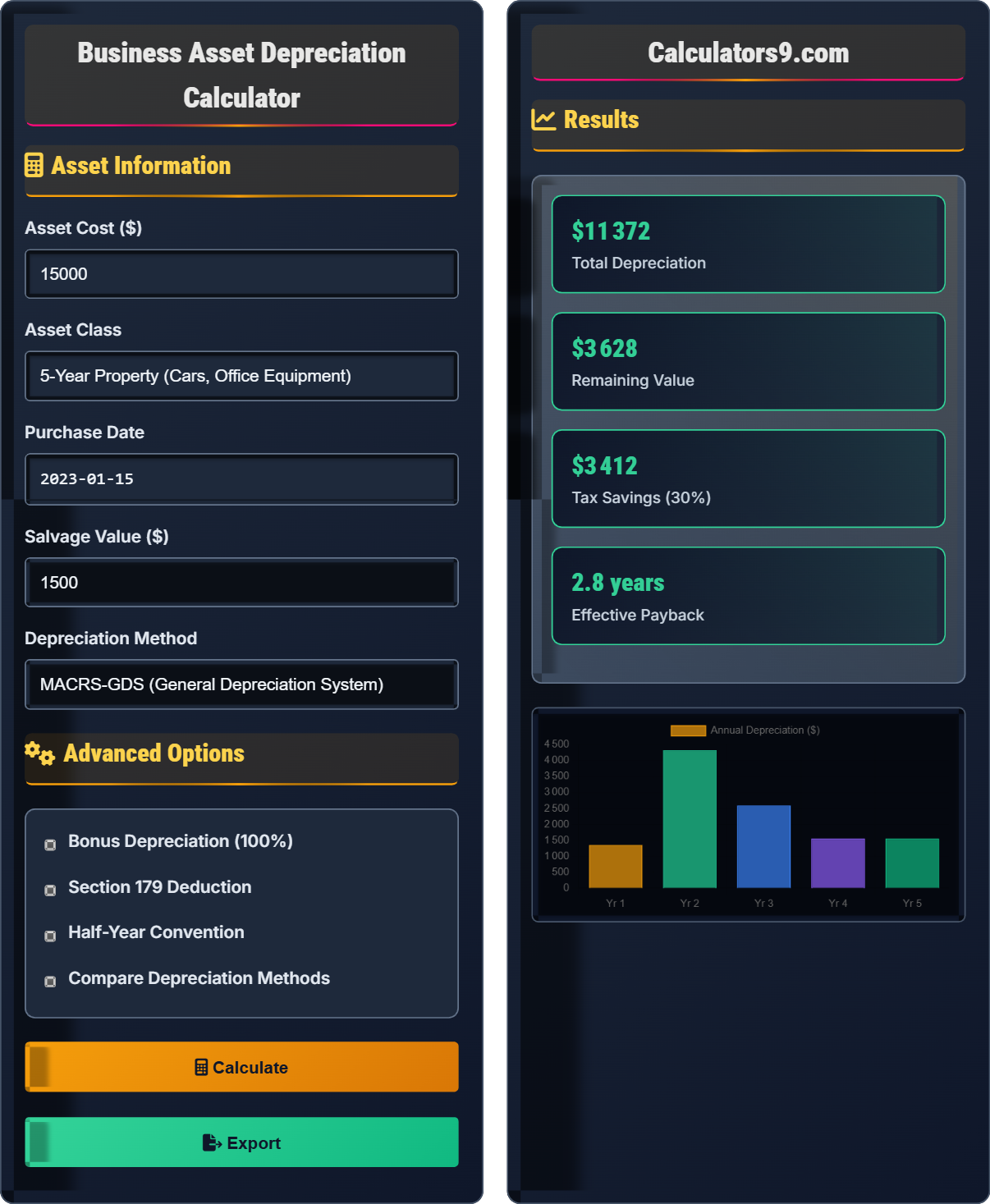
Asset Information
Advanced Options
Results
| Year | Depreciation | Accumulated | Book Value |
|---|
| Method | Year 1 | Year 5 | Total |
|---|
| Category | Amount | Percentage |
|---|
Comprehensive MACRS Guide
The Modified Accelerated Cost Recovery System (MACRS) is the current tax depreciation system in the United States. It provides specific depreciation schedules for different asset classes and allows businesses to recover the cost of tangible property through annual deductions. MACRS replaced the Accelerated Cost Recovery System (ACRS) in 1986 and is required for most property placed in service after 1986.
The standard MACRS calculation uses the following formula:
Where:
- \(D_t\) = Depreciation in year \(t\)
- \(C\) = Cost basis of the asset
- \(R_t\) = MACRS depreciation rate for year \(t\)
- \(M\) = Mid-year convention factor (usually 0.5 for first year)
Comparison of depreciation methods:
- MACRS-GDS: Accelerated depreciation, required for most assets
- MACRS-ADS: Straight-line over longer periods, for certain property
- Straight-Line: Equal depreciation each year, simpler calculation
- Declining Balance: Faster depreciation in early years
Factors to consider when choosing depreciation methods:
- Tax situation: Accelerated methods benefit high earners
- Cash flow: Front-loaded deductions affect current taxes
- Asset usage: How quickly the asset loses value
- Business type: Different industries have different requirements
- Future plans: Anticipated sale or replacement of asset
MACRS Learning Quiz
Which asset class would a new computer system fall under for MACRS depreciation?
The answer is B) 5-Year Property. Computer systems are classified as 5-year property under MACRS. This includes desktop computers, laptops, servers, and related equipment. The 5-year classification allows for faster depreciation compared to longer-lived assets.
This question tests knowledge of asset classifications under MACRS. Correct classification is crucial for accurate depreciation calculations. Computer equipment falls under the 5-year property class along with other office equipment and vehicles. Understanding these classifications helps ensure proper tax deductions.
Asset Classification: Categorization of property for depreciation purposes
Cost Recovery: Process of recovering asset cost through depreciation
Tax Deduction: Reduction in taxable income allowed by law
• Assets must be classified correctly for proper depreciation
• Computer equipment is 5-year property
• Classification determines depreciation schedule
• Refer to IRS Publication 946 for asset classifications
• Keep detailed records of asset purchases
• Consider bonus depreciation for new assets
• Misclassifying assets (e.g., calling 7-year property 5-year)
• Not accounting for special depreciation rules
• Forgetting to apply half-year convention
Calculate the first-year depreciation for a $20,000 computer using MACRS 5-year property with half-year convention. Show your work.
For MACRS 5-year property, the first-year rate is 20%.
With half-year convention: First year depreciation = $20,000 × 20% × 0.5 = $2,000
Second year depreciation = $20,000 × 32% = $6,400
Therefore, the first-year depreciation is $2,000.
This problem demonstrates the importance of the half-year convention in MACRS. Even if an asset is purchased on January 1st, only half a year of depreciation is allowed in the first year. This convention simplifies calculations by treating all assets as if they were placed in service in the middle of the year.
Half-year convention: Treating all assets as placed in service mid-year
Depreciation rate: Percentage of asset value deducted annually
Cost basis: Original cost used for depreciation calculations
• Half-year convention applies to first year
• Use correct MACRS table for asset class
• Apply salvage value in final year
• Memorize common MACRS rates
• Remember half-year convention for first year
• Use IRS tables for exact rates
• Forgetting half-year convention
• Using wrong depreciation rate
• Not accounting for salvage value
A business purchases a $25,000 equipment for a 5-year MACRS property. The business elects to take the maximum Section 179 deduction of $25,000. How does this affect the depreciation schedule?
With Section 179 deduction:
Year 1: $25,000 deduction (entire cost basis)
Years 2-5: $0 depreciation (no remaining basis)
Without Section 179:
Year 1: $25,000 × 20% × 0.5 = $2,500
Year 2: $25,000 × 32% = $8,000
And so on for remaining years.
Section 179 allows immediate expensing of the entire asset cost up to the limit.
This example shows how Section 179 can significantly accelerate tax benefits. Instead of spreading deductions over 5 years, the business can deduct the entire cost in the first year. However, this requires sufficient taxable income to benefit from the deduction. The election is made annually and can be changed if circumstances change.
Section 179: Immediate expensing election for business equipment
Immediate expensing: Deducting entire cost in first year
Taxable income limitation: Deduction limited by business income
• Section 179 reduces MACRS basis dollar-for-dollar
• Limited by taxable business income
• Cannot create or increase net operating loss
• Consider Section 179 for new equipment purchases
• Combine with bonus depreciation when beneficial
• Not considering income limitations
• Forgetting to reduce MACRS basis
• Not comparing to other strategies
If a business purchases $100,000 of qualified 5-year property in 2023, how much bonus depreciation can be taken?
For 2023, bonus depreciation is 100% for qualified property.
Bonus depreciation = $100,000 × 100% = $100,000
This allows the business to deduct the entire $100,000 in 2023.
Any remaining basis (if less than 100%) would be depreciated using MACRS rates.
This demonstrates the significant impact of bonus depreciation. For qualified property placed in service in 2023, businesses can deduct 100% of the cost immediately. This provides substantial cash flow benefits. The bonus depreciation percentage phases down over time: 80% in 2024, 60% in 2025, etc.
Bonus depreciation: Additional first-year depreciation for qualified property
Qualified property: New depreciable property meeting specific criteria
Phase-down schedule: Gradual reduction in bonus percentage over time
• Bonus depreciation applies only to qualified property
• Percentage changes annually (100% in 2023)
• Applied before regular MACRS depreciation
• Purchase qualified property before year-end
• Consider bonus depreciation with Section 179
• Track phase-down schedule changes
• Not verifying property qualifies for bonus
• Forgetting to apply in first year
• Not considering income limitations
When would MACRS-ADS be preferable to MACRS-GDS?
The answer is D) Both B and C. MACRS-ADS is required for certain types of property (such as property used predominantly outside the US) and is elected by taxpayers who prefer the straight-line method. ADS uses longer recovery periods than GDS.
This question highlights the circumstances under which MACRS-ADS is used. While MACRS-GDS is generally preferred for its accelerated depreciation, ADS may be required by law in certain situations or elected by taxpayers who prefer straight-line depreciation. ADS typically has longer recovery periods than GDS.
MACRS-ADS: Alternative Depreciation System using straight-line method
Required by law: Mandatory method in certain circumstancesElective method: Choice available to taxpayers in certain situations
• ADS required for certain property types
• ADS uses longer recovery periods than GDS
• ADS provides straight-line depreciation
• Know when ADS is mandatory
• Understand election requirements
• Compare total deductions over asset life
• Using ADS when GDS is available
• Not knowing mandatory ADS situations
• Incorrectly calculating longer recovery periods
Depreciation Basics
Modified Accelerated Cost Recovery System for tax depreciation.
\(D = C \times R \times M\)
Where D=depreciation, C=cost, R=rate, M=convention factor.
- Required for most assets after 1986
- Uses predetermined rates
- Applies half-year convention
Tax Strategies
Maximizing tax benefits through smart depreciation planning.
- Consider Section 179 deductions
- Apply bonus depreciation when available
- Time asset purchases strategically
- Track asset classifications
- Don't forget income limitations
- Consider AMT implications
- Track asset disposition rules
- Plan for recapture provisions
FAQ
Q: Can I change depreciation methods after I start depreciating an asset?
A: Generally, you cannot change depreciation methods for an asset once you start using MACRS. The method must be elected in the first year the asset is placed in service. However, there are exceptions:
- Automatic change: Some changes can be made automatically using Form 3115
- Revocation: Section 179 elections can be revoked in later years
- Change request: With IRS permission for valid business reasons
For most business assets, you must stick with the method chosen in the first year. It's crucial to select the optimal method initially based on your business situation.
Q: How does MACRS work for real estate investments?
A: Real estate has special MACRS rules:
- Residential Rental (27.5 years): Uses straight-line method, mid-month convention
- Commercial Real Estate (39 years): Uses straight-line method, mid-month convention
- No bonus depreciation: Real estate doesn't qualify for bonus depreciation
- No Section 179: Real estate cannot be expensed under Section 179
For a $200,000 residential rental, annual depreciation would be $200,000 ÷ 27.5 = $7,273 per year. This provides a consistent tax deduction over the recovery period.